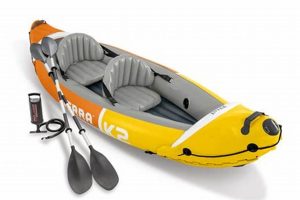
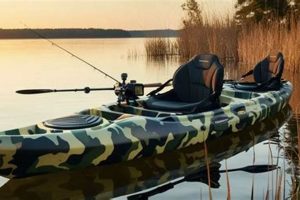
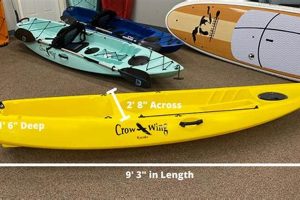
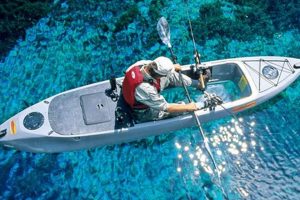
This type of watercraft blends the stability of a pontoon boat with the maneuverability and compact size of a kayak, creating a hybrid vessel ideal for anglers. Imagine a small, stable platform, often featuring specialized seating, rod holders, and storage compartments, all designed to enhance the fishing experience on lakes, ponds, and slow-moving rivers. These vessels are typically propelled by paddles, but motorized versions also exist.
Enhanced stability is a key advantage, allowing anglers to stand and cast with confidence, a feature often absent in traditional kayaks. This stability also contributes to a more comfortable and accessible fishing experience, particularly for individuals with mobility concerns. The added deck space facilitates movement and gear organization, contributing to longer and more productive fishing trips. While relatively recent in design, these craft fulfill a longstanding need for a stable, compact, and fishing-focused watercraft, representing a significant advancement in recreational fishing technology.
This article will delve deeper into the various aspects of these versatile fishing platforms, exploring their design variations, key features, advantages, and disadvantages, offering readers a comprehensive understanding to assist in informed purchase decisions. Further discussion will cover suitable fishing locations, essential accessories, and safety considerations for maximizing the enjoyment and productivity of angling from these unique vessels.
Tips for Utilizing Fishing-Oriented Pontoon-Style Kayaks
Careful consideration of several factors contributes significantly to a successful and enjoyable fishing experience from these specialized watercraft.
Tip 1: Weight Distribution and Balance: Proper distribution of weight, including gear and occupants, is crucial for maintaining stability and preventing capsizing. Centering weight low and evenly across the deck optimizes performance.
Tip 2: Anchor Selection and Deployment: Selecting an appropriate anchor system, considering water depth and bottom conditions, is essential for maintaining position in desired fishing locations. Proper deployment techniques ensure secure anchoring.
Tip 3: Personal Flotation Devices (PFDs): Wearing a properly fitted PFD is paramount for safety. Regulations regarding PFDs should be observed, and adherence ensures preparedness for unforeseen circumstances.
Tip 4: Navigation and Safety Equipment: Carrying essential navigation tools, including a compass or GPS, and communication devices ensures safe navigation and facilitates emergency response if required.
Tip 5: Weather Awareness and Preparation: Checking weather forecasts before embarking on a fishing trip is critical. Appropriate clothing and gear should be selected based on anticipated conditions. Awareness of changing weather patterns allows for informed decisions while on the water.
Tip 6: Respecting Wildlife and the Environment: Practicing responsible angling methods, including catch and release, contributes to preserving fish populations. Proper disposal of fishing line and other waste minimizes environmental impact.
Tip 7: Regular Maintenance and Inspection: Regular inspection and maintenance of the vessel, including checking for leaks, damage, and proper functioning of components, ensures optimal performance and prolongs its lifespan.
Adhering to these guidelines enhances safety, improves fishing success, and contributes to a more enjoyable and responsible experience on the water.
This compilation of tips provides valuable insights for both novice and experienced anglers. The subsequent conclusion will summarize the key advantages of these unique fishing platforms and offer final recommendations for selecting the ideal vessel.
1. Stability

Stability represents a critical performance characteristic in pontoon fishing kayaks, directly influencing angler safety, comfort, and fishing effectiveness. The inherent design of these vessels prioritizes stability, setting them apart from traditional kayaks and enabling diverse angling techniques.
- Primary Stability:
Primary stability refers to the initial resistance a vessel offers to tipping when subjected to minor disturbances. Pontoon fishing kayaks, with their wide, flat-bottomed design derived from pontoon boats, exhibit high primary stability. This characteristic provides a secure and stable feeling, particularly beneficial for novice kayakers or those fishing in calm waters. Anglers can confidently shift their weight, make casting motions, and even stand without excessive concern for capsizing.
- Secondary Stability:
Secondary stability describes the vessel’s resistance to capsizing when tilted beyond its initial stable range. While pontoon fishing kayaks may not possess the same secondary stability as wider, more traditional pontoon boats, they still offer a significant advantage over standard kayaks. The pontoon structure provides a buoyant platform that resists complete rollover, even when significantly tilted. This characteristic offers a margin of safety in rougher water or during unexpected movements.
- Impact of Design Features on Stability:
Specific design elements contribute to the overall stability of pontoon fishing kayaks. Wider pontoon spacing generally increases primary stability. The shape and size of the pontoons themselves influence both primary and secondary stability. Features like outriggers further enhance stability, particularly in challenging conditions. Understanding the interplay of these design elements empowers informed purchasing decisions based on individual needs and intended usage scenarios.
- Stability Enhancements and Accessories:
Various accessories and modifications can further enhance the stability of these vessels. Stabilizer pontoons or outriggers offer increased resistance to tipping. Weight distribution plays a critical role; strategically positioning gear and maintaining a low center of gravity optimizes stability. Anglers should familiarize themselves with the impact of weight distribution and utilize available accessories to maximize stability and safety on the water.
The enhanced stability offered by pontoon fishing kayaks is a defining feature, contributing significantly to their popularity among anglers. This characteristic not only improves safety and comfort but also expands angling possibilities, enabling techniques like stand-up casting and providing a more stable platform for fighting fish. Careful consideration of stability factors, alongside other design features, ensures selection of the optimal vessel for individual fishing needs and preferences.
2. Fishing Features

Specialized fishing features distinguish pontoon fishing kayaks from recreational models, directly impacting angling efficacy and overall experience. These features cater to diverse fishing styles and needs, transforming the vessel into a dedicated fishing platform.
Rod Holders: Integrated rod holders secure fishing rods, freeing hands for other tasks like paddling, baiting hooks, or landing fish. Flush-mounted, adjustable, and rotating rod holders accommodate various fishing techniques and rod types. Multiple rod holders allow anglers to deploy several lines simultaneously, increasing catch potential.
Tackle Storage: Dedicated compartments and storage solutions organize tackle and keep essential gear readily accessible. Dry storage protects sensitive items from water damage. Tackle organization contributes to efficient lure changes and streamlines the fishing process.
Livewells: Livewells maintain the health and vitality of caught fish. Aerated livewells provide oxygenated water, preserving fish for later release or transport. Proper livewell management ensures humane treatment of catches.
Mounting Options for Fish Finders and Other Electronics: Integrated mounting systems facilitate the installation of fish finders, GPS units, and other electronic devices. These technologies aid in locating fish, navigating waterways, and enhancing overall fishing success. Secure mounting systems ensure devices remain stable and functional in various water conditions.
Other Specialized Features: Additional features like anchor trolleys, bait trays, and cutting boards further enhance the fishing experience. Anchor trolleys control drift and maintain precise positioning. Bait trays provide convenient access to live bait. Cutting boards facilitate on-the-water fish preparation.
The integration of these specialized features enhances the functionality of pontoon fishing kayaks, transforming them into purpose-built angling platforms. Careful consideration of these features during the selection process ensures alignment with individual fishing styles and preferences. Understanding the practical applications of these features maximizes their utility, contributing to a more productive and enjoyable fishing experience.
3. Compact Design
The compact design of pontoon fishing kayaks presents a significant advantage, particularly regarding transport and storage. Unlike larger, more cumbersome watercraft, these vessels offer a manageable footprint, simplifying ownership logistics and expanding access to diverse fishing locations.
- Portability and Transportation:
The reduced length and width of pontoon fishing kayaks, compared to traditional boats or larger pontoon platforms, facilitate easier transportation. Many models can be loaded onto roof racks or transported in the beds of pickup trucks, eliminating the need for trailers. This portability expands access to remote fishing spots and simplifies launch and retrieval processes, particularly in areas with limited access ramps.
- Storage Considerations:
Compact dimensions simplify storage requirements. These kayaks can be stored in garages, sheds, or even within some residences, reducing the need for dedicated outdoor storage spaces or marinas. This ease of storage reduces off-season maintenance concerns and contributes to the overall convenience of ownership.
- Maneuverability in Tight Spaces:
The compact design enhances maneuverability, particularly in confined areas such as narrow creeks, shallow coves, or densely vegetated waters. The shorter length and responsive handling characteristics allow anglers to navigate tight turns and access secluded fishing spots often inaccessible to larger vessels. This maneuverability expands fishing opportunities and contributes to a more versatile angling experience.
- Weight and Handling:
While stability remains a key feature, pontoon fishing kayaks are generally lighter than traditional boats of comparable size. This reduced weight, coupled with the compact design, simplifies handling both on and off the water. Single individuals can often manage launching, loading, and transporting these vessels without assistance, enhancing overall convenience and accessibility.
The compact design of pontoon fishing kayaks directly addresses key logistical challenges associated with boat ownership, offering a convenient and accessible solution for anglers. The combination of portability, ease of storage, enhanced maneuverability, and manageable weight expands fishing opportunities and simplifies the overall angling experience. This focus on compact design underscores the versatility and practicality of these specialized fishing platforms.
4. Maneuverability

Maneuverability represents a critical performance attribute in pontoon fishing kayaks, directly influencing access to fishing locations and overall on-the-water effectiveness. While stability remains a defining characteristic, the ability to navigate efficiently and precisely enhances the angling experience, particularly in diverse or challenging environments. This section explores the multifaceted nature of maneuverability within the context of pontoon fishing kayaks.
- Tracking and Responsiveness:
Tracking refers to the vessel’s ability to maintain a straight course with minimal corrective input. Responsiveness dictates how quickly and predictably the kayak reacts to paddle strokes or rudder adjustments. Efficient tracking minimizes effort required to maintain desired direction, conserving energy for fishing. Responsive handling enables quick turns and precise adjustments, essential for navigating complex waterways or pursuing moving targets. In pontoon fishing kayaks, design elements like hull shape, fin configuration, and the presence of a rudder system influence tracking and responsiveness.
- Navigating Shallow Water and Obstacles:
Pontoon fishing kayaks often excel in shallow water environments due to their relatively shallow draft. The ability to navigate shallow areas expands access to prime fishing locations often inaccessible to deeper-draft vessels. Maneuverability in tight spaces, such as narrow creeks or areas with submerged obstacles, further enhances fishing versatility. Precise control and responsive handling enable anglers to navigate complex environments effectively.
- Influence of Propulsion Systems:
Propulsion systems significantly impact maneuverability. Paddle-powered pontoon fishing kayaks offer excellent control and maneuverability in confined spaces, facilitating precise movements. Motorized versions provide increased speed and range, enabling access to distant fishing grounds. However, motorized kayaks may sacrifice some maneuverability in tight quarters compared to paddle-powered counterparts. The choice of propulsion system depends on individual fishing preferences and the characteristics of the target fishing environment.
- Impact of Wind and Current:
Wind and current conditions directly influence maneuverability. Pontoon fishing kayaks, with their higher profile compared to traditional kayaks, can be more susceptible to wind drift. Understanding how wind and current affect handling characteristics allows anglers to anticipate and compensate for these forces, maintaining control and navigating effectively. Proper paddling techniques and the use of accessories like drift socks or anchors can mitigate the impact of wind and current.
The interplay of these factors determines the overall maneuverability of a pontoon fishing kayak. Careful consideration of these elements during the selection process ensures alignment with individual fishing styles and target environments. Understanding the nuances of maneuverability empowers anglers to maximize the performance of their vessels, enhancing fishing success and overall on-the-water experience.
5. Propulsion Options
Propulsion systems significantly influence the versatility and effectiveness of pontoon fishing kayaks, dictating access to fishing grounds and impacting overall angling experience. Understanding the diverse propulsion options available empowers informed decision-making, aligning vessel selection with individual fishing styles and target environments. These options present distinct advantages and disadvantages, requiring careful consideration based on specific needs and priorities.
Paddle Power: Traditional paddle propulsion offers several benefits, including quiet operation, enhanced maneuverability in tight spaces, and the absence of fuel requirements. Paddle power allows stealthy approach to fishing locations, minimizing disturbance to fish. Precise control and responsiveness contribute to effective navigation in complex environments like shallow creeks or densely vegetated areas. However, paddle power limits range and speed, potentially restricting access to distant fishing grounds, especially in larger bodies of water or against strong currents.
Motorized Options: Electric motors and small outboard engines provide increased speed and range, expanding access to distant fishing locations and facilitating travel against currents or wind. Motorized propulsion reduces physical exertion, conserving energy for fishing activities. However, motors introduce noise, potentially disrupting fish and impacting the tranquility of the natural environment. Fuel requirements, battery charging, and maintenance considerations add complexity compared to paddle propulsion.
Pedal-Powered Kayaks: Pedal-driven systems offer a hands-free propulsion method, allowing anglers to maintain constant fishing readiness. Pedal power provides a balance between speed and maneuverability, exceeding paddling speeds while retaining greater control than motorized options. However, pedal-driven systems typically increase vessel weight and complexity. The underwater components of pedal drives can be susceptible to entanglement in weeds or debris, requiring careful consideration when fishing in certain environments.
Selection of the optimal propulsion system requires careful evaluation of individual fishing preferences, target environments, and desired angling experience. Prioritizing stealth and maneuverability favors paddle power. Maximizing range and speed necessitates motorized options. Seeking hands-free propulsion for active fishing suggests pedal-driven systems. Understanding the practical implications of each propulsion method empowers anglers to tailor vessel selection to their specific needs, maximizing fishing effectiveness and overall enjoyment on the water.
6. Load Capacity

Load capacity represents a critical specification in pontoon fishing kayaks, directly influencing vessel performance, safety, and overall practicality. Understanding load capacity parameters enables informed decision-making, ensuring appropriate vessel selection aligned with individual angler needs and intended usage scenarios. Exceeding specified load capacity compromises stability, maneuverability, and safety, potentially leading to hazardous situations on the water. Careful consideration of load requirements, encompassing angler weight, gear, and potential catch, ensures safe and effective operation.
- Maximum Weight Capacity:
Maximum weight capacity defines the total weight a pontoon fishing kayak can safely support, encompassing passengers, gear, and any additional load. This specification, typically provided by the manufacturer, serves as a critical safety threshold. Exceeding this limit compromises stability, increasing the risk of capsizing. Accurately estimating total anticipated weight, including personal weight, fishing gear, and potential catch, ensures operation within safe parameters.
- Weight Distribution and Stability:
Proper weight distribution within the vessel plays a crucial role in maintaining stability and optimal performance, even when operating within specified load capacity limits. Distributing weight evenly across the deck, avoiding excessive concentration at either end, maximizes stability. Securing heavier items low in the vessel, near the center of gravity, further enhances stability. Understanding the impact of weight distribution empowers anglers to optimize vessel balance, minimizing the risk of tipping and maximizing on-the-water safety.
- Impact of Load on Performance:
Increasing load within the vessel, even within specified limits, impacts performance characteristics. Higher loads reduce maneuverability, requiring increased effort for turning and maneuvering. Speed and responsiveness decrease with increased load, potentially affecting fishing effectiveness, especially in dynamic environments. Understanding these performance implications allows anglers to anticipate changes in handling characteristics and adapt techniques accordingly, maintaining control and maximizing fishing efficiency.
- Legal and Safety Considerations:
Adhering to specified load capacity limits ensures compliance with safety regulations and minimizes risks associated with overloading. Overloading a vessel compromises its structural integrity and increases susceptibility to capsizing, potentially leading to legal repercussions. Prioritizing safety by operating within established load limits safeguards both angler well-being and adherence to legal requirements. Consulting manufacturer guidelines and relevant regulations ensures responsible and safe operation on the water.
Careful consideration of load capacity, including maximum weight limits, weight distribution principles, performance implications, and safety regulations, represents a fundamental aspect of responsible pontoon fishing kayak ownership and operation. Understanding these factors ensures angler safety, maximizes vessel performance, and promotes an enjoyable and productive fishing experience. Prioritizing load capacity considerations contributes to a safe and successful outing on the water.
Frequently Asked Questions
This section addresses common inquiries regarding pontoon fishing kayaks, providing concise and informative responses to facilitate informed decision-making and enhance understanding of these specialized vessels.
Question 1: How does the stability of a pontoon fishing kayak compare to a traditional kayak?
Pontoon fishing kayaks offer significantly greater stability than traditional kayaks due to their wider base and pontoon structure. This enhanced stability allows anglers to stand and cast with confidence, a feature often challenging or impossible in traditional kayaks.
Question 2: What are the typical propulsion options available for pontoon fishing kayaks?
Common propulsion options include paddling, electric motors, and pedal drives. Each method offers distinct advantages and disadvantages related to speed, maneuverability, range, and cost. Selection depends on individual fishing styles, target environments, and budget considerations.
Question 3: Are pontoon fishing kayaks suitable for use in saltwater environments?
While many pontoon fishing kayaks are designed for freshwater use, some models are constructed with saltwater-resistant materials and components. Careful consideration of materials and intended usage environment is crucial when selecting a kayak for saltwater applications.
Question 4: How does the maneuverability of a pontoon fishing kayak compare to a traditional kayak?
While pontoon fishing kayaks prioritize stability, they generally exhibit reduced maneuverability compared to traditional kayaks, particularly in tight spaces or fast-moving water. However, their maneuverability often surpasses that of larger, more cumbersome fishing boats.
Question 5: What maintenance is typically required for a pontoon fishing kayak?
Regular maintenance includes cleaning, inspection for damage, and lubrication of moving parts. Motorized versions require additional maintenance specific to the motor and battery systems. Proper maintenance ensures optimal performance and prolongs the lifespan of the vessel.
Question 6: What safety precautions should be observed when using a pontoon fishing kayak?
Essential safety precautions include wearing a personal flotation device (PFD), carrying appropriate safety equipment, checking weather conditions before embarking, and adhering to established load capacity limits. Understanding and observing these safety measures minimizes risks and ensures a safe and enjoyable fishing experience.
Addressing these frequently asked questions provides a comprehensive overview of key considerations related to pontoon fishing kayaks. This information empowers potential buyers and current owners to make informed decisions, maximize vessel utilization, and prioritize safety on the water.
The following section will offer concluding remarks and summarize the key advantages of pontoon fishing kayaks within the broader context of recreational fishing.
Conclusion
This exploration of pontoon fishing kayaks has highlighted their unique position within the realm of recreational fishing. The fusion of stability, specialized features, and compact design creates a versatile platform well-suited for diverse angling pursuits. Key advantages, including enhanced stability for stand-up casting, ample storage for tackle and gear, and the convenience of compact portability, distinguish these vessels from traditional kayaks and larger fishing boats. Careful consideration of factors like propulsion options, load capacity, and maneuverability ensures appropriate selection aligned with individual angler needs and target environments.
The evolution of fishing kayak design continues to refine the balance between stability, performance, and specialized functionality. As technology advances and angler preferences evolve, further innovation in materials, design, and integrated features promises to enhance the capabilities and broaden the appeal of these specialized fishing platforms. Informed selection, responsible operation, and a commitment to safety ensure a rewarding and sustainable approach to enjoying the unique advantages offered by pontoon fishing kayaks.