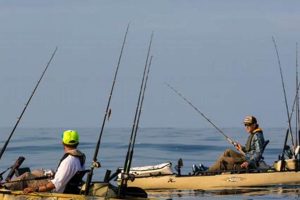
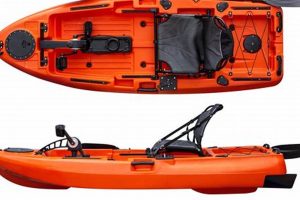
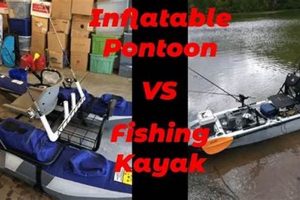
This motorized fishing vessel combines the utility of a hands-free, GPS-guided autopilot system with the maneuverability and stability of a pedal-driven kayak. The 136 designates the approximate length of the kayak in inches, indicating a spacious platform designed for fishing comfort and gear storage. This specific model is manufactured by Old Town, a recognized brand known for its quality and innovation in the recreational watercraft industry. The integration of automated navigation allows anglers to focus entirely on fishing, optimizing their time on the water.
The advantages of this type of watercraft are numerous. Hands-free navigation frees the angler to focus on casting, reeling, and landing fish, enhancing fishing efficiency. GPS-guided piloting offers precise control, enabling anglers to maintain position, troll specific depths or routes, and return to marked locations with ease. The combination of pedal propulsion and automated steering provides a quiet, non-intrusive approach, minimizing disturbance to fish and enhancing the overall fishing experience. This represents a significant advancement in fishing kayak technology, providing an unparalleled level of control and convenience.
This discussion will further explore the specific features, performance characteristics, and user experiences associated with this advanced angling platform. Topics covered will include an in-depth analysis of the autopilot system, a review of its pedal-drive mechanism, and a comprehensive assessment of its overall suitability for various fishing environments.
Tips for Utilizing the Motorized Fishing Kayak
Maximizing the capabilities of this advanced fishing platform requires a thorough understanding of its features and operational best practices. The following tips offer valuable insights for optimizing performance and enhancing the overall fishing experience.
Tip 1: Pre-Trip Planning: Prior to each outing, meticulously plan the fishing route, marking waypoints and identifying target areas using the integrated GPS system. Consult nautical charts and weather forecasts to ensure safe and productive navigation.
Tip 2: Battery Management: Monitor battery levels closely throughout the fishing trip. Understanding the estimated battery life based on usage patterns is crucial for avoiding unexpected power loss. Carry a backup power source or consider investing in a higher-capacity battery for extended excursions.
Tip 3: Spot-Lock Optimization: Utilize the spot-lock feature strategically to maintain precise positioning in desired fishing locations. Understand the limitations of the system in strong currents or windy conditions, and adjust anchoring strategies accordingly.
Tip 4: Pedal Drive Efficiency: Maximize pedal drive efficiency by maintaining a consistent cadence and utilizing proper pedaling technique. Adjust the seat position for optimal comfort and power transfer.
Tip 5: Kayak Maintenance: Regularly rinse the kayak with fresh water after each use, paying particular attention to the pedal drive system and propeller. Periodically lubricate moving parts and inspect the hull for any damage. Proper maintenance ensures optimal performance and extends the lifespan of the vessel.
Tip 6: Safety Precautions: Always wear a personal flotation device (PFD) while operating the kayak. Carry essential safety equipment, including a whistle, signaling device, and first-aid kit. Familiarize oneself with local boating regulations and adhere to safe navigation practices.
Tip 7: Effective Gear Storage: Organize fishing gear and equipment efficiently within the designated storage compartments. Distribute weight evenly to maintain stability and balance. Secure loose items to prevent shifting during movement.
Adhering to these guidelines will contribute significantly to a safe, efficient, and productive fishing experience. Careful planning, responsible operation, and routine maintenance are essential for maximizing the benefits of this sophisticated fishing platform.
This information provides a practical foundation for operating the motorized fishing kayak. The following conclusion will summarize the key features and benefits, solidifying its position as a valuable tool for the modern angler.

Automated navigation represents a pivotal advancement in fishing kayak technology, fundamentally transforming the angling experience offered by vessels like the Old Town Sportsman Autopilot 136. This sophisticated system employs GPS technology to provide precise control over the kayak’s movement, freeing the angler from constant manual paddling and allowing for increased focus on fishing techniques. This capability facilitates a range of advanced maneuvering options, including maintaining position against currents (spot-lock), following pre-planned routes, and returning accurately to marked fishing locations. Consider a scenario where an angler identifies a promising fishing spot amidst a strong current. Without automated navigation, maintaining position would require continuous paddling adjustments, diverting attention from the actual fishing. However, with the automated system, the angler can effortlessly lock onto the desired location, conserving energy and maximizing fishing time.
The practical significance of automated navigation extends beyond mere convenience. It contributes substantially to fishing efficiency by enabling precise trolling at controlled speeds and depths, following contour lines, and covering larger areas systematically. For instance, an angler seeking to troll a specific lure at a consistent depth can program the autopilot to maintain the desired course and speed, eliminating the need for constant manual adjustments and ensuring optimal lure presentation. This level of precision and control is particularly valuable in challenging environments or when targeting specific fish species with unique behavioral patterns. Furthermore, the ability to return accurately to previously marked waypoints, such as productive fishing spots or underwater structures, significantly enhances the chances of repeated success.
In conclusion, automated navigation is not simply a supplementary feature but an integral component of the modern fishing kayak experience. It empowers anglers with unprecedented control over their vessel, enabling them to optimize fishing strategies, navigate challenging waters effectively, and ultimately increase their chances of success. The integration of this technology in models like the Old Town Sportsman Autopilot 136 signifies a paradigm shift in fishing kayak design, catering to the demands of the contemporary angler seeking enhanced efficiency and a more focused fishing experience.
2. Hands-Free Fishing

Hands-free fishing represents a significant advantage offered by the Old Town Sportsman Autopilot 136. This capability stems directly from the integration of the autopilot system, which allows anglers to relinquish manual control of the kayak’s movement. The implications of this feature are substantial, impacting various aspects of the fishing experience. Consider the scenario of fighting a fish. Traditionally, anglers would need to simultaneously manage the rod and reel while also maintaining the kayak’s position and stability, often a challenging balancing act. With hands-free control, anglers can focus entirely on the fight, increasing the likelihood of a successful landing, especially with larger or more energetic fish. This advantage extends beyond battling fish. Hands-free operation allows for more efficient lure retrieval, easier net deployment, and even the opportunity to photograph a catch without the constant concern of kayak management. The practical significance of this feature becomes particularly apparent in challenging environments such as windy conditions or strong currents, where maintaining position and stability would otherwise demand significant effort and attention.
The benefits of hands-free fishing extend beyond individual tasks to enhance the overall angling experience. By freeing the angler from constant paddling or positional adjustments, the autopilot system promotes a more relaxed and focused approach. This allows for greater observation of the surrounding environment, potentially leading to the identification of subtle clues like baitfish activity or underwater structures that might otherwise be missed. Moreover, hands-free operation reduces physical fatigue, enabling longer fishing trips and sustained concentration throughout the day. This can be particularly beneficial in demanding fishing scenarios requiring extended periods of active angling. For example, techniques like trolling or drifting benefit significantly from the ability to maintain precise control and positioning without constant manual intervention.
In summary, hands-free fishing, facilitated by the autopilot system of the Old Town Sportsman Autopilot 136, represents a fundamental shift in angling practicality and efficiency. It empowers anglers to dedicate their full attention to the art of fishing, from casting and retrieving to battling and landing fish. This enhanced focus translates into a more rewarding and productive experience, particularly in challenging conditions or when engaging in techniques that require precise boat control and positioning. The freedom afforded by hands-free operation not only simplifies individual tasks but also contributes to a more immersive and enjoyable experience on the water, allowing anglers to truly connect with their surroundings and the pursuit of their target species.
3. GPS-Guided Control

GPS-guided control forms the foundation of the Old Town Sportsman Autopilot fishing kayak’s automated navigation capabilities. This technology integrates a global positioning system receiver with the kayak’s onboard computer, enabling precise positioning, route planning, and automated maneuvering. Cause and effect are directly linked: GPS data informs the autopilot system, which then controls the motor and rudder to execute user-defined commands. This integration allows anglers to define waypoints, follow pre-planned routes, and maintain position against currents or wind. For example, an angler can mark a productive fishing spot, navigate away to explore another area, and then command the kayak to return precisely to the marked location using GPS coordinates. Without GPS-guided control, such precise and automated navigation would be impossible, significantly limiting the kayak’s capabilities.
The importance of GPS-guided control as a component of this specific kayak model cannot be overstated. It differentiates the Autopilot series from traditional paddle or pedal kayaks, providing a level of control and navigational precision previously unavailable in this class of watercraft. This translates to increased fishing efficiency, allowing anglers to focus on fishing rather than kayak management. Consider the scenario of trolling a specific depth contour. The autopilot, guided by GPS and depth data, can maintain the desired course and depth automatically, even in changing currents or wind conditions. This frees the angler to concentrate on lure presentation and fish detection, optimizing the chances of success. Further practical applications include navigating safely in low-visibility conditions, exploring new waters with confidence, and precisely controlling drift fishing patterns.
In conclusion, GPS-guided control is not merely a convenient feature but an integral component of the Old Town Sportsman Autopilot fishing kayak’s functionality. It empowers anglers with enhanced control, precision, and efficiency on the water. The understanding of its operation and practical applications is essential for maximizing the benefits of this advanced fishing platform. While challenges such as GPS signal loss or electronic malfunction can arise, the advantages offered by GPS-guided control significantly outweigh these potential drawbacks, solidifying its position as a transformative technology in the evolution of fishing kayaks. This technology opens up new possibilities for angling strategies and enhances the overall fishing experience, allowing for a more focused and productive time on the water.
4. Pedal-Powered Propulsion
Pedal-powered propulsion is a defining characteristic of the Old Town Sportsman Autopilot 136, distinguishing it from traditional paddle kayaks and even some motorized alternatives. This human-powered system offers distinct advantages that directly impact the fishing experience, particularly in stealth, efficiency, and overall control. The following facets explore the key components, implications, and benefits of this propulsion system within the context of the Old Town Sportsman Autopilot 136.
- Quiet Operation:
Unlike motorized propulsion systems with their inherent noise, pedal-powered systems operate silently. This is crucial for minimizing disturbance to fish, particularly in shallow waters or when targeting wary species. Consider a scenario in a calm, shallow cove: a traditional outboard motor would likely spook fish, whereas the near-silent operation of the pedal drive allows an angler to approach and fish undisturbed. This advantage contributes significantly to increased fishing success, especially in environments sensitive to noise pollution.
- Efficient and Continuous Power:
Pedal drives offer continuous power delivery, unlike paddling, which requires intermittent strokes. This translates to sustained speed and more efficient movement across the water. For example, when covering long distances or navigating against currents, the consistent power of the pedal drive allows for sustained progress without the fatigue associated with continuous paddling. This sustained power delivery is further enhanced by the autopilot system, enabling prolonged trolling or maintaining position without physical exertion.
- Hands-Free Operation and Maneuverability:
The pedal-powered system, combined with the autopilot, enables hands-free operation. While maintaining propulsion, anglers can focus entirely on fishing tasks, from casting and retrieving to landing and handling fish. Furthermore, the pedal drive system often allows for precise maneuverability, including reverse and turning adjustments, offering greater control than traditional paddling. This maneuverability is crucial for navigating tight spaces, such as around submerged structures or through dense vegetation, enhancing access to prime fishing locations.
- Physical Engagement and Health Benefits:
While the autopilot handles navigation, the pedal drive system encourages physical activity, offering a low-impact workout while fishing. This aspect adds a health and wellness dimension to the fishing experience, contrasting with the sedentary nature of purely motorized watercraft. Anglers benefit from improved cardiovascular health and muscle engagement, turning a relaxing fishing trip into a subtly active pursuit.
In conclusion, pedal-powered propulsion is integral to the Old Town Sportsman Autopilot 136’s design and functionality. The quiet operation, efficient power delivery, hands-free capability, and inherent health benefits combine to elevate the angling experience. This system, in concert with the automated navigation, represents a significant advancement in fishing kayak technology, offering a balanced approach that prioritizes both fishing effectiveness and user experience. This combination ultimately delivers a more engaging, efficient, and productive time on the water.
5. Stable Fishing Platform
Stability is a critical factor in fishing kayak design, directly influencing angling effectiveness and safety. The Old Town Sportsman Autopilot 136 addresses this requirement through a combination of hull design, weight distribution, and overall construction. The kayak’s hull features a wide, flat bottom, enhancing primary stabilityresistance to initial tipping. This design characteristic provides a secure feeling platform, particularly beneficial when standing to cast or reel. Weight distribution within the hull plays a crucial role in secondary stability, the kayak’s ability to recover from a tilted position. The Autopilot 136 incorporates design features that optimize weight distribution, contributing to its inherent stability. Consider the scenario of an angler leaning over the side to retrieve a dropped lure. A stable platform minimizes the risk of capsizing, ensuring angler safety and preserving the fishing experience. Construction materials and techniques further enhance stability. Durable, impact-resistant plastics contribute to structural rigidity, minimizing flex and maintaining a stable platform even in challenging conditions such as choppy water or minor collisions.
The practical implications of a stable fishing platform are numerous. Enhanced stability allows anglers to confidently stand and cast, increasing casting distance and accuracy. This is particularly advantageous when sight fishing or targeting specific structures. Furthermore, a stable platform facilitates more effective fish fighting techniques, reducing the risk of losing balance during a struggle with a hooked fish. Consider an angler battling a strong fish near a submerged log. A stable kayak allows the angler to focus on the fight without the added challenge of maintaining balance, increasing the chances of landing the fish. Additionally, a stable platform contributes to overall angler comfort and confidence, reducing fatigue and enhancing the overall fishing experience. This is especially important during long fishing trips or when navigating challenging waters. A stable and predictable platform allows the angler to focus on fishing rather than constantly adjusting for balance, maximizing enjoyment and focus on the water.
In conclusion, the stable fishing platform provided by the Old Town Sportsman Autopilot 136 is not merely a desirable feature but a fundamental component of its overall effectiveness. The combination of hull design, weight distribution, and robust construction contributes to both primary and secondary stability. This stability translates directly to increased angler confidence, improved fishing performance, and enhanced safety on the water. While external factors such as water conditions and angler behavior can influence stability, the inherent design characteristics of the Autopilot 136 provide a solid foundation for a secure and productive fishing experience. Understanding the factors contributing to platform stability and their practical implications empowers anglers to utilize the kayak effectively and maximize its performance advantages in diverse fishing environments.
Frequently Asked Questions
This section addresses common inquiries regarding the Old Town Sportsman Autopilot fishing kayak, providing concise and informative responses to clarify key features and functionalities.
Question 1: What differentiates the Autopilot system from standard GPS on other fishing kayaks?
The Autopilot system goes beyond basic GPS functionality by integrating automated control of the kayak’s motor and rudder. This allows for hands-free navigation, including maintaining position, following pre-planned routes, and returning to marked locations automatically.
Question 2: What is the range of the autopilot system, and what factors influence its performance?
The range is dependent on several factors including GPS signal strength, environmental conditions, and battery life. Obstructions, interference, and battery depletion can impact performance. Consulting the user manual for specific range estimations under various conditions is recommended.
Question 3: How does the pedal-drive system contribute to fishing effectiveness?
The pedal drive offers quiet propulsion, minimizing disturbance to fish. Continuous power delivery allows for sustained speed and efficient movement, while hands-free operation enables anglers to focus on fishing techniques. Precise maneuverability enhances control in tight spaces and varying water conditions.
Question 4: What are the weight capacity limitations and how do they affect performance?
Weight capacity is specified in the manufacturer’s documentation. Exceeding this limit can compromise stability, maneuverability, and overall performance. Proper weight distribution is crucial for maintaining optimal balance and safe operation. Consulting the specifications is advised for specific details.
Question 5: What maintenance procedures are recommended for the pedal drive and autopilot systems?
Regular rinsing with fresh water after each use is essential. Periodic lubrication of moving parts and inspection for damage are recommended. Consulting the user manual for detailed maintenance schedules and procedures is crucial for optimal performance and longevity.
Question 6: What safety precautions should be observed when operating the Autopilot kayak?
Always wear a personal flotation device (PFD). Carry essential safety equipment, including a whistle, signaling device, and first-aid kit. Familiarize oneself with local boating regulations and adhere to safe navigation practices. Understanding the limitations of the autopilot system in challenging conditions is crucial for safe operation.
These responses offer clarity on key aspects of the Old Town Sportsman Autopilot fishing kayak. Consulting the comprehensive owner’s manual for detailed information and specific operational guidelines is always recommended.
The following section delves into user reviews and experiences, providing real-world perspectives on the practical application and performance of this fishing kayak.
Old Town Sportsman Autopilot Fishing Kayak 136
This exploration of the Old Town Sportsman Autopilot fishing kayak 136 has detailed its key features, functionalities, and benefits. Automated navigation, powered by GPS-guided control, offers hands-free fishing and precise maneuvering capabilities. The pedal-powered propulsion system provides quiet, efficient movement, minimizing disturbance to fish and maximizing angler endurance. Its stable platform ensures comfortable and secure fishing experiences, even in challenging conditions. From pre-trip planning and battery management to spot-lock optimization and safety precautions, operational best practices ensure effective utilization of the kayak’s advanced features. The integration of these technologies signifies a paradigm shift in fishing kayak design, catering to the demands of the modern angler seeking enhanced efficiency and a more immersive fishing experience.
The Old Town Sportsman Autopilot 136 presents a significant advancement in fishing kayak technology. Its innovative features empower anglers with unprecedented control, precision, and efficiency on the water. Further investigation into real-world applications, long-term performance assessments, and evolving user experiences will undoubtedly continue to shape the narrative surrounding this cutting-edge fishing platform and its impact on the future of angling. Careful consideration of its capabilities and alignment with individual fishing styles are essential for determining its suitability for specific angling needs and aspirations. This exploration serves as a comprehensive starting point for those seeking to understand the potential and practical implications of this sophisticated angling vessel.