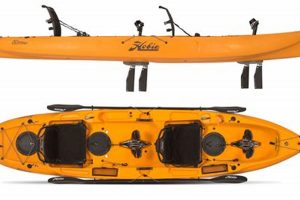
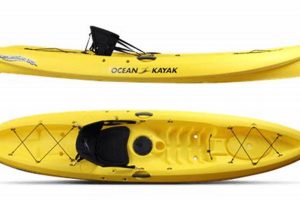
Choosing between a canoe and a kayak for solitary fishing expeditions involves considering several factors related to stability, maneuverability, and storage capacity. A canoe, characterized by its open design and use of a single-bladed paddle, offers excellent stability and ample space for gear and fish. Kayaks, with their enclosed cockpits and double-bladed paddles, provide greater speed and efficiency in navigating various water conditions.
Selecting the right watercraft significantly impacts fishing success and overall enjoyment. The decision affects an angler’s ability to access desired fishing locations, maintain balance while casting and reeling, and transport necessary equipment. Historically, canoes have served diverse purposes, including transportation and hunting, while kayaks were initially developed for hunting and traversing icy waters. The adaptation of both vessels for recreational fishing highlights their versatility and adaptability.
The following sections will delve deeper into specific aspects of canoe and kayak fishing, exploring the advantages and disadvantages of each watercraft type regarding stability, maneuverability, storage, and overall suitability for different fishing styles and environments.
Tips for Choosing Between a Solo Canoe and Kayak for Fishing
Selecting the appropriate watercraft for a solo fishing trip requires careful consideration of individual needs and preferences. The following tips offer guidance for making an informed decision.
Tip 1: Evaluate Stability Needs: Canoes generally offer greater initial stability, beneficial for stand-up fishing or for anglers concerned about balance. Kayaks, while less initially stable, can become more stable with practice and proper technique.
Tip 2: Consider Water Conditions: Canoes excel in calm waters like lakes and slow-moving rivers. Kayaks, due to their lower profile and maneuverability, handle windy conditions and faster currents more effectively.
Tip 3: Assess Storage Requirements: Canoes provide significantly more storage space for gear, coolers, and catches. Kayaks offer more limited storage, requiring careful packing and prioritization of essential equipment.
Tip 4: Factor in Transportation and Portability: Kayaks are generally lighter and easier to transport and launch than canoes. Canoe transport may require specialized roof racks or trailers.
Tip 5: Analyze Fishing Style: Trolling or still-fishing often benefits from the stability of a canoe. Kayak anglers might find sight fishing or navigating tight spaces easier due to enhanced maneuverability.
Tip 6: Think About Physical Capabilities: Paddling a canoe typically involves more upper body strength, while kayaking engages the core and legs. Consider individual physical limitations and comfort levels.
Tip 7: Prioritize Comfort and Ergonomics: Test out different canoe and kayak models to assess seating comfort, paddling position, and overall ergonomics. Ensure the chosen watercraft allows for comfortable fishing over extended periods.
By carefully considering these factors, anglers can choose the watercraft that best aligns with their individual needs and fishing preferences, ultimately enhancing their on-the-water experience.
Through understanding the nuances of each vessel, informed decisions can be made, leading to improved fishing success and enjoyment.
1. Stability

Stability plays a crucial role in the “solo canoe vs. kayak for fishing” debate. A stable platform is essential for various fishing activities, including casting, retrieving, and landing fish, especially in challenging conditions. Differences in hull design significantly influence the stability characteristics of canoes and kayaks. Canoes, with their wider beams and flatter bottoms, generally offer superior initial stability. This makes them well-suited for anglers who prefer to stand while fishing or who prioritize a stable platform for casting in calm waters. Kayaks, typically narrower and featuring a more rounded or V-shaped hull, possess less initial stability but often exhibit greater secondary stability the resistance to tipping once tilted. This characteristic allows experienced kayakers to lean into turns and maintain balance in rougher conditions. For example, a kayak angler might confidently lean into a wave, while a similar maneuver in a canoe could lead to capsizing.
The choice between a canoe and a kayak based on stability depends heavily on intended fishing style and environment. Anglers fishing in calm lakes or rivers, particularly those employing techniques like fly fishing which require more movement, might prioritize the initial stability of a canoe. Conversely, anglers tackling moving water or ocean conditions often favor the secondary stability and maneuverability of a kayak. Consider a scenario where an angler hooks a large fish; in a stable canoe, there is less risk of capsizing during the fight, whereas a kayak requires more skillful balance and bracing. Adding accessories or modifications, such as outriggers for canoes or stabilizers for kayaks, can further influence stability.
Understanding the nuances of stability concerning canoes and kayaks is fundamental for safe and effective fishing. Evaluating individual needs and the anticipated fishing environment allows anglers to prioritize stability characteristics appropriately, enhancing both fishing success and overall safety on the water. Ultimately, choosing the appropriate watercraft based on stability considerations contributes significantly to a positive and productive fishing experience.
2. Maneuverability

Maneuverability represents a critical factor in the selection of a solo fishing watercraft. A highly maneuverable vessel allows anglers to navigate complex waterways, access secluded fishing spots, and respond effectively to changing conditions. Canoes and kayaks exhibit distinct maneuverability characteristics due to their design and paddling methods. Canoes, propelled by a single-bladed paddle, excel in straight-line tracking and offer good stability, but turning and maneuvering in tight spaces can be challenging. Kayaks, utilizing a double-bladed paddle, provide superior turning ability and agility. This advantage proves beneficial in navigating narrow creeks, maneuvering around obstacles like fallen trees or rocks, and efficiently changing direction in pursuit of fish. Consider navigating a winding river choked with fallen logs; a kayak’s maneuverability allows for precise navigation through tight passages, while a canoe might require more effort and careful maneuvering.
The impact of maneuverability on fishing success is significant. In situations requiring quick adjustments, such as following a moving school of fish or responding to a sudden change in current, kayak anglers often possess a distinct advantage. Canoes, while less nimble, offer a stable platform for casting in open water. For instance, when fishing in a fast-flowing stream, a kayak’s responsiveness allows anglers to hold position and maintain precise presentation of lures or bait, whereas a canoe might require more effort to counteract the current’s force. Water conditions also influence maneuverability. Wind and waves can significantly impact a canoe’s tracking, requiring more corrective strokes. A kayak’s lower profile and streamlined design reduce wind resistance, enhancing control in challenging conditions.
Choosing between a canoe and a kayak based on maneuverability requires careful assessment of the intended fishing environment and target species. In environments requiring intricate navigation and precise control, a kayak often provides a more suitable platform. When stability and straight-line tracking are prioritized over agility, a canoe becomes the more practical choice. Ultimately, understanding the nuances of maneuverability as it relates to each watercraft type empowers anglers to select the vessel best suited to their specific fishing needs and maximizes their chances of success on the water. This understanding extends beyond simply choosing a vessel; it informs tactical decisions made during the fishing trip itself, such as approach angles, drift control, and positioning for optimal casting.
3. Storage Capacity

Storage capacity represents a significant consideration when choosing between a solo canoe and kayak for fishing. The ability to transport essential gear, food, and potential catches directly impacts the duration and success of fishing expeditions. Differing design philosophies between canoes and kayaks result in varying storage options and capacities, influencing their suitability for diverse fishing styles and trip lengths.
- Open vs. Enclosed Storage:
Canoes typically offer open storage areas, allowing for bulkier items and flexible packing configurations. This open design facilitates easy access to gear during the fishing trip. Kayaks, conversely, primarily utilize enclosed storage compartments, accessed through hatches. While offering protection from the elements, these compartments can limit the size and shape of stored items. For example, a multi-day fishing trip requiring camping gear necessitates the voluminous storage of a canoe, while a short excursion with minimal equipment might favor the secure, enclosed storage of a kayak. The trade-off between accessibility and protection from water requires careful consideration based on anticipated needs.
- Capacity and Weight Limits:
Canoes generally boast greater overall carrying capacity compared to kayaks. This increased volume accommodates larger coolers, more tackle boxes, and even camping gear for extended trips. Kayak weight limits, often lower than those of canoes, restrict the amount of gear carried. Exceeding weight limits in either vessel compromises stability and performance. For instance, an angler planning to target large game fish requiring heavier tackle benefits from the higher capacity of a canoe. Conversely, a minimalist angler focusing on lighter tackle might find a kayak’s capacity sufficient. Understanding these limitations aids in informed equipment selection and safe loading practices.
- Accessibility and Organization:
Accessibility to stored gear impacts fishing efficiency. In a canoe, equipment is readily available within reach, allowing for quick adjustments during fishing. Kayak anglers might need to pause and access hatches to retrieve specific items, potentially interrupting fishing flow. Organization systems, such as dry bags, tackle organizers, and gear tie-downs, play a crucial role in maximizing available space and maintaining order within both canoes and kayaks. Efficient organization ensures essential items remain readily accessible without compromising stability or hindering paddling efficiency.
- Securing the Catch:
Storing caught fish safely and responsibly is paramount. Canoes offer ample space for coolers or livewells to maintain fish freshness. Kayaks often require creative solutions, such as specialized kayak coolers or fish bags, to accommodate catches. Regulations regarding fish storage, including size and species limits, must be adhered to. Proper storage preserves fish quality and demonstrates responsible angling practices.
By analyzing storage capacity needs in relation to planned fishing trips and target species, anglers can confidently select the most appropriate watercraft. Balancing storage capacity with other factors like maneuverability and stability ensures a well-equipped and successful fishing experience. The choice between a canoe and kayak becomes clearer when viewed through the lens of individual storage requirements, ultimately impacting fishing trip logistics and overall satisfaction. Failure to adequately plan for storage can lead to a cramped and inefficient fishing experience, emphasizing the critical nature of this decision in the solo canoe vs. kayak for fishing evaluation.
4. Fishing Style

Fishing style significantly influences watercraft selection for solo anglers. Specific techniques and target species often favor either a canoe or kayak due to inherent differences in stability, maneuverability, and storage capacity. Understanding these relationships allows anglers to optimize their fishing experience and maximize success. For example, trolling, a technique involving dragging lures or bait behind a moving boat, benefits from the stability and tracking capabilities of a canoe. The angler can maintain a consistent speed and course while covering a larger area, increasing the likelihood of encountering fish. Conversely, sight fishing, where anglers visually locate fish before casting, often favors the maneuverability and stealth of a kayak. The kayak allows for precise positioning and quiet movement, crucial for approaching wary fish without disturbance. Fly fishing, requiring frequent casting and line management, typically benefits from the stability offered by a canoe, especially when wading or standing is desired. Spin fishing, adaptable to various environments, can be effectively practiced from both canoes and kayaks, with the choice depending more on the specific location and target species.
The connection between fishing style and watercraft choice extends beyond simple technique. Consider the target species. Anglers pursuing large, powerful fish, such as muskies or salmon, might prefer the stability and higher weight capacity of a canoe for managing heavy tackle and the ensuing fight. Anglers targeting smaller species in tight, shallow waters, like panfish or bass in a densely vegetated pond, often find a kayak’s maneuverability advantageous. Furthermore, specialized fishing styles, such as bowfishing, where anglers shoot fish with a bow and arrow, frequently utilize specialized canoes designed for shallow-water navigation and elevated shooting platforms. Kayak fishing for pelagic species in open ocean environments requires specialized kayaks designed for stability in rough conditions and equipped with features like rod holders and anchor systems.
Matching fishing style to the appropriate watercraft is crucial for maximizing efficiency, comfort, and overall success on the water. Careful consideration of technique, target species, and fishing environment leads to informed decisions regarding stability, maneuverability, and storage requirements. Ignoring the interplay between fishing style and vessel choice can lead to frustration and diminished success. By understanding these nuances, anglers can tailor their equipment choices to their specific needs and enhance their overall fishing experience. This knowledge translates to improved fishing performance, optimized use of resources, and a greater appreciation for the interplay between angler, equipment, and environment.
5. Water Conditions

Water conditions significantly influence watercraft selection for solo fishing expeditions. Currents, wind, waves, and obstacles present distinct challenges, necessitating careful consideration of vessel stability, maneuverability, and overall suitability. Choosing between a solo canoe and kayak requires analyzing how each performs under specific water conditions to ensure safety and maximize fishing effectiveness.
Current strength and direction impact both canoe and kayak handling. Canoes, due to their higher profile and susceptibility to wind drift, can be challenging to control in strong currents. Kayaks, with their lower profile and greater maneuverability, offer more control in moving water, allowing anglers to navigate faster currents and maintain position effectively. In a fast-flowing river, a kayak’s responsiveness enables precise adjustments to maintain desired fishing locations, whereas a canoe might require constant correction to avoid being swept downstream. Similarly, wind significantly affects both vessel types. A canoe’s larger surface area catches wind more readily, making it susceptible to drifting and difficult to paddle into a headwind. Kayaks, offering a smaller profile, experience less wind resistance, allowing for better control in windy conditions. Consider fishing a large, exposed lake on a windy day; a kayak’s lower wind profile allows for continued fishing, while a canoe might become difficult to manage, potentially requiring postponement of the trip. Wave action presents another critical consideration. Canoes, while stable in calm water, can become unstable and prone to capsizing in choppy conditions. Kayaks, designed with a lower center of gravity and greater secondary stability, handle waves more effectively. Ocean kayaking, for instance, requires vessels specifically designed to handle waves and surf, demonstrating the specialized nature of kayak design tailored to challenging water conditions.
Obstacles, such as rocks, submerged logs, and aquatic vegetation, also influence watercraft selection. A canoe’s shallow draft allows access to shallow, weedy areas inaccessible to deeper-draft kayaks. However, navigating tight spaces around rocks or fallen trees favors a kayak’s maneuverability. Consider accessing a secluded fishing spot hidden within a shallow, overgrown backwater; a canoe might allow access where a kayak cannot venture, while a kayak might excel in navigating a rocky, fast-flowing stream. Understanding the interplay between water conditions and vessel characteristics enables informed decision-making. Matching watercraft capabilities to anticipated conditions is essential for both safety and fishing success. Failure to account for water conditions can lead to hazardous situations and significantly diminish the enjoyment and productivity of a fishing trip. This careful evaluation ultimately empowers anglers to select the optimal vessel, ensuring a safe and productive experience on the water, regardless of the prevailing conditions.
6. Transportation

Transportation logistics significantly influence the choice between a solo canoe and kayak for fishing excursions. Consideration of vehicle type, storage space, and ease of loading and unloading is crucial for a seamless and enjoyable fishing experience. The selection of an appropriate watercraft depends heavily on transportation practicalities, impacting accessibility to desired fishing locations.
- Vehicle Compatibility
Canoes, typically longer and bulkier than kayaks, often require specialized roof racks or trailers for transport. Kayaks, generally smaller and lighter, can often be transported using standard roof racks or even inside larger vehicles. An angler with a compact car might find transporting a canoe impractical, while a truck owner has more flexibility. Evaluating vehicle limitations and compatibility with each watercraft type is essential before embarking on a fishing trip.
- Loading and Unloading
The physical effort required to load and unload each vessel type varies significantly. Canoes, often heavier and more awkward to handle, might require assistance or specialized loading equipment. Kayaks, generally lighter and easier to maneuver, can typically be loaded and unloaded by a single person. Physical limitations or solo trips necessitate considering ease of handling during loading and unloading procedures. An angler with back problems, for example, might find a lightweight kayak easier to manage than a heavier canoe.
- Storage Space
Available storage space at home or during transport dictates watercraft practicality. Canoes, requiring more storage area, might pose challenges for individuals with limited space. Kayaks, often more compact, present fewer storage constraints. Apartment dwellers or those with limited garage space might find kayak storage more convenient than accommodating a larger canoe. Long-term storage considerations influence the feasibility of owning and maintaining each watercraft type.
- Distance to Launch Site
Transporting a watercraft over long distances influences fuel consumption and overall trip logistics. Heavier canoes and trailers contribute to increased fuel costs compared to transporting a lighter kayak. The distance from storage location to launch site becomes a practical consideration, affecting both trip planning and overall expenses. Anglers frequently fishing remote locations might prioritize fuel efficiency and ease of transport over other factors, potentially favoring a kayak over a canoe.
Careful evaluation of transportation logistics, including vehicle compatibility, ease of loading, storage capacity, and distance to fishing locations, is paramount for a successful solo fishing trip. Choosing between a canoe and kayak requires aligning transportation practicalities with individual needs and available resources. Failing to adequately address transportation logistics can lead to unnecessary complications and detract from the overall fishing experience. By considering these factors, anglers can ensure a smooth and enjoyable outing, maximizing time spent fishing rather than managing logistical challenges. This comprehensive understanding empowers anglers to make informed decisions regarding watercraft selection, facilitating efficient transport and ultimately contributing to a more rewarding and productive fishing experience.
Frequently Asked Questions
This section addresses common inquiries regarding the selection of a solo canoe or kayak for fishing, providing concise and informative responses to aid in decision-making.
Question 1: Which is more stable for fishing: a canoe or a kayak?
Canoes generally offer greater initial stability, making them suitable for stand-up fishing. Kayaks possess less initial but greater secondary stability, advantageous in rougher conditions once paddling skills develop. Optimal choice depends on individual balance and anticipated water conditions.
Question 2: Which is easier to paddle: a canoe or a kayak?
Canoe paddling utilizes upper body strength for single-bladed strokes, while kayaking engages the core and legs with a double-bladed paddle. “Easier” depends on individual strength, preference, and paddling experience. Learning curves exist for both.
Question 3: What type of fishing is best suited for a canoe?
Canoes excel in calm water fishing styles like trolling, still-fishing, and fly fishing where casting space and stability are prioritized. Their open design and ample storage accommodate diverse gear and larger catches.
Question 4: What type of fishing is best suited for a kayak?
Kayaks thrive in environments requiring maneuverability, such as navigating tight creeks, rivers, or ocean conditions. Techniques like sight fishing, casting in moving water, and accessing shallow areas benefit from kayak agility.
Question 5: Which is easier to transport: a canoe or a kayak?
Kayaks, generally smaller and lighter, are easier to transport than canoes. Canoes often require specialized roof racks or trailers due to their length and bulk. Transportation ease depends on vehicle type and available storage space.
Question 6: What are the storage capacity differences between canoes and kayaks?
Canoes offer significantly more open storage space, accommodating bulkier items and larger quantities of gear. Kayaks utilize enclosed hatches, limiting storage space and requiring strategic packing. Choice depends on gear requirements and trip duration.
Careful consideration of these factors, alongside personal preferences and intended fishing environments, facilitates informed decision-making regarding optimal watercraft selection. Prioritizing individual needs and anticipated fishing conditions leads to a more enjoyable and successful experience on the water.
The subsequent section delves deeper into specific features and modifications relevant to fishing from both canoes and kayaks, further refining selection criteria.
Solo Canoe vs Kayak for Fishing
Choosing between a solo canoe and kayak for fishing presents a nuanced decision, contingent upon careful evaluation of individual needs and anticipated fishing environments. Factors such as stability, maneuverability, storage capacity, fishing style, water conditions, and transportation logistics play crucial roles in determining the optimal watercraft. Canoes offer enhanced stability and storage, benefiting anglers prioritizing a stable platform and ample gear capacity, particularly in calm waters. Kayaks excel in maneuverability and handling challenging conditions, making them well-suited for anglers navigating tight spaces, currents, and open water. Neither vessel type inherently surpasses the other; rather, selection hinges on prioritizing specific characteristics based on anticipated fishing scenarios.
Ultimately, successful angling relies on informed equipment choices tailored to individual preferences and environmental factors. Thorough consideration of the distinct advantages and disadvantages of solo canoes and kayaks empowers anglers to select the most appropriate vessel, maximizing both safety and fishing effectiveness. A well-informed decision transforms the “solo canoe vs kayak for fishing” debate into a personalized selection process, ensuring a fulfilling and productive experience on the water. The ideal choice hinges not on universality but on the unique interplay between angler, environment, and fishing style.