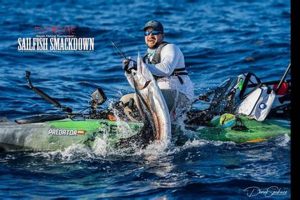
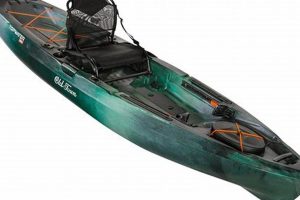
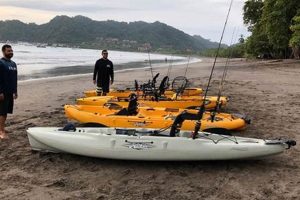
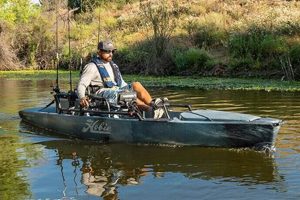
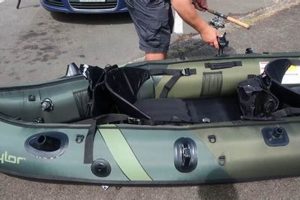
This sit-on-top vessel, designed for angling in marine environments, offers a stable platform for fishing activities. Characterized by its 13-foot length, the design facilitates both paddling and pedal-powered propulsion, providing anglers with versatility and maneuverability on the water. Common features often include rod holders, storage compartments for tackle and gear, and a comfortable seating system designed for extended fishing trips.
A craft of this type provides several advantages to the angler. Its stability contributes to casting accuracy and ease of fighting fish, while the specialized features enhance organization and efficiency during fishing excursions. The length allows for navigating various water conditions, from calm bays to open ocean environments (within reasonable limits). Over time, advancements in design and materials have led to lighter, more durable, and feature-rich fishing kayaks, improving the overall angling experience and making this type of vessel a popular choice among fishing enthusiasts.
The subsequent sections will explore specific aspects of this type of fishing platform in greater detail, covering topics such as construction materials, propulsion systems, key features, and recommended usage scenarios.
Tips for Utilizing a 13-Foot Sit-On-Top Fishing Kayak in Marine Environments
Proper preparation and technique enhance safety and enjoyment while fishing from a kayak. The following tips provide guidance for maximizing the experience.
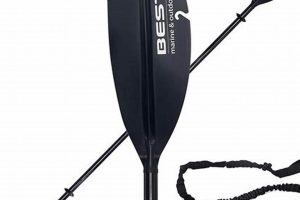
Tip 1: Prioritize Safety Equipment. Always wear a personal flotation device (PFD) and carry essential safety gear, including a whistle, signaling device, and first-aid kit. A leash connecting the paddle to the vessel prevents loss in rough conditions.
Tip 2: Plan the Trip Carefully. Check weather forecasts and tides before embarking. Inform someone of the planned route and estimated return time. Choose launch and landing points accessible to the kayak and prevailing conditions.
Tip 3: Distribute Weight Evenly. Balance gear distribution within the kayak to maintain stability. Heavier items should be positioned low and centrally. Secure all equipment to prevent shifting during movement.
Tip 4: Practice Paddling and Maneuvering Techniques. Familiarize oneself with basic paddling strokes and turning techniques in calm water before venturing into more challenging environments. This builds confidence and control.
Tip 5: Understand Water Conditions. Be aware of currents, tides, and potential hazards such as boat traffic and submerged obstacles. Adapt paddling techniques to suit the prevailing conditions. Exercise caution in windy or choppy waters.
Tip 6: Respect Wildlife and the Environment. Observe wildlife from a safe distance and avoid disturbing their natural habitat. Pack out all trash and fishing line to minimize environmental impact.
Tip 7: Utilize Appropriate Anchoring Techniques. When fishing in a specific location, employ appropriate anchoring techniques to maintain position and prevent drift. Consider using a drift sock or anchor trolley system.
Adherence to these guidelines contributes to a safe, enjoyable, and productive fishing experience. Proper planning and preparation are essential for maximizing time on the water and minimizing potential risks.
The following section concludes with essential information regarding maintenance and care for a fishing kayak, ensuring its longevity and optimal performance.
1. Sit-on-Top Design

The sit-on-top design is integral to the Ocean Trident 13 fishing kayak’s functionality and suitability for marine environments. This design choice directly influences stability, water access, and overall angler experience. Unlike traditional sit-inside kayaks, the open deck allows for greater freedom of movement and eliminates the risk of becoming trapped in the event of a capsize. This self-bailing configuration enhances safety, particularly in rough conditions or when landing larger fish. The elevated seating position also improves visibility, aiding navigation and fish spotting. Anglers can easily enter and exit the kayak directly from the water, a significant advantage for maneuvering in ocean environments or retrieving gear.
Consider a scenario where an angler hooks a large fish in choppy conditions. The stability provided by the sit-on-top design allows the angler to maintain balance and control while fighting the fish, reducing the risk of capsizing. Furthermore, the ease of re-entry afforded by the open deck provides reassurance should an accidental capsize occur. The design also facilitates casting and retrieving fishing lines, as anglers are not restricted by a closed cockpit. Practical applications extend to diving or snorkeling excursions, where the sit-on-top configuration simplifies water entry and exit.
In summary, the sit-on-top design of the Ocean Trident 13 contributes significantly to its suitability as a fishing platform in marine environments. The enhanced stability, self-bailing capability, and ease of water access are crucial features for angler safety and enjoyment. While the open deck may offer less protection from the elements compared to sit-inside designs, its advantages in terms of stability and safety make it a preferred choice for many ocean anglers. This design characteristic directly influences the kayak’s performance and contributes to its overall effectiveness as a specialized fishing vessel.
2. Thirteen-foot length

The 13-foot length of the Ocean Trident kayak represents a deliberate design choice balancing several critical performance factors relevant to its intended use in ocean environments. This length influences hull speed, maneuverability, and stability, impacting tracking performance, ease of turning, and resistance to tipping. Compared to shorter kayaks, the increased length generally contributes to greater hull speed, allowing anglers to cover more water efficiently. However, this added length can reduce maneuverability in tight spaces or surf zones. The 13-foot length also provides a stable platform, especially beneficial when casting, reeling, and landing fish in open water. A longer kayak tends to handle chop and swell more effectively than a shorter one, providing a smoother ride in challenging conditions.
Consider navigating through dense kelp forests or rocky coastlines. While a shorter kayak might offer superior agility in these confined environments, the 13-foot length of the Ocean Trident provides enhanced stability in potentially turbulent water. This stability becomes paramount when dealing with strong currents or unexpected waves near shore. Conversely, when paddling longer distances in open water, the increased hull speed of the 13-foot kayak becomes advantageous, allowing anglers to reach fishing grounds more quickly and efficiently. This length becomes a critical factor in balancing speed and maneuverability based on the specific fishing environment.
In summary, the 13-foot length of the Ocean Trident fishing kayak represents a compromise designed to optimize performance across diverse ocean conditions. It provides sufficient hull speed for efficient travel in open water, while maintaining a manageable degree of maneuverability and enhanced stability crucial for near-shore fishing. Understanding the impact of this length on performance characteristics allows anglers to make informed decisions regarding its suitability for their specific needs and the prevailing conditions of their chosen fishing locations.
3. Fishing-Specific Features
Fishing-specific features distinguish the Ocean Trident 13 from recreational kayaks, optimizing its performance as a dedicated angling platform. These integrated design elements enhance efficiency, organization, and overall fishing success in marine environments. Features such as rod holders, tackle storage compartments, and specialized mounting points for fish finders or other electronic accessories contribute directly to the kayak’s practicality. Rod holders secure fishing rods while paddling or preparing bait, freeing the angler’s hands. Organized tackle storage facilitates quick access to lures and equipment, minimizing disruption during critical moments. Mounting points for electronics integrate technology seamlessly, providing real-time information about water depth, fish location, and bottom structure, enhancing angling strategy.
Consider a scenario where an angler encounters a school of feeding fish. Having readily accessible rods in dedicated holders allows for immediate casting, capitalizing on the opportunity. The ability to quickly locate and deploy specific lures from organized tackle storage further maximizes efficiency. Integrated electronics provide crucial insights into fish behavior and habitat, informing lure selection and retrieval techniques. These features work in concert to streamline the fishing process, allowing anglers to focus on the task at hand.
In summary, the integration of fishing-specific features is essential to the Ocean Trident 13’s effectiveness as a dedicated fishing kayak. These features transform a general-purpose vessel into a specialized angling platform, directly influencing efficiency and success on the water. From rod holders and tackle storage to mounting points for electronics, each feature plays a crucial role in optimizing the angler’s experience. Understanding the purpose and practical application of these features allows anglers to fully utilize the kayak’s potential and maximize their fishing opportunities in marine environments. This specialized design contributes directly to the Ocean Trident 13’s value and appeal within the fishing kayak market.
4. Stability and Maneuverability
Stability and maneuverability represent fundamental performance characteristics directly influencing the suitability of the Ocean Trident 13 fishing kayak for its intended purpose in marine environments. The design seeks to balance these often-competing attributes to create a platform optimized for angling activities. Stability refers to the kayak’s resistance to tipping or capsizing, crucial for casting, fighting fish, and general safety. Maneuverability describes the ease with which the kayak can be turned and controlled, important for navigating complex shorelines, kelp forests, and changing water conditions. The Ocean Trident 13s hull design, length, and width contribute to its overall stability, while features like the rudder and pedal-driven propulsion system influence its maneuverability. The interaction of these elements determines the kayaks performance characteristics and its suitability for specific fishing environments.
Consider an angler encountering a strong crosswind while fishing near a rocky reef. A stable platform is essential for maintaining balance and preventing capsize in such conditions. Simultaneously, the ability to maneuver quickly and precisely around submerged rocks or breaking waves becomes crucial for safety and effective fishing. The Ocean Trident 13s design attempts to address both needs, allowing anglers to maintain a stable fishing position while retaining sufficient control to navigate challenging environments. Another example involves landing a large fish. Stability is paramount during this process, preventing the kayak from tipping while the angler manages the fish and fishing gear. Once the fish is secured, maneuverability becomes important for repositioning the kayak or returning to a more sheltered location.
In summary, the balance of stability and maneuverability is integral to the Ocean Trident 13s overall effectiveness as a fishing platform. The kayaks design incorporates features aimed at maximizing both attributes, recognizing their critical importance for angler safety, efficient navigation, and successful fishing outcomes in diverse ocean conditions. While some trade-offs between these characteristics are inevitable, understanding their interplay and influence on performance allows anglers to make informed decisions regarding the kayak’s suitability for their specific fishing style and the anticipated conditions of their chosen fishing locations. This careful balance differentiates the Ocean Trident 13 from kayaks designed for other purposes, such as recreational paddling or whitewater navigation.
5. Pedal and Paddle Propulsion

The Ocean Trident 13 fishing kayak offers a unique advantage through its hybrid propulsion system, combining traditional paddle power with the efficiency and hands-free operation of pedal drive. This dual functionality significantly expands the kayak’s versatility and adaptability to diverse fishing scenarios and environmental conditions. Paddle propulsion provides a reliable and readily available means of movement, requiring no specialized equipment beyond the paddle itself. This human-powered approach offers excellent control in tight spaces, surf zones, and areas with potential underwater obstacles where a pedal drive might be impractical or susceptible to damage. Pedal drive, conversely, allows anglers to cover greater distances with less physical exertion, conserving energy for fishing activities. The hands-free operation of the pedal drive enables continuous lure retrieval, trolling, and precise boat control while simultaneously managing fishing rods and tackle. This becomes invaluable when targeting specific fish species requiring constant line tension or when fishing in open water where maintaining a consistent drift or slow troll is essential.
Consider an angler targeting bottom-dwelling fish in a shallow bay. Paddle propulsion allows for quiet and controlled movement through shallow areas, minimizing disturbance to the fish and maximizing stealth. Upon reaching a promising fishing spot, the angler can switch to pedal drive, freeing their hands to focus on fishing and maintaining precise boat position without the continuous effort of paddling. Conversely, in a scenario involving navigating through dense kelp forests, the immediate responsiveness and fine control offered by paddle propulsion become advantageous. The angler can swiftly and accurately maneuver around kelp stalks, avoiding entanglement with the propeller-driven pedal system. Once clear of the kelp, the angler can revert to pedal drive for more efficient travel to open water.
In summary, the integration of both pedal and paddle propulsion within the Ocean Trident 13 fishing kayak significantly enhances its versatility and adaptability across diverse fishing environments. The ability to seamlessly transition between these two propulsion modes allows anglers to optimize their approach based on the specific demands of the situation. This adaptability contributes directly to the kayak’s effectiveness as a specialized fishing platform, empowering anglers to efficiently explore various fishing grounds and respond effectively to changing conditions. The hybrid propulsion system distinguishes the Ocean Trident 13, offering a distinct advantage over kayaks limited to a single mode of propulsion.
6. Ocean Kayaking Capability

Ocean kayaking capability, a critical consideration for any kayak intended for marine environments, directly relates to the suitability of the Ocean Trident 13 fishing kayak for its intended purpose. This capability encompasses a range of factors impacting performance and safety in open water, including stability, seaworthiness, and handling in various conditions. Exploring these facets provides a comprehensive understanding of the Ocean Trident 13’s suitability for ocean use.
- Seaworthiness and Hull Design
Seaworthiness refers to the kayak’s ability to handle waves, chop, and currents. The Ocean Trident 13’s hull design plays a crucial role in its seaworthiness, impacting its stability and tracking in challenging conditions. A well-designed hull minimizes the risk of capsizing and allows for efficient paddling or pedaling, even in adverse conditions. The length and shape of the hull influence its performance in waves, affecting its tendency to pitch or roll. Its seaworthiness determines the conditions in which the kayak can be safely operated and contributes significantly to angler confidence in open water.
- Stability in Open Water Conditions
Stability is paramount in ocean kayaking, particularly when fishing. The Ocean Trident 13’s sit-on-top design and wide beam contribute to its inherent stability, minimizing the likelihood of capsize. This stability is essential not only for safety but also for effectively casting, fighting fish, and performing other fishing-related tasks. Consider a scenario involving landing a large fish in choppy water; the kayak’s stability becomes crucial for maintaining balance and control throughout the process. Its design prioritizes stability in open water, enabling anglers to focus on fishing without constantly battling instability.
- Handling in Various Sea States
Ocean conditions can change rapidly, demanding a kayak capable of handling a variety of sea states. The Ocean Trident 13’s performance in different wave heights, currents, and wind conditions determines its true ocean kayaking capability. Its tracking, speed, and maneuverability in various sea states influence its suitability for specific fishing locations and conditions. For example, a kayak performing well in calm bays might struggle in exposed coastal areas with strong winds and swell. The Ocean Trident 13’s design considerations aim to provide a balance of performance characteristics suitable for a range of ocean environments.
- Safety Features and Considerations
Safety remains a paramount concern in ocean kayaking. While the Ocean Trident 13’s inherent design features contribute to its safety profile, additional precautions and equipment enhance overall safety in open water. These include wearing a personal flotation device (PFD), carrying essential safety gear, and practicing self-rescue techniques. Understanding and respecting ocean conditions, such as tides, currents, and weather patterns, further contributes to safe operation. The kayak’s ocean kayaking capability also depends on the angler’s skill and preparedness for managing potential hazards in a marine environment.
The convergence of these factors determines the Ocean Trident 13’s true ocean kayaking capability. While its design features contribute significantly to its suitability for marine environments, responsible operation, appropriate safety measures, and a realistic assessment of conditions remain crucial for a safe and successful ocean kayaking experience. Recognizing the interplay of design, conditions, and angler preparedness allows for informed decision-making and maximizes the enjoyment of ocean fishing from this specialized kayak.
7. Durable Construction Materials

Durable construction materials are fundamental to the Ocean Trident 13 fishing kayak’s longevity and performance in demanding marine environments. Material selection directly influences resistance to impact, abrasion, UV degradation, and saltwater corrosion. These factors impact the kayak’s structural integrity, lifespan, and overall cost of ownership. Commonly utilized materials include high-density polyethylene (HDPE), rotomolded for seamless construction and impact resistance, and UV-stabilized plastics engineered to withstand prolonged sun exposure. Selecting appropriate materials ensures the kayak can endure the rigors of ocean use, including impacts from rocks, waves, and transported gear, as well as prolonged exposure to saltwater and sunlight. This durability translates to a reliable platform capable of withstanding regular use and minimizing the need for frequent repairs or replacement.
Consider the scenario of launching and landing through surf zones. The kayak’s hull experiences significant abrasion from sand and rocks. Durable construction materials, such as HDPE, minimize damage during these high-impact events, preserving the kayak’s structural integrity and preventing leaks. Another example involves extended exposure to saltwater. Corrosion-resistant hardware and UV-stabilized plastics maintain their functionality and appearance over time, preventing premature failure and preserving the kayak’s aesthetic appeal. Choosing robust materials directly translates to a longer lifespan and reduced maintenance requirements, factors impacting overall cost and user satisfaction. The specific material choices made by the manufacturer directly influence the kayak’s resilience and suitability for long-term use in harsh marine conditions.
In summary, durable construction materials constitute a crucial aspect of the Ocean Trident 13 fishing kayak’s design. Material selection directly impacts the kayak’s ability to withstand the harsh marine environment, influencing its lifespan, maintenance requirements, and overall performance. Utilizing robust, impact-resistant, and corrosion-resistant materials ensures the kayak remains a reliable fishing platform for extended periods, minimizing downtime and maximizing enjoyment on the water. The connection between material durability and long-term performance represents a key consideration for prospective buyers evaluating the suitability of the Ocean Trident 13 for their fishing needs. This understanding allows for informed purchasing decisions and contributes to a more satisfying ownership experience.
Frequently Asked Questions
This section addresses common inquiries regarding kayaks designed for fishing in ocean environments, specifically focusing on aspects relevant to the Ocean Trident 13.
Question 1: What differentiates a fishing kayak from a recreational kayak?
Fishing kayaks typically incorporate specialized features like rod holders, tackle storage, and anchor trolleys, prioritizing stability and functionality for angling. Recreational kayaks prioritize speed, comfort, and maneuverability for general paddling.
Question 2: How does the length of a kayak affect its performance in ocean conditions?
Longer kayaks generally offer better tracking and speed in open water but can be less maneuverable in surf or tight spaces. Shorter kayaks enhance maneuverability but may sacrifice speed and stability in rougher conditions.
Question 3: What safety precautions are essential for ocean kayaking?
Essential precautions include wearing a personal flotation device (PFD), carrying a whistle, signaling device, and first-aid kit, checking weather forecasts, informing someone of the trip plan, and understanding local regulations.
Question 4: What are the advantages and disadvantages of pedal-powered kayaks for ocean fishing?
Pedal drive provides hands-free propulsion, beneficial for trolling and managing fishing gear. However, they can be less efficient in shallow water or areas with dense vegetation and require more maintenance.
Question 5: How does one choose the right kayak for their specific fishing needs and experience level?
Consider factors like fishing style, target species, typical water conditions, storage capacity requirements, and budget. Research various models and seek expert advice to determine the most suitable kayak.
Question 6: What maintenance procedures are recommended for ensuring the longevity of a fishing kayak used in saltwater?
Regular rinsing with fresh water after each use, periodic cleaning with mild soap, and proper storage out of direct sunlight prolong the lifespan of a kayak. Inspecting and lubricating moving parts, particularly in pedal-drive systems, is also essential.
Addressing these common inquiries provides a foundation for informed decision-making regarding kayak selection and safe operation in marine environments. Understanding these factors contributes significantly to a positive and productive ocean kayaking experience.
The subsequent section will provide concluding remarks regarding the significance and practical applications of specialized fishing kayaks in the context of ocean angling.
Conclusion
Exploration of the Ocean Trident 13 fishing kayak reveals a vessel designed for specific angling demands within challenging marine environments. Key attributes, including the sit-on-top configuration, hybrid propulsion system, and specialized fishing features, contribute to its suitability for this purpose. Stability, maneuverability, and durable construction enhance performance and longevity in diverse ocean conditions. Understanding these characteristics provides valuable insights for prospective users evaluating its suitability for their individual needs.
The evolution of fishing kayak design reflects a continuous refinement process, driven by angler requirements and technological advancements. Continued innovation promises further enhancements in performance, safety, and integration of technology, ultimately shaping the future of ocean angling experiences. Careful selection based on individual needs and responsible operation within appropriate conditions maximizes the potential offered by specialized fishing kayaks like the Ocean Trident 13.