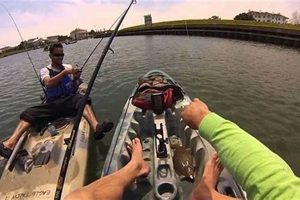
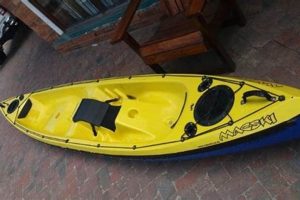
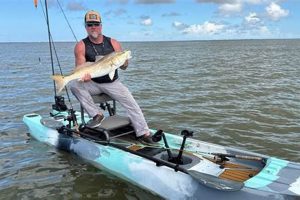
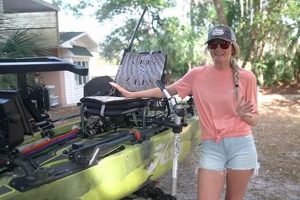
A kayak designed specifically for angling, typically measuring approximately twelve feet in length, offers a stable and efficient platform for navigating waterways. These vessels often feature specialized design elements such as rod holders, tackle storage, and comfortable seating arrangements tailored for extended fishing trips. A typical example would be a sit-on-top model constructed from durable, lightweight materials like high-density polyethylene.
The twelve-foot length represents a balance between maneuverability and tracking performance, making such kayaks suitable for a variety of aquatic environments, from calm lakes and slow-moving rivers to sheltered coastal areas. This size category frequently provides ample storage for fishing gear and offers sufficient stability for casting and reeling. The evolution of specialized fishing kayaks reflects the growing popularity of kayak angling, providing anglers with dedicated watercraft optimized for their pursuit.
This discussion will further explore key aspects of these watercraft, including design variations, material selection, essential features, and considerations for choosing the appropriate model for specific fishing styles and environments.
Tips for Selecting and Using a Twelve-Foot Fishing Kayak
Choosing and utilizing a fishing kayak of this size requires careful consideration of several factors to ensure optimal performance and safety. The following tips offer guidance for anglers seeking to maximize their on-the-water experience.
Tip 1: Consider Hull Design: Kayak hull designs significantly influence stability and maneuverability. A wider, flatter hull provides greater initial stability, beneficial for stand-up fishing, while a narrower, V-shaped hull offers enhanced speed and tracking in open water.
Tip 2: Evaluate Weight Capacity: Ensure the kayak’s weight capacity accommodates the combined weight of the angler, fishing gear, and any potential catch. Exceeding the capacity can compromise stability and safety.
Tip 3: Prioritize Comfort and Ergonomics: A comfortable seat and adjustable footrests are essential for extended fishing trips. Consider features like adjustable backrests and thigh supports for enhanced comfort.
Tip 4: Assess Storage Options: Adequate storage is crucial for organizing tackle and equipment. Evaluate the size, accessibility, and water resistance of storage compartments.
Tip 5: Choose Appropriate Propulsion: Paddle propulsion offers a quiet and efficient mode of travel. Pedal-driven kayaks provide hands-free operation, advantageous for fishing, while motorized kayaks offer increased range and speed.
Tip 6: Practice Safety Precautions: Always wear a personal flotation device (PFD) and carry essential safety equipment, including a whistle, signaling device, and first-aid kit.
Tip 7: Research Local Regulations: Familiarize oneself with local boating regulations, including licensing requirements and permitted fishing areas.
By considering these tips, anglers can make informed decisions regarding kayak selection, ensuring a safe and productive fishing experience on the water.
These considerations provide a foundational understanding for informed kayak selection and usage, contributing to an enhanced and successful fishing experience.
1. Stability

Stability represents a critical performance attribute in twelve-foot fishing kayaks, directly influencing angler safety, comfort, and fishing effectiveness. A stable platform enables anglers to cast, retrieve, and land fish without compromising balance, particularly crucial when handling larger fish or navigating challenging water conditions. Stability also contributes to angler comfort, allowing for extended periods on the water without fatigue or discomfort. Several factors influence kayak stability, including hull design, width, and weight distribution. Wider, flatter hulls generally offer greater initial stability, beneficial for stand-up fishing, while narrower hulls may provide enhanced maneuverability at the expense of some stability. For example, a kayak designed for still-water fishing often features a wider, more stable hull than one designed for traversing open water or swift currents. The distribution of weight within the kayak also plays a crucial role; proper weight distribution enhances stability, while uneven loading can negatively impact balance.
Understanding the factors influencing stability allows anglers to make informed decisions when selecting a kayak. Consider the intended fishing environment and style. Anglers frequently standing to cast or sight fish in calm waters benefit from a kayak prioritizing primary stability. Conversely, anglers paddling longer distances in varied conditions may prioritize secondary stability, the ability to remain upright during unexpected rocking or leaning. Practical applications of this understanding include choosing kayaks with appropriate hull designs, distributing weight evenly within the kayak, and practicing re-entry techniques in the event of a capsize. These considerations minimize risks associated with instability, such as accidental falls or equipment loss.
In summary, stability stands as a crucial factor influencing the performance and safety of a twelve-foot fishing kayak. Selecting a kayak with the appropriate stability characteristics for the intended fishing environment and style is essential for a positive on-the-water experience. Further, understanding the interplay between hull design, weight distribution, and stability empowers anglers to make informed choices, maximizing both safety and fishing effectiveness.
2. Maneuverability
Maneuverability represents a critical performance characteristic in twelve-foot fishing kayaks, directly influencing an angler’s ability to navigate diverse waterways and access prime fishing locations. Efficient maneuvering enables precise navigation through complex environments such as narrow creeks, shallow flats, and areas with submerged obstacles. This attribute becomes particularly crucial when targeting specific fish species that inhabit tight spaces or require precise boat positioning. The relationship between maneuverability and kayak design involves multiple factors, including hull design, length, and waterline width. Shorter kayaks with a narrower waterline generally offer enhanced maneuverability, allowing for quicker turns and adjustments in direction. For example, a kayak with a distinctly pointed or V-shaped hull design tends to track straight but sacrifices some turning agility. Conversely, a flatter, wider hull design facilitates sharper turns but may compromise tracking performance in open water or strong currents. Understanding this interplay between hull design and maneuverability enables informed decisions tailored to specific fishing environments.
Practical applications of this understanding include selecting a kayak with the appropriate maneuverability characteristics for the intended fishing environment. Anglers targeting fish in narrow, winding streams benefit from kayaks that prioritize turning agility, while those fishing vast, open lakes or coastal waters may prioritize tracking performance. Consider, for example, a fishing scenario in a mangrove-lined estuary. A highly maneuverable kayak allows the angler to navigate the intricate channels and access secluded fishing spots, whereas a less maneuverable kayak might prove cumbersome and limit access. Furthermore, the ability to execute quick turns and precise adjustments in position enhances fishing techniques like sight casting and drift fishing, where accurate boat control is paramount. Conversely, reduced maneuverability can hinder fishing effectiveness and potentially pose safety risks in challenging environments.
In summary, maneuverability plays a crucial role in the effectiveness and safety of a twelve-foot fishing kayak. The interplay between hull design, length, and waterline width directly affects turning performance and tracking. Selecting a kayak with maneuverability characteristics aligned with the intended fishing environment and techniques optimizes fishing success. This awareness enables anglers to make informed decisions, enhancing their ability to access target-rich areas and execute successful fishing strategies.
3. Storage Capacity

Storage capacity represents a critical factor influencing the practicality and effectiveness of twelve-foot fishing kayaks. Adequate storage facilitates organized transport of essential fishing gear, including tackle boxes, rods, reels, safety equipment, and personal items. This organized storage directly impacts fishing efficiency by reducing time spent searching for equipment and maximizing time spent fishing. Insufficient storage can lead to cluttered decks, hindering movement and potentially compromising safety. Conversely, ample and well-designed storage contributes to a streamlined and productive fishing experience. Consider, for instance, an angler targeting multiple species requiring diverse tackle and lures. Sufficient storage allows for organized storage of various rods, reels, and tackle boxes, facilitating quick transitions between fishing techniques without disrupting the fishing flow. Furthermore, dedicated storage compartments for items like electronics, food, and water enhance overall organization and convenience. Dry storage compartments specifically designed for sensitive electronics or personal items are crucial for maintaining equipment functionality and preserving valuable possessions.
The practical significance of understanding storage capacity lies in informed kayak selection. Anglers planning extended trips or carrying specialized equipment benefit from kayaks offering maximum storage volume and specialized compartments. Evaluate storage features such as hatches, tank wells, and integrated storage systems when selecting a kayak. Consider the type and volume of gear typically carried and the accessibility of storage compartments during on-the-water activities. A well-designed twelve-foot fishing kayak often incorporates features like recessed storage areas to minimize interference with paddling and fishing movements. For example, a kayak designed for offshore fishing might prioritize larger storage compartments capable of accommodating bulky safety gear and specialized fishing equipment, while a kayak designed for freshwater fishing might offer smaller, more readily accessible compartments suitable for lighter tackle and gear. Furthermore, the type of material used in storage compartment construction influences durability and water resistance, safeguarding stored items from the elements. Evaluating these aspects empowers anglers to choose kayaks that meet their specific storage needs.
In summary, storage capacity stands as a crucial consideration in selecting a twelve-foot fishing kayak. Adequate and well-designed storage directly impacts fishing efficiency, organization, and overall enjoyment on the water. Understanding the relationship between storage capacity, fishing style, and kayak design empowers anglers to make informed decisions. This consideration ultimately optimizes time spent fishing and minimizes potential challenges associated with disorganized or insufficient storage. The careful evaluation of storage features contributes significantly to a successful and fulfilling fishing experience.
4. Hull Design
Hull design significantly influences the performance characteristics of a 12-foot fishing kayak, affecting stability, maneuverability, speed, and tracking. These kayaks typically employ one of three primary hull designs: pontoon, flat bottom, or V-shaped. Pontoon hulls, characterized by two separate hulls connected by a deck, offer exceptional stability, making them suitable for stand-up fishing and challenging conditions. However, this stability comes at the expense of maneuverability and speed. Flat-bottomed hulls provide excellent stability and maneuverability in calm waters, making them well-suited for shallow-water fishing and navigating tight spaces. However, they tend to be less efficient in open water and choppy conditions. V-shaped hulls excel in tracking and speed, slicing through water efficiently and maintaining direction in currents or wind. They offer less initial stability than pontoon or flat-bottom designs but often provide superior secondary stability, the ability to recover from leaning or rocking.
The choice of hull design depends on the intended fishing environment and angler preferences. A kayak intended for calm lakes or slow-moving rivers might prioritize stability with a pontoon or flat-bottom hull. Conversely, a kayak designed for open-water coastal fishing or navigating swift currents benefits from the tracking and speed offered by a V-shaped hull. Consider, for example, an angler targeting bonefish in shallow flats. A flat-bottomed hull would allow for stealthy maneuvering and quick turns, while a pontoon hull might provide the necessary stability for sight casting while standing. In contrast, an angler trolling for offshore species would benefit from the tracking and speed of a V-shaped hull. Understanding these design principles allows for informed decisions aligned with specific fishing requirements.
Effective hull design represents a critical element in optimizing a 12-foot fishing kayak for its intended purpose. The chosen hull design directly impacts performance, affecting stability, maneuverability, speed, and tracking. Careful consideration of the fishing environment and angler preferences ensures the selection of a kayak that maximizes efficiency and enjoyment on the water. A well-designed hull contributes significantly to overall fishing success, enabling anglers to navigate diverse waterways, access target-rich areas, and maintain stability and control in varying conditions.
5. Weight Capacity

Weight capacity represents a critical safety and performance parameter for 12-foot fishing kayaks. This specification denotes the maximum combined weight of the angler, gear, and any potential catch the kayak can safely support. Exceeding this limit compromises stability, potentially leading to capsizing or significantly hindering maneuverability. A kayak operating within its specified weight capacity maintains designed performance characteristics, ensuring optimal stability, maneuverability, and freeboardthe distance between the waterline and the deck. For instance, a kayak with a 350-pound weight capacity carrying a 200-pound angler, 50 pounds of gear, and a 20-pound fish operates well within safe limits. However, adding another 100 pounds of gear or catch would exceed the capacity, increasing the risk of instability or swamping.
Understanding a kayak’s weight capacity is fundamental for safe and effective kayak fishing. Calculations must account for all potential weight, including not only the angler and gear but also potential catches and even water absorbed by the kayak itself. Selecting a kayak with sufficient weight capacity provides a margin of safety and ensures optimal performance. Consider an angler planning an extended fishing trip requiring substantial gear, food, and water. Choosing a kayak with a higher weight capacity accommodates these additional supplies without compromising safety or performance. Conversely, an angler fishing lighter and closer to shore could opt for a kayak with a lower weight capacity. Practical application involves weighing all intended items before embarking to verify they fall within the kayak’s specified limit. This proactive approach mitigates risks associated with overloading and ensures a safe and enjoyable fishing experience.
In summary, weight capacity is a non-negotiable safety parameter for 12-foot fishing kayaks. Careful consideration of this factor, alongside accurate calculation of intended loads, is crucial for safe and effective operation. Selecting a kayak with appropriate weight capacity ensures optimal performance and minimizes risks associated with overloading. This understanding allows anglers to make informed decisions that prioritize safety and enhance the overall fishing experience.
6. Propulsion Options
Propulsion systems significantly influence the performance and versatility of 12-foot fishing kayaks. The chosen method of propulsion affects speed, maneuverability, fishing efficiency, and access to different fishing environments. Understanding available propulsion options allows anglers to select the system best suited to their individual needs and fishing styles. Key considerations include physical capabilities, fishing environment characteristics, and desired fishing techniques.
- Paddle Propulsion
Traditional paddle propulsion offers a cost-effective and readily available option. Kayaks designed for paddle propulsion prioritize hull efficiency and maneuverability, allowing for navigation through various water conditions. Paddle propulsion offers a quiet and stealthy approach, beneficial for approaching fish in shallow water or easily spooked species. However, paddling requires physical exertion and can limit fishing time by requiring hands for propulsion rather than fishing activities. This method remains popular for its simplicity, affordability, and exercise benefits.
- Pedal Propulsion
Pedal-powered kayaks utilize leg muscles for propulsion, freeing hands for fishing. This hands-free operation allows for simultaneous fishing and maneuvering, enhancing efficiency and reducing fatigue. Pedal drives often incorporate fins or propellers, providing greater speed and range than traditional paddling, particularly advantageous in larger bodies of water or when navigating against currents. However, pedal-driven kayaks typically come at a higher cost and may require more maintenance than paddle kayaks. Additionally, certain pedal systems can be susceptible to damage in shallow water or areas with submerged obstacles.
- Motorized Propulsion
Motorized kayaks utilize electric or gas-powered motors for propulsion. These systems offer the greatest speed and range among available options, allowing anglers to cover vast distances and access remote fishing areas. Motors eliminate the physical exertion of paddling or pedaling, offering a more relaxed and less tiring fishing experience. However, motorized kayaks typically involve higher purchase and maintenance costs. Electric motors require battery management, while gas motors necessitate fuel and regular maintenance. Furthermore, regulations regarding motorized watercraft may restrict access to certain areas.
- Combination Propulsion
Some 12-foot fishing kayaks offer hybrid propulsion systems, combining paddle propulsion with either pedal or motor options. This versatility allows anglers to adapt to changing conditions or fishing requirements. For example, an angler might use paddle propulsion in shallow, protected waters and switch to motor propulsion when traversing larger, open areas. Combination systems provide flexibility but often involve increased complexity and cost compared to single propulsion methods.
Choosing the optimal propulsion system for a 12-foot fishing kayak depends on individual angler needs and fishing styles. Factors such as physical limitations, target fishing environments, desired fishing techniques, and budget constraints influence this decision. Careful consideration of these aspects ensures the selection of a propulsion system that maximizes fishing efficiency, enjoyment, and access to desired fishing locations. This choice ultimately enhances the overall fishing experience, optimizing time on the water and enabling anglers to effectively pursue their target species.
7. Specialized Features
Specialized features distinguish fishing kayaks from recreational models, enhancing angling effectiveness and overall experience. These features cater specifically to the needs of anglers, optimizing functionality and comfort on the water. A 12-foot fishing kayak often incorporates several specialized features designed to improve fishing performance and convenience.
- Rod Holders
Rod holders secure fishing rods, freeing hands for other tasks like paddling, maneuvering, or handling tackle. Various rod holder types exist, including flush-mounted, adjustable, and rotating models. Flush-mounted rod holders offer a streamlined profile but limit adjustability, while adjustable rod holders allow for customized positioning. Rotating rod holders facilitate trolling and various fishing techniques. Multiple rod holders enable anglers to employ different setups or target multiple species simultaneously. For instance, an angler might use one rod for trolling and another for casting, maximizing fishing opportunities. The number, type, and placement of rod holders contribute significantly to fishing efficiency and convenience.
- Tackle Storage
Dedicated tackle storage compartments keep essential fishing gear organized and readily accessible. These compartments vary in size, configuration, and accessibility. Some kayaks feature large, open storage wells suitable for tackle boxes and larger items, while others incorporate smaller, sealed compartments for protecting sensitive electronics or personal items. Specialized tackle storage solutions, such as trays, dividers, and removable containers, enhance organization and prevent gear from shifting during transport or rough water conditions. Efficient tackle storage minimizes time spent searching for equipment and maximizes time spent fishing. For example, readily accessible compartments for frequently used lures or tools streamline fishing processes and improve overall efficiency.
- Anchor Systems
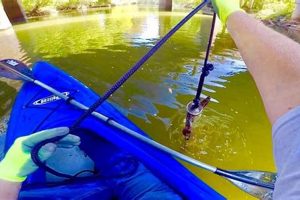
Anchor systems maintain kayak position in desired fishing locations, essential for techniques like still fishing or drift fishing. Anchor trolleys allow for controlled anchor deployment and retrieval from various points on the kayak, adapting to changing wind or current conditions. Stake-out poles offer a shallow-water anchoring solution, particularly useful in rivers or flats. Integrated anchor systems often include dedicated storage compartments and retrieval mechanisms, enhancing convenience and minimizing clutter. For example, a retractable anchor trolley system allows an angler to easily adjust anchor position without leaving the seated position. Effective anchoring systems enhance fishing effectiveness by enabling precise boat positioning and maintaining stability in target areas.
- Electronics Mounts and Integrations
Electronics mounts and integrations accommodate fish finders, GPS units, and other electronic devices essential for navigation and fish location. Flush-mounted electronics displays offer a streamlined profile and protect devices from the elements. Integrated wiring systems provide power and data connectivity for seamless operation. Some kayaks offer dedicated battery compartments for powering electronics, ensuring uninterrupted functionality. For instance, a kayak with an integrated transducer mount simplifies fish finder installation and optimizes sonar performance. Strategic placement of electronics mounts ensures clear visibility and easy access to controls, maximizing their effectiveness and minimizing distractions while fishing. The integration of electronics enhances fishing success by providing valuable information about water depth, fish location, and navigation.
These specialized features significantly enhance the functionality of a 12-foot fishing kayak, transforming it from a basic watercraft into a dedicated fishing platform. The selection and utilization of these features depend on individual fishing styles, target species, and environmental conditions. Choosing a kayak equipped with appropriate specialized features contributes significantly to fishing success, enhancing efficiency, comfort, and overall enjoyment on the water.
Frequently Asked Questions
This section addresses common inquiries regarding twelve-foot fishing kayaks, providing concise and informative responses to facilitate informed decision-making.
Question 1: What are the advantages of a twelve-foot kayak for fishing?
Twelve-foot kayaks offer a balance of maneuverability and stability suitable for various fishing environments. Their length allows for efficient paddling and tracking while maintaining agility in tighter spaces. This size typically accommodates sufficient storage for fishing gear and provides a stable platform for casting and landing fish.
Question 2: How does the hull design impact performance?
Hull design significantly influences stability, maneuverability, and speed. Wider, flatter hulls provide greater initial stability, while narrower, V-shaped hulls enhance speed and tracking. Anglers should select a hull design based on their intended fishing environment and style.
Question 3: What is the importance of weight capacity?
Weight capacity dictates the maximum load a kayak can safely carry. Exceeding this limit compromises stability and safety. Anglers must consider the combined weight of the angler, gear, and potential catch when selecting a kayak.
Question 4: What propulsion options are available?
Common propulsion options include paddle, pedal, and motor. Paddle propulsion offers simplicity and affordability. Pedal drives provide hands-free operation, while motors offer increased speed and range. The optimal choice depends on individual needs and fishing environment.
Question 5: What essential features should anglers consider?
Essential features include rod holders, tackle storage, anchor systems, and electronics mounts. These features enhance fishing efficiency, organization, and overall experience. Anglers should prioritize features aligned with their fishing style and target species.
Question 6: What safety precautions should be taken when using a fishing kayak?
Always wear a personal flotation device (PFD) and carry essential safety equipment, including a whistle, signaling device, and first-aid kit. Check weather conditions before embarking and inform someone of your fishing plans. Adhere to local boating regulations and be aware of potential hazards in the fishing environment.
Careful consideration of these frequently asked questions empowers anglers to make informed decisions regarding kayak selection, usage, and safety precautions, contributing to a positive and successful fishing experience.
This information provides a foundation for understanding the key aspects of twelve-foot fishing kayaks. Further research and practical experience will enhance knowledge and proficiency in kayak fishing.
Fishing Kayak 12 ft
Twelve-foot fishing kayaks represent a versatile platform for diverse angling pursuits. Selection necessitates careful evaluation of hull design, weight capacity, propulsion systems, and specialized features relative to individual fishing styles and target environments. Appropriate consideration of these factors ensures optimal performance, stability, and safety on the water.
Informed decision-making regarding kayak selection empowers anglers to maximize their on-the-water experiences. Continuous refinement of knowledge and skills related to kayak fishing promotes enhanced angling proficiency and responsible engagement with aquatic environments.