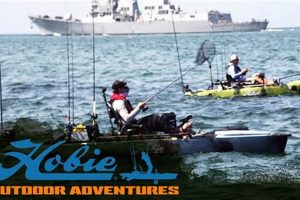
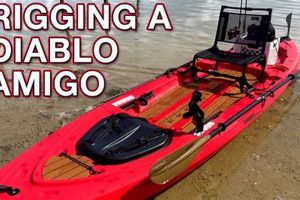
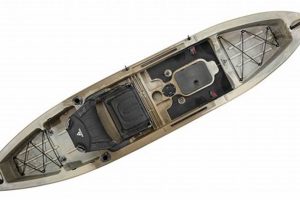
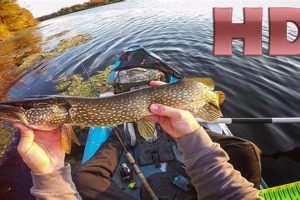
A kayak designed for ocean fishing prioritizing stability is characterized by a wider hull, potentially outriggers or pontoons, and a design prioritizing balance over speed. These vessels offer anglers a secure platform for casting, reeling, and landing fish in open water, often incorporating specialized features like rod holders, tackle storage, and anchor systems. A typical example might be a sit-on-top model with a broad beam and a flat deck.
Enhanced stability in a sea fishing kayak contributes significantly to angler safety and comfort, particularly in challenging conditions. It allows for more confident movement while fishing, reducing the risk of capsizing and enabling anglers to focus on their technique. Historically, fishing kayaks were narrower and less stable, but advancements in design and materials have led to the development of highly stable platforms capable of handling rougher seas and larger catches. This evolution has broadened the accessibility of ocean fishing, making it a safer and more enjoyable pursuit for a wider range of individuals.
The subsequent sections will delve further into the specific design features that contribute to kayak stability, including hull shape, length-to-width ratios, and the impact of added features like outriggers. Further discussions will cover key considerations when selecting a stable fishing kayak, including angler experience, intended fishing locations, and carrying capacity needs. Finally, proper safety precautions and techniques for maintaining balance and stability on the water will be addressed.
Tips for Enhanced Kayak Fishing Stability
Maintaining balance and stability is paramount for a safe and successful fishing experience from a kayak. These tips offer guidance on selecting and handling a kayak designed for stability in open water.
Tip 1: Prioritize Hull Design: Consider kayaks with wider, flatter hulls, such as pontoon or tunnel hull designs. These offer greater initial stability, reducing the likelihood of tipping, especially for less experienced paddlers.
Tip 2: Evaluate Length-to-Width Ratio: Shorter, wider kayaks generally provide more stability than longer, narrower ones. Consider the intended fishing environment and the angler’s experience level when selecting the appropriate ratio.
Tip 3: Consider Outriggers or Stabilizers: Outriggers and stabilizers significantly enhance stability, especially in rough conditions or when standing to fish. These additions can provide added security for anglers of all skill levels.
Tip 4: Distribute Weight Evenly: Proper weight distribution is crucial for maintaining balance. Center heavier items low in the kayak and distribute gear evenly throughout the hull.
Tip 5: Practice Paddle Strokes and Maneuvers: Refined paddling techniques improve balance and control. Practicing in calm water before venturing into more challenging conditions builds confidence and reduces the risk of capsizing.
Tip 6: Understand Water Conditions: Wind, currents, and waves impact stability. Assess conditions before launching and choose sheltered areas when appropriate, especially for less experienced kayakers.
Tip 7: Wear a Personal Flotation Device (PFD): A PFD is essential safety equipment for any kayaking trip. It provides buoyancy and can be lifesaving in the event of a capsize.
By adhering to these guidelines, anglers can significantly improve their stability on the water, allowing for a safer and more enjoyable fishing experience. Focus on proper kayak selection, weight distribution, and understanding environmental conditions contribute to enhanced stability and overall safety.
In conclusion, selecting a stable kayak and practicing safe paddling techniques are crucial for a successful fishing expedition. The next section will offer further guidance on essential safety gear and emergency procedures.
1. Wide Hull Design

Wide hull design is a critical factor in achieving stability in sea fishing kayaks. A wider hull increases the kayak’s footprint on the water, creating a broader base of support and enhancing primary stability, which refers to the kayak’s resistance to initial tipping. This characteristic is particularly important for sea fishing, where anglers often encounter unpredictable conditions such as waves, currents, and wind. A wider hull provides a more stable platform for casting, reeling, and landing fish, minimizing the risk of capsizing. For instance, kayaks designed specifically for offshore fishing frequently feature significantly wider hulls compared to recreational touring kayaks, prioritizing stability over speed. This design choice allows anglers to confidently navigate challenging waters and focus on fishing, rather than constantly battling to maintain balance.
The increased stability offered by a wide hull translates to enhanced safety and comfort. Anglers can shift their weight, stand up to cast, or even land larger fish without compromising the kayak’s balance. This is crucial in open water situations where a capsize can be dangerous. However, it’s important to note that a wider hull can also impact maneuverability and speed. Wider kayaks tend to be slower and less responsive to paddle strokes. This trade-off is generally considered acceptable for sea fishing, where stability is paramount, but it is a factor to consider when selecting a kayak for specific fishing styles or locations. Consider a scenario where an angler needs to quickly maneuver away from an approaching motorboat or navigate through tight channels; a wider hull might present a slight disadvantage in such situations.
In summary, wide hull design is a fundamental element in achieving the stability required for successful and safe sea fishing. While it may slightly compromise speed and maneuverability, the added stability significantly improves angler safety, comfort, and fishing performance in challenging open water conditions. The relationship between hull width and stability is a key consideration for anyone selecting a sea fishing kayak, requiring a careful balance based on individual needs and fishing style.
2. Flat Deck

A flat deck contributes significantly to the stability of a sea fishing kayak, particularly in activities requiring frequent movement or standing. The even surface area provides a secure and predictable platform for anglers, minimizing the risk of tripping or losing balance while casting, reeling, or landing fish. This feature’s importance is amplified in the dynamic environment of open water, where stability is paramount for safety and fishing success.
- Enhanced Standing Stability
A flat deck allows for more secure footing when standing to cast or sight fish, a common practice in many sea fishing scenarios. The absence of pronounced contours or raised features reduces the chances of stumbling or losing balance. This stability translates to more accurate casts, better hooksets, and improved overall fishing performance. For example, anglers targeting bonefish in shallow flats often stand to spot their prey, and a flat deck is essential for maintaining balance in such situations.
- Facilitated Movement and Gear Access
The uninterrupted surface of a flat deck makes it easier to move around and access gear within the kayak. Anglers can quickly and safely shift positions, retrieve tackle from storage compartments, or reposition fishing rods without the risk of tripping over raised features. This ease of movement is particularly beneficial in active fishing situations, where swift reactions and adjustments are often necessary. Consider a scenario where an angler needs to quickly adjust their position to follow a hooked fish; a flat deck facilitates smooth and unimpeded movement.
- Improved Gear Organization and Mounting
A flat deck provides a versatile surface for mounting fishing accessories such as rod holders, fish finders, and anchor trolleys. The consistent surface area allows for greater flexibility in positioning gear and optimizing its accessibility. This customized setup enhances fishing efficiency and allows anglers to tailor their kayak to specific fishing styles and needs. For instance, a flat deck allows for the strategic placement of rod holders within easy reach, streamlining the process of switching between rods or quickly grabbing a rod when a fish strikes.
- Simplified Re-Entry after a Capsize
While a stable kayak minimizes the risk of capsizing, it can still occur in challenging conditions. A flat deck simplifies re-entry into the kayak after a capsize, providing a more stable and accessible platform to climb back onto. This feature can be critical in open water situations where self-rescue is essential. The flat surface offers better leverage and grip, facilitating a quicker and safer return to the kayak.
In the context of a sea fishing kayak, a flat deck contributes significantly to stability, maneuverability, and overall fishing performance. Its benefits extend beyond mere convenience, playing a crucial role in safety and efficiency on the water. When combined with other design elements like a wide hull and a low center of gravity, a flat deck becomes an integral component of a stable and functional platform for sea fishing, enabling anglers to confidently tackle the challenges of open water environments.
3. Outriggers/Stabilizers
Outriggers and stabilizers play a crucial role in maximizing stability for sea fishing kayaks, transforming them into secure platforms capable of handling challenging conditions and diverse fishing styles. These additions significantly enhance stability, particularly valuable in open water environments where anglers encounter waves, currents, and wind. Understanding their function and benefits is essential for selecting the most suitable setup for individual needs and fishing preferences.
- Enhanced Initial and Secondary Stability
Outriggers and stabilizers bolster both initial and secondary stability. Initial stability refers to the kayak’s resistance to tipping when at rest, while secondary stability describes its ability to remain upright when tilted or leaning. These additions broaden the kayak’s effective beam, creating a wider base of support and reducing the likelihood of capsizing, even in rough conditions or during abrupt movements. For example, an angler shifting weight to one side to land a fish will experience significantly less tilting with outriggers deployed.
- Enabling Stand-Up Fishing
One of the most significant advantages of outriggers and stabilizers is the ability to stand up while fishing. This elevated position provides better visibility for spotting fish, improved casting accuracy, and greater leverage for fighting larger catches. While standing in a kayak without added support is generally risky, outriggers and stabilizers create a stable platform that allows anglers to confidently stand and fish for extended periods. This is particularly advantageous in shallow water sight fishing or when targeting pelagic species from a kayak.
- Increased Capacity and Gear Storage
Outriggers often incorporate additional storage platforms or compartments, expanding the kayak’s overall carrying capacity. This added space is valuable for storing gear, coolers, or even additional anglers. The increased buoyancy provided by the outriggers also enhances the kayak’s ability to handle heavier loads without compromising stability. This is particularly beneficial for longer fishing trips or when carrying specialized equipment like diving gear.
- Adaptability and Customization
Outriggers and stabilizers are available in various configurations, allowing anglers to customize their setup based on their specific needs and fishing style. Some systems are removable or adjustable, providing flexibility for different water conditions or fishing techniques. For instance, an angler might deploy outriggers for added stability in open water but remove them for improved maneuverability in calmer, shallower areas. This adaptability makes outriggers and stabilizers versatile additions to a sea fishing kayak.
By enhancing stability and enabling stand-up fishing, outriggers and stabilizers expand the capabilities of sea fishing kayaks, making them suitable for a wider range of fishing styles and conditions. While factors like added weight and potential impact on maneuverability should be considered, the significant improvement in stability contributes substantially to angler safety and fishing performance, making outriggers a valuable addition for many sea kayak anglers, particularly those seeking enhanced stability and the ability to stand while fishing.
4. Weight Capacity
Weight capacity is a critical factor influencing the stability of a sea fishing kayak. It represents the maximum combined weight of the angler, gear, and any potential catch the kayak can safely support without compromising stability or performance. Understanding the relationship between weight capacity and stability is essential for selecting a suitable kayak for sea fishing, ensuring a safe and enjoyable experience on the water.
- Impact on Buoyancy and Freeboard
Weight capacity directly affects the kayak’s buoyancy and freeboardthe distance between the waterline and the deck. Exceeding the specified weight capacity reduces freeboard, bringing the waterline closer to the deck and increasing the risk of water ingress, potentially leading to instability and even capsizing. For instance, a kayak overloaded with gear will sit lower in the water, making it more susceptible to swamping by waves. Conversely, a kayak with ample weight capacity for its load will maintain sufficient freeboard, promoting stability and dryness.
- Influence on Center of Gravity
Weight distribution within the kayak influences its center of gravity. A kayak loaded beyond its capacity, or with weight improperly distributed, can have a raised center of gravity, making it more prone to tipping. Proper weight distribution, within the specified weight limit, is crucial for maintaining a low center of gravity and maximizing stability. Consider a scenario where heavy gear is placed high on the deck; this raises the center of gravity and increases the risk of capsize. Conversely, distributing weight evenly and low within the hull lowers the center of gravity, contributing to greater stability.
- Considerations for Sea Fishing Gear
Sea fishing often involves carrying specialized gear, including fishing rods, tackle boxes, coolers, and potentially anchors or fish finders. This equipment adds considerable weight, emphasizing the importance of selecting a kayak with adequate weight capacity. A kayak designed specifically for sea fishing typically has a higher weight capacity than recreational kayaks, accommodating the additional weight of fishing gear and potential catches. For example, an angler planning to troll for large offshore species will require a kayak with a higher weight capacity than someone fishing for smaller inshore species.
- Relationship with Kayak Dimensions
Weight capacity is often related to kayak dimensions, particularly length and width. Longer and wider kayaks generally have higher weight capacities. However, simply choosing the largest kayak isn’t always the solution, as larger kayaks can be less maneuverable. Finding the right balance between weight capacity, stability, and maneuverability is crucial for selecting the optimal sea fishing kayak. An angler fishing in confined mangrove areas might prioritize maneuverability over maximum weight capacity, while someone fishing in open ocean conditions might prioritize stability and higher weight capacity.
Selecting a sea fishing kayak with appropriate weight capacity is paramount for safety and performance. A kayak overloaded beyond its capacity compromises stability, increasing the risk of capsizing. Careful consideration of gear weight, potential catch size, and individual angler weight is crucial for choosing a kayak that provides optimal stability and a safe, enjoyable fishing experience. Balancing weight capacity with maneuverability and other performance characteristics ensures the chosen kayak effectively meets the specific demands of sea fishing.
5. Low Center of Gravity
A low center of gravity is fundamental to the stability of a sea fishing kayak, directly influencing its resistance to tipping or capsizing. Understanding its impact is crucial for selecting and effectively utilizing a kayak in varying water conditions and fishing scenarios. This discussion explores the multifaceted relationship between a low center of gravity and kayak stability, highlighting its implications for safe and successful sea fishing.
- Reduced Roll Moment
A lower center of gravity minimizes the kayak’s tendency to roll, a critical factor in stability, especially in rough seas or when encountering unexpected waves or wakes. The roll moment, the rotational force that causes a kayak to tip, is reduced when the center of gravity is closer to the waterline. This effect is analogous to a weighted keel on a sailboat, providing resistance to tipping. A kayak with a higher center of gravity, conversely, experiences a greater roll moment, making it more susceptible to capsizing. Imagine the difference between tipping a tall, narrow object versus a short, wide one; the principle is similar for kayaks.
- Enhanced Initial and Secondary Stability
Both initial (resistance to initial tipping) and secondary (resistance to further tipping once leaning) stability benefit from a low center of gravity. By lowering the center of gravity, the kayak becomes more resistant to the initial forces that might cause it to tip, and if it does begin to lean, it requires a greater force to capsize it completely. This is particularly important when making sudden movements, such as casting or reaching for a dropped item, as a low center of gravity minimizes the destabilizing effect of these actions.
- Influence of Weight Distribution
Weight distribution plays a crucial role in determining a kayak’s center of gravity. Concentrating heavier items low in the hull and distributing weight evenly helps lower the overall center of gravity, enhancing stability. Conversely, placing heavy items high on the deck raises the center of gravity and increases the risk of capsizing. Consider the example of loading a kayak with fishing gear; placing heavier items like tackle boxes and batteries low in the hull creates a more stable platform than storing them on the deck.
- Impact of Kayak Design
Kayak design itself influences the center of gravity. Kayaks designed specifically for stability often feature wider hulls and lower decks, contributing to a naturally lower center of gravity. Additionally, design features like integrated seating systems and recessed storage compartments help keep weight low and centered. Compare this to a narrow, high-sided kayak designed for speed; its higher center of gravity makes it less stable, even with careful weight distribution.
A low center of gravity is essential for maximizing stability in a sea fishing kayak. By minimizing roll moment, enhancing both initial and secondary stability, and influencing weight distribution effectiveness, it creates a safer and more predictable platform for anglers. Understanding its importance, combined with careful weight management and appropriate kayak selection, empowers anglers to confidently navigate varying water conditions and fully enjoy their fishing experience.
6. Proper Weight Distribution

Proper weight distribution is paramount for achieving optimal stability in a sea fishing kayak. It directly influences the kayak’s center of gravity, buoyancy, and overall balance, impacting maneuverability, safety, and fishing effectiveness. Understanding and implementing correct weight distribution principles is crucial for maximizing stability and ensuring a secure and productive fishing experience.
- Center of Gravity Management
Weight distribution significantly affects a kayak’s center of gravity. Positioning heavier items low in the hull and near the centerline minimizes the kayak’s tendency to roll or tip. Conversely, concentrating weight high on the deck or unevenly across the beam raises the center of gravity, increasing instability. This principle is analogous to balancing a seesaw; evenly distributed weight creates equilibrium, while uneven weight leads to tilting. In a kayak, a low and centered center of gravity is crucial for maintaining balance, particularly in dynamic sea conditions.
- Impact on Buoyancy and Freeboard
Proper weight distribution optimizes buoyancy and freeboard. Evenly distributed weight ensures the kayak sits level in the water, maximizing its designed waterline and maintaining adequate freeboard. Uneven weight distribution can cause one side of the kayak to sit lower in the water, reducing freeboard and increasing the risk of swamping or capsizing, especially in waves or rough conditions. Consider a scenario where all heavy gear is placed at the stern; this causes the stern to sit low, reducing freeboard and increasing the likelihood of water entering the cockpit.
- Influence on Maneuverability and Tracking
Weight distribution affects a kayak’s handling characteristics. Evenly distributed weight promotes efficient trackingthe kayak’s ability to maintain a straight courseand predictable maneuverability. Uneven weight distribution can make the kayak difficult to control, causing it to veer off course or respond sluggishly to paddle strokes. For example, if the majority of the weight is concentrated in the bow, the kayak will tend to plow through the water, reducing speed and responsiveness.
- Considerations for Gear Placement
Strategic gear placement is crucial for proper weight distribution. Heavier items, such as batteries, tackle boxes, and anchors, should be positioned low and centrally in the hull. Lighter items can be stored higher or towards the ends of the kayak. Distributing weight evenly across the beam is equally important. This practice optimizes stability and prevents the kayak from listing to one side. An angler organizing gear for a fishing trip should consider the weight of each item and its placement to ensure balanced distribution.
Achieving optimal stability in a sea fishing kayak requires careful attention to weight distribution. By managing the center of gravity, optimizing buoyancy and freeboard, and influencing maneuverability, proper weight distribution enhances safety, control, and overall fishing effectiveness. Understanding and applying these principles enables anglers to maximize their kayak’s performance and confidently navigate the challenges of open water environments. This knowledge, combined with a stable kayak design, creates a secure and efficient platform for pursuing a successful and enjoyable sea fishing experience.
7. Appropriate Paddling Technique
Appropriate paddling technique is integral to maximizing the inherent stability of a sea fishing kayak. While a stable hull design provides a foundation for balance, effective paddling enhances this stability, allowing anglers to confidently navigate varying water conditions and focus on fishing. A refined paddling technique minimizes unnecessary movement, conserves energy, and enhances overall control, contributing significantly to a safe and productive fishing experience.
- Efficient Forward Stroke
An efficient forward stroke is the cornerstone of effective paddling. A smooth, powerful stroke, utilizing core muscles and proper blade entry and exit, propels the kayak forward with minimal rocking or swaying. This controlled movement maintains stability and conserves energy, crucial for long days on the water. Conversely, a choppy, inefficient stroke can introduce instability, particularly in challenging conditions. Consider the difference between a smooth, gliding motion and a jerky, unbalanced one; the former exemplifies an efficient forward stroke contributing to stability.
- Effective Turning Strokes
Controlled turning strokes are essential for maneuvering in tight spaces or changing direction efficiently. Techniques like sweep strokes and rudder strokes allow for precise turns without compromising stability. These controlled maneuvers minimize the risk of capsizing, especially in currents or waves. Conversely, abrupt or poorly executed turns can create instability, particularly in a fully loaded fishing kayak. Visualize the smooth arc of a well-executed sweep stroke compared to a jerky, unbalanced turn; the former maintains stability while the latter compromises it.
- Bracing and Recovery Techniques
Bracing techniques, such as high and low braces, are essential skills for recovering from unexpected destabilizing forces, such as waves or wakes. These techniques involve using the paddle blade to create support against the water, preventing capsize. Practicing these techniques in calm water builds confidence and prepares anglers to react effectively in challenging conditions. Imagine encountering a sudden wave; a well-executed brace maintains stability, while a lack of bracing could result in a capsize.
- Wind and Current Management
Appropriate paddling technique considers environmental factors like wind and current. Adjusting paddling style and stroke to compensate for these forces maintains stability and conserves energy. Techniques like edging and corrective strokes help maintain course and prevent unwanted drifting or turning. Consider paddling against a strong wind; adjusting paddling angle and power compensates for the wind’s force, maintaining stability and progress. Ignoring these adjustments can lead to instability and difficulty maintaining course.
In the context of a sea fishing kayak, appropriate paddling technique is not merely a matter of efficiency; it is integral to maximizing the kayak’s inherent stability. A refined paddling style minimizes extraneous movement, conserves energy, and enhances control, contributing significantly to a secure and productive fishing experience. By integrating proper paddling technique with a stable kayak design and appropriate safety precautions, anglers can confidently navigate diverse water conditions, maximizing their enjoyment and success on the water.
Frequently Asked Questions
This section addresses common inquiries regarding the stability of kayaks designed for sea fishing, offering concise and informative responses to aid in informed decision-making.
Question 1: How is stability measured in a sea fishing kayak?
Stability is assessed through several factors, including hull design (width, shape, and chines), length-to-width ratio, and the presence of stabilizing features like outriggers. Initial stability refers to resistance to initial tipping, while secondary stability describes resistance to further tipping once leaning. These factors, combined with the kayak’s weight capacity, influence its overall stability profile.
Question 2: Are wider kayaks always more stable than narrower ones for sea fishing?
Generally, wider kayaks offer greater initial stability, making them less prone to tipping from a resting position. However, excessive width can compromise maneuverability and speed. The optimal width depends on the intended fishing style and conditions. Anglers prioritizing stability over speed often prefer wider hulls, while those requiring agility might opt for a slightly narrower design with enhanced secondary stability.
Question 3: Do outriggers or stabilizers negatively impact paddling performance?
Outriggers and stabilizers enhance stability but can introduce added drag, slightly reducing paddling speed and efficiency. Their impact on maneuverability varies depending on the design and deployment. Removable or retractable outriggers offer flexibility, allowing anglers to deploy them only when needed for maximum stability, such as during stand-up fishing.
Question 4: How does weight capacity relate to stability in a sea fishing kayak?
Weight capacity denotes the maximum load a kayak can safely carry without compromising stability and performance. Exceeding this limit significantly reduces freeboard and increases the risk of capsizing. Selecting a kayak with adequate weight capacity for the angler, gear, and potential catch is crucial for maintaining stability and safety.
Question 5: Can proper weight distribution compensate for a less stable kayak design?
While proper weight distribution significantly influences stability, it cannot fully compensate for inherent design limitations. Evenly distributing weight low in the hull maximizes stability within the kayak’s design parameters but cannot transform an inherently unstable kayak into a stable one. Choosing a kayak designed for stability remains the foundation for a secure and balanced platform.
Question 6: What role does paddling technique play in kayak stability?
Appropriate paddling technique is crucial for maintaining and maximizing stability. Efficient strokes minimize rocking and swaying, while bracing techniques help recover from destabilizing forces. Skilled paddling enhances the inherent stability of the kayak, allowing anglers to navigate varied conditions with confidence and control.
Careful consideration of these factors ensures selection of a sea fishing kayak that offers optimal stability for individual needs and preferences. Prioritizing stability enhances safety, comfort, and overall fishing performance.
The following section explores specific kayak models renowned for their stability, offering detailed reviews and comparisons to further aid in the selection process.
Conclusion
Kayak stability is paramount for safe and successful sea fishing. This exploration has highlighted key factors contributing to stability, including hull design, deck configuration, outriggers, weight capacity, center of gravity, weight distribution, and paddling technique. A wider hull and flat deck enhance initial stability, while outriggers provide additional support, even enabling stand-up fishing. Proper weight distribution, centering heavy items low and evenly distributed, optimizes the center of gravity, maximizing stability. Appropriate paddling technique complements inherent kayak stability, allowing for controlled maneuvering and efficient navigation. Careful consideration of these elements is crucial for informed decision-making.
Ultimately, selecting a stable sea fishing kayak empowers anglers to confidently navigate challenging open water environments, focusing on the fishing experience rather than constantly managing balance. This informed approach enhances not only fishing success but also angler safety and overall enjoyment on the water. Continued exploration of kayak design and paddling techniques will further refine stability principles, contributing to enhanced safety and performance in the dynamic realm of sea fishing.