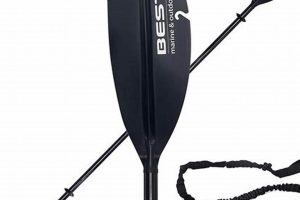
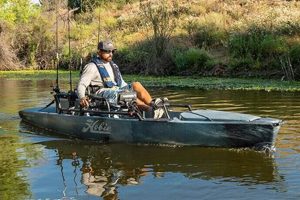
A specialized tool designed for propelling and maneuvering small watercraft in angling contexts, this equipment typically features a double-bladed design, often with a shorter shaft than recreational paddles, facilitating efficient movement and casting. Features like drip rings and lightweight construction are common. Specialized blades might be asymmetrical or feathered to reduce wind resistance and improve performance in various water conditions. Some models integrate features like hooks for retrieving lures or measuring fish.
This equipment plays a vital role in the sport of angling from small, human-powered vessels. It offers quiet propulsion, allowing anglers to approach fish stealthily without disturbing the water. The compact size and specialized design contribute to maneuverability in tight spaces, such as shallows, weed beds, and areas with submerged obstacles. Its evolution reflects the growing popularity and specialization of this type of angling, with advancements in materials and design enhancing efficiency and performance.
The following sections will delve deeper into specific aspects of this essential piece of angling equipment, exploring topics such as selecting the right design, proper paddling techniques, maintenance and care, and the latest innovations in design and technology.
Tips for Effective Paddle Use
Optimizing paddle selection and technique enhances angling efficiency and enjoyment. Consider these practical tips for improved performance and reduced strain.
Tip 1: Blade Shape Matters: Choose a blade shape based on paddling style and water conditions. High-angle blades offer powerful strokes for short distances and quick maneuvers, while low-angle blades suit longer distances and calmer waters.
Tip 2: Proper Shaft Length is Crucial: Selecting an appropriate shaft length ensures efficient paddling and reduces strain. Factors like kayak width, angler height, and paddling style influence this choice.
Tip 3: Feathering Improves Efficiency: Offset blades, or feathered paddles, reduce wind resistance and improve tracking, especially in windy conditions. Experiment with feather angles to find optimal performance.
Tip 4: Drip Rings Minimize Water Entry: Drip rings prevent water from running down the shaft onto the angler, keeping hands drier and warmer, especially in colder climates.
Tip 5: Employ Efficient Paddling Techniques: Engage core muscles for power and minimize arm strain. High-angle strokes prioritize power, while low-angle strokes are better for endurance.
Tip 6: Regular Maintenance Prolongs Lifespan: Rinse the paddle with fresh water after each use to remove salt and grime. Periodically inspect for wear and tear, addressing any issues promptly.
Tip 7: Consider a Lightweight Construction: Lighter paddles reduce fatigue, especially during extended outings. Materials like carbon fiber and fiberglass offer a balance of strength and light weight.
By implementing these strategies, anglers can enhance their on-the-water experience, improving efficiency, comfort, and overall success.
This understanding of paddle selection, technique, and care lays the foundation for maximizing performance and enjoyment while angling.
1. Material

Paddle material significantly influences performance, durability, and cost. Selecting the appropriate material depends on individual paddling style, budget, and intended use. An understanding of the properties of various paddle materials is essential for informed decision-making.
- Aluminum
Aluminum offers a balance of affordability and durability. Resistant to corrosion and impacts, it serves as a reliable option for recreational use. However, aluminum paddles tend to be heavier than other materials, potentially leading to fatigue during extended paddling sessions.
- Fiberglass
Fiberglass offers a lighter weight and improved performance compared to aluminum. Its inherent flexibility provides a smoother paddling experience by absorbing some of the impact from each stroke. Fiberglass also offers good durability, though it can be more susceptible to scratches and chips than other premium materials.
- Carbon Fiber
Carbon fiber represents the premium option, offering the lightest weight and highest performance. Its stiffness transmits power efficiently, resulting in faster paddling with less effort. While generally durable, carbon fiber is more susceptible to damage from impacts than aluminum or fiberglass, and typically comes at a higher cost.
- Plastic/Composite
Plastic and composite paddles offer an economical entry point. While generally heavier and less efficient than other materials, they provide sufficient functionality for casual use. Durability varies depending on the specific composite blend, and these paddles are often best suited for calm, protected waters.
The choice of paddle material directly impacts the overall angling experience. Careful consideration of factors like budget, performance requirements, and intended use ensures selection of the most appropriate material for optimal on-the-water efficiency and enjoyment.
2. Length

Paddle length significantly impacts paddling efficiency and comfort. An incorrectly sized paddle can lead to fatigue, reduced performance, and potential strain. Several factors influence optimal paddle length, including kayak width, angler height, and paddling style. Wider kayaks require longer paddles for effective reach, while taller anglers generally benefit from increased paddle length. High-angle paddlers, often found in whitewater or surf environments, typically utilize shorter paddles for quick, powerful strokes. Conversely, low-angle paddlers, commonly encountered in touring or recreational settings, prefer longer paddles for efficient, sustained paddling.
For example, a shorter paddle might be suitable for an angler in a narrow kayak fishing in tight quarters, allowing for quick maneuvering and precise strokes. In contrast, an angler fishing in open water from a wider, more stable platform would likely benefit from a longer paddle to maximize reach and maintain efficient paddling over longer distances. Consider a hypothetical scenario: two anglers of similar height, one fishing from a sit-on-top kayak and the other from a sit-inside kayak. The angler in the sit-on-top, which typically sits higher above the waterline, will generally require a longer paddle compared to the angler in the lower-sitting sit-inside kayak.
Understanding the relationship between paddle length and these influencing factors allows for informed decisions during paddle selection. Appropriate paddle length translates to improved paddling efficiency, reduced strain, and enhanced comfort on the water, ultimately contributing to a more enjoyable and successful angling experience. Failure to select the correct length can negatively impact performance and lead to discomfort or even injury. Consult sizing charts and consider individual paddling style and kayak dimensions to determine the optimal paddle length. This understanding empowers anglers to choose equipment best suited to their specific needs and maximize their on-the-water performance.
3. Blade Shape

Blade shape significantly influences a kayak fishing paddle’s performance characteristics. Selecting an appropriate blade design depends on factors such as intended use, paddling style, and water conditions. Understanding the nuances of various blade shapes empowers informed decision-making and optimizes on-the-water efficiency.
- High-Angle Blades
High-angle blades, characterized by a shorter, wider profile and more aggressive curvature, excel in delivering powerful strokes for short distances and quick maneuvers. These blades are well-suited for situations requiring rapid acceleration and precise control, such as navigating tight fishing spots or maneuvering in currents. The increased surface area provides substantial power, but can lead to fatigue over longer distances.
- Low-Angle Blades
Low-angle blades, typically longer and narrower with a less pronounced curvature, prioritize efficiency over raw power. These blades are designed for sustained paddling over longer distances and calmer water conditions. They require less effort per stroke and minimize fatigue, making them suitable for extended fishing trips or touring. However, they may lack the immediate acceleration offered by high-angle blades.
- Asymmetrical Blades
Asymmetrical blades feature a non-uniform shape designed to reduce flutter and improve tracking. The uneven curvature creates a smoother, more stable stroke by reducing the tendency of the blade to twist during the paddling cycle. This design enhances paddling efficiency and control, particularly in windy conditions.
- Feathered Blades
Feathered blades, offset at an angle relative to each other, minimize wind resistance on the blade not submerged in the water. This offset reduces windage and improves tracking, especially beneficial in crosswinds. The degree of feathering is often adjustable, allowing paddlers to customize the angle based on individual preference and wind conditions.
Blade shape considerations are integral to selecting an effective kayak fishing paddle. The choice between high-angle and low-angle designs, asymmetrical profiles, and feathered configurations depends on individual paddling styles, intended use, and environmental factors. A thorough understanding of these design elements allows anglers to optimize paddle selection for enhanced performance, reduced fatigue, and increased enjoyment on the water. Matching blade shape to specific needs and conditions directly influences paddling efficiency and contributes to a more successful and satisfying angling experience.
4. Feather Angle

Feather angle, the offset between the blades of a kayak fishing paddle, plays a crucial role in paddling efficiency and comfort. This angle reduces wind resistance on the blade out of the water, minimizing flutter and improving tracking, particularly in windy conditions. A higher feather angle presents a smaller surface area to the wind, lessening the impact of gusts and allowing for more consistent paddling strokes. Conversely, a lower feather angle, or no feathering at all, may be preferable in calm conditions where wind resistance is less of a factor.
Consider a scenario where an angler is paddling into a strong headwind. A higher feather angle, perhaps 45 degrees, would significantly reduce the force of the wind against the raised blade, allowing for smoother, more controlled strokes and minimizing fatigue. Conversely, on a calm day, a lower feather angle, around 15 degrees, or an unfeathered paddle might be more comfortable and efficient. Some paddlers prefer no feathering for maneuvering in tight spaces, as it allows for quicker blade adjustments and more precise control. The optimal feather angle is often a matter of personal preference and depends on individual paddling style and prevailing conditions. Experimentation is key to finding the most comfortable and effective feather angle for a given environment.
Understanding the impact of feather angle allows anglers to optimize paddle performance and adapt to varying wind conditions. Adjustable feathering systems offer flexibility, allowing on-the-water adjustments to match prevailing conditions and individual preferences. This adaptability contributes significantly to paddling efficiency, comfort, and overall enjoyment on the water. Selecting and adjusting feather angle appropriately enhances control, reduces fatigue, and promotes a more positive angling experience. Ignoring feather angle altogether can lead to decreased performance, increased effort, and potentially discomfort, especially in challenging wind conditions.
5. Weight

Paddle weight significantly influences paddling efficiency and fatigue levels, particularly during extended fishing trips. A lighter paddle requires less exertion per stroke, conserving energy and reducing strain on joints and muscles. This is especially crucial for kayak anglers who often spend hours paddling and maneuvering their vessels. Understanding the impact of paddle weight enables informed decisions and contributes to a more comfortable and enjoyable on-the-water experience.
- Reduced Fatigue
A lighter paddle minimizes fatigue, allowing for longer paddling sessions with less exertion. This is particularly beneficial during extended fishing trips or when navigating challenging waters. Reduced fatigue allows anglers to focus on fishing rather than battling exhaustion, maximizing enjoyment and potentially increasing success.
- Enhanced Performance
Lighter paddles facilitate quicker strokes and more efficient maneuvering. This enhanced responsiveness is advantageous when navigating tight spots, pursuing fish, or making quick adjustments in changing conditions. Improved paddle control contributes to overall angling effectiveness.
- Material Influence
Paddle weight is directly related to the materials used in its construction. Lighter materials, such as carbon fiber, offer significant weight reductions compared to heavier materials like aluminum. However, lighter materials often come at a higher cost, requiring anglers to balance weight savings against budget constraints.
- Overall Comfort
A lighter paddle reduces stress on joints and muscles, improving overall comfort and reducing the risk of strain or injury. This is especially important for anglers with pre-existing conditions or those who spend long hours on the water. Enhanced comfort contributes to a more enjoyable and sustainable angling experience.
The weight of a kayak fishing paddle is a critical factor influencing performance, comfort, and overall angling experience. Selecting a paddle of appropriate weight, considering factors like materials, intended use, and individual physical capabilities, directly impacts on-the-water efficiency and enjoyment. Investing in a lighter paddle can significantly enhance performance, reduce fatigue, and contribute to a more comfortable and ultimately more successful fishing experience. Conversely, neglecting paddle weight can lead to unnecessary exertion, discomfort, and potentially diminished angling effectiveness.
6. Durability
A kayak fishing paddle’s durability directly impacts its lifespan and long-term performance. Exposure to various environmental factors, including saltwater, UV radiation, and potential impacts, necessitates a robust construction. Evaluating paddle durability requires consideration of materials, construction techniques, and intended usage. A durable paddle ensures reliable performance over extended periods, minimizing the need for replacements and contributing to a consistent angling experience.
- Material Strength
Material choice plays a pivotal role in paddle durability. Aluminum offers excellent resistance to impacts and corrosion, making it suitable for harsh environments. Fiberglass provides a balance of strength and flexibility, while carbon fiber offers exceptional strength-to-weight performance but can be more susceptible to damage from direct impacts. Material strength dictates the paddle’s ability to withstand regular use, accidental drops, and contact with underwater obstacles.
- Construction Quality
Construction techniques influence a paddle’s ability to resist wear and tear. Robust bonding between blade and shaft, reinforced joints, and quality hardware contribute to overall structural integrity. Examining the construction details, such as the type of adhesive used and the presence of reinforcements, provides insights into the paddle’s long-term durability. A well-constructed paddle resists delamination, cracking, and loosening of components, ensuring sustained performance over time.
- Usage Environment
The intended paddling environment significantly impacts durability requirements. Paddles used in harsh saltwater environments require greater corrosion resistance than those used exclusively in freshwater. Similarly, paddles frequently used in rocky or shallow areas benefit from increased impact resistance. Aligning paddle construction with the intended environment ensures optimal durability and long-term performance.
- Maintenance and Care
Proper maintenance contributes significantly to paddle longevity. Rinsing the paddle with fresh water after each use removes salt and grime, minimizing corrosion and material degradation. Regular inspection for damage, addressing any issues promptly, further extends lifespan. Diligent care preserves the paddle’s structural integrity and performance characteristics, maximizing its usable life.
A durable kayak fishing paddle is an essential investment, ensuring reliable performance and long-term value. Considering factors like material strength, construction quality, intended usage environment, and maintenance practices allows anglers to select a paddle that withstands the rigors of regular use and provides consistent performance over extended periods. Prioritizing durability minimizes the need for frequent replacements, reduces long-term costs, and contributes to a more enjoyable and productive angling experience. A well-maintained, durable paddle becomes a reliable companion on the water, supporting countless fishing adventures.
Frequently Asked Questions
This section addresses common inquiries regarding kayak fishing paddles, providing concise and informative responses to facilitate informed decision-making and enhance understanding.
Question 1: How does paddle length affect performance?
Paddle length significantly influences paddling efficiency and comfort. An appropriately sized paddle maximizes reach and minimizes strain, while an incorrect length can lead to fatigue and reduced performance. Kayak width, angler height, and paddling style are key factors determining optimal paddle length.
Question 2: What are the advantages of a feathered paddle?
Feathered paddles reduce wind resistance on the blade not submerged in the water, improving tracking and minimizing flutter, particularly in windy conditions. The degree of feathering can often be adjusted to suit individual preferences and varying wind conditions.
Question 3: Which paddle material is best suited for saltwater environments?
Aluminum and fiberglass offer good corrosion resistance in saltwater environments. While carbon fiber provides superior performance characteristics, it requires more diligent care to prevent saltwater damage. Proper rinsing and maintenance are essential for any paddle material used in saltwater.
Question 4: How does blade shape impact paddling style?
Blade shape influences paddling efficiency and power delivery. High-angle blades are suited for short, powerful strokes and quick maneuvers, while low-angle blades prioritize efficiency for sustained paddling over longer distances. Asymmetrical blades enhance tracking and reduce flutter.
Question 5: What are the benefits of a lightweight paddle?
Lightweight paddles reduce fatigue and enhance responsiveness, allowing for quicker strokes and more efficient maneuvering. This is particularly advantageous during long paddling sessions and when navigating challenging waters. Reduced weight minimizes strain on joints and muscles, enhancing overall comfort.
Question 6: How should a kayak fishing paddle be maintained?
Regular maintenance prolongs paddle lifespan and preserves performance. Rinsing with fresh water after each use removes salt and grime, minimizing corrosion. Periodic inspection for wear and tear, addressing any issues promptly, further contributes to paddle longevity. Proper storage in a cool, dry place prevents damage and maintains material integrity.
Understanding these key aspects of kayak fishing paddles empowers informed choices, enhancing on-the-water performance, comfort, and overall enjoyment. Selecting the right paddle contributes significantly to a more successful and satisfying angling experience.
The following section explores advanced paddling techniques and strategies for maximizing efficiency and maneuverability on the water.
Conclusion
This exploration has highlighted the critical role the specialized paddle plays in kayak angling. From material selection and length considerations to blade shape and feather angle adjustments, each aspect contributes significantly to on-the-water performance, efficiency, and comfort. Understanding the interplay of these elements empowers informed decisions, enabling anglers to choose equipment optimized for individual needs and paddling styles. Durability and proper maintenance ensure long-term reliability and consistent performance, maximizing the value of this essential piece of angling equipment.
Effective paddle selection and utilization are integral components of successful kayak angling. A thoughtfully chosen paddle, combined with proper paddling technique, elevates the angling experience, transforming a simple means of propulsion into a tool for enhanced maneuverability, reduced fatigue, and increased enjoyment on the water. As kayak angling continues to evolve, advancements in paddle design and technology promise further enhancements in performance and efficiency, solidifying its crucial role in this dynamic and demanding sport.