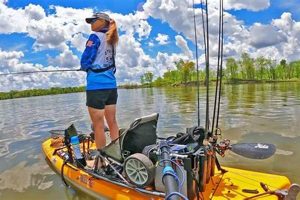
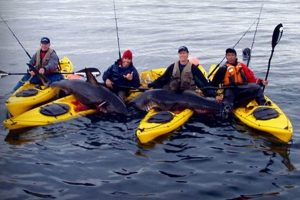
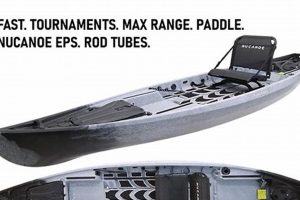
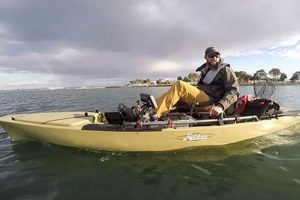
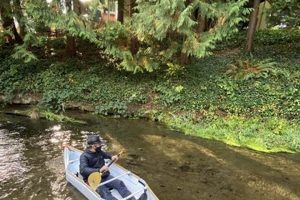
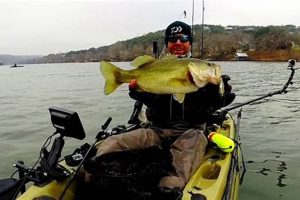
This specific range of recreational watercraft is designed for angling, combining stability, maneuverability, and specialized features. These vessels typically feature a V-shaped hull design, contributing to improved tracking and performance in various water conditions. Common features include rod holders, storage compartments for tackle and gear, and comfortable seating arrangements designed for extended fishing trips. Some models may also incorporate advanced features like pedal-powered propulsion systems or integrated fish finders.
The popularity of this category of watercraft stems from the increasing demand for stable, versatile, and feature-rich platforms for fishing. The combination of a stable hull design and specialized features allows anglers to access diverse fishing locations, from calm lakes and ponds to slow-moving rivers and coastal waters. This style of fishing kayak provides a unique blend of stability and performance, offering anglers a comfortable and efficient way to pursue their passion. The evolution of kayak design has led to these highly specialized vessels, catering to the specific needs and demands of fishing enthusiasts.
The following sections will delve deeper into specific aspects of these kayaks, covering topics such as construction materials, hull design variations, available features and accessories, and comparisons with other types of fishing kayaks. This detailed examination will provide prospective buyers with the necessary information to make informed decisions.
Tips for Kayak Fishing
Proper preparation and technique enhance safety and fishing success. These guidelines offer valuable insights for anglers of all skill levels.
Tip 1: Understand Water Conditions: Prior to launch, thoroughly assess weather forecasts, currents, and tides. Wind and water conditions significantly impact kayak control and angler safety.
Tip 2: Proper Gear Selection: Choose appropriate rods, reels, and tackle based on target fish species and fishing location. Lightweight and compact gear is ideal for kayak fishing.
Tip 3: Effective Kayak Positioning: Utilize anchor systems or drift socks to maintain optimal positioning in desired fishing areas. Proper positioning maximizes fishing efficiency.
Tip 4: Safety First: Always wear a personal flotation device (PFD). Carry essential safety equipment including a whistle, signaling device, and first-aid kit.
Tip 5: Efficient Paddle Strokes: Learn and practice efficient paddling techniques to conserve energy and navigate effectively. Proper paddling minimizes fatigue and improves maneuverability.
Tip 6: Fish Handling Techniques: Utilize appropriate fish handling practices to minimize stress on the fish and ensure safe release. Proper handling promotes conservation.
Tip 7: Respect Wildlife and the Environment: Practice Leave No Trace principles. Pack out all trash and minimize disturbance to natural habitats.
Adhering to these guidelines ensures a safe and productive experience, allowing anglers to fully enjoy the advantages of kayak fishing. These practical tips contribute to a more rewarding and responsible approach to the sport.
The concluding section offers a summary of key takeaways and reinforces the importance of responsible kayak fishing practices.
1. Stability

Stability is a critical factor influencing the performance and safety of a fishing kayak. For the Glide V series, stability plays a pivotal role in enabling anglers to cast, reel, and land fish effectively while maintaining balance and control in various water conditions. This section explores the key facets contributing to stability in these kayaks.
- Hull Design:
The V-shaped hull contributes significantly to primary stability, resisting initial tipping. This design provides a wider base compared to flatter hulls, enhancing balance. The deep keel aids in tracking, minimizing lateral movement and improving stability in windy conditions. In contrast, flatter hulls, while offering superior secondary stability (resistance to capsizing after initial tipping), might compromise initial stability, making activities like standing and casting more challenging. The V-hull balances initial stability with maneuverability.
- Width and Length:
The width of the kayak directly impacts stability. Wider kayaks provide more initial stability, making them less prone to tipping. Length also plays a role, with longer kayaks generally tracking straighter and offering more resistance to turning. The Glide V series balances width and length to achieve optimal stability without sacrificing maneuverability. Shorter, wider kayaks offer greater stability but may be slower, whereas longer, narrower kayaks sacrifice stability for speed.
- Center of Gravity:
A lower center of gravity enhances stability. The design of the Glide V series, including seating position and weight distribution, aims to keep the center of gravity low. Loading gear properly and evenly further contributes to stability. Placing heavier items closer to the center and bottom of the kayak helps maintain a low center of gravity, minimizing the risk of tipping. High seating positions raise the center of gravity, making the kayak less stable.
- Water Conditions:
While the kayak’s design plays a crucial role, prevailing water conditions significantly influence stability. Calm water provides optimal stability, while wind, waves, and currents present challenges. Understanding how the Glide V series performs in various conditions is vital for angler safety and efficient fishing. For instance, the V-hull design excels in cutting through chop and maintaining stability in moderate wind compared to flatter hulls, which can be more susceptible to wind drift.
These factors combine to determine the overall stability of the Glide V series fishing kayak. The interplay of hull design, dimensions, center of gravity, and consideration of water conditions all contribute to creating a platform that balances stability with performance. This allows anglers to confidently focus on fishing while maintaining a safe and balanced position on the water.
2. Maneuverability

Maneuverability is a crucial performance attribute, directly influencing the effectiveness and enjoyment of kayak fishing. For the Glide V series, maneuverability translates to the ability to navigate tight spots, swiftly change directions, and efficiently position the vessel for optimal casting angles. This capability is essential for accessing shallow coves, navigating around obstacles like fallen trees or rocks, and adjusting to changing currents or wind conditions.
Several design elements contribute to the maneuverability of these kayaks. The V-shaped hull, while providing stability, also allows for responsive turning. The length and width of the kayak influence turning radius and responsiveness. Shorter kayaks generally turn more quickly, while longer kayaks track straighter. The Glide V series balances these dimensions to provide a blend of maneuverability and stability. Features like rudders or skegs can further enhance directional control, particularly in windy or current-prone environments. For example, navigating a narrow, winding creek necessitates a kayak with a tight turning radius, a capability facilitated by the hull design and potentially enhanced by a rudder. Conversely, open-water fishing may prioritize straight-line tracking over quick turning. The design of the Glide V series considers these diverse scenarios, seeking to provide versatile performance.
Understanding the maneuverability characteristics of the Glide V series is crucial for anglers. Matching kayak maneuverability to specific fishing environments and techniques optimizes fishing effectiveness. Knowing how the kayak responds to paddle strokes, rudder adjustments, and external forces like wind and current allows anglers to position themselves precisely and confidently. This knowledge translates to a more efficient and enjoyable fishing experience, empowering anglers to access desired locations and react effectively to changing conditions. Consideration of maneuverability during the kayak selection process is essential for ensuring compatibility with individual fishing styles and target environments.
3. Fishing Features
Specialized features distinguish fishing kayaks from recreational models. The Glide V series integrates several key elements designed to enhance angling effectiveness and convenience. Rod holders, strategically placed for easy access and secure rod storage, are a standard feature. These often include adjustable angles and configurations to accommodate diverse fishing techniques. Integrated tackle storage compartments keep essential gear organized and within reach, minimizing clutter and maximizing fishing time. These compartments are typically designed with water resistance and secure closures to protect gear from the elements. Built-in storage wells or tank wells provide ample space for larger items like tackle boxes, coolers, or even live bait containers. Further enhancements might include paddle parks or leashes to secure paddles when not in use, freeing hands for fishing. For example, a dedicated space for a fish finder transducer and wiring facilitates seamless integration of electronics, crucial for locating fish and understanding underwater structures. The availability of these features transforms the kayak into a dedicated fishing platform.
The presence and design of these features directly impact fishing success and overall experience. Efficiently organized tackle storage allows anglers to quickly switch lures or rigs, adapting to changing fish behavior or water conditions. Secure rod holders prevent rod loss and facilitate hands-free operation during critical moments like landing a fish. Ample storage space for larger items reduces clutter and ensures essential gear is readily accessible. The integration of these specialized features minimizes distractions and maximizes fishing time, contributing directly to a more productive and enjoyable outing. For instance, an angler targeting different species at varying depths can quickly switch between pre-rigged rods stored securely in designated holders, maximizing fishing efficiency without the need to constantly re-rig lines. This streamlined approach, facilitated by integrated fishing features, enhances the angling experience and improves the chances of success.
Careful consideration of fishing features is paramount when selecting a fishing kayak. The specific features offered by the Glide V series cater to the needs of anglers, providing a dedicated and efficient platform for pursuing their passion. The integration of these features highlights the purpose-built nature of the kayak, distinguishing it from recreational models and reinforcing its value as a specialized fishing tool. The inclusion of these features signifies a design philosophy centered around the angler’s needs, optimizing both functionality and enjoyment on the water. Evaluating these features alongside other key aspects like stability, maneuverability, and hull design allows for informed decisions aligned with individual fishing styles and preferences.
4. V-hull Design

The V-hull design is a defining characteristic of the Glide V series fishing kayaks, significantly influencing performance characteristics and suitability for specific water conditions. Understanding the implications of this hull design is crucial for informed selection and optimal utilization of these specialized watercraft. The following facets explore the key aspects of the V-hull design in the context of the Glide V series.
- Tracking and Stability:
The V-shaped hull promotes straight-line tracking, especially beneficial in currents or wind. The sharp entry point of the hull cuts through water efficiently, minimizing lateral drift and maintaining directional stability. This characteristic is crucial for covering distances effectively and maintaining desired courses in challenging conditions. While the V-shape enhances tracking, it can also influence initial stability. Compared to flatter hulls, V-hulls may feel less stable initially, requiring a period of adjustment for anglers accustomed to wider, flatter platforms. However, the V-hull design offers superior performance in choppy water, maintaining course and minimizing rocking compared to flatter hull designs which are more susceptible to wind and wave influence.
- Performance in Various Water Conditions:
V-hulls excel in a variety of conditions, from calm lakes to moderately choppy coastal waters. The sharp entry point allows the kayak to slice through waves and chop, minimizing impact and maintaining a smoother ride. This versatility makes the Glide V series suitable for diverse fishing environments, expanding angling opportunities. In contrast, flatter hulls, while stable on calm water, can be more challenging to control in rougher conditions, potentially impacting paddling efficiency and angler comfort. The V-hull’s performance characteristics extend the usable range of the kayak, providing a reliable platform in varying water conditions.
- Speed and Efficiency:
The V-hull design contributes to efficient paddling and increased speed compared to flatter hull designs. The reduced water resistance at the bow allows for easier forward movement with each paddle stroke. This efficiency is crucial for covering longer distances and reaching fishing spots quickly. While not as fast as specialized racing kayaks, the Glide V series balances speed with stability, providing an efficient platform for fishing. Flatter hulls, while stable, often create more drag, requiring greater effort to achieve similar speeds. The V-hull’s streamlined design optimizes paddling efficiency, conserving energy and maximizing fishing time.
- Draft and Access:
The V-hull generally draws less water than flatter hulls, enabling access to shallower areas. This is advantageous for fishing close to shorelines, navigating shallow creeks or rivers, and reaching areas inaccessible to deeper-draft vessels. The reduced draft also contributes to maneuverability in tight spaces, allowing for precise navigation around obstacles. While flatter hulls provide greater displacement and load-carrying capacity, the V-hull prioritizes access and maneuverability in shallow environments, expanding fishing opportunities. This characteristic is particularly valuable in environments where navigating shallows or accessing tight spots is crucial for reaching prime fishing locations.
The V-hull design significantly impacts the Glide V series fishing kayak’s performance. The interplay of tracking, stability, speed, efficiency, and draft influences suitability for various water conditions and fishing styles. Understanding these characteristics enables informed selection and optimal use of these specialized kayaks. By combining the benefits of a V-hull with fishing-specific features, the Glide V series provides a versatile and efficient platform for anglers seeking to maximize their on-the-water experience. The V-hull design, in essence, contributes to a well-rounded fishing platform capable of handling diverse environments and angler demands.
5. Targeted Use

The Glide V series kayaks are purpose-built for fishing, differentiating them from recreational or touring kayaks. This targeted design philosophy influences every aspect of their construction and feature set. Cause and effect are directly linked: the need for a stable, efficient, and feature-rich fishing platform drives the design choices. For instance, the inclusion of rod holders, tackle storage, and often a transducer mount directly results from the intended use case: fishing. Without this targeted design, the kayak would likely resemble a more generic recreational model lacking specialized features. Consider a scenario where an angler needs to quickly adjust lure depth based on fish finder readings. A readily accessible tackle storage compartment, a direct consequence of targeted design, allows for efficient lure changes, maximizing fishing time and potential success. This targeted design is crucial, enhancing the kayak’s effectiveness as a fishing tool.
The importance of “targeted use” as a component of the Glide V series cannot be overstated. It transforms a simple vessel into a specialized fishing platform. Practical implications are substantial. Anglers benefit from increased efficiency, enhanced comfort, and improved fishing success. Consider navigating through dense vegetation in shallow water. A kayak designed for fishing might offer a shallower draft and superior maneuverability compared to a recreational model, enabling access to prime fishing spots. Similarly, integrated rod holders allow anglers to troll multiple lines or quickly switch techniques, maximizing opportunities. These practical advantages underscore the value of targeted design. Failure to consider targeted use during kayak selection could lead to a mismatch between angler needs and kayak capabilities, hindering fishing effectiveness and overall enjoyment.
In summary, the targeted design of the Glide V series for fishing directly influences its features, performance characteristics, and overall effectiveness. Understanding this connection is crucial for informed purchasing decisions. Recognizing the practical significance of targeted design empowers anglers to select the appropriate kayak for their specific needs and fishing style, ultimately maximizing their on-the-water experience and success. Choosing a kayak designed for the intended purposefishingensures a platform optimized for efficiency, comfort, and ultimately, a more rewarding angling experience.
Frequently Asked Questions
This section addresses common inquiries regarding the Glide V series fishing kayaks, providing concise and informative responses to facilitate informed decision-making.
Question 1: What differentiates the Glide V series from other fishing kayaks?
The Glide V series distinguishes itself through a combination of features tailored specifically for angling. These typically include a V-shaped hull design for enhanced tracking and stability, integrated rod holders and tackle storage solutions, and comfortable seating arrangements designed for extended fishing trips. Specific models may offer additional features like pedal-powered propulsion or integrated fish finder compatibility.
Question 2: What water conditions are suitable for these kayaks?
Glide V series kayaks are generally suitable for a range of water conditions, from calm lakes and ponds to slow-moving rivers and protected coastal waters. The V-hull design contributes to stability and tracking in moderate chop or currents. However, extreme conditions like rough seas or fast-flowing rivers are generally not recommended.
Question 3: What weight capacity can these kayaks typically handle?
Weight capacity varies depending on the specific model within the Glide V series. It is crucial to consult manufacturer specifications for precise weight limits, which typically range from 300 to 500 pounds, encompassing angler weight, gear, and any additional cargo.
Question 4: What are the typical dimensions and weights of these kayaks?
Lengths typically range from 10 to 14 feet, while widths vary based on specific models. Weights range from 50 to 100 pounds. Detailed dimensions and weight specifications should be confirmed with the manufacturer for each individual model within the series.
Question 5: What materials are commonly used in their construction?
Common construction materials include high-density polyethylene (HDPE) and rotomolded plastic, selected for durability, impact resistance, and UV protection. Specific models might utilize other materials like fiberglass for enhanced performance characteristics.
Question 6: What maintenance is required for a Glide V series kayak?
Routine maintenance includes rinsing with fresh water after each use, especially after exposure to saltwater, and storing the kayak out of direct sunlight. Periodic inspections for damage and appropriate repairs are essential for maintaining performance and longevity.
Addressing these frequently asked questions provides clarity regarding key aspects of the Glide V series fishing kayaks. Consulting manufacturer specifications for individual models ensures access to the most accurate and up-to-date information for informed purchasing and ownership experiences.
The following section will explore advanced features and customization options available within the Glide V series.
Conclusion
This exploration of the Glide V series fishing kayaks has highlighted their specialized design, catering specifically to the needs of anglers. Key features, including the V-hull design, integrated fishing features, and focus on stability and maneuverability, contribute to a purpose-built fishing platform. The analysis of hull design, performance in various water conditions, and targeted use underscores the distinct advantages offered by this series. Understanding these attributes empowers informed decision-making for prospective buyers seeking a dedicated fishing kayak.
The Glide V series represents a significant step in the evolution of fishing kayak design. Its focus on angler-specific features and performance characteristics enhances fishing experiences and promotes efficient use of specialized equipment. Continued development in kayak design and technology promises further advancements in this specialized field, offering exciting prospects for the future of kayak fishing.