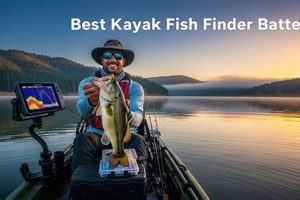
A small, human-powered watercraft designed for angling, often equipped with an electric motor for propulsion and electronic sonar for locating fish, represents a significant advancement in the sport of angling. This combination of features allows anglers to cover more water with less physical exertion and target fish with greater precision.
The integration of these technologies enhances angling efficiency and accessibility. Previously limited by physical stamina and the challenges of locating fish in vast bodies of water, anglers can now explore further reaches, conserve energy for fighting fish, and increase their chances of a successful catch. This evolution in fishing equipment contributes to a more productive and enjoyable experience on the water.
This article will explore the key components of this modern angling platform, including the types of kayaks best suited for this purpose, the selection and installation of appropriate motors, and the effective utilization of sonar technology for fish finding. Further discussion will cover relevant safety considerations, maintenance procedures, and responsible fishing practices.
Tips for Effective Kayak Fishing with Motor and Sonar
Optimizing the use of motorized kayaks equipped with sonar requires careful consideration of several factors. These tips offer guidance for enhancing angling success and overall experience.
Tip 1: Battery Management: Deep-cycle marine batteries are recommended for powering trolling motors. Monitor battery levels closely and avoid fully depleting the charge to prolong battery lifespan. Carrying a spare battery ensures uninterrupted fishing sessions.
Tip 2: Kayak Stability: Choose a kayak designed for stability, especially when using a trolling motor. Wider hulls and outriggers enhance stability, particularly important when standing to cast or reel in fish.
Tip 3: Sonar Interpretation: Learning to interpret sonar readings accurately is crucial for locating fish. Understanding how bottom structure, water depth, and temperature influence fish behavior maximizes the effectiveness of this technology.
Tip 4: Motor Mounting and Control: Securely mount the trolling motor to the kayak, ensuring proper wiring and control placement for easy access and maneuverability. Practice maneuvering the kayak with the motor before venturing into open water.
Tip 5: Safety Precautions: Always wear a personal flotation device (PFD) and carry essential safety gear, including a whistle, signaling device, and first-aid kit. Inform someone of fishing plans, including location and expected return time.
Tip 6: Navigation and Planning: Utilize charts, maps, or GPS devices to plan fishing routes and navigate safely. Be mindful of weather conditions and water currents, adjusting plans accordingly.
Tip 7: Respectful Angling Practices: Adhere to local fishing regulations and practice catch-and-release principles whenever possible to conserve fish populations and maintain sustainable fishing practices.
By adhering to these guidelines, anglers can enhance their on-the-water experience, improve their chances of success, and ensure a safe and enjoyable fishing trip.
These tips provide a foundation for successful kayak fishing with a motor and sonar. The following section will delve into specific techniques for targeting various fish species.
1. Kayak Selection
Kayak selection represents a critical first step in establishing an effective fishing platform incorporating a trolling motor and fish finder. Compatibility between the kayak and these technological components directly influences stability, performance, and overall fishing success. Choosing an unsuitable kayak can compromise stability, limit motor mounting options, and restrict effective sonar deployment. For example, a narrow, recreational kayak designed for calm waters lacks the stability required for operating a trolling motor, especially in windy or choppy conditions. Conversely, a wider, more stable fishing kayak with a dedicated transom or bow-mounted motor platform provides a secure foundation for both the motor and the transducer of the fish finder.
Several factors influence kayak selection within this context. Hull design plays a pivotal role in stability and tracking. Longer kayaks generally track straighter, beneficial when trolling, while shorter kayaks offer greater maneuverability in tight spaces. Wider kayaks offer increased stability, essential for standing and casting, but may sacrifice some maneuverability. Sit-on-top kayaks offer inherent buoyancy and self-bailing capabilities, advantageous in rougher water conditions. Weight capacity dictates the amount of gear, including batteries and fishing tackle, the kayak can safely carry. Material considerations influence durability and weight. For instance, a high-density polyethylene (HDPE) kayak offers robustness and affordability, while lighter, more expensive composite kayaks provide enhanced performance and maneuverability.
Appropriate kayak selection ensures seamless integration of the trolling motor and fish finder, optimizing performance and maximizing angling effectiveness. Careful consideration of hull design, weight capacity, and material characteristics enables informed decision-making, resulting in a stable, efficient, and productive fishing platform. Failure to prioritize these factors can lead to instability, reduced motor efficiency, and compromised sonar performance, hindering the overall fishing experience. Selecting a kayak specifically designed for fishing, with features such as built-in rod holders, gear tracks, and transducer mounts, further enhances practicality and streamlines the integration of electronic accessories.
2. Motor Integration

Motor integration represents a critical aspect of optimizing a fishing kayak equipped with a trolling motor and fish finder. Effective motor integration directly influences maneuverability, range, and overall fishing effectiveness. Properly integrating the motor ensures seamless propulsion, enhances boat control, and maximizes battery efficiency. Conversely, improper integration can lead to instability, reduced performance, and a compromised fishing experience.
- Motor Type and Mounting Location:
Trolling motors specifically designed for kayaks offer compact size and adjustable shaft lengths. Transom mounts provide simplicity and versatility, while bow mounts offer enhanced control and maneuverability, particularly in windy conditions. Selecting the appropriate motor and mount depends on kayak design, fishing style, and intended use. For example, a transom mount suits a sit-on-top kayak for general fishing, while a bow mount benefits a bass fishing kayak requiring precise boat positioning.
- Power and Thrust:
Motor power, measured in pounds of thrust, dictates speed and the ability to overcome wind and current. Higher thrust motors enable faster speeds and better performance in challenging conditions, but consume more battery power. Matching motor thrust to kayak size and intended fishing environment ensures optimal performance and range. For instance, a smaller kayak in calm waters might only require a lower thrust motor, while a larger kayak used in windy or tidal areas benefits from a higher thrust option.
- Wiring and Battery Connection:
Proper wiring ensures safe and efficient power delivery to the trolling motor. Marine-grade wiring, connectors, and circuit breakers protect against corrosion and electrical faults. Securely mounting and protecting the battery safeguards against movement and damage during operation. Using appropriately sized wiring and connectors minimizes voltage drop and maximizes motor performance. For example, using undersized wiring can lead to overheating and reduced motor efficiency.
- Motor Control and Steering:
Foot-controlled motors offer hands-free operation, advantageous for fishing. Hand-controlled motors provide precise control in tight spaces. Integrating the motor control system ergonomically enhances comfort and efficiency during extended fishing trips. Positioning the motor controls within easy reach allows for quick adjustments to speed and direction. For instance, foot controls allow anglers to maintain fishing rod control while adjusting the motor.
These facets of motor integration contribute significantly to the overall effectiveness of a fishing kayak equipped with a trolling motor and fish finder. Properly integrating the motor maximizes performance, enhances boat control, and extends fishing range. Careful consideration of motor type, mounting location, power, wiring, and control mechanisms ensures a seamless and productive fishing experience. Neglecting these factors can compromise stability, limit motor efficiency, and detract from the overall enjoyment of kayak fishing.
3. Fish Finder Technology
Fish finder technology represents a pivotal component within the integrated system of a fishing kayak equipped with a trolling motor. This technology provides anglers with crucial underwater insights, enhancing fish-finding capabilities and significantly improving angling success. Understanding the nuances of fish finder technology, including transducer types, display interpretations, and feature utilization, maximizes the effectiveness of this essential tool.
- Transducer Selection and Placement:
Transducers emit sonar signals that reflect off objects underwater, providing information about depth, bottom structure, and fish location. Different transducer types, such as transom-mount, thru-hull, and in-hull, offer varying performance characteristics. Selecting the appropriate transducer depends on kayak type, fishing style, and desired information detail. Proper transducer placement optimizes sonar performance and minimizes interference. For example, a transom-mount transducer provides convenient installation on most kayaks, while a thru-hull transducer offers enhanced performance at higher speeds, particularly in deeper water.
- Display Interpretation and Sonar Readings:
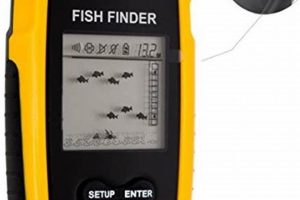
Fish finders display information graphically, representing depth, bottom contours, water temperature, and fish echoes. Interpreting these displays accurately requires understanding how different factors, such as water clarity and bottom composition, influence sonar readings. Recognizing fish arches, distinguishing between fish and structure, and interpreting bottom hardness contribute to effective fish identification and location. For example, a dense, arched shape on the display typically indicates a fish, while a scattered or irregular shape suggests vegetation or debris. Understanding the color palettes used to represent different bottom densities aids in identifying potential fishing hotspots.
- Utilizing Fish Finder Features:
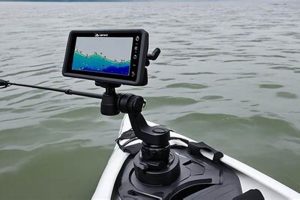
Modern fish finders offer advanced features, such as CHIRP sonar, down-imaging, and side-imaging, providing enhanced detail and clarity. CHIRP sonar utilizes multiple frequencies to create clearer images of fish and structure. Down-imaging provides a near-photographic view of the bottom directly beneath the kayak, aiding in identifying specific features. Side-imaging expands the view to either side of the kayak, revealing fish and structure beyond the traditional sonar cone. Effectively utilizing these features significantly improves the angler’s ability to locate and target fish. For instance, side-imaging reveals submerged logs or rock piles that might attract fish, while down-imaging allows anglers to distinguish between different fish species based on their size and shape.
- Integration with Trolling Motor and Kayak:
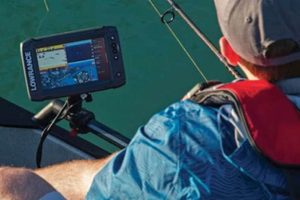
Seamless integration of the fish finder with the trolling motor and kayak enhances overall fishing efficiency. Mounting the transducer correctly minimizes interference from the motor and ensures accurate sonar readings. Connecting the fish finder to the kayak’s power supply provides consistent operation. Positioning the display unit within easy view allows for real-time monitoring of sonar data without compromising boat control. For example, mounting the fish finder display near the kayak’s cockpit provides convenient access to information while maintaining optimal paddling or motor control.
Effective utilization of fish finder technology within the context of a fishing kayak equipped with a trolling motor significantly enhances angling success. Understanding transducer selection, display interpretation, and advanced feature utilization empowers anglers to locate fish more efficiently and improve their overall catch rate. Integrating these technological elements seamlessly contributes to a more productive and informed fishing experience. For example, combining the information from the fish finder with the maneuverability offered by the trolling motor allows anglers to precisely target specific fish-holding locations identified on the sonar display, thereby increasing the likelihood of a successful catch.
4. Battery Management
Battery management constitutes a critical aspect of operating a fishing kayak equipped with a trolling motor and fish finder. These electronic devices rely on a stable power supply for optimal performance. Effective battery management ensures consistent power delivery, extends battery lifespan, and prevents premature failure, maximizing time on the water and minimizing disruptions to fishing activities.
- Battery Selection:
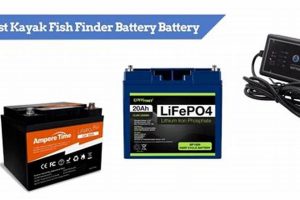
Deep-cycle marine batteries, specifically designed for sustained discharge, provide the optimal power source for trolling motors and fish finders. These batteries withstand repeated discharge and recharge cycles better than automotive batteries. Selecting the appropriate battery capacity (amp-hours) ensures sufficient power for extended fishing trips. For instance, a higher amp-hour rating provides longer run times, critical for all-day fishing excursions.
- Charging Practices:
Proper charging practices maximize battery lifespan and performance. Utilizing a marine-grade battery charger designed for deep-cycle batteries ensures efficient and safe charging. Avoiding overcharging or completely depleting the battery prolongs its useful life. Regularly checking battery electrolyte levels (for flooded lead-acid batteries) and maintaining proper ventilation during charging prevent damage and ensure safe operation. For example, using a trickle charger during the off-season maintains battery health and prevents sulfation.
- Power Consumption Management:
Efficient power consumption maximizes battery life during fishing trips. Operating the trolling motor at lower speeds conserves energy, extending run times. Minimizing fish finder usage when not actively searching for fish also conserves power. Turning off all electronic devices when not in use further extends battery life. For instance, reducing trolling motor speed when moving between fishing spots significantly conserves battery power.
- Battery Storage and Maintenance:
Proper battery storage during the off-season preserves battery health and extends its lifespan. Storing batteries in a cool, dry environment prevents damage from extreme temperatures and humidity. Disconnecting the battery from the trolling motor and fish finder prevents parasitic drains that can deplete the battery over time. Periodically charging stored batteries prevents complete discharge and maintains their capacity. For example, storing a fully charged battery in a cool, dry location prevents sulfation and maintains its capacity for the next fishing season.
Effective battery management directly impacts the functionality and reliability of a fishing kayak equipped with a trolling motor and fish finder. Proper battery selection, charging practices, power consumption management, and storage procedures ensure consistent power delivery, maximize battery life, and contribute to a more productive and enjoyable fishing experience. Neglecting these practices can lead to power failures, shortened battery lifespan, and disruptions to fishing trips. For example, consistent adherence to recommended charging practices can double or triple the lifespan of a deep-cycle marine battery, reducing long-term costs and ensuring reliable power for extended fishing adventures.
5. Safety Equipment

Safety equipment constitutes a non-negotiable aspect of operating a fishing kayak equipped with a trolling motor and fish finder. The inherent risks associated with on-water activities, amplified by the presence of electronic devices and potential navigation further from shore, necessitate meticulous attention to safety precautions. Overlooking safety equipment can lead to severe consequences, transforming a recreational outing into a life-threatening situation. A seemingly minor mishap, such as capsizing or encountering unexpected weather conditions, can escalate rapidly without appropriate safety measures in place.
Several key safety items warrant consideration. A personal flotation device (PFD), specifically designed for kayaking, represents the most crucial piece of safety equipment. A PFD provides essential buoyancy in the event of capsizing, preventing drowning, particularly in cold water or challenging conditions. A whistle, attached to the PFD, enables signaling for assistance in emergencies. A visual distress signal, such as a flare or signal mirror, further enhances visibility and aids in attracting attention. A first-aid kit, containing essential medical supplies, allows for immediate treatment of minor injuries or stabilization of more serious injuries until professional medical assistance arrives. Carrying a fully charged mobile phone or VHF radio enables communication with emergency services or shore contacts in case of distress. A bilge pump or bailing device aids in removing water from the kayak in the event of swamping or capsizing, enhancing stability and preventing sinking. Navigation lights, particularly when fishing in low-light conditions, enhance visibility to other boaters, reducing the risk of collisions.
Practical application of these safety measures hinges on consistent and informed usage. A PFD remains ineffective unless worn consistently throughout the fishing trip. Regularly inspecting safety equipment, such as flares and PFDs, for expiry dates and proper function ensures readiness in emergencies. Familiarization with the operation of communication devices, such as VHF radios, enables effective communication in distress situations. Understanding basic first-aid procedures allows for prompt and appropriate response to injuries. Checking weather forecasts before embarking on a fishing trip and continuously monitoring weather conditions while on the water allows for proactive adjustments to plans and avoidance of potentially hazardous situations. Informing someone of planned fishing locations and estimated return times provides an additional layer of safety, enabling timely assistance in case of unexpected delays or emergencies. Neglecting these precautions can transform a recreational fishing trip into a perilous situation, highlighting the critical importance of prioritizing safety equipment and practices when operating a fishing kayak equipped with a trolling motor and fish finder. The potential consequences of inadequate safety preparation underscore the imperative of integrating these measures into every fishing excursion.

Navigation tools play a crucial role in maximizing the effectiveness and safety of fishing kayaks equipped with trolling motors and fish finders. These tools facilitate efficient route planning, precise location tracking, and safe navigation, particularly in unfamiliar waters or challenging conditions. The integration of navigation tools with the enhanced mobility offered by trolling motors and the fish-finding capabilities of sonar technology creates a synergistic effect, enabling anglers to explore wider areas, locate productive fishing spots, and return safely to their launch points. Without reliable navigation, the advantages conferred by the motor and fish finder become significantly diminished, particularly in larger bodies of water or areas with complex shorelines. For instance, an angler relying solely on visual landmarks might easily become disoriented in foggy conditions or when navigating a maze of inlets and coves, even with a motor and fish finder. A GPS unit, however, provides accurate location information regardless of visibility, ensuring safe and efficient navigation.
Several types of navigation tools prove beneficial in this context. Chartplotters provide detailed maps, including water depths, navigational markers, and points of interest, allowing anglers to plan routes, identify potential fishing hotspots, and navigate safely around hazards. Handheld GPS units offer portability and backup navigation capabilities, crucial in case of electronic failures on the main fish finder unit. Mapping apps on smartphones or tablets provide convenient access to cartographic information, though their reliance on cellular service can limit their effectiveness in remote areas. Traditional compass and nautical charts, while less technologically advanced, offer a reliable backup navigation system independent of electronic power sources, providing a crucial safety net in case of battery failure or electronic malfunction. For example, if the fish finder’s internal GPS malfunctions, a handheld GPS unit or nautical chart and compass become essential for returning safely to shore. The integration of these navigation tools with the trolling motor and fish finder expands the angler’s effective fishing range, allowing exploration of more distant locations with confidence.
Effective navigation represents a critical component of responsible and successful kayak fishing with a trolling motor and fish finder. Accurate navigation enhances safety by reducing the risk of disorientation or becoming lost, particularly in challenging conditions. Precise location tracking enables anglers to return to productive fishing spots, maximizing catch rates and overall fishing success. Efficient route planning minimizes travel time and maximizes time spent fishing. The integration of these navigation tools with the enhanced mobility provided by the trolling motor and the fish-finding capabilities of sonar technology expands fishing opportunities and enhances overall on-the-water experience. Failure to prioritize navigation can compromise safety, limit fishing effectiveness, and detract from the enjoyment of the sport. Therefore, incorporating reliable navigation tools becomes essential for responsible and productive kayak fishing, transforming the kayak, motor, and fish finder from individual components into a cohesive and highly effective fishing platform.
7. Fishing Techniques
Fishing techniques employed from a kayak equipped with a trolling motor and fish finder differ significantly from those used in traditional boat fishing or shore angling. The kayak’s unique platform, combined with the enhanced mobility of the motor and the precision targeting offered by the fish finder, necessitates specific adaptations in angling methodologies. Effective kayak fishing techniques leverage these advantages to maximize catch potential while accounting for the kayak’s inherent limitations in size and stability. Understanding these specialized techniques is crucial for transforming the combined capabilities of the kayak, motor, and fish finder into a cohesive and highly productive fishing system.
- Trolling:
The trolling motor transforms the kayak into an effective trolling platform. Slow-trolling lures or bait at controlled speeds, guided by the fish finder’s identification of fish-holding structures or schools, allows for covering extensive water while precisely targeting specific areas. Variable speed control on the trolling motor facilitates adjustments to lure presentation and depth based on target species and environmental conditions. For example, trolling crankbaits along a submerged weed line identified on the fish finder allows for precise targeting of ambush-feeding predators.
- Drift Fishing:
The trolling motor aids in controlling drift speed and direction, optimizing bait presentation in moving water scenarios. The fish finder assists in identifying areas of concentrated fish activity along current breaks or drop-offs, enhancing the effectiveness of drift fishing techniques. Precise boat control facilitated by the motor allows for maintaining optimal position within the drift, maximizing exposure to target species. For example, using the trolling motor to maintain a slow drift over a submerged point identified on the fish finder allows for presenting bait to fish holding in the current.
- Spot Locking:
Advanced trolling motors equipped with GPS anchoring or “spot lock” functionality revolutionize kayak fishing. This feature allows anglers to maintain a stationary position over a specific location, even in wind or current. Combined with fish finder data, spot locking allows for precisely targeting identified fish or structure, such as a school of suspended crappie or a submerged wreck. This eliminates the need for constant adjustments to boat position, allowing anglers to focus on fishing techniques and optimizing lure presentation. For example, spot locking over a reef identified on the fish finder allows for repeated casts to fish holding within the structure.
- Casting and Jigging:
While the trolling motor and fish finder enhance mobility and fish-finding capabilities, traditional casting and jigging techniques remain essential for kayak anglers. The fish finder assists in locating promising areas for casting or jigging, such as points, drop-offs, or submerged vegetation beds. The trolling motor facilitates quick and efficient movement between these locations, maximizing fishing time and coverage. The kayak’s relatively low profile and quiet operation offer advantages for stealthy approaches to shallow-water fish. For example, identifying a school of baitfish on the fish finder, then quietly positioning the kayak with the trolling motor and casting topwater lures into the school represents an effective technique for targeting predatory fish.
Effective kayak fishing techniques integrate the capabilities of the trolling motor and fish finder with adapted angling methodologies specific to the kayak platform. Trolling, drift fishing, spot locking, and casting/jigging benefit significantly from the enhanced mobility, precise boat control, and targeted fish-finding capabilities offered by this integrated system. These techniques, combined with a stable and well-equipped kayak, transform the fishing experience, expanding access to productive fishing grounds, increasing catch potential, and enhancing overall enjoyment on the water. By understanding and implementing these specialized techniques, kayak anglers maximize the advantages offered by their equipment, transforming the kayak, motor, and fish finder into a cohesive and highly effective fishing system.
Frequently Asked Questions
This section addresses common inquiries regarding fishing kayaks equipped with trolling motors and fish finders. The information provided aims to clarify potential uncertainties and facilitate informed decision-making for anglers considering this specialized fishing platform.
Question 1: What type of kayak is best suited for a trolling motor and fish finder?
Kayaks designed specifically for fishing, featuring wider hulls, stable platforms, and built-in mounting points for accessories, offer optimal compatibility with trolling motors and fish finders. Sit-on-top kayaks are generally preferred for their stability and self-bailing capabilities.
Question 2: How much thrust is needed in a trolling motor for kayak fishing?
Required thrust depends on kayak size, anticipated fishing conditions (wind, current), and desired speed. Generally, 30 to 55 pounds of thrust suffice for most kayak fishing applications. Higher thrust provides increased speed and control in challenging conditions.
Question 3: What type of fish finder is recommended for kayak use?
Fish finders with CHIRP sonar technology offer enhanced clarity and target separation. GPS capabilities facilitate navigation and waypoint marking. Portable units or those designed for kayak mounting provide convenient installation and portability.
Question 4: What battery type and capacity are suitable for powering a trolling motor and fish finder?
Deep-cycle marine batteries, specifically designed for prolonged discharge, are recommended. Battery capacity (amp-hours) should align with anticipated motor usage and fish finder runtime. Higher capacity batteries provide longer run times.
Question 5: What safety precautions are essential when kayak fishing with a motor?
Always wear a personal flotation device (PFD). Carry a whistle, signaling device, and first-aid kit. Inform someone of fishing plans, including location and expected return time. Monitor weather conditions and adhere to safe boating practices.
Question 6: How does one maintain a fishing kayak equipped with a motor and fish finder?
Regularly rinse the kayak and motor with fresh water after each use to remove salt or debris. Inspect wiring connections for corrosion. Follow manufacturer recommendations for battery maintenance and storage. Periodically check fish finder transducer for damage or fouling.
Addressing these common questions provides a foundation for informed decisions regarding kayak selection, equipment integration, and safe operation. Careful consideration of these factors contributes significantly to a safe, productive, and enjoyable kayak fishing experience.
For further information on specific products, techniques, or regional regulations, consult local fishing authorities or specialized kayak fishing retailers.
Fishing Kayak with Trolling Motor and Fish Finder
Exploration of the fishing kayak equipped with a trolling motor and fish finder reveals a significant advancement in angling technology. Integration of these components offers enhanced mobility, precise fish targeting, and expanded access to productive fishing grounds. Careful consideration of kayak selection, motor integration, fish finder technology, battery management, safety equipment, navigation tools, and specialized fishing techniques contributes significantly to maximizing the effectiveness and enjoyment of this specialized fishing platform. Understanding the nuanced interplay of these elements empowers anglers to transform individual components into a cohesive and highly productive system.
The evolution of fishing kayak technology continues to refine the angling experience. Further advancements in motor efficiency, sonar clarity, and kayak design promise continued enhancement of on-the-water performance and angler success. Responsible utilization of these technologies, coupled with adherence to established safety practices and conservation principles, ensures the sustainable enjoyment of this evolving angling pursuit for generations to come. The future of kayak fishing, powered by innovation and guided by responsible stewardship, holds immense potential for enriching the connection between anglers and the aquatic environment.