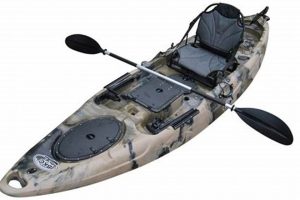
The pursuit of an affordable yet high-quality vessel for angling presents a common challenge for many. This requires careful consideration of various factors, including construction materials, features, and overall performance. A successful approach involves balancing cost-effectiveness with necessary functionality for a positive on-the-water experience. For instance, a basic sit-on-top model made from durable, lightweight plastic might suit a beginner on a budget, while a more experienced angler might prioritize features like rod holders, storage compartments, and advanced stability in a slightly higher price range.
Finding the right balance between price and performance allows greater access to the sport of fishing. It enables individuals to enjoy the outdoors and engage with nature without significant financial barriers. Historically, fishing kayaks were often expensive, limiting participation. However, advancements in manufacturing and materials have led to a wider range of options catering to different budgets, making the activity more inclusive. This increased accessibility promotes a healthier lifestyle and fosters appreciation for aquatic environments.
The following sections will explore essential factors to consider when seeking a budget-friendly, high-performing fishing kayak. These factors include hull design, materials, key features, and reputable brands, providing readers with a comprehensive guide for making an informed purchase decision.
Tips for Finding an Affordable, High-Quality Fishing Kayak
Acquiring a fishing kayak that excels in both affordability and performance requires careful consideration. The following tips offer guidance for navigating this process effectively.
Tip 1: Define Fishing Needs: Clarifying fishing style, target species, and typical water conditions informs appropriate kayak selection. River fishing necessitates different features than ocean fishing, influencing hull design and stability requirements.
Tip 2: Research Materials: Kayak construction materials impact durability, weight, and price. High-density polyethylene (HDPE) offers excellent value and durability, while lighter materials like fiberglass come at a premium.
Tip 3: Prioritize Features: Focus on essential features like rod holders, storage compartments, and comfortable seating. Prioritization prevents overspending on non-essential additions.
Tip 4: Consider Used Kayaks: Exploring the used market offers potential cost savings. Thoroughly inspect used kayaks for damage and ensure functionality before purchase.
Tip 5: Compare Brands and Models: Research various reputable brands and compare models within a desired price range. Online reviews and forums provide valuable insights from experienced users.
Tip 6: Factor in Accessories: Account for the cost of essential accessories such as paddles, life vests, and fish finders when budgeting. These can significantly add to the overall investment.
Tip 7: Think Long-Term Value: A slightly higher initial investment in a durable, well-equipped kayak may offer greater long-term value compared to a cheaper model requiring frequent repairs or upgrades.
By carefully considering these tips, individuals can make informed decisions and maximize their investment, leading to a rewarding and enjoyable fishing experience.
Equipped with these strategies, one can confidently proceed to the concluding recommendations.
1. Budget-friendly options

Affordability represents a primary concern for many seeking fishing kayaks. Budget-friendly options allow broader access to the sport without compromising essential functionality. Exploring these options requires careful consideration of several key facets to ensure value and performance.
- Material Selection
Material choice significantly influences cost. High-density polyethylene (HDPE) offers an excellent balance of durability and affordability, making it prevalent in budget-friendly kayaks. While other materials like fiberglass offer performance advantages, they typically command higher prices. Selecting HDPE allows manufacturers to offer robust, functional kayaks at accessible price points.
- Feature Prioritization
Distinguishing between essential and non-essential features helps manage costs. Prioritizing core features like rod holders, paddle clips, and basic storage compartments ensures functionality without the expense of premium additions like advanced electronics or specialized seating systems. This focused approach maximizes value within budget constraints.
- Manufacturing Processes
Manufacturing techniques impact production costs. Rotational molding, commonly used for HDPE kayaks, offers cost-effective production at scale. This process allows manufacturers to offer durable, well-equipped kayaks at competitive prices. Understanding these processes clarifies the relationship between manufacturing and affordability.
- Retail Strategies
Retailers employing direct-to-consumer models or online sales platforms often offer lower prices due to reduced overhead. Comparing prices across different retail channels can reveal significant savings. Savvy consumers can leverage these strategies to maximize their purchasing power.
Successfully navigating budget-friendly kayak options requires a balanced approach. Understanding material selection, feature prioritization, manufacturing processes, and retail strategies empowers consumers to make informed decisions aligning with both financial constraints and performance expectations, ultimately enhancing the accessibility and enjoyment of kayak fishing.
2. Sufficient Stability

Stability forms a cornerstone of a successful fishing kayak, particularly when affordability is a key consideration. A stable platform enables anglers to cast, reel, and land fish effectively, ensuring safety and enhancing the overall fishing experience. Compromised stability detracts significantly from functionality, even in the most budget-friendly options. This section explores key facets of stability as they relate to the pursuit of an affordable, high-performing fishing kayak.
- Hull Design
Hull design significantly influences stability. Wider hulls generally offer greater initial stability, resisting tipping during common fishing movements. Flat-bottomed hulls provide excellent primary stability, suitable for calm waters. However, they may be less maneuverable. Pontoon-style hulls, featuring multiple chambers beneath the waterline, offer exceptional stability, often found in budget-friendly fishing kayak designs. The trade-off between stability and maneuverability should be considered based on intended fishing environments.
- Center of Gravity
A lower center of gravity contributes to increased stability. Kayak design and weight distribution play crucial roles. Sit-on-top kayaks inherently have a lower center of gravity compared to sit-inside models, enhancing stability. Proper weight distribution within the kayak further optimizes balance. Positioning heavier items lower and centrally within the hull minimizes the risk of tipping, particularly important in budget-friendly kayaks often constructed from lighter materials.
- Kayak Width and Length
Wider kayaks generally offer more stability than narrower designs. A wider beam provides a larger base of support, resisting tipping forces. However, increased width can compromise maneuverability, especially in narrow waterways. Longer kayaks tend to track straighter but may be less responsive in turning. Balancing width and length within a budget requires careful consideration of intended fishing locations and individual paddling preferences.
- Secondary Stability
Secondary stability refers to a kayak’s ability to resist tipping at higher angles of lean. While primary stability is crucial for initial balance, secondary stability becomes vital when leaning to reach for a fish or paddle stroke. A kayak with good secondary stability inspires confidence, especially in challenging conditions. Evaluating secondary stability often involves research and reviews, as it is less readily apparent than primary stability in budget-friendly kayak options.
Finding an affordable, high-performing fishing kayak necessitates prioritizing sufficient stability. Understanding the interplay of hull design, center of gravity, dimensions, and secondary stability empowers consumers to select a kayak that balances cost-effectiveness with on-the-water performance and safety, maximizing enjoyment and angling success.
3. Essential Features

Balancing cost-effectiveness and functionality presents a central challenge when selecting a fishing kayak. Essential features directly impact on-the-water performance and angler comfort. Understanding these features and their implications allows for informed decision-making, optimizing the value proposition of a budget-friendly fishing kayak.
- Rod Holders
Rod holders are fundamental for hands-free fishing and safe rod storage. Flush-mounted rod holders offer a streamlined profile, minimizing interference with paddling. Adjustable rod holders provide versatility for different fishing techniques. Including multiple rod holders allows anglers to carry a variety of rods or switch techniques quickly. The presence and type of rod holders directly impact a kayak’s fishing functionality, even in budget-friendly models.
- Storage Compartments
Storage compartments are essential for carrying tackle, gear, and personal items. Dry storage compartments protect sensitive items from water damage. Larger storage wells accommodate bulky items like tackle boxes or coolers. Bungee cords provide additional storage options on deck for readily accessible items. Adequate storage enhances organization and efficiency on the water, making the most of limited space in budget-friendly kayaks.
- Seating Comfort and Adjustability
Seating comfort directly impacts fishing endurance. A well-designed seat reduces fatigue, allowing for longer fishing sessions. Adjustable seating systems accommodate different body types and preferences. Padding and back support enhance comfort and reduce strain. Prioritizing seating comfort contributes to a more positive overall fishing experience, particularly important for extended trips in budget-friendly kayaks that may lack premium seating features.
- Paddle Holders or Clips
Paddle holders or clips offer a secure and convenient way to store the paddle when not in use, freeing hands for fishing. This seemingly minor feature significantly enhances safety and efficiency. A readily accessible paddle prevents accidental loss and ensures quick maneuverability when needed, particularly important when fighting a fish or navigating challenging conditions in a budget-friendly kayak.
Selecting a “cheapest best fishing kayak” requires careful evaluation of essential features. Prioritizing rod holders, storage, seating comfort, and paddle management enhances functionality without significantly increasing cost. By focusing on these key elements, anglers can maximize their investment and enjoyment on the water, achieving a balance between affordability and essential performance characteristics.
4. Durable Construction

Durable construction represents a critical factor in the pursuit of a cost-effective, high-performing fishing kayak. Durability directly influences a kayak’s lifespan and resistance to damage from impacts, UV exposure, and general wear and tear. A durable kayak minimizes repair costs and replacement frequency, contributing significantly to long-term value. This factor becomes particularly relevant when seeking the “cheapest best” option, as initial cost savings can be quickly negated by frequent repairs or premature replacement. For example, a kayak constructed from high-density polyethylene (HDPE) might exhibit greater resistance to impact and abrasion compared to a less durable material, reducing the likelihood of punctures or cracks during normal use. This inherent durability translates to a longer lifespan, maximizing the return on investment.
The choice of construction materials and manufacturing processes directly impacts durability. Rotational molding, a common process for HDPE kayaks, produces a consistent, uniform hull with inherent strength. Reinforced areas, such as the keel and chines, further enhance resistance to impact and abrasion. UV stabilizers added during the manufacturing process protect against sun damage, preventing material degradation and extending the kayak’s functional life. Consideration of these factors allows for a comprehensive evaluation of durability. A kayak designed and constructed with durability in mind offers greater long-term value, aligning with the goal of finding the “cheapest best” option by minimizing future expenses and maximizing the usable lifespan of the product. Investing in a durable kayak, even at a slightly higher initial cost, often proves more economical in the long run compared to repeatedly replacing less durable, cheaper alternatives.
Prioritizing durable construction ensures long-term value and minimizes lifecycle costs, aligning with the core principle of finding the “cheapest best” fishing kayak. Evaluating construction materials, manufacturing processes, and features like UV resistance empowers informed purchasing decisions. This approach balances initial investment with long-term performance and cost-effectiveness, resulting in a durable and reliable fishing platform for years of enjoyment.
5. Suitable Size and Weight

Appropriate size and weight represent critical factors in the pursuit of a “cheapest best fishing kayak.” These dimensions directly influence transportability, maneuverability, and overall on-the-water performance. Balancing size and weight with budget constraints requires careful consideration of individual needs and intended usage scenarios. A kayak too large or heavy may prove difficult to transport and maneuver, negating the benefits of its affordability. Conversely, a kayak too small or light may lack the stability and storage capacity required for a successful fishing experience. Understanding the interplay of these factors is crucial for informed decision-making.
- Transportation Considerations
Transportation logistics significantly influence suitable kayak dimensions. Limited vehicle capacity or storage space necessitates a kayak easily loaded and transported. Shorter, lighter kayaks simplify transport, particularly for individuals without specialized roof racks or trailers. For instance, a compact, lightweight kayak easily fits within a car’s trunk or backseat, eliminating the need for more complex transport solutions. This factor directly impacts accessibility and convenience, especially for those seeking budget-friendly options.
- On-the-Water Maneuverability
Maneuverability dictates a kayak’s responsiveness and ease of control on the water. Shorter kayaks generally turn more quickly, beneficial in narrow waterways or when navigating tight spaces. Longer kayaks track straighter and offer greater speed over distance, advantageous in open water environments. Consideration of intended fishing locations and paddling styles informs appropriate length selection. A shorter, more maneuverable kayak might be ideal for navigating a small, winding river, while a longer kayak might be preferred for traversing larger lakes or coastal areas. Balancing maneuverability with other factors, such as stability and storage capacity, is crucial within budget constraints.
- Storage Capacity and Weight Limits
Storage capacity and weight limits dictate the amount of gear and equipment a kayak can safely carry. Fishing necessitates carrying rods, tackle, safety gear, and potentially fish. Kayaks with ample storage compartments and higher weight capacities accommodate these needs without compromising stability or performance. Exceeding weight limits risks capsizing or negatively impacting maneuverability. For example, a kayak with a higher weight capacity allows for carrying a larger cooler with ice and drinks for extended fishing trips. Balancing storage needs and weight limits ensures a safe and comfortable fishing experience.
- Individual Paddler Size and Weight
Individual paddler size and weight influence kayak selection. Kayaks designed for smaller paddlers are generally shorter and narrower with lower weight capacities. Larger paddlers require kayaks with greater volume and higher weight limits to ensure proper flotation and stability. Matching kayak dimensions to individual physical characteristics optimizes comfort, performance, and safety. A kayak properly sized for the paddler ensures efficient paddling and minimizes the risk of tipping, particularly important when considering stability and safety in budget-friendly options.
Successfully selecting a “cheapest best fishing kayak” requires careful consideration of size and weight. Balancing transportability, maneuverability, storage capacity, and individual paddler characteristics ensures an optimal on-the-water experience within budget limitations. A kayak appropriately sized and weighted maximizes functionality, convenience, and safety, enhancing overall enjoyment and angling success while adhering to cost-effectiveness principles.
Frequently Asked Questions
Addressing common inquiries regarding the selection of a cost-effective, high-performing fishing kayak clarifies potential misconceptions and empowers informed purchasing decisions. The following questions and answers offer practical guidance for navigating this process.
Question 1: Does “cheapest” necessarily imply compromised quality in fishing kayaks?
Not invariably. Advancements in manufacturing processes and materials enable the production of durable, functional kayaks at competitive price points. Careful research and prioritization of essential features allow for cost-effective selections without sacrificing necessary performance characteristics.
Question 2: What materials typically constitute budget-friendly fishing kayaks?
High-density polyethylene (HDPE) frequently serves as the primary material in budget-friendly kayaks due to its durability, UV resistance, and cost-effectiveness. While less expensive than alternatives like fiberglass or composites, HDPE offers sufficient performance for many recreational anglers.
Question 3: How does one balance essential features with affordability?
Prioritizing core features like rod holders, storage compartments, and a comfortable seat ensures adequate functionality without incurring the expense of premium additions. Careful evaluation of individual fishing needs and preferences informs effective feature selection within budget constraints.
Question 4: Are used kayaks a viable option for budget-conscious anglers?
The used kayak market presents opportunities for significant cost savings. However, thorough inspection for potential damage or wear is crucial. Assessing the kayak’s condition, evaluating remaining lifespan, and verifying functionality protect against unforeseen expenses or performance issues.
Question 5: How does kayak size influence affordability and performance?
Smaller kayaks typically command lower prices due to reduced material usage and simpler manufacturing processes. However, smaller size may limit storage capacity and stability. Balancing size with individual needs and intended usage ensures adequate functionality without exceeding budgetary limitations.
Question 6: Where can reliable information on budget-friendly fishing kayaks be found?
Reputable online retailers, kayak fishing forums, and independent review websites offer valuable insights and comparative analyses. Consulting multiple sources allows for a comprehensive understanding of available options, features, and pricing within a desired budget range.
Careful consideration of these frequently asked questions equips prospective buyers with the knowledge necessary for informed decision-making. Balancing cost-effectiveness with essential features and performance characteristics ensures a satisfying and productive fishing experience.
Moving forward, the subsequent section offers concluding recommendations for selecting the “cheapest best fishing kayak,” culminating in informed purchasing decisions aligned with individual needs and budgetary constraints.
Conclusion
Selecting a fishing kayak that effectively balances affordability and performance requires careful evaluation of numerous factors. Material selection, hull design, essential features, and size/weight considerations all contribute significantly to the overall value proposition. Prioritizing durability ensures long-term cost-effectiveness, while understanding transportation and maneuverability requirements optimizes on-the-water experiences. Thorough research, comparison of available options, and consideration of individual fishing needs empower informed purchasing decisions. Balancing these elements allows anglers to maximize their investment and enjoyment, achieving a harmonious blend of cost efficiency and practical functionality.
The pursuit of a “cheapest best fishing kayak” represents a dynamic challenge, constantly evolving with advancements in materials, manufacturing processes, and design innovations. Adaptability and a comprehensive understanding of these factors are essential for navigating this landscape effectively. By prioritizing informed decision-making, anglers can unlock accessible pathways to rewarding fishing experiences, fostering a deeper connection with the sport and the natural world.