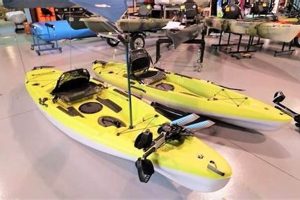
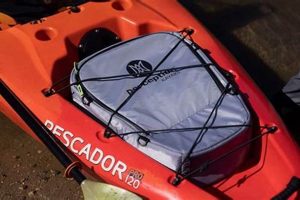
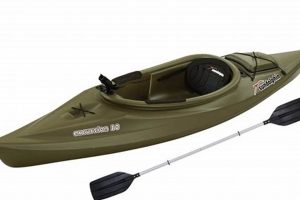
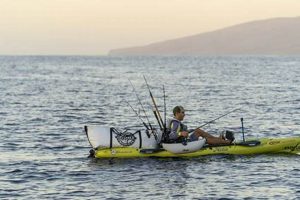
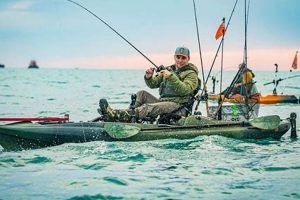
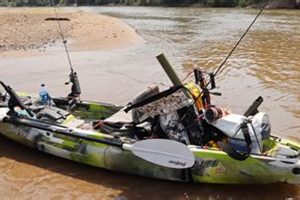
An affordable, sit-on-top style vessel designed for angling typically features essential accessories like rod holders and storage compartments while remaining economical. These kayaks offer a cost-effective entry point into kayak fishing, eliminating the need for large upfront investments. They are usually constructed from durable, lightweight materials like high-density polyethylene.
Affordable fishing kayaks open up the world of angling from a water-based perspective to a wider audience. This accessibility fosters increased participation in the sport, allowing more individuals to experience the tranquility and excitement of fishing in diverse environments. The relatively recent rise in popularity of this type of kayak is directly linked to advancements in manufacturing processes that allow for cost-effective production without sacrificing essential features. This increased availability has had a positive impact on the accessibility of fishing.
This article will further examine factors influencing cost, key features to consider, recommended models, and essential safety information for those exploring this accessible and rewarding approach to fishing.
Tips for Selecting an Affordable Fishing Kayak
Choosing an affordable fishing kayak requires careful consideration of various factors to ensure the vessel meets individual needs and provides a safe and enjoyable fishing experience. The following tips offer guidance for navigating the selection process.
Tip 1: Prioritize Stability over Speed. Stability is paramount, especially for anglers. Wider kayaks generally offer greater stability, making them ideal for casting and reeling. While speed is less critical, consider the typical fishing environment and choose a hull design offering reasonable maneuverability.
Tip 2: Assess Storage Capacity. Adequate storage is crucial for carrying tackle, gear, and personal items. Evaluate storage compartments, bungee cords, and other storage features to ensure sufficient space for all fishing essentials.
Tip 3: Consider Weight Capacity. The kayak’s weight capacity should accommodate the angler’s weight, plus the weight of all gear and potential catches. Exceeding the weight capacity can compromise stability and safety.
Tip 4: Evaluate Comfort and Ergonomics. A comfortable seat and adjustable footrests are essential for longer fishing trips. Consider the seat material, adjustability, and overall cockpit design for optimal comfort.
Tip 5: Research Reputable Brands and Retailers. Opt for kayaks from established manufacturers and reputable retailers known for quality and customer service. This can ensure warranty coverage and access to replacement parts if needed.
Tip 6: Inspect Used Kayaks Thoroughly. Purchasing a used kayak can be a cost-effective option. However, carefully inspect the hull for any damage, cracks, or repairs before making a purchase. Check for wear and tear on accessories and ensure all components are functional.
Tip 7: Factor in Additional Costs. Remember to budget for essential accessories such as a paddle, personal flotation device (PFD), and fishing rod holders. These items are often sold separately and contribute to the overall cost.
By considering these tips, individuals can make informed decisions and select an affordable fishing kayak that aligns with their specific needs and budget, ultimately enhancing their fishing experience.
This guidance helps equip prospective buyers with the knowledge needed to select a kayak best suited for their individual requirements, ensuring a safe and enjoyable fishing experience. The following section will provide concluding remarks and summarize key takeaways for prospective kayak anglers.
1. Affordability

Affordability represents a critical factor in the increasing popularity of kayak fishing, enabling broader participation in the sport. Access to reasonably priced equipment removes a significant barrier to entry, allowing more individuals to experience the enjoyment and rewards of fishing from a kayak. Understanding the components of affordability provides valuable insights for prospective kayak anglers.
- Initial Purchase Price
The initial cost of the kayak itself forms the foundation of affordability. Prices vary based on factors such as size, features, materials, and brand reputation. Entry-level kayaks constructed from high-density polyethylene (HDPE) offer a balance between durability and cost-effectiveness, making them a popular choice for budget-conscious anglers. For example, a basic fishing kayak can range from $300 to $600, while higher-end models can exceed $1000.
- Essential Accessories
Beyond the kayak itself, essential accessories contribute to the overall cost. These include paddles, personal flotation devices (PFDs), rod holders, and storage solutions. Opting for cost-effective accessories without compromising safety or functionality allows anglers to manage their budget effectively. Purchasing used accessories in good condition can also represent a significant cost saving.
- Maintenance and Repairs
Long-term affordability involves considering potential maintenance and repair costs. HDPE kayaks generally require minimal maintenance, but occasional repairs might be necessary. Factoring in these potential expenses provides a more realistic assessment of overall affordability. Learning basic kayak maintenance can also minimize future costs.
- Transportation and Storage
Transporting and storing the kayak also influences affordability. Roof racks, trailers, or other transportation methods may require additional investment. Storage solutions, whether at home or in a storage facility, also contribute to ongoing costs. Compact, lightweight kayaks can simplify transportation and storage, reducing associated expenses.
Careful consideration of these facets of affordability empowers prospective kayak anglers to make informed purchasing decisions. Balancing initial investment with ongoing expenses ensures a sustainable approach to enjoying the sport without exceeding budgetary constraints. By understanding the components of affordability, individuals can select a kayak and associated equipment that aligns with their financial resources while maximizing their on-the-water experience.
2. Stability

Stability represents a paramount concern in the selection of a budget fishing kayak, directly impacting safety and angling success. A stable platform facilitates casting, reeling, and landing fish, while minimizing the risk of capsizing. Understanding the factors influencing stability is crucial for informed decision-making.
- Hull Design
Hull design significantly influences stability. Wider, flatter hulls generally offer greater primary stability, resisting initial tipping. Pontoon-style hulls provide exceptional stability, while V-shaped hulls offer enhanced tracking and speed but compromise primary stability. Budget fishing kayaks often feature wider hulls to prioritize stability for anglers.
- Center of Gravity
The kayak’s center of gravity and the angler’s position within it affect stability. Lowering the center of gravity by sitting closer to the waterline enhances stability. Distributing weight evenly within the kayak also contributes to balance. Budget fishing kayaks often have wider seats and lower profiles to aid in maintaining a low center of gravity.
- Water Conditions
Calm, flat water presents fewer stability challenges compared to choppy or turbulent conditions. Kayak stability is inherently influenced by the surrounding environment. Anglers utilizing budget fishing kayaks should exercise caution in challenging conditions and select locations with calmer waters, particularly when starting out.
- Kayak Width and Length
Wider kayaks inherently offer greater stability than narrower designs. Longer kayaks generally track straighter but may be less maneuverable. Budget fishing kayaks often prioritize width over length to enhance stability for a wider range of users, particularly in calmer waters suitable for this type of vessel.
Prioritizing stability within a budget context involves selecting a kayak with a wider hull, a low center of gravity, and appropriate length for intended use. Evaluating these factors enables anglers to choose a stable platform that enhances both safety and the overall fishing experience, even within budgetary constraints. This focus on stability contributes significantly to angler confidence and enjoyment on the water.
3. Storage

Storage capacity significantly impacts the practicality and enjoyment derived from a budget fishing kayak. Effective storage solutions enable anglers to carry essential gear, tackle, and personal items, facilitating longer and more productive fishing trips. The relationship between storage and a budget-friendly approach necessitates careful consideration of available options and their impact on overall cost and functionality. For example, a kayak with limited storage may require anglers to purchase additional accessories like dry bags or crates, increasing overall expenditure and potentially cluttering the deck. Conversely, integrated storage compartments in a budget kayak can eliminate the need for extra purchases, maximizing cost-effectiveness.
Several factors influence the efficacy of storage solutions in budget fishing kayaks. The size, placement, and accessibility of storage compartments play a crucial role in their usability. Recessed storage wells protect gear from water damage, while bungee cords offer convenient storage for readily accessible items. The presence of a tank well, typically located at the rear of the kayak, provides ample space for larger items like tackle boxes or coolers. Clever utilization of limited space is often a hallmark of well-designed budget fishing kayaks. A thoughtfully designed budget model might incorporate a small, waterproof compartment for electronics alongside larger, open storage areas for tackle boxes, demonstrating an effective balance of needs and constraints. Evaluating storage options based on individual fishing styles and anticipated gear requirements is crucial. A minimalist angler might prioritize compact storage for essential lures and tackle, whereas an angler targeting larger species might require more substantial storage for specialized equipment.
Understanding the importance of storage within a budget fishing kayak context empowers anglers to make informed purchasing decisions. Balancing cost with functionality ensures anglers select a kayak that meets their specific needs without exceeding financial constraints. Assessing storage options alongside other critical factors like stability and maneuverability contributes to a well-rounded selection process, ultimately maximizing the enjoyment and success of fishing excursions. Failing to prioritize storage can lead to frustration and inconvenience on the water, highlighting the practical significance of this often-overlooked aspect of budget kayak selection.
4. Durability

Durability represents a critical factor in evaluating the long-term value of a budget fishing kayak. While affordability remains a primary concern, compromising durability can lead to premature wear and tear, ultimately increasing costs through repairs or replacements. A durable kayak withstands the rigors of regular use, including impacts, abrasion, and exposure to the elements, ensuring a reliable platform for extended fishing excursions.
- Material Selection
The choice of material significantly influences a kayak’s durability. High-density polyethylene (HDPE) offers a balance of impact resistance, UV resistance, and affordability, making it a prevalent material in budget fishing kayaks. Other materials, such as rotomolded polyethylene, offer enhanced durability but often come at a higher price point. Understanding the properties of different materials allows informed decisions aligned with budget and usage expectations.
- Construction Quality
Construction quality plays a vital role in overall durability. Well-constructed kayaks feature reinforced seams, robust hull designs, and quality hardware. Examining the kayak for consistent welds, smooth finishes, and securely attached fittings provides insights into its construction quality. Attention to detail in manufacturing processes often translates to greater longevity.
- UV Resistance
Exposure to sunlight can degrade kayak materials over time, leading to fading, cracking, and reduced structural integrity. UV-resistant coatings and additives enhance a kayak’s ability to withstand prolonged sun exposure, preserving its appearance and extending its lifespan. Budget kayaks with adequate UV protection offer better long-term value.
- Impact and Abrasion Resistance
Kayaks inevitably encounter impacts and abrasion during transport, launch, and retrieval. A durable kayak resists scratches, dents, and punctures, maintaining its structural integrity and preventing leaks. The thickness and composition of the hull material directly influence its resistance to impact and abrasion. Evaluating these factors contributes to informed decision-making.
Balancing durability with affordability requires careful consideration of material selection, construction quality, UV resistance, and impact/abrasion resistance. Prioritizing these factors ensures a budget-friendly kayak provides reliable performance and extended lifespan, maximizing the return on investment. A durable kayak withstands the demands of regular fishing excursions, minimizing the need for repairs and replacements, ultimately contributing to a more cost-effective and enjoyable angling experience.
5. Features (essential)
Essential features distinguish a purpose-built fishing kayak from a recreational model, impacting functionality and angling success. Budget considerations often necessitate careful evaluation of these features, balancing cost against practical needs. Flush-mounted rod holders, for instance, offer a convenient and secure way to manage fishing rods while paddling or trolling, enhancing angling efficiency without requiring expensive aftermarket additions. Similarly, integrated storage compartments, while potentially increasing the initial cost slightly, eliminate the need for separate waterproof storage solutions, contributing to long-term cost-effectiveness.
Prioritizing essential features within a budget context often involves compromise. Adjustable footrests, while enhancing comfort and paddling efficiency, may not be a standard feature on the most budget-friendly models. Anglers must weigh the importance of such features against their budget constraints. A basic, molded-in seat might suffice for shorter trips, while a more comfortable, adjustable seat becomes crucial for longer excursions. Understanding the trade-offs between features and cost enables informed purchasing decisions. For example, an angler prioritizing stability might choose a wider, more stable kayak with fewer built-in features and later add desired accessories incrementally. This approach allows for a balanced investment over time.
Selecting a budget fishing kayak requires careful consideration of essential features and their impact on both functionality and long-term cost. Balancing essential features against budgetary limitations often involves trade-offs. Informed decisions stem from understanding the practical significance of each feature within the context of individual fishing styles and intended use. This focused approach ensures anglers acquire a kayak equipped for successful and enjoyable fishing excursions without exceeding financial constraints. Recognizing the interplay between essential features and budget constraints ultimately optimizes the value and enjoyment derived from a budget-friendly fishing kayak.
6. Maneuverability
Maneuverability plays a crucial role in the overall performance of a budget fishing kayak, directly influencing its effectiveness in various fishing environments. Navigating tight spaces, changing directions swiftly, and maintaining control in currents or wind are essential aspects of successful kayak fishing. Maneuverability in a budget-friendly context often requires balancing performance with cost constraints, impacting material choices, hull design, and overall kayak dimensions.
- Hull Design and Length
Hull design significantly impacts maneuverability. Shorter kayaks generally turn more easily than longer ones, making them ideal for navigating tight creeks, ponds, or mangrove forests. Longer kayaks, while offering better tracking in open water, may prove cumbersome in confined spaces. Budget fishing kayaks often prioritize maneuverability over straight-line tracking, opting for shorter lengths suitable for diverse environments.
- Width and Stability
Kayak width influences both stability and maneuverability. Wider kayaks, while offering enhanced stability, tend to be less maneuverable. Narrower kayaks turn more quickly but sacrifice some stability. Budget fishing kayaks often strike a balance between width and maneuverability, prioritizing stability for anglers while retaining reasonable agility.
- Water Conditions
Maneuverability is also affected by prevailing water conditions. Strong currents and winds can challenge kayak control, requiring designs that offer enhanced stability and responsiveness. Budget fishing kayaks intended for use in varied conditions often incorporate design features that improve tracking and control in challenging environments.
- Weight and Material
Kayak weight influences maneuverability, particularly when paddling against wind or current. Lighter kayaks are easier to maneuver and accelerate, while heavier kayaks require more effort. Budget-friendly kayaks often utilize lightweight, durable materials like HDPE to balance cost with performance.
Understanding the interplay between maneuverability and other factors like stability, cost, and intended fishing environment allows for informed decisions when selecting a budget fishing kayak. Prioritizing maneuverability ensures anglers can effectively navigate diverse waterways, maximizing their fishing opportunities within budgetary constraints. A maneuverable kayak enhances the overall fishing experience by enabling anglers to access prime fishing spots and respond effectively to changing conditions on the water.
Frequently Asked Questions
This section addresses common inquiries regarding budget fishing kayaks, providing concise and informative responses to assist prospective buyers in making informed decisions.
Question 1: What is the typical price range for a budget fishing kayak?
Budget fishing kayaks typically range from $300 to $700. Prices vary based on features, materials, and brand. Used kayaks offer potential cost savings.
Question 2: Are budget fishing kayaks durable enough for regular use?
Most budget fishing kayaks utilize durable materials like high-density polyethylene (HDPE), providing adequate durability for regular recreational use. Proper care and maintenance enhance longevity.
Question 3: What essential features should one look for in a budget fishing kayak?
Essential features include rod holders, storage compartments, and a comfortable seat. Adjustable footrests and a rudder system enhance comfort and control but may not be standard on all budget models.
Question 4: How does one choose between a sit-on-top and a sit-inside kayak for fishing?
Sit-on-top kayaks offer greater stability and easier access to gear, making them popular for fishing. Sit-inside kayaks offer better protection from the elements but can be more challenging to re-enter after a capsize.
Question 5: Is it necessary to purchase additional accessories for a budget fishing kayak?
Essential accessories include a paddle, personal flotation device (PFD), and appropriate fishing gear. Additional accessories like rod holders, anchors, and fish finders can enhance functionality but increase overall cost.
Question 6: Where can one purchase a budget fishing kayak?
Budget fishing kayaks are available from various retailers, including sporting goods stores, online marketplaces, and specialized kayak dealers. Comparing prices and features across different retailers is advisable.
Careful consideration of these frequently asked questions empowers prospective buyers to make informed decisions aligned with individual needs and budgetary constraints. Understanding the nuances of budget fishing kayaks ensures a satisfying and successful on-the-water experience.
The subsequent section will offer concluding remarks and summarize key takeaways for prospective kayak anglers.
Budget Fishing Kayak
Careful selection of a budget fishing kayak involves balancing cost with essential features. Prioritizing stability, storage, durability, essential features, and maneuverability ensures a functional and enjoyable vessel. Understanding the interplay of these factors empowers informed purchasing decisions, maximizing value and long-term satisfaction. Affordability should not necessitate compromising safety or functionality. Thorough research and consideration of individual needs remain paramount.
The increasing accessibility of budget-friendly fishing kayaks presents an opportunity for broader participation in the sport. Empowering anglers with knowledge enables informed choices and enhances the overall fishing experience. This accessibility fosters a deeper appreciation for the outdoors and promotes responsible engagement with aquatic environments. Continued innovation in kayak design and manufacturing promises further advancements in affordability, performance, and accessibility, benefiting both seasoned anglers and newcomers alike.