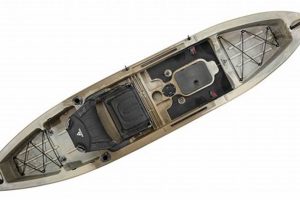
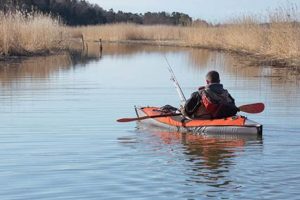
The specifications of a 105-inch sit-on-top fishing kayak designed for larger individuals are crucial for ensuring stability, comfort, and performance on the water. These details typically include dimensions (length, width, height), weight capacity, hull design, and incorporated features such as rod holders, storage compartments, and seating systems. Understanding these metrics allows anglers to choose a watercraft appropriate for their physique, fishing style, and targeted waterways.
Appropriate vessel selection improves safety and fishing success. A kayak with insufficient weight capacity can capsize, while one lacking adequate storage may limit fishing gear or essential safety equipment. Historically, kayaks have evolved from traditional hunting craft to highly specialized designs for diverse activities, including fishing. The development of specialized fishing kayaks, with features like rod holders and live wells, highlights the growing popularity and specific needs of this angling approach. Considering these technical details ensures a suitable vessel for diverse fishing environments, from calm lakes to challenging ocean conditions.
This article will delve into the key attributes of fishing kayak design, encompassing stability considerations, material analysis, and an overview of common features. It will also explore the impact of kayak dimensions on performance and maneuverability, offering guidance for anglers selecting their ideal fishing platform.
Tips for Utilizing Kayak Specifications
Understanding and applying kayak specifications is crucial for selecting the appropriate vessel for individual needs and intended usage. The following tips offer guidance for navigating these technical details.
Tip 1: Prioritize Weight Capacity: Exceeding the manufacturer’s specified weight capacity compromises stability and increases the risk of capsizing. Total weight includes the paddler, gear, and any potential catch.
Tip 2: Consider Length and Width: Longer kayaks generally track straighter and offer higher speeds, while shorter kayaks are more maneuverable. Wider kayaks provide increased stability but may sacrifice speed.
Tip 3: Evaluate Hull Design: Different hull designs (e.g., flat-bottom, pontoon, V-shaped) impact stability, tracking, and maneuverability. Research which design best suits the intended water conditions.
Tip 4: Assess Storage Capacity: Adequate storage is essential for carrying fishing gear, safety equipment, and personal items. Consider the type and amount of gear typically carried.
Tip 5: Examine Seating Comfort: A comfortable seat is vital for longer fishing trips. Consider adjustable features, back support, and material breathability.
Tip 6: Factor in Feature Integration: Evaluate integrated features like rod holders, fish finders, and anchor trolleys based on specific fishing needs and preferences.
Tip 7: Research Material Durability: Kayak materials (e.g., polyethylene, fiberglass, composite) differ in durability, weight, and cost. Select a material suited to the environment and frequency of use.
By considering these factors, anglers can select a kayak that optimizes performance, comfort, and safety on the water. Careful consideration of specifications ensures a suitable vessel for diverse fishing environments and individual preferences.
This understanding of kayak specifications lays the groundwork for informed decision-making and ultimately enhances the overall fishing experience.
1. Length

The 10′ 5″ length is a defining characteristic within the “big fish 105 kayak specs.” This measurement directly influences performance aspects, impacting both maneuverability and tracking. A kayak of this length represents a compromise between the agility of shorter kayaks and the tracking efficiency of longer ones. In practical terms, this translates to adequate maneuverability within confined spaces like creeks or inlets while maintaining reasonable straight-line tracking for open-water paddling. For example, navigating tight turns around submerged structures becomes more feasible compared to longer kayaks. Conversely, covering distances across larger bodies of water requires less corrective paddling compared to shorter, more easily diverted kayaks.
This length contributes to the kayak’s intended purpose as a fishing platform. Sufficient deck space becomes available for mounting fishing accessories and storing gear, crucial for extended fishing excursions. The length also contributes to stability, a crucial factor when battling larger fish. While shorter kayaks might be quicker to turn, they can be less stable. The 10′ 5″ length allows for a balance that supports the angler during the fight, reducing the risk of capsizing. Furthermore, the increased length improves glide, enabling anglers to cover more water with less effort, beneficial for reaching distant fishing spots.
In summary, the 10′ 5″ length is a carefully chosen design element that directly addresses the target use of the Big Fish 105 as a stable and efficient fishing kayak. This length provides a balance between maneuverability and tracking, contributing significantly to the kayak’s overall performance and suitability for its intended purpose. Understanding this specific dimension provides valuable insight into the kayak’s capabilities and limitations, facilitating informed purchasing decisions for anglers.
2. Width

The 33″ width is a critical component within the overall specifications of the Big Fish 105 kayak, significantly influencing stability and maneuverability. Width directly impacts a kayak’s primary and secondary stability. Primary stability refers to the initial resistance to tipping, while secondary stability describes how stable the kayak remains when leaned. A wider kayak, like the Big Fish 105, inherently possesses greater primary stability, making it less likely to tip over with sudden movements or shifts in weight. This characteristic proves beneficial for activities like fishing, where anglers frequently shift positions and cast lines. The increased width also contributes to a higher initial stability, creating a secure platform, especially valuable for less experienced paddlers or those fishing in challenging conditions.
While increased width enhances stability, it can influence maneuverability. Wider kayaks generally require more effort to turn compared to narrower designs. However, within the context of the Big Fish 105’s intended use as a fishing platform, the emphasis on stability outweighs the slight reduction in turning speed. The enhanced stability provides a secure platform for casting, reeling, and landing fish, particularly in rougher water conditions. This design prioritizes the secure and comfortable experience crucial for angling, even if it implies slightly reduced agility compared to narrower, faster kayaks designed for speed or racing. For example, standing to cast in a 33″-wide kayak offers a more stable experience than attempting the same in a narrower model.
In summary, the 33″ width of the Big Fish 105 directly contributes to its core functionality as a stable fishing platform. The design choice emphasizes stability over pure maneuverability, aligning with the specific needs and priorities of anglers. Understanding the influence of width on performance characteristics empowers informed decision-making, ensuring anglers select a kayak aligned with their individual needs and skill levels. This balance between stability and maneuverability is a defining feature of the Big Fish 105, making it suitable for those seeking a secure and comfortable fishing experience.
3. Weight Capacity

The 475 lbs weight capacity is a defining characteristic within the Big Fish 105 kayak specifications, directly impacting its suitability for various users and activities. This capacity dictates the maximum combined weight of the paddler, gear, and any potential catch the kayak can safely support. Understanding this limit is crucial for ensuring both safety and performance on the water. Exceeding this capacity significantly increases the risk of capsizing and compromises the kayak’s stability and maneuverability.
- Safety Margin:
A generous weight capacity provides a critical safety margin. This buffer becomes particularly important in dynamic fishing situations, accommodating sudden movements, shifting weight distribution, and the added weight of a landed fish. An adequate safety margin reduces the risk of swamping or capsizing, ensuring angler safety.
- Gear Capacity:
A 475 lbs capacity allows for substantial gear storage, essential for anglers carrying fishing rods, tackle boxes, coolers, and safety equipment. This ample capacity enables longer fishing trips and supports diverse fishing styles, accommodating specialized equipment needs. For example, anglers targeting larger species can carry heavier tackle and gear without compromising stability or safety.
- User Suitability:
This high weight capacity makes the Big Fish 105 suitable for a wider range of users, including larger individuals or those who require additional gear capacity. Kayaks with lower weight limits can restrict larger paddlers, limiting their equipment choices and potentially compromising stability. The Big Fish 105s capacity ensures a wider user base can utilize the kayak safely and comfortably.
- Performance Impact:
While weight capacity primarily relates to safety, it also influences performance. A kayak loaded near its maximum capacity will sit lower in the water, increasing drag and impacting speed and maneuverability. Understanding the relationship between load and performance allows anglers to optimize their experience by packing efficiently and distributing weight evenly.
In conclusion, the 475 lbs weight capacity of the Big Fish 105 is a key specification that directly impacts safety, gear capacity, and user suitability. This capacity aligns with the kayaks intended purpose as a stable and efficient fishing platform, accommodating the diverse needs of anglers. Understanding this specification is crucial for making informed decisions about kayak selection and ensuring a safe and successful fishing experience.
4. Weight
The 75 lbs weight of the Big Fish 105 kayak is a significant factor within its overall specifications, influencing transportation, handling, and overall usability. While seemingly a simple metric, the kayak’s weight impacts various aspects of its practicality, from car-topping and launching to overall maneuverability on the water. Understanding the implications of this weight is crucial for assessing its suitability for individual needs and logistical considerations.
- Transportation and Storage:
A 75 lbs kayak presents transportation challenges. Loading and unloading from a vehicle roof rack often requires assistance or specialized loading systems. Storage considerations also arise, as lifting and maneuvering the kayak into storage spaces can be difficult for some individuals. For example, transporting the kayak up a flight of stairs or storing it on overhead racks might necessitate additional equipment or assistance.
- Launching and Landing:
The weight influences the ease of launching and landing. Maneuvering the kayak from shore to water and back requires sufficient strength and technique. Soft or uneven terrain can further complicate the process. The physical effort required for these activities should be considered, particularly for individuals with physical limitations.
- On-Water Performance:
While not as directly impactful as length or width, the kayak’s weight can subtly influence on-water performance. Heavier kayaks generally exhibit slightly greater momentum and stability in rough conditions, but they can be slower to accelerate and require more effort to paddle over long distances. This factor becomes more noticeable in challenging conditions, such as strong currents or windy environments.
- Material and Construction:
The 75 lbs weight reflects the kayak’s material and construction. Polyethylene kayaks are known for their durability and impact resistance, but they tend to be heavier than composite materials. This trade-off between weight and durability is a key consideration when evaluating kayak specifications. The chosen material directly influences the kayak’s longevity and resistance to wear and tear in various environments.
In summary, the 75 lbs weight of the Big Fish 105 kayak is integral to its overall profile. While the weight contributes to durability and stability, it also presents logistical considerations regarding transportation, storage, and handling. A comprehensive understanding of these factors ensures informed decisions aligned with individual capabilities and logistical constraints. The weight, when considered in conjunction with other specifications like length, width, and weight capacity, provides a complete picture of the kayak’s suitability for various uses and user profiles. This analysis empowers potential buyers to evaluate the kayak’s practicality within their specific context.
5. Material

Polyethylene construction significantly influences the Big Fish 105 kayak’s overall performance, durability, and cost-effectiveness. This thermoplastic polymer offers a balance of properties suitable for recreational kayaking, particularly within the context of fishing applications where durability and impact resistance are paramount. Understanding the implications of polyethylene construction provides valuable insights into the Big Fish 105’s suitability for various fishing environments and usage patterns.
- Durability and Impact Resistance:
Polyethylene exhibits excellent impact resistance, safeguarding the kayak against collisions with rocks, submerged logs, or other obstacles commonly encountered in fishing environments. This resilience translates to a longer lifespan and reduced risk of damage during transport, launching, or landing. For example, polyethylene kayaks can withstand minor impacts without sustaining structural damage, unlike more fragile materials.
- UV Resistance and Weathering:
Modern polyethylene kayaks incorporate UV stabilizers, mitigating the degrading effects of prolonged sun exposure. This resistance to UV radiation prevents material breakdown and color fading, preserving the kayak’s structural integrity and aesthetic appeal over time. While some fading may occur over extended periods, polyethylene kayaks generally maintain their structural integrity under typical sun exposure.
- Maintenance and Repair:
Polyethylene kayaks require minimal maintenance. Cleaning typically involves rinsing with fresh water and mild soap. Minor scratches or abrasions can often be repaired using readily available polyethylene repair kits. This ease of maintenance contributes to the kayak’s overall practicality and long-term cost-effectiveness. Significant damage, while less common, can also be repaired by experienced technicians.
- Cost-Effectiveness:
Polyethylene offers a cost-effective material choice compared to alternatives like fiberglass or composites. This affordability makes kayaks like the Big Fish 105 accessible to a wider range of anglers. While composite materials offer performance advantages, polyethylene provides a balance of durability and cost-effectiveness suitable for recreational fishing applications.
In summary, the choice of polyethylene construction for the Big Fish 105 kayak directly influences its durability, maintenance requirements, and overall cost. This material’s inherent properties align well with the demands of fishing environments, where impact resistance and resilience are crucial. Understanding the characteristics of polyethylene provides a comprehensive perspective on the Big Fish 105’s construction, contributing to informed purchasing decisions and appropriate usage within its intended applications.
6. Propulsion

Paddle propulsion is a defining characteristic of the Big Fish 105 kayak, directly influencing its performance, usability, and overall suitability for fishing applications. While other propulsion methods exist, such as pedal drives or motors, the Big Fish 105’s reliance on paddle power shapes its design and intended usage. This choice impacts maneuverability, speed, and the overall fishing experience.
Paddle propulsion offers distinct advantages in fishing scenarios. Precise and nuanced control of the kayak’s movement is crucial for navigating tight spaces, approaching fish stealthily, and maintaining position in currents. Paddles offer this level of control, allowing anglers to make subtle adjustments in direction and speed. For instance, a slight paddle adjustment can prevent spooking fish in shallow water, while a strong paddle stroke can maneuver the kayak quickly out of the path of an approaching motorboat. Furthermore, paddle propulsion is inherently quiet, minimizing disturbance to the underwater environment and maximizing fishing success. This silent approach contrasts with motorized propulsion, which can generate noise and vibrations that deter fish.
The choice of paddle propulsion influences other aspects of the Big Fish 105’s specifications. The kayak’s length and width are optimized for efficient paddling and maneuverability, balancing stability and tracking performance. The absence of a motor or pedal drive simplifies the kayak’s design, reduces weight, and lowers maintenance requirements. This simplicity contributes to the kayak’s overall affordability and ease of use. While alternative propulsion methods offer speed and convenience advantages, they often come at a higher cost and increased complexity. The Big Fish 105’s paddle propulsion prioritizes affordability, simplicity, and nuanced control, aligning with the needs of anglers seeking a versatile and practical fishing platform. Understanding the implications of paddle propulsion within the context of the Big Fish 105’s specifications provides valuable insights into its intended usage and performance characteristics.
7. Usage

The designation “Usage: Fishing” fundamentally shapes the design and features encompassed within the “big fish 105 kayak specs.” This specialized purpose dictates design choices that prioritize stability, storage, and specialized features catering to angling needs. Understanding this core purpose provides a framework for interpreting the specifications and appreciating their relevance to the overall fishing experience.
- Stability and Handling
Fishing kayaks require enhanced stability to accommodate angler movements, casting, and the potential struggle with hooked fish. The Big Fish 105’s width and hull design contribute to this stability, allowing anglers to maintain balance and control in various fishing scenarios. For example, the wider beam provides a stable platform for standing casts, while the flat bottom enhances stability in calm waters. This focus on stability directly relates to the “fishing” designation, prioritizing a secure and balanced platform crucial for angling success.
- Storage and Gear Management
Anglers require ample storage for rods, tackle, and other fishing gear. The Big Fish 105 incorporates dedicated storage compartments and mounting points designed to accommodate these needs. Rod holders, tackle storage, and dry hatches provide organized and accessible storage, essential for efficient gear management during fishing trips. This emphasis on storage directly aligns with the kayak’s intended “fishing” usage, ensuring anglers can carry necessary equipment without compromising stability or maneuverability.
- Specialized Features
Fishing-specific features distinguish angling kayaks from recreational models. The Big Fish 105 may include features like rod holders, fish finder mounts, and anchor trolleys. These additions enhance the fishing experience, providing dedicated functionality crucial for various angling techniques. For instance, integrated rod holders secure rods while paddling or preparing tackle, while fish finder mounts facilitate electronic fish location. These features underscore the “fishing” designation, demonstrating the kayak’s specialized design catering to angling needs.
- Durability and Construction
Fishing kayaks often encounter harsh environments, requiring durable construction to withstand impacts and abrasions. The Big Fish 105’s polyethylene construction provides this resilience, protecting the kayak from damage against rocks, submerged logs, and other potential hazards. This durable construction aligns with the rigors of “fishing” usage, ensuring the kayak can withstand the demands of diverse fishing environments. The robust construction contributes to the kayak’s longevity and maintains its functionality over extended use.
In conclusion, the “Usage: Fishing” designation is not merely a label; it is a core principle that informs the entirety of the “big fish 105 kayak specs.” Each specification, from stability and storage to specialized features and durable construction, contributes to the kayak’s effectiveness as a fishing platform. Understanding this interconnectedness between intended usage and technical specifications empowers informed purchasing decisions and ensures the chosen kayak aligns with individual angling needs and preferences.
Frequently Asked Questions
This FAQ section addresses common inquiries regarding the specifications of the Big Fish 105 kayak, providing clarity on key features and performance characteristics.
Question 1: What is the maximum weight capacity of the Big Fish 105?
The Big Fish 105 boasts a maximum weight capacity of 475 lbs. This includes the combined weight of the paddler, gear, and any potential catch.
Question 2: How does the width of the kayak impact its stability?
The 33″ width contributes significantly to the kayak’s primary stability, making it less prone to tipping. This width provides a secure platform, especially beneficial for fishing activities.
Question 3: What is the advantage of the polyethylene construction?
Polyethylene offers excellent durability and impact resistance, protecting the kayak from damage in various fishing environments. It also requires minimal maintenance.
Question 4: How does the length of the Big Fish 105 affect its performance?
The 10′ 5″ length balances maneuverability and tracking. It provides adequate maneuverability in tight spaces while maintaining reasonable straight-line tracking in open water.
Question 5: Is the Big Fish 105 suitable for larger paddlers?
The high weight capacity of 475 lbs and the spacious cockpit make the Big Fish 105 suitable for a wide range of paddler sizes, including larger individuals.
Question 6: What type of propulsion system does the Big Fish 105 utilize?
The Big Fish 105 utilizes paddle propulsion, offering anglers precise control and a quiet approach beneficial for fishing.
Understanding these key specifications empowers informed decisions regarding the suitability of the Big Fish 105 for individual needs and intended usage. Careful consideration of these factors contributes to a safe and enjoyable kayaking experience.
For further inquiries or detailed information beyond the provided specifications, consulting manufacturer resources or authorized dealers is recommended.
Big Fish 105 Kayak Specs
Examination of the Big Fish 105 kayak specifications reveals a design prioritizing stability, capacity, and fishing-specific features. The kayak’s dimensions, weight capacity, material construction, and propulsion method collectively contribute to its suitability for angling activities. Key attributes include a 475 lbs weight capacity accommodating larger anglers and ample gear, a 33″ width enhancing stability, and a 10′ 5″ length balancing maneuverability and tracking. Polyethylene construction ensures durability, while paddle propulsion offers precise control and a quiet approach beneficial for fishing. Understanding these specifications empowers informed assessments of the kayak’s suitability for diverse fishing environments and angler preferences.
Careful consideration of technical specifications remains paramount when selecting fishing kayaks. Appropriate vessel selection directly impacts safety, performance, and overall angling success. The Big Fish 105, with its emphasis on stability and fishing-specific features, presents a compelling option for anglers seeking a dedicated fishing platform. Further research, including hands-on experience whenever possible, is recommended before final purchase decisions. This comprehensive understanding of specifications empowers informed choices, contributing to enhanced enjoyment and success on the water.