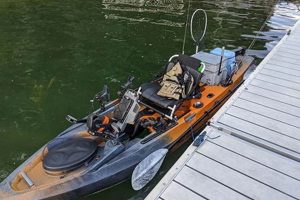
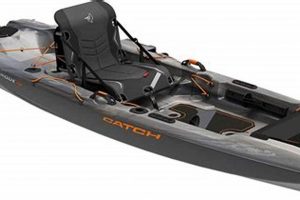
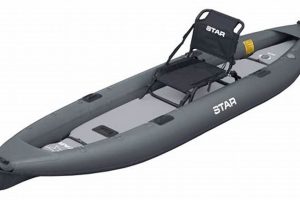
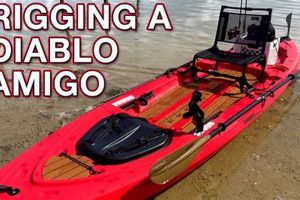
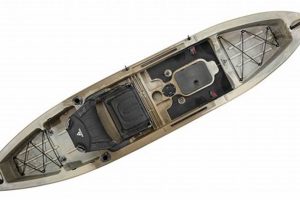
This particular sit-on-top fishing kayak is manufactured by Sevylor, a well-established company in the inflatable watercraft market. It is designed as an entry-level option for anglers seeking a portable and affordable vessel for calm waters. Typically equipped with features like rod holders, paddle holders, and adjustable seats, this inflatable kayak prioritizes convenience and ease of use. Its compact nature allows for straightforward transport and storage, making it an appealing choice for individuals with limited space.
Portable fishing kayaks offer distinct advantages for anglers seeking accessible fishing experiences. Their lightweight design allows for easy transport to remote fishing locations, eliminating the need for trailers or roof racks. The inflatable nature of these vessels also simplifies storage during the off-season or when not in use. These features contribute to the growing popularity of inflatable fishing kayaks among both novice and experienced anglers.
The subsequent sections will delve deeper into specific aspects of this type of inflatable fishing kayak, including its construction, features, performance on the water, and user experiences. This detailed examination will provide a comprehensive understanding of its suitability for various fishing environments and angler preferences.
Tips for Using an Inflatable Fishing Kayak
Optimizing the use of an inflatable fishing kayak involves careful consideration of various factors, from pre-trip preparation to on-the-water safety procedures. The following tips offer valuable insights for maximizing the fishing experience while ensuring safety and responsible enjoyment.
Tip 1: Proper Inflation is Crucial: Ensure the vessel is inflated to the manufacturer’s recommended pressure. Underinflation can compromise stability and tracking, while overinflation can damage the seams. A pressure gauge is an essential tool for accurate inflation.
Tip 2: Pre-Trip Planning: Before heading out, research the intended fishing location. Check weather forecasts, water conditions, and local regulations. Planning ahead ensures a safe and productive fishing trip.
Tip 3: Weight Distribution and Balance: Distribute gear evenly within the kayak to maintain balance and stability. Avoid overloading the vessel, as this can impact maneuverability and increase the risk of capsizing.
Tip 4: Essential Safety Gear: Always wear a personal flotation device (PFD). Carry a whistle, signaling device, and first-aid kit. Inform someone of the intended fishing location and estimated return time.
Tip 5: Paddle Selection and Technique: Choose a paddle appropriate for the kayak’s size and the user’s height. Employ proper paddling techniques to maximize efficiency and minimize fatigue.
Tip 6: Respect for the Environment: Practice Leave No Trace principles. Pack out all trash and fishing line. Avoid disturbing wildlife and sensitive habitats.
Tip 7: Regular Maintenance: After each use, rinse the kayak with fresh water and allow it to dry thoroughly before storage. Inspect for any damage and perform necessary repairs promptly. Proper maintenance extends the lifespan of the kayak.
Adhering to these guidelines promotes safe and enjoyable kayak fishing experiences. Proper preparation, responsible practices, and respect for the environment contribute to a positive and sustainable approach to this rewarding recreational activity.
With these key considerations addressed, anglers can confidently explore the world of inflatable kayak fishing. The following section will summarize key features and benefits, providing a concise overview for potential users.
1. Inflatable Design

The inflatable design of the Sevylor Fish Hunter 1 kayak distinguishes it from traditional hard-shell kayaks, offering distinct advantages and disadvantages. This construction method impacts portability, durability, performance, and overall user experience. Understanding the implications of inflatable design is crucial for evaluating its suitability for various fishing applications.
- Portability and Storage:
Deflation allows for compact storage and easy transport. This feature eliminates the need for roof racks or trailers, making it convenient for anglers with limited storage space or those who travel frequently. The reduced bulk simplifies transport to remote fishing locations, expanding angling possibilities.
- Durability and Maintenance:
Constructed from durable PVC or similar materials, inflatable kayaks exhibit reasonable resistance to punctures and abrasion. However, they require careful handling and adherence to manufacturer guidelines for inflation and deflation. Regular inspection and prompt repair of any damage are essential for maintaining long-term performance.
- Performance on the Water:
While generally less rigid than hard-shell kayaks, inflatable designs offer adequate stability for calm water fishing. Tracking performance may be slightly compromised, requiring more effort to maintain a straight course. However, advancements in inflatable kayak technology continue to improve tracking and overall on-the-water performance.
- Setup and Inflation Time:
Inflating the kayak requires a dedicated pump and several minutes of effort. While relatively straightforward, this setup process adds time compared to simply launching a hard-shell kayak. However, advancements in pump technology have reduced inflation times considerably.
The inflatable design of the Sevylor Fish Hunter 1 directly influences its practicality and suitability for specific fishing scenarios. While offering advantages in portability and storage, considerations regarding durability, performance, and setup time contribute to a comprehensive understanding of this kayak’s capabilities and limitations. Evaluating these factors alongside individual angling needs and preferences informs appropriate selection and optimal utilization.
2. Fishing-Specific Features

The efficacy of the Sevylor Fish Hunter 1 kayak as a fishing platform hinges significantly on its integrated fishing-specific features. These design elements differentiate it from standard recreational kayaks, enhancing its utility and appeal to anglers. The presence and design of these features directly impact fishing success and overall user experience. Analyzing these components reveals how they contribute to the kayak’s specialized functionality.
Common features include strategically placed rod holders, often adjustable to accommodate various fishing techniques. These holders provide secure rod storage and hands-free operation, crucial for managing lines and tackling other tasks. Integrated paddle holders further enhance convenience, allowing anglers to secure paddles without interference during casting or retrieving. Additional features, like adjustable seating positions and strategically placed D-rings for attaching accessories, contribute to angler comfort and customization. Consider a scenario where an angler trolls for fish; adjustable rod holders become essential for maintaining proper line angle and lure presentation. Similarly, when fly fishing, a readily accessible paddle park system ensures the paddle remains secure without hindering casting motions.
The availability and design of fishing-specific features directly influence the kayak’s practicality and effectiveness for angling. While the Sevylor Fish Hunter 1 may not offer the comprehensive feature set of high-end fishing kayaks, its integrated design elements significantly enhance its functionality compared to standard recreational models. Evaluating these features alongside target species, fishing techniques, and individual preferences allows for a comprehensive assessment of the kayak’s suitability for specific angling needs. Understanding the practical application of these features empowers informed decision-making and contributes to enhanced on-the-water success.
3. Portability and Storage

The Sevylor Fish Hunter 1 kayak’s portability and storage capabilities are defining characteristics, directly influencing its appeal to anglers. Unlike rigid kayaks requiring substantial storage space and specialized transport solutions, this inflatable model prioritizes compact storage and ease of transport. This design consideration significantly expands accessibility, particularly for individuals with limited storage capacity or those seeking to transport the kayak to remote fishing locations. The deflated kayak packs down into a manageable size, easily fitting within a vehicle’s trunk or even public transport. This eliminates the need for roof racks or trailers, reducing transport complexity and associated costs. For instance, an angler living in an apartment with limited storage can easily store the deflated kayak in a closet or under a bed. Similarly, transporting the kayak to a remote lake accessible only by hiking becomes feasible due to its compact packed size.
The practical implications of this portability extend beyond mere convenience. Consider an angler targeting a series of small ponds or rivers within a region. The Sevylor Fish Hunter 1’s portability facilitates efficient movement between locations, maximizing fishing opportunities within a given timeframe. Furthermore, the ability to easily transport the kayak by air travel expands angling horizons, enabling fishing expeditions to distant destinations. This level of portability contributes significantly to the versatility and appeal of the kayak, catering to a broader range of angling scenarios and user needs. One could envision transporting this kayak on a backpacking trip, allowing access to pristine mountain lakes otherwise unreachable with traditional kayaks.
In summary, the Sevylor Fish Hunter 1’s portability and storage benefits are essential considerations for prospective buyers. The compact pack-down size and ease of transport enhance accessibility, particularly for individuals with limited storage or those seeking to access remote fishing areas. This design element expands the kayak’s versatility, enabling a wider range of angling applications and catering to diverse user preferences and logistical constraints. Understanding these practical advantages empowers informed decision-making, aligning kayak selection with individual needs and angling aspirations. This focus on portability and storage directly contributes to the overall value proposition of the Sevylor Fish Hunter 1 within the inflatable kayak market segment.
4. Stability and Maneuverability
Stability and maneuverability are critical performance attributes for any kayak, particularly one intended for fishing like the Sevylor Fish Hunter 1. These factors directly influence on-the-water safety, fishing effectiveness, and overall user experience. Understanding how this specific kayak performs in terms of stability and maneuverability is essential for evaluating its suitability for various fishing environments and angler preferences. This analysis delves into the interplay of design, materials, and user technique in shaping these key performance characteristics.
- Primary Stability:
Primary stability refers to the kayak’s initial resistance to tipping when at rest. The Sevylor Fish Hunter 1, being an inflatable kayak, typically exhibits good primary stability due to its wider beam and lower center of gravity compared to some hard-shell kayaks. This characteristic contributes to a stable platform for casting and reeling, essential for anglers. Consider an angler sitting still and casting; a stable platform minimizes the risk of tipping during the casting motion. The wide base of the Fish Hunter 1 provides this initial stability, inspiring confidence in less experienced paddlers.
- Secondary Stability:
Secondary stability describes the kayak’s ability to resist capsizing when leaned or tilted. Inflatable kayaks generally have softer secondary stability compared to hard-shell kayaks. While the Sevylor Fish Hunter 1 can handle moderate leaning, it is crucial to maintain a balanced posture, particularly in choppy water or when making sharp turns. For example, an angler reaching for a dropped lure needs to be mindful of maintaining balance due to the kayak’s softer secondary stability. This characteristic requires users to exercise caution and avoid sudden, exaggerated movements.
- Tracking and Maneuverability:
Tracking refers to the kayak’s ability to maintain a straight course. Inflatable kayaks, due to their flexible nature, can sometimes exhibit less efficient tracking than rigid kayaks. The Sevylor Fish Hunter 1 may require more corrective strokes to maintain a desired heading, especially in windy conditions. Maneuverability, however, is generally good due to the shorter length and lighter weight of the kayak, allowing for relatively easy turning and positioning in tight spots. Navigating a narrow, winding creek effectively demonstrates the kayak’s maneuverability, while paddling across a large, open lake highlights the importance of consistent corrective strokes for maintaining course.
- Impact of User Technique and Conditions:
Both stability and maneuverability are influenced by user technique and prevailing water conditions. Proper weight distribution within the kayak is crucial for maintaining balance. External factors, such as wind and currents, also impact performance. Experienced paddlers can compensate for some of these challenges, but novice users need to be mindful of these factors. For example, unevenly distributed fishing gear can compromise stability, while strong winds can exacerbate tracking challenges. Adapting paddling technique and understanding environmental influences are crucial for maximizing on-the-water performance and safety.
The Sevylor Fish Hunter 1’s stability and maneuverability characteristics, while suitable for calm water fishing, present certain limitations in more challenging conditions. Understanding the interplay of primary and secondary stability, tracking performance, and the influence of user technique and environmental factors allows for a realistic assessment of the kayak’s suitability for specific angling scenarios. This detailed analysis empowers informed decision-making, ensuring angler safety and optimizing on-the-water performance within the kayak’s intended operational envelope.
5. Affordability

Affordability plays a significant role in the appeal of the Sevylor Fish Hunter 1 kayak, positioning it as an accessible entry point into kayak fishing. Cost considerations are often paramount for prospective buyers, particularly those new to the sport or operating within budget constraints. Analyzing the kayak’s affordability requires examining its price point relative to comparable models, considering both initial purchase price and potential long-term costs. Understanding the economic factors surrounding this model provides valuable context for evaluating its overall value proposition.
- Initial Purchase Price:
The Sevylor Fish Hunter 1 typically falls within a lower price bracket compared to many hard-shell and higher-end inflatable fishing kayaks. This lower initial investment makes it an attractive option for budget-conscious anglers. This allows individuals to experience kayak fishing without a substantial upfront financial commitment. For example, someone exploring the sport can enter with a lower financial barrier, testing its suitability before investing in more expensive equipment.
- Long-Term Costs:
Beyond the initial purchase, ongoing costs associated with inflatable kayaks are generally lower than those of hard-shell kayaks. Storage costs are minimized due to the compact pack-down size, eliminating the need for dedicated storage racks or facilities. Transportation costs are also reduced, as the kayak can be transported in a standard vehicle without requiring roof racks or trailers. These factors contribute to the long-term affordability of ownership. An angler might avoid ongoing storage rental fees often associated with hard-shell kayaks, demonstrating the long-term cost benefits. Reduced fuel consumption due to the elimination of roof rack drag further contributes to long-term savings.
- Cost of Accessories:
While the kayak itself is affordably priced, the overall cost of kayak fishing should also account for necessary accessories. These may include a paddle, personal flotation device (PFD), pump, and potentially fishing-specific gear like rod holders or fish finders. While some packages include basic accessories, evaluating the complete cost picture is essential. For example, while the kayak might be budget-friendly, anglers must factor in the additional expense of a suitable paddle, PFD, and potentially a higher-capacity pump for quicker inflation.
- Value Proposition:
Assessing the Sevylor Fish Hunter 1’s affordability requires evaluating its value proposition. This involves considering the features and performance offered relative to the price point. While it may not possess the same level of durability or performance as higher-priced kayaks, it provides a functional and accessible entry point into the sport. An angler primarily fishing calm lakes or slow-moving rivers might find the kayak’s features and performance perfectly adequate given its price point, representing excellent value. However, an angler venturing into more challenging conditions might require a more robust, and consequently more expensive, kayak.
The affordability of the Sevylor Fish Hunter 1 significantly contributes to its accessibility within the kayak fishing market. While recognizing the limitations associated with its price point, the lower initial investment and reduced long-term costs position this model as a viable option for budget-conscious anglers, particularly those new to the sport. A balanced consideration of initial purchase price, long-term costs, and required accessories enables a comprehensive assessment of the kayak’s overall value proposition, empowering informed purchasing decisions aligned with individual budgetary constraints and angling aspirations. Ultimately, this analysis underscores the importance of affordability in broadening access to kayak fishing and fostering participation within the sport.
Frequently Asked Questions
This section addresses common inquiries regarding the Sevylor Fish Hunter 1 kayak, providing concise and informative responses to facilitate informed decision-making among prospective buyers. Clarity and accuracy are prioritized to ensure a comprehensive understanding of this particular kayak model.
Question 1: What is the weight capacity of this kayak?
The weight capacity typically ranges between 400-450 lbs, accommodating one to two paddlers plus gear. Exceeding the specified capacity compromises stability and performance.
Question 2: How long does inflation take?
Using the included pump, inflation typically requires 5-10 minutes. Higher-capacity pumps can reduce inflation time. Manufacturer instructions should be consulted for optimal inflation procedures.
Question 3: What materials are used in its construction?
The kayak is typically constructed from heavy-duty PVC or similar rugged materials designed for puncture and abrasion resistance. Specific material composition may vary depending on the model year.
Question 4: Is it suitable for ocean use?
While designed primarily for calm waters such as lakes and slow-moving rivers, it can handle mild ocean conditions near shore. However, venturing into open ocean or rough waters is strongly discouraged due to safety concerns.
Question 5: What is included in the standard package?
Standard packages typically include the kayak, a hand pump, and paddles. Some packages may include additional accessories. Confirming package contents with the retailer before purchase is advised.
Question 6: How does it perform in windy conditions?
Being lightweight and inflatable, this kayak can be susceptible to wind drift. Corrective paddling techniques are necessary to maintain course in windy conditions. Extreme wind conditions should be avoided.
Understanding these key aspects contributes to informed decision-making, ensuring user expectations align with the kayak’s capabilities and limitations. Careful consideration of weight capacity, inflation time, material construction, intended use environment, package contents, and performance in wind are all crucial for selecting the appropriate kayak and optimizing on-the-water experiences.
The next section offers concluding remarks, summarizing the key strengths and weaknesses of the Sevylor Fish Hunter 1 kayak and providing final recommendations for potential buyers.
Conclusion
The Sevylor Fish Hunter 1 kayak presents a compelling option for anglers seeking a portable and affordable entry point into kayak fishing. Its inflatable design, coupled with fishing-specific features, facilitates convenient transport and storage, enabling access to diverse fishing locations. While its performance characteristics may not rival those of high-end kayaks, its stability and maneuverability prove adequate for calm water environments. Affordability remains a significant advantage, broadening accessibility to the sport. However, potential users should carefully consider its limitations in challenging conditions, including wind susceptibility and softer secondary stability. A thorough understanding of its capabilities and constraints ensures informed purchase decisions aligned with individual angling needs and preferences.
Ultimately, the suitability of the Sevylor Fish Hunter 1 hinges upon a realistic assessment of its strengths and weaknesses within the context of intended use. Careful consideration of individual fishing styles, target environments, and budgetary constraints empowers informed choices, fostering positive and productive on-the-water experiences. The continuing evolution of inflatable kayak technology warrants ongoing evaluation and comparison, ensuring optimal alignment between angler needs and available equipment.