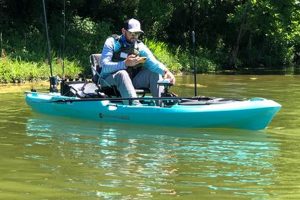
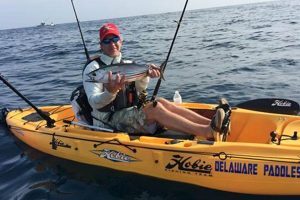
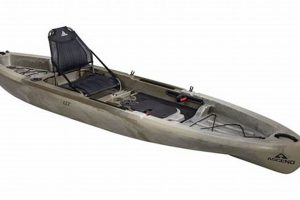
The ideal measurement of a fishing rod designed for use in a kayak is a crucial factor influencing casting performance, maneuverability, and overall fishing success in this specialized environment. A kayak angler contends with limited space and unique challenges related to stability and storage. For example, a shorter measurement provides better control in close quarters, while a longer one allows for greater casting distance, highlighting the importance of selecting the correct tool for the specific fishing situation.
Appropriate equipment dimensions contribute significantly to angler comfort and efficiency. Historically, kayak anglers adapted existing fishing rods, but the growing popularity of the sport has led to the development of specialized equipment designed specifically for kayaks. The correct measurement optimizes casting accuracy and leverage while minimizing the risk of entanglement with the kayak or surrounding obstacles. This advancement benefits anglers by improving catch rates and enhancing the overall fishing experience.
This discussion will explore the factors influencing optimal equipment choices for kayak fishing, including target species, fishing techniques, and kayak size. Further sections will delve into specific recommendations for different fishing scenarios and provide guidance on selecting the perfect setup for maximized success on the water.
Tips for Selecting Appropriate Fishing Rod Lengths for Kayaks
Choosing the correct fishing rod length significantly impacts success and enjoyment while kayak fishing. These tips offer guidance for selecting appropriate equipment based on common kayak fishing scenarios.
Tip 1: Prioritize Maneuverability: Shorter rods, typically between 6 and 7 feet, are advantageous in confined kayak cockpits. These lengths offer superior control for accurate casts and efficient fish fighting in close quarters.
Tip 2: Consider Target Species: Longer rods (7-8 feet) are better suited for larger game fish requiring longer casts and heavier tackle. Shorter rods are ideal for smaller species like panfish or trout.
Tip 3: Match Fishing Technique: Techniques like vertical jigging or trolling often benefit from shorter rods, while casting lures or bait requires the extended reach of longer rods.
Tip 4: Factor in Kayak Width and Stability: Wider, more stable kayaks can accommodate longer rods more comfortably. Narrower kayaks may necessitate shorter rods for improved balance and control.
Tip 5: Account for Storage and Transportation: Two-piece or collapsible rods are practical for kayak anglers due to their ease of storage and transport.
Tip 6: Balance Rod Length with Line Weight: Ensure the chosen rod length complements the intended line weight for optimal performance. A longer rod may require heavier line to manage larger fish, while a shorter rod often pairs well with lighter line.
Tip 7: Test Before Committing: If possible, try different rod lengths before purchasing. Borrowing from friends or renting equipment can help determine the most comfortable and effective length for individual needs and kayak setups.
By considering these factors, anglers can select a fishing rod length that optimizes their kayak fishing experience. The right equipment contributes significantly to casting accuracy, fish fighting ability, and overall comfort on the water.
Ultimately, selecting the appropriate fishing rod length for a kayak involves careful consideration of individual needs, target species, and the specific fishing environment. The following section provides concluding recommendations and reinforces the importance of proper equipment selection for a successful and enjoyable kayak fishing adventure.
1. Casting Distance

Casting distance is a critical factor in kayak fishing, directly influencing the angler’s ability to reach target areas and present lures or bait effectively. The relationship between casting distance and fishing rod length is complex and nuanced, requiring careful consideration for optimal performance on the water.
- Rod Length and Leveraging:
Longer rods provide increased leverage, allowing anglers to generate higher line speed and propel lures farther. This advantage becomes particularly significant when targeting fish in open water or when needing to overcome obstacles like vegetation or structure. However, longer rods can be cumbersome in the confined space of a kayak.
- Line Weight and Casting Performance:
The chosen line weight interacts with rod length to impact casting distance. Heavier lines are typically used with longer rods to handle larger fish, but they can also reduce casting distance. Lighter lines, often paired with shorter rods, improve casting distance but may limit the size of fish that can be effectively landed.
- Casting Technique and Rod Control:
Effective casting technique plays a crucial role in maximizing distance, regardless of rod length. Proper form and timing are essential for smooth, controlled casts that minimize line tangles and maximize distance. Shorter rods often allow for greater casting accuracy in tight spaces, compensating for the reduced leverage compared to longer rods.
- Kayak Stability and Casting Distance:
Kayak stability influences casting distance, particularly when using longer rods. A stable kayak provides a solid platform for casting, allowing anglers to generate more power and control. Conversely, an unstable kayak can hinder casting performance and even lead to capsizing, particularly when attempting long casts with a heavier rod.
The ideal rod length for maximizing casting distance in a kayak depends on a delicate balance of factors. Anglers must carefully consider the target species, fishing environment, kayak stability, and personal casting technique when choosing the appropriate rod length. While longer rods generally offer greater casting potential, shorter rods provide increased control and maneuverability, essential considerations in the confined space of a kayak. The ultimate goal is to select a rod length that optimizes casting performance while maintaining kayak stability and control.
2. Maneuverability

Maneuverability in a kayak significantly influences fishing rod length selection. Kayak anglers operate within a limited space, often surrounded by obstacles such as overhanging branches, submerged logs, or other vegetation. Rod length directly impacts the angler’s ability to cast and retrieve effectively within these constraints. A shorter rod, typically between six and seven feet, offers superior maneuverability compared to a longer rod, particularly in tight quarters. For example, navigating a narrow, mangrove-lined creek requires precise rod control, making a shorter rod essential for accurate casts and tangle-free retrievals. Conversely, a longer rod, while advantageous for casting distance in open water, can become cumbersome and unwieldy in confined spaces, hindering the angler’s ability to present lures effectively or manage hooked fish.
The importance of maneuverability extends beyond casting and retrieving. Landing a fish in a kayak necessitates efficient rod handling to control the fish and guide it towards the net or hand landing. Shorter rods provide enhanced leverage and control during this critical phase, minimizing the risk of tangling the line or losing the fish due to restricted movement. Consider battling a strong fish near a snag-filled area; a shorter rod allows for quicker adjustments and more precise control, increasing the likelihood of a successful landing. Furthermore, maneuverability contributes to overall safety in a kayak. A shorter rod reduces the risk of entanglement with gear or the kayak itself, especially in challenging conditions such as wind or currents. This enhanced control helps maintain balance and stability, critical factors for a safe and enjoyable kayak fishing experience.
In summary, maneuverability plays a pivotal role in kayak fishing, directly influencing the appropriate rod length. Shorter rods offer distinct advantages in confined spaces, facilitating accurate casting, efficient fish fighting, and enhanced safety. While longer rods excel in open-water scenarios where casting distance is paramount, the limited space and unique challenges of kayak fishing often prioritize maneuverability, making shorter rods the preferred choice for many kayak anglers. The selection process requires a careful assessment of the fishing environment, target species, and personal preferences to achieve the optimal balance between maneuverability and casting performance.
3. Fish Fighting Power

Fish-fighting power, the ability to effectively control and land a hooked fish, is significantly influenced by rod length in the context of kayak fishing. Shorter rods generally offer increased leverage, allowing anglers to exert more pressure on the fish and reduce the duration of the fight. This leverage advantage becomes crucial when battling strong fish in close proximity to the kayak, minimizing the risk of line breakage or the fish wrapping around obstacles. For example, a shorter rod provides superior control when wrestling a powerful saltwater species near a mangrove root system, increasing the chances of a successful landing.
Conversely, longer rods, while advantageous for casting distance, can compromise fish-fighting power due to reduced leverage. The increased length amplifies the force exerted by the fish, potentially leading to angler fatigue and decreased control. This disadvantage becomes particularly apparent when battling large, powerful fish in open water. Consider a scenario involving a large tuna hooked on a long rod from a kayak; the angler’s ability to effectively manage the fish’s runs and exert sufficient pressure to bring it to the boat is significantly hampered by the rod’s length. Therefore, selecting an appropriate rod length requires carefully balancing casting distance requirements with the need for adequate fish-fighting power. The target species and fishing environment play crucial roles in this decision.
Rod action, the rod’s bending characteristic, interacts with length to influence fish-fighting power. A faster action rod, typically stiffer, offers greater lifting power and control, beneficial for quickly subduing strong fish. Combined with a shorter length, this setup maximizes leverage and control, ideal for targeting powerful species in close quarters. In contrast, a slower action rod, while offering more forgiving hooksets and a smoother fight, may lack the lifting power necessary for efficiently landing larger fish from a kayak. Understanding the interplay between rod length, action, and fish-fighting power is crucial for selecting the optimal setup for a specific fishing scenario, enhancing the likelihood of landing the target species while maintaining control and safety in the kayak.
4. Kayak Stability
Kayak stability is a paramount consideration when determining appropriate fishing rod length. Stability, influenced by kayak width, hull design, and weight distribution, directly impacts an angler’s ability to cast, retrieve, and fight fish effectively. A stable kayak provides a secure platform for casting, allowing for controlled movements and minimizing the risk of capsizing, especially when using longer rods that require more sweeping motions. Conversely, an unstable kayak, particularly a narrower model or one with a higher center of gravity, necessitates shorter rods for enhanced balance and control. For example, attempting a long cast with a 7-foot rod from a narrow, tippy kayak significantly increases the risk of capsizing, whereas a shorter rod allows for a more controlled cast within the kayak’s stability limits. Choosing a rod length that complements kayak stability ensures a safe and productive fishing experience.
The interplay between kayak stability and rod length becomes particularly critical during the fish-fighting process. Landing a large, energetic fish from a kayak requires careful management of balance and leverage. A shorter rod offers improved control and reduces the likelihood of the kayak tipping during the fight. Consider the scenario of hooking a strong fish near submerged structure; a shorter rod allows for quicker adjustments and more precise movements, minimizing the risk of capsizing while maintaining pressure on the fish. Longer rods, while offering greater casting distance, can exacerbate instability during a fight, especially in challenging conditions like wind or current. Matching rod length to kayak stability optimizes control and minimizes the risk of losing both the fish and balance.
Ultimately, achieving optimal performance and safety in kayak fishing requires careful consideration of kayak stability in relation to rod length. Anglers should assess their kayak’s stability characteristics, including width, hull design, and weight capacity, when selecting a rod length. Prioritizing stability contributes significantly to casting accuracy, fish-fighting control, and overall safety on the water. Failing to account for stability can compromise performance and create potentially hazardous situations. Careful selection of rod length based on kayak stability ensures a balanced and enjoyable fishing experience.
5. Target Species

Target species significantly influence appropriate rod length for kayak fishing. Species-specific behaviors, habitat preferences, and fighting characteristics necessitate tailored equipment choices. For instance, pursuing smaller, agile species like panfish or trout in confined, vegetated areas often favors shorter rods (5-7 feet). These shorter lengths provide enhanced maneuverability and control for precise casts and delicate presentations in tight quarters. Conversely, targeting larger, more powerful species such as bass, pike, or inshore saltwater fish like redfish or snook typically necessitates longer rods (7-8 feet or more) to manage heavier lines, achieve longer casts, and provide the necessary backbone for controlling strong runs and headshakes. Matching rod length to the target species’ typical size and fighting ability optimizes angler performance and increases the likelihood of a successful landing.
Consider the practical application of this principle. Anglers targeting smallmouth bass in a rocky, riverine environment benefit from a medium-length rod (6-7 feet) that balances casting accuracy with sufficient fish-fighting power. This length allows for precise presentations under overhanging branches or around submerged boulders while providing enough strength to manage the bass’s spirited fight in the current. Alternatively, an angler pursuing large tarpon in open, nearshore waters requires a much longer, heavier rod (8-9 feet) to cast large flies or lures long distances and withstand the tarpon’s powerful runs and acrobatic leaps. The extended length provides the necessary leverage and backbone for controlling the fish and preventing line breakage during prolonged fights.
Matching rod length to target species optimizes angler performance and enhances the kayak fishing experience. Understanding the target species’ behavior, habitat preferences, and fighting abilities allows anglers to select the appropriate rod length for effective presentations, efficient fish fighting, and increased success on the water. This targeted approach maximizes the chances of landing the desired species while maintaining control and safety in the dynamic kayak fishing environment.
Frequently Asked Questions
This section addresses common inquiries regarding appropriate fishing rod lengths for kayak angling.
Question 1: What is the most versatile rod length for kayak fishing?
While no single length suits all situations, a 7-foot rod often provides a balance between casting distance and maneuverability, making it suitable for various species and techniques.
Question 2: Are shorter rods always better for kayak fishing?
Shorter rods excel in tight spaces and offer increased control, but they may limit casting distance, making longer rods preferable in open water or when targeting larger species.
Question 3: How does kayak stability influence rod length choice?
Kayak stability is paramount. Less stable kayaks benefit from shorter rods for maintaining balance, while wider, more stable platforms accommodate longer rods comfortably.
Question 4: Can longer rods be used effectively in a kayak?
Longer rods enhance casting distance but can compromise maneuverability and stability. Careful consideration of the fishing environment and kayak type is essential.
Question 5: What role does target species play in rod length selection?
Target species significantly influences rod length. Smaller species in confined areas often require shorter rods, while larger species in open water necessitate longer rods for increased casting distance and lifting power.
Question 6: Are two-piece rods recommended for kayak fishing?
Two-piece or collapsible rods are highly practical for kayak angling due to their ease of transport and storage in confined spaces.
Careful consideration of these factors ensures appropriate rod length selection, optimizing performance and safety on the water. Anglers are encouraged to evaluate individual needs and fishing conditions when making equipment choices.
The subsequent section delves into specific rod and reel combinations recommended for various kayak fishing scenarios.
Rod Length for Kayak Fishing
Appropriate rod length selection significantly impacts kayak fishing success. Factors such as kayak stability, target species, fishing environment, and casting distance requirements necessitate careful consideration. Shorter rods prioritize maneuverability and control in tight spaces, while longer rods enhance casting distance in open water. Balancing these factors against the target species’ size and fighting characteristics ensures optimal performance. Choosing a rod length that complements both kayak stability and fishing style is essential for a safe and productive experience.
Ultimately, successful kayak angling necessitates a holistic approach to equipment selection. Rod length, a critical component of this equation, must be carefully evaluated in relation to the angler’s specific needs and the dynamic kayak fishing environment. A well-informed decision regarding rod length enhances casting accuracy, fish-fighting efficiency, and overall enjoyment on the water. Continued exploration of rod and reel combinations, fishing techniques, and kayak-specific strategies further elevates angler expertise and promotes responsible engagement with the sport.