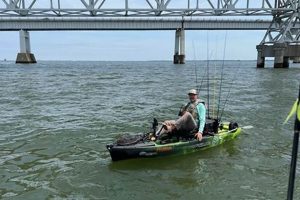
Specialized insulated containers designed for use aboard kayaks provide anglers with a portable means of preserving their catch, bait, and refreshments. These containers often feature specific design elements like tie-down points, recessed handles, and specialized storage compartments tailored for fishing gear.
The ability to maintain a low temperature for perishable goods on the water is critical for both successful fishing trips and food safety. A fresh catch can be kept in optimal condition for later consumption or proper release, while bait remains viable, maximizing fishing opportunities. Historically, anglers relied on less effective methods like damp burlap sacks or basic ice chests, but purpose-built insulated containers represent a significant advancement in on-the-water convenience and effectiveness.
This article will further explore key considerations for selecting these essential pieces of equipment, including size, features, construction materials, and popular brands.
Tips for Selecting Onboard Refrigeration
Choosing appropriate onboard refrigeration is crucial for a successful and enjoyable fishing experience. Careful consideration of various factors ensures optimal performance and longevity.
Tip 1: Size and Capacity: Assess anticipated storage needs based on typical trip length and catch size. Oversized units sacrifice valuable kayak space, while insufficient capacity limits storage potential.
Tip 2: Insulation Quality: Prioritize superior insulation for extended ice retention. Consider models with thicker walls and robust lid seals to maximize cooling efficiency.
Tip 3: Secure Mounting: Ensure the chosen unit can be securely fastened to the kayak to prevent shifting or loss during navigation. Integrated tie-down points and compatible mounting systems are essential.
Tip 4: Durability and Construction: Opt for robust materials designed to withstand the rigors of the marine environment. UV resistance and impact-resistant construction minimize damage from sunlight and potential impacts.
Tip 5: Drainage Features: Efficient drainage systems simplify cleaning and prevent water accumulation within the cooler. Look for strategically placed drain plugs and channels for easy emptying.
Tip 6: Additional Features: Consider features like integrated cutting boards, storage compartments, and cup holders to enhance functionality and convenience on the water.
Tip 7: Price and Value: Evaluate the features and benefits of various models against their respective costs to determine the best value for individual needs.
By carefully considering these factors, anglers can select an onboard refrigeration solution that enhances their fishing experience by preserving catches, keeping bait fresh, and providing convenient access to refreshments.
These tips provide a foundation for informed decision-making when selecting onboard refrigeration, contributing to a more successful and enjoyable kayaking fishing experience overall.
1. Capacity

Cooler capacity is a critical factor in kayak fishing, directly impacting the success and enjoyment of outings. Adequate storage volume is essential for preserving catch freshness, maintaining bait viability, and accommodating provisions. Insufficient capacity can lead to spoilage, limiting the practicality of storing fish for consumption or necessitating premature trips back to shore. For example, a smaller cooler might suffice for short trips targeting panfish, while larger game fish like salmon or tuna demand significantly greater storage space. Conversely, excessive capacity adds unnecessary weight and consumes valuable kayak space, impacting stability and maneuverability.
Balancing capacity with other essential factors, such as insulation and portability, is crucial. A larger cooler with superior insulation might be ideal for multi-day expeditions, whereas shorter trips might prioritize portability. Determining the appropriate capacity requires careful consideration of typical trip duration, target species size, and individual storage preferences. Calculations should account for the volume needed for both intended catch and other essential items like ice, food, and beverages. Practical considerations include anticipated weather conditions, which can influence ice melt rates and therefore required storage volume.
Careful capacity selection ensures efficient use of limited kayak space while maximizing functionality. Understanding individual needs, considering typical fishing scenarios, and anticipating potential challenges all contribute to informed decisions regarding cooler capacity. The appropriate balance directly influences the success and overall enjoyment of kayak fishing experiences.
2. Insulation
Insulation represents a critical performance characteristic in kayak fishing coolers. The ability to maintain low internal temperatures directly impacts the viability of stored items, especially catch and bait. Effective insulation minimizes heat transfer, preserving ice and extending the lifespan of perishables. Inadequate insulation can lead to rapid ice melt, compromising the quality of stored fish and rendering bait ineffective. For example, a poorly insulated cooler exposed to direct sunlight on a summer fishing trip may result in spoiled catch and unusable bait within hours. Conversely, a well-insulated cooler maintains optimal conditions for extended periods, even in challenging environments. The type and thickness of insulation material significantly impact performance. Common insulation materials include rotomolded plastic, which offers superior durability and ice retention, and injected molded plastic, generally a more budget-friendly option with slightly lower insulation properties.
The practical significance of proper insulation extends beyond preserving catch and bait. Maintaining low temperatures is crucial for food safety, preventing bacterial growth and ensuring consumables remain safe for consumption throughout the fishing trip. Cooler insulation also plays a role in energy efficiency, reducing the need for frequent ice replenishment. This translates to less frequent trips ashore and more time focused on fishing. Selecting a cooler with appropriate insulation for anticipated conditionslength of trip, ambient temperature, and level of sun exposuremaximizes its effectiveness and contributes to a more successful and enjoyable experience.
In summary, insulation performance directly impacts the practicality and success of kayak fishing excursions. Choosing the right insulation material and thickness ensures catch preservation, bait viability, and food safety. This selection process should align with anticipated trip conditions and individual storage needs. Prioritizing insulation contributes to overall efficiency and enhances the enjoyment of time spent on the water.
3. Security
Secure storage of onboard refrigeration is paramount in kayak fishing. Unsecured coolers risk shifting during maneuvers, potentially impacting kayak stability and even resulting in loss overboard. Ensuring cooler stability safeguards both equipment and the overall fishing experience. Several key factors contribute to effective cooler security on a kayak.
- Attachment Points:
Integrated tie-down points on the cooler itself are essential for secure attachment. These points should be robustly constructed to withstand stress. Durable straps or bungee cords are used to lash the cooler to designated anchor points on the kayak. Multiple attachment points offer greater stability, particularly in rough conditions. Insufficient or poorly designed attachment points compromise security and increase the risk of cooler displacement.
- Kayak Compatibility:
Cooler dimensions and design should align with the kayak’s layout. A cooler that fits snugly within designated recesses or against the kayak’s hull enhances stability. Compatibility also involves considering the placement of attachment points on both the cooler and kayak, ensuring accessible and secure connection points. An incompatible cooler may shift during paddling or maneuvering, creating instability.
- Environmental Factors:
Weather conditions and water movement influence cooler security. Strong winds and waves can exacerbate cooler movement, stressing attachment points. In challenging environments, additional securing measures may be necessary. For example, adding supplementary straps or using a dedicated cooler anchoring system enhances security in rough water.
- Weight Distribution:
Proper weight distribution within the kayak is crucial. An unevenly loaded cooler, or one placed too high on the deck, can compromise stability. Distributing weight evenly low in the kayak’s hull maximizes balance and reduces the risk of capsizing. An overloaded cooler combined with improper weight distribution significantly increases instability risks.
Prioritizing cooler security through appropriate attachment mechanisms, considering kayak compatibility, and accounting for environmental factors are crucial for a safe and productive fishing trip. Failure to adequately secure onboard refrigeration can lead to equipment loss, compromised stability, and ultimately, a less enjoyable experience.
4. Durability
Durability is a paramount concern in kayak fishing coolers, given the demanding conditions these products endure. Exposure to the marine environment, including saltwater, UV radiation, and physical impacts, necessitates robust construction. A durable cooler retains its structural integrity and insulating properties over extended periods, providing reliable performance and value. Cooler failure can jeopardize a fishing trip, leading to spoilage of catch and bait, impacting not only the angler’s success but also potentially creating food safety concerns.
Several factors contribute to cooler durability. Material selection plays a crucial role. High-quality, UV-resistant plastics, such as rotomolded polyethylene, offer superior impact resistance and long-term resilience against environmental degradation. Hardware, including hinges, latches, and handles, should be corrosion-resistant and robustly designed to withstand repeated use and stress. Construction methods also influence durability. Seamless, one-piece construction eliminates potential leak points and weak areas susceptible to cracking or breakage. Reinforced corners and lids further enhance impact resistance. For example, a cooler constructed from thin, brittle plastic with inadequate hardware is unlikely to withstand the rigors of regular kayak fishing, potentially failing prematurely. In contrast, a rotomolded cooler with heavy-duty hardware provides years of reliable service, even under challenging conditions.
Investing in a durable kayak fishing cooler represents a long-term value proposition. While initial costs may be higher for robustly constructed models, their extended lifespan and reliable performance offset the investment. Reduced maintenance, less frequent replacement needs, and the avoidance of trip disruptions due to cooler failure contribute to the overall value. Durability directly influences the practicality, success, and enjoyment of kayak fishing experiences.
5. Portability

Portability is a critical factor influencing the practicality and enjoyment of kayak fishing. Transporting a cooler to and from the kayak, often across varying terrain, requires manageable size and weight. Overly cumbersome coolers impede mobility and detract from the overall experience. Balancing storage capacity with portability is essential for optimizing on-the-water functionality without compromising ease of transport.
- Weight:
Cooler weight significantly impacts portability. Heavier coolers, especially when fully loaded, become difficult to manage, particularly when launching or landing a kayak. Empty weight and potential loaded weight should be considered in relation to individual carrying capacity and the terrain typically encountered. A lightweight cooler constructed from materials like high-density polyethylene offers a balance between durability and manageable weight.
- Dimensions and Shape:
Cooler dimensions and shape influence both portability and kayak compatibility. Compact, streamlined designs facilitate easier transport and maneuverability. Oversized coolers, even if lightweight, can be awkward to handle and may not fit securely within the kayak’s confines. A cooler’s dimensions should be assessed in relation to available storage space and the angler’s physical stature.
- Carrying Features:
Integrated carrying features, such as comfortable handles and shoulder straps, enhance portability. Recessed handles minimize snag points and streamline the cooler’s profile. Padded shoulder straps distribute weight evenly, reducing strain during transport. A cooler lacking appropriate carrying features can be cumbersome and uncomfortable to carry, particularly over longer distances.
- Integration with Kayak:
Cooler integration with the kayak itself influences portability. Wheeled coolers or those with integrated kayak cart compatibility simplify transport to and from the launch site. Specialized mounting systems allow for quick and secure attachment to the kayak, further enhancing portability. Conversely, coolers lacking these features may require separate transport systems, increasing complexity and effort.
Careful consideration of these portability factors ensures a seamless transition from land to water. Balancing storage capacity, weight, and carrying features contributes to a more enjoyable and efficient kayak fishing experience, allowing anglers to focus on the sport rather than logistical challenges.
Frequently Asked Questions
This section addresses common inquiries regarding specialized onboard refrigeration for kayak angling.
Question 1: What size cooler is optimal for kayak fishing?
Optimal cooler size depends on individual needs, including trip duration, target species, and storage requirements beyond catch. Smaller coolers suffice for short trips and smaller fish, while larger game or longer expeditions necessitate greater capacity. Balance capacity with available kayak space and weight limitations.
Question 2: What type of insulation provides the best ice retention?
Rotomolded construction generally offers superior ice retention due to its uniform thickness and density. Less expensive options, like injection-molded coolers, provide adequate insulation for shorter trips but may sacrifice long-term ice retention.
Question 3: How can cooler security be maximized on a kayak?
Utilize integrated tie-down points and durable straps or bungee cords to secure the cooler to designated anchor points on the kayak. Ensure compatibility between cooler dimensions and kayak layout for a snug fit. Consider additional securing measures in rough conditions.
Question 4: What features enhance cooler durability in marine environments?
UV-resistant, impact-resistant materials like rotomolded polyethylene contribute to cooler longevity. Corrosion-resistant hardware, including hinges and latches, is crucial. Seamless, one-piece construction minimizes weak points susceptible to damage.
Question 5: How can cooler portability be improved?
Consider cooler weight, dimensions, and carrying features like comfortable handles and shoulder straps. Integrated wheels or kayak cart compatibility simplify transport. Balance storage capacity with manageable weight and size for optimal portability.
Question 6: How does cooler selection impact the overall kayak fishing experience?
Appropriate cooler selection directly influences catch preservation, bait viability, and overall trip enjoyment. Balancing capacity, insulation, security, durability, and portability ensures optimal functionality and enhances time spent on the water.
Careful consideration of these factors ensures informed decision-making and contributes to a more successful and enjoyable kayak fishing experience.
The subsequent section will delve into recommended cooler models and brands suitable for various kayak fishing applications.
Conclusion
Effective onboard refrigeration is paramount for successful kayak angling. Considerations encompassing capacity, insulation, security, durability, and portability are crucial for selecting appropriate equipment. Balancing these factors ensures preserved catch, viable bait, and enhanced on-the-water experiences. Prioritizing informed decision-making regarding these specialized containers directly contributes to optimized fishing outcomes.
Strategic equipment choices empower anglers to maximize their time on the water. Investing in reliable, purpose-built refrigeration solutions elevates the kayak fishing experience, enabling anglers to focus on the pursuit of their target species while ensuring the responsible handling of their catch. The future of kayak fishing relies on mindful equipment selection that balances functionality, sustainability, and respect for the environment.