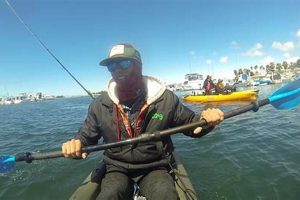
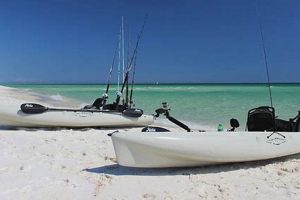
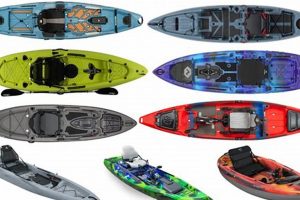
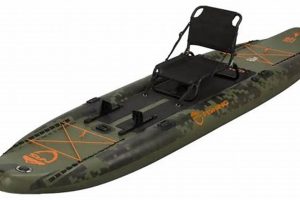
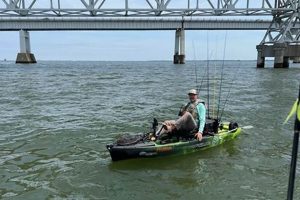
Adapting a standard kayak for angling involves adding specialized equipment and making modifications to enhance its functionality for fishing. This might include installing rod holders, mounting fish finders, creating storage for tackle, and incorporating anchor systems. For example, a recreational kayak can be transformed into a fishing platform by adding a few strategically placed rod holders and a small anchor trolley system.
Creating a fishing-specific vessel from a conventional kayak offers significant advantages, primarily increased stability, improved organization, and enhanced fishing efficiency. Anglers benefit from hands-free fishing, readily accessible gear, and a platform specifically designed for the demands of their sport. This adaptation has become increasingly popular as kayaking and fishing have grown individually, combining into a favored recreational activity. Historically, anglers relied on more traditional boats; however, the adaptability of kayaks has presented a cost-effective and versatile alternative.
The following sections will explore the key considerations and methods involved in converting a standard kayak into a personalized fishing craft, encompassing equipment choices, installation techniques, safety measures, and popular modifications.
Tips for Kayak Fishing Conversions
Careful planning and execution are essential for transforming a regular kayak into an effective fishing platform. The following tips offer guidance for a successful conversion.
Tip 1: Assess Kayak Compatibility: Evaluate the kayak’s hull design and stability. Wider, flatter hulls offer greater stability, crucial for fishing activities. Consider the kayak’s weight capacity to ensure it can accommodate the added weight of fishing gear and potential catches.
Tip 2: Prioritize Rod Holders: Select appropriate rod holders based on fishing style and rod types. Flush-mounted rod holders offer a streamlined profile, while adjustable rod holders provide flexibility. Consider the optimal number and placement for easy access and casting.
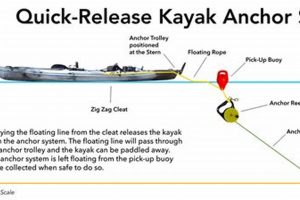
Tip 3: Integrate an Anchor System: An anchor system is essential for maintaining position in currents or wind. Anchor trolleys allow for controlled anchor deployment from various points on the kayak, maximizing fishing coverage. Consider anchor size and type based on fishing locations.
Tip 4: Optimize Storage Solutions: Integrate storage solutions for tackle boxes, tools, and personal items. Consider waterproof storage compartments or dry bags to protect gear from water damage. Strategic placement of storage maximizes space efficiency.
Tip 5: Install a Fish Finder (Optional): A fish finder provides valuable underwater insights, aiding in locating fish and identifying suitable habitats. Choose a fish finder with appropriate features and mounting options compatible with the kayak.
Tip 6: Ensure Safety Equipment: Prioritize safety by including essential equipment such as a personal flotation device (PFD), a whistle, and a first-aid kit. Consider adding navigation lights and communication devices for enhanced safety, particularly in low-light conditions.
Tip 7: Plan Cable Management: If installing electronic devices, plan cable routing carefully to minimize clutter and prevent entanglement. Use cable ties or clips to secure wiring and maintain a clean, organized setup.
By addressing these key areas, a standard kayak can be effectively transformed into a customized fishing platform, enhancing angling experiences and maximizing on-the-water success. These modifications improve both functionality and enjoyment on the water.
The final section will summarize key considerations and offer concluding insights into converting a standard kayak into a dedicated fishing vessel.
1. Planning

Successful kayak fishing conversions hinge on thorough planning. A well-defined plan ensures compatibility between the kayak and intended modifications, maximizing functionality and fishing enjoyment. Pre-conversion planning minimizes potential issues and optimizes resource allocation.
- Assessing Kayak Compatibility
Evaluating the kayak’s design, stability, and weight capacity is crucial. A stable hull is essential for fishing activities. Weight capacity dictates the amount of gear and potential catch the kayak can safely handle. For instance, a recreational kayak designed for calm waters may not be suitable for ocean fishing due to stability limitations.
- Defining Fishing Style and Needs
Identifying target fish species and preferred fishing techniques informs equipment choices. Trolling requires different rod holders and storage solutions compared to fly fishing. Understanding specific needs ensures appropriate modifications, preventing unnecessary expenses and enhancing fishing effectiveness. An angler targeting large pelagic species will require heavier-duty equipment than someone fishing for panfish.
- Budgeting and Resource Allocation
Establishing a budget prevents overspending and guides equipment choices. Prioritizing essential modifications ensures efficient resource allocation. Researching prices and comparing options maximizes value. Choosing cost-effective alternatives, like DIY rod holders, can significantly reduce overall expenses.
- Creating a Modification Roadmap
Developing a step-by-step plan ensures efficient execution. This roadmap outlines the sequence of modifications, from installing rod holders to integrating an anchor system. A clear plan minimizes errors and ensures a streamlined conversion process. This might involve creating a visual diagram of the planned layout.
Careful planning in these areas creates a strong foundation for a successful kayak fishing conversion. A well-planned conversion enhances functionality, safety, and overall fishing enjoyment. This ultimately translates to a more productive and rewarding on-the-water experience.
2. Stability
Stability forms a cornerstone of successful kayak fishing conversions. A stable platform is essential for casting, reeling, and landing fish, especially in challenging conditions. Compromised stability can lead to capsizing, jeopardizing both angler safety and equipment. The relationship between stability and converting a regular kayak into a fishing kayak is directly proportional: enhanced stability translates to increased fishing efficacy and safety. A stable kayak allows anglers to focus on fishing rather than constantly correcting balance, crucial when handling rods, tackle, and potentially struggling fish.
Kayak stability is influenced by hull design, width, and weight distribution. Wider kayaks generally offer greater primary stabilityresistance to initial tipping. Longer kayaks possess superior secondary stabilityresistance to capsizing once tilted. Adding fishing gear and equipment alters weight distribution, impacting stability. Understanding these factors is crucial for choosing appropriate modifications. For example, adding outriggers can enhance stability on narrower kayaks, while strategically placing gear inside the hull can optimize weight distribution and prevent instability. Consider a scenario where an angler hooks a large fish; a stable kayak provides a secure platform for the ensuing fight, minimizing the risk of capsizing during the struggle.
Ensuring sufficient stability is paramount for safe and effective kayak fishing. Modifications should enhance, not compromise, stability. Careful consideration of kayak design, weight capacity, and added gear placement contributes to a stable and functional fishing platform. Neglecting stability can lead to dangerous situations, highlighting its critical role in successful kayak fishing conversions. A stable kayak ultimately allows for a more confident and enjoyable fishing experience, enabling anglers to fully focus on the sport.
3. Rod Holders

Rod holders constitute a fundamental component in converting a standard kayak into a dedicated fishing platform. They provide secure storage for fishing rods, freeing hands for paddling, navigating, and handling other fishing tasks. Without rod holders, anglers face the impracticality of constantly holding rods, significantly hindering maneuverability and increasing the risk of rod loss or damage. Consider trolling, where multiple lines are deployed; rod holders become essential for managing multiple rods simultaneously. Their presence directly addresses a core requirement of kayak fishingthe need for hands-free fishing.
Various rod holder types exist, each offering distinct advantages and disadvantages. Flush-mounted rod holders offer a streamlined profile, minimizing interference while paddling. Adjustable rod holders provide flexibility in rod positioning, accommodating diverse fishing techniques. Rail-mounted rod holders attach to existing kayak rails, offering versatile placement options. The choice depends on individual fishing styles and kayak configurations. For example, a fly fisherman might prefer an adjustable rod holder for optimal line management, while a troller might opt for multiple flush-mounted holders for a streamlined setup. The selection of appropriate rod holders directly impacts fishing efficiency and overall experience.
Effective rod holder placement is crucial for both functionality and safety. Positioning rod holders within easy reach allows for effortless rod retrieval and stowage. However, placement should not obstruct paddling or other essential movements. Careful consideration of fishing style, kayak layout, and potential interference factors informs optimal placement. Incorrect placement can lead to entanglement with paddles, lines, or other gear, highlighting the practical significance of thoughtful rod holder positioning. Ultimately, well-placed rod holders contribute significantly to a safe, efficient, and enjoyable kayak fishing experience.
4. Storage
Adequate storage is integral to converting a regular kayak into a fishing platform. Kayak fishing necessitates carrying various items, including tackle boxes, fishing tools, safety gear, and personal belongings. Without sufficient storage, these items become cumbersome, hindering movement and potentially compromising safety. Effective storage solutions directly impact organization, accessibility, and overall fishing efficiency. Consider a scenario where an angler needs to quickly access pliers to remove a hook; well-organized storage allows for immediate retrieval, minimizing stress and maximizing fishing time. Conversely, inadequate storage can lead to misplaced gear, wasted time searching for items, and potential safety hazards due to clutter.
Several storage options cater specifically to kayak fishing. Dry bags offer waterproof protection for sensitive items like electronics and clothing. Tackle boxes provide organized compartments for lures, hooks, and other small fishing accessories. Milk crates offer cost-effective storage solutions, readily adaptable for kayak use. Dedicated kayak fishing crates often feature integrated rod holders and other specialized compartments. Choosing appropriate storage solutions depends on individual needs and fishing styles. For example, a fly fisherman might prioritize waterproof storage for delicate flies, while a bass angler might opt for a larger tackle box with compartments for various lures. The selection of storage solutions directly impacts efficiency and enjoyment on the water.
Strategic storage placement maximizes space utilization and accessibility. Positioning frequently used items within easy reach minimizes disruption during fishing. Securing storage containers prevents shifting and potential loss of gear, particularly in rough conditions. Weight distribution also influences kayak stability, emphasizing the importance of balanced loading. For instance, placing heavier items closer to the center of gravity enhances stability. Understanding the interplay between storage placement, accessibility, and stability contributes significantly to a safe and efficient fishing experience. Ultimately, effective storage transforms a standard kayak into a well-organized and functional fishing platform, enabling anglers to focus on the sport rather than managing gear.
5. Anchor System

An anchor system plays a crucial role in converting a regular kayak into a dedicated fishing platform. Maintaining position in a chosen fishing spot is often essential for angling success, particularly in currents, wind, or near structure. Without an anchor system, the kayak drifts, hindering targeted fishing and potentially carrying the angler away from promising areas. The anchor system provides the necessary stability to focus on fishing techniques rather than constantly correcting position. For instance, when fishing near a reef or drop-off, an anchor prevents drift and allows precise presentation of bait or lures in the strike zone. In rivers or tidal flows, an anchor maintains position, allowing anglers to effectively fish a specific area without being swept downstream or away from the target location.
Various anchor systems exist, each with its advantages and disadvantages. Stake-out poles offer simplicity and shallow-water effectiveness, ideal for anchoring in rivers or lakes with soft bottoms. Folding grapnel anchors provide strong holding power in various bottom conditions, suitable for deeper water or stronger currents. Drift chutes control drift speed, effective in rivers or tidal flows where maintaining a slow, controlled drift is desirable. Anchor trolleys allow for controlled anchor deployment and retrieval from various points on the kayak, maximizing fishing coverage and adapting to changing wind or current directions. Choosing an appropriate anchor system depends on the specific fishing environment and kayak configuration. A kayak angler fishing in a fast-flowing river would likely benefit from a drift chute or stake-out pole for controlled drift, while an angler fishing in a deeper lake or ocean environment would benefit from a grapnel anchor and trolley system for maintaining a fixed position. The choice directly impacts fishing efficiency and safety.
Effective anchor system deployment and retrieval are essential for safe and efficient kayak fishing. Understanding proper techniques for setting and retrieving the anchor, considering factors like bottom type, current, and wind, minimizes potential complications and ensures secure anchoring. Improper deployment can lead to anchor entanglement or loss, while unsafe retrieval techniques can compromise stability. Integration with an anchor trolley system further enhances control and flexibility. Ultimately, a well-chosen and properly deployed anchor system enhances fishing effectiveness and safety, allowing anglers to focus on the sport and maximize their chances of success. It transforms a regular kayak into a stable and controllable fishing platform, a key element in a successful conversion.
6. Fish Finder
Integrating a fish finder significantly enhances a converted fishing kayak’s functionality. While not strictly essential, it provides a crucial informational advantage, transforming the kayak into a more sophisticated and effective fishing platform. Fish finders offer real-time underwater insights, enabling anglers to locate fish, identify underwater structures, and understand bottom compositioninformation directly impacting fishing success.
- Locating Fish
Fish finders utilize sonar technology to detect fish and display their location on a screen. This allows anglers to target specific areas holding fish, increasing efficiency and minimizing wasted time searching unproductive waters. Distinguishing between individual fish and schools, or identifying larger predatory fish near baitfish, provides valuable tactical information. This targeted approach enhances fishing success, particularly in larger bodies of water or unfamiliar locations.
- Identifying Underwater Structures
Identifying underwater structures like reefs, drop-offs, and submerged vegetation provides crucial insights into fish habitat. Fish often congregate around these structures, making them prime fishing locations. A fish finder’s ability to depict these features allows anglers to strategically target these high-potential areas. Understanding the contours and composition of the underwater landscape informs lure selection and retrieval techniques. This knowledge proves especially valuable in locations with complex underwater terrain.
- Understanding Bottom Composition
Determining bottom compositionwhether rocky, sandy, or muddyinforms lure selection and fishing strategy. Certain fish species prefer specific bottom types, and understanding this preference allows for more effective targeting. For instance, a rocky bottom might indicate the presence of species like snapper or grouper, influencing lure choices and retrieval techniques. A fish finder’s ability to differentiate between bottom types provides critical environmental context, enhancing decision-making.
- Enhancing Kayak Fishing Safety
While primarily used for locating fish, fish finders indirectly contribute to kayak fishing safety. By providing information on water depth and underwater obstacles, they help anglers avoid grounding or collisions. This is particularly relevant in unfamiliar waters or areas with changing tides. Knowledge of depth contours also allows for safer navigation and anchoring. In this respect, a fish finder contributes to a safer and more informed on-the-water experience.
By providing real-time underwater intelligence, a fish finder transforms a converted kayak into a more sophisticated fishing vessel. The ability to locate fish, identify structures, and understand bottom composition significantly enhances fishing effectiveness and contributes to a more informed and ultimately successful angling experience. This technological advantage elevates the kayak fishing experience beyond simply casting a line, providing a deeper understanding of the underwater environment and its inhabitants.
7. Safety Equipment

Safety equipment forms a critical component when converting a regular kayak into a fishing platform. The inherent risks associated with on-the-water activities are amplified when incorporating fishing elements, necessitating a heightened awareness of safety considerations. Adding fishing gear, such as rods and tackle, can affect stability, while the act of fishing itself introduces potential hazards like hook injuries or entanglement. Therefore, integrating appropriate safety equipment is paramount to mitigating these risks. For example, an angler unexpectedly hooking a large fish can be pulled off balance; a personal flotation device (PFD) becomes crucial in such a scenario, preventing potential drowning. Similarly, venturing further offshore in pursuit of fish increases the importance of carrying a signaling device like a whistle or flare, enabling communication in case of emergencies.
Several key safety items are particularly relevant for kayak fishing. A PFD is non-negotiable, providing essential buoyancy in case of capsizing. A first-aid kit equipped to handle common fishing-related injuries like hook punctures or cuts is vital. A whistle or air horn enables signaling for assistance in emergencies. Navigation lights become crucial for low-light conditions, enhancing visibility and preventing collisions. A communication device, such as a VHF radio or a waterproof cell phone, provides a lifeline in remote locations or during unforeseen circumstances. Consider a scenario where an angler experiences equipment failure or inclement weather far from shore; a communication device can summon assistance, ensuring a safe return. The absence of these precautions can transform minor incidents into life-threatening situations, underscoring the practical significance of prioritizing safety equipment.
Prioritizing safety equipment during kayak fishing conversions is not merely a recommendation; it’s a fundamental requirement. The potential consequences of neglecting safety precautions can be severe, ranging from minor injuries to life-threatening situations. Understanding the specific risks associated with kayak fishing and equipping oneself accordingly ensures a safe and enjoyable experience. Ultimately, a comprehensive approach to safety, including proper equipment selection and usage, transforms a converted kayak from a potential hazard into a secure and functional fishing platform. This proactive approach safeguards against unforeseen circumstances and enables anglers to fully appreciate the sport without compromising personal well-being.
Frequently Asked Questions
This section addresses common inquiries regarding kayak conversions for fishing, providing concise and informative responses.
Question 1: What type of kayak is best suited for conversion into a fishing kayak?
Sit-on-top kayaks are generally preferred for their stability, ease of entry and exit, and self-bailing capabilities. Sit-in kayaks can also be adapted, but stability considerations are paramount. Wider, flatter hulls offer enhanced stability for fishing activities.
Question 2: What is the estimated cost of converting a regular kayak for fishing?
Conversion costs vary significantly depending on chosen modifications and equipment. Basic conversions, involving rod holders and minimal storage solutions, can be achieved at lower costs. More advanced conversions incorporating fish finders, anchor trolleys, and specialized seating systems increase overall expenses. Careful budgeting and equipment selection control overall costs.
Question 3: Are DIY modifications recommended for kayak fishing conversions?
DIY modifications are possible for certain aspects, such as installing rod holders or adding storage solutions. However, modifications affecting structural integrity or involving complex electrical systems are best left to professionals. Prioritizing safety and ensuring proper installation techniques prevent potential complications.
Question 4: How does adding fishing gear affect kayak performance and stability?
Added weight from fishing gear impacts kayak performance and stability. Reduced maneuverability and slightly slower speeds are common. Maintaining a low center of gravity by distributing weight evenly enhances stability. Understanding weight capacity limitations ensures safe and efficient operation.
Question 5: Is it necessary to register or obtain permits for a converted fishing kayak?
Registration and permitting requirements vary by jurisdiction. Consulting local regulations ensures compliance with legal obligations. Some regions may require registration or specific permits for kayaks used in certain bodies of water or for specific fishing activities. Researching local regulations prevents potential legal issues.
Question 6: What essential safety precautions should one take while kayak fishing?
Wearing a PFD, carrying a communication device, and informing someone of fishing plans are crucial safety measures. Checking weather conditions before embarking and understanding local water hazards enhances safety. Carrying a first-aid kit and appropriate signaling devices mitigates potential risks. Prioritizing safety precautions ensures a responsible and enjoyable fishing experience.
Careful consideration of these frequently asked questions equips individuals with the knowledge necessary for informed decision-making regarding kayak fishing conversions. Understanding these aspects contributes to a safer, more efficient, and ultimately more rewarding fishing experience.
The following section offers concluding insights and recommendations for converting a standard kayak into a dedicated fishing platform.
Turning a Regular Kayak into a Fishing Kayak
Transforming a standard kayak into a dedicated fishing vessel involves careful planning and execution. Key considerations encompass stability, storage solutions, rod holder placement, anchor system integration, and the potential addition of electronic devices like fish finders. Prioritizing safety equipment remains paramount throughout the conversion process. Understanding kayak compatibility with intended modifications ensures a functional and efficient fishing platform. Strategic equipment choices and thoughtful placement maximize space utilization and enhance on-the-water performance. Addressing these elements contributes significantly to a successful conversion, optimizing both functionality and fishing enjoyment.
Adapting a kayak for fishing presents a cost-effective and versatile approach to enjoying this popular recreational activity. Careful consideration of individual fishing styles, target species, and local waterway characteristics informs appropriate modifications. A well-equipped and thoughtfully modified kayak enhances angling opportunities and contributes to a more rewarding experience. Ultimately, the transformation process empowers anglers to create personalized fishing platforms tailored to their specific needs and preferences, fostering greater enjoyment and success on the water.