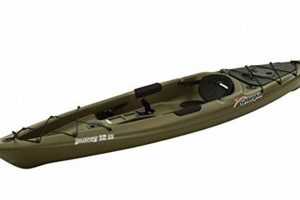
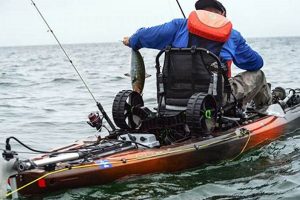
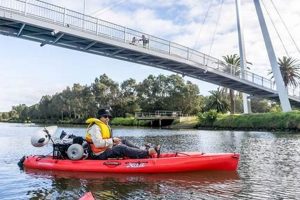
High-speed, human-powered watercraft designed for angling represent a specialized niche within the broader kayaking market. These vessels prioritize efficient hull designs and lightweight construction to maximize speed and maneuverability while retaining stability and sufficient storage for fishing gear. Examples include designs with longer waterlines, narrower beams, and features minimizing drag.
Rapid on-water transportation allows anglers to cover more water, reach distant fishing spots quickly, and exploit fleeting opportunities like schooling fish or changing tides. This efficiency can translate to increased fishing success. Historically, fishing kayaks prioritized stability and load capacity over speed. However, advancements in materials and hull design now allow manufacturers to create kayaks that excel in both areas, offering anglers a significant advantage on the water.
The following sections will explore the key factors influencing performance in these specialized kayaks, including hull design, materials, propulsion systems, and essential features for anglers.
Tips for Selecting a High-Performance Fishing Kayak
Choosing a kayak optimized for both speed and fishing requires careful consideration of several key factors. The following tips offer guidance for selecting a suitable vessel.
Tip 1: Prioritize Hull Design: Longer, narrower hulls generally offer greater speed and tracking ability, while shorter, wider hulls provide enhanced stability. Consider individual needs and paddling conditions when selecting a hull design. A “V” shaped hull is known for speed, while a flatter hull is often more stable.
Tip 2: Evaluate Construction Materials: Lightweight materials like fiberglass and carbon fiber contribute to higher speeds but often come at a premium. Thermoformed plastics offer a balance of durability and affordability. Consider the trade-offs between weight, durability, and cost.
Tip 3: Consider Propulsion Options: While paddling remains the primary means of propulsion, pedal-powered kayaks offer hands-free operation and potential speed advantages. Evaluate the pros and cons of each system based on individual fishing styles and preferences.
Tip 4: Assess Storage Capacity: Ensure adequate storage for fishing gear, including rods, tackle boxes, and safety equipment. Consider specialized storage features like rod holders, dry hatches, and integrated tackle management systems.
Tip 5: Factor in Seating Comfort: Long hours on the water necessitate a comfortable and supportive seat. Look for adjustable seating systems that provide adequate back support and cushioning.
Tip 6: Test Before Purchasing: Whenever possible, test paddle different models before making a purchase. This allows for direct assessment of speed, stability, and overall comfort.
Tip 7: Consider Water Conditions: Think about the typical water conditions encountered. A longer kayak is better suited for larger, open water while a shorter kayak might be more maneuverable in rivers or creeks.
By carefully evaluating these factors, anglers can select a kayak that maximizes both speed and fishing functionality. A well-chosen vessel contributes significantly to overall fishing success and enjoyment on the water.
In conclusion, selecting a high-performance fishing kayak requires careful consideration of design, materials, features, and intended use. The insights provided here aim to empower informed decision-making and contribute to a more rewarding angling experience.
1. Hull Design

Hull design plays a pivotal role in determining the speed and efficiency of a paddling fishing kayak. Several key design features contribute significantly to hydrodynamic performance. A longer waterline generally correlates with increased potential speed, as it reduces frictional resistance. Narrower beam widths minimize drag, particularly at higher speeds. A displacement hull, characterized by a pointed bow and a rounded or “V” shaped bottom, slices through the water efficiently, prioritizing speed over stability. Conversely, a flatter hull, often found in recreational kayaks, enhances stability but sacrifices speed due to increased water resistance.
Consider a comparison between two hypothetical kayaks: one with a long, narrow displacement hull and another with a shorter, wider, flatter hull. Under identical paddling conditions, the kayak with the displacement hull will achieve and maintain higher speeds due to reduced drag and a longer waterline. The wider, flatter hull, while offering more stability, will encounter greater resistance, limiting its speed potential. Real-world examples include racing kayaks, which prioritize speed with long, narrow hulls, compared to recreational kayaks, which favor stability with wider, flatter designs.
Understanding the impact of hull design is crucial for selecting a fishing kayak optimized for speed. While stability remains important for fishing activities, prioritizing a hull design that minimizes drag and maximizes waterline length allows anglers to cover more water efficiently. This understanding allows for informed decisions based on individual needs and priorities, balancing speed, stability, and fishing functionality. It also provides context for evaluating manufacturer claims and understanding the trade-offs inherent in different hull designs.
2. Paddle Selection

Paddle selection significantly impacts the speed and efficiency of a fastest paddling fishing kayak. An appropriate paddle maximizes power transfer and minimizes energy expenditure, contributing directly to on-water performance. Choosing the right paddle involves considering blade shape, shaft material, length, and feather angle.
- Blade Shape
Blade shape influences water displacement and propulsion. High-angle blades, with a shorter, wider profile, generate more power per stroke, ideal for higher speeds and shorter distances. Low-angle blades, longer and narrower, are better suited for endurance paddling and covering greater distances with less exertion. Asymmetrical blades, with a curved or dihedral shape, reduce flutter and enhance stroke efficiency. For instance, a high-angle blade provides rapid acceleration, while a low-angle blade is better for maintaining cruising speed.
- Shaft Material
Shaft material affects paddle weight, stiffness, and overall performance. Lightweight materials like carbon fiber reduce fatigue and increase paddling cadence. Fiberglass shafts offer a balance of durability and affordability. Aluminum shafts, while durable and cost-effective, are heavier and less efficient for high-speed paddling. A lighter paddle allows for faster stroke rates and reduced fatigue, directly contributing to increased speed. For example, a carbon fiber paddle, though more expensive, significantly reduces swing weight compared to an aluminum paddle, facilitating faster paddling.
- Paddle Length
Paddle length depends on factors like paddler height, kayak width, and paddling style. A properly sized paddle ensures efficient biomechanics and maximizes power transfer. Too short a paddle limits reach and reduces stroke effectiveness, while too long a paddle can strain muscles and impede efficient paddling. Correct length varies, but using a paddle that is too short or too long negatively impacts performance. Specialized kayak shops offer fitting services to determine optimal paddle length.
- Feather Angle
Feather angle refers to the offset between the two paddle blades. Feathered blades reduce wind resistance on the blade not in the water, improving efficiency, especially in windy conditions. Feather angle is often a matter of personal preference, but a properly feathered paddle can reduce wind resistance and improve paddling efficiency. Many paddles offer adjustable feather angles to accommodate individual preferences and varying conditions.
Careful consideration of these factors ensures selection of a paddle optimized for speed and efficiency in a fastest paddling fishing kayak. Choosing the right paddle, coupled with proper paddling technique, allows anglers to reach fishing destinations quickly and maximize time on the water. The synergy between an appropriately selected paddle and an efficient paddling technique ultimately contributes to a more productive and enjoyable fishing experience.
3. Efficient Technique

Efficient paddling technique is paramount for maximizing speed and minimizing energy expenditure in a high-performance fishing kayak. Proper technique involves a synergistic combination of body posture, paddle placement, stroke execution, and torso rotation. A paddler employing efficient technique utilizes core muscles for power generation, transferring energy effectively from body to paddle to water. This minimizes reliance on less powerful arm muscles, reducing fatigue and enabling sustained high speeds over longer distances.
Cause and effect relationships exist between paddling technique and kayak speed. A high-angle paddle entry, close to the kayak, combined with a powerful pull through the water using core muscles generates substantial forward momentum. Conversely, a shallow paddle entry and reliance primarily on arm strength results in less efficient propulsion and reduced speed. Consider two paddlers in identical kayaks: one employing proper torso rotation and core engagement, the other paddling primarily with arms. The paddler utilizing efficient technique will achieve and maintain higher speeds with less effort. Real-world examples include competitive kayak racers, who meticulously refine technique to optimize speed and endurance. Their performance demonstrates the direct correlation between efficient technique and maximized speed.
Understanding and practicing efficient paddling technique is essential for realizing the full speed potential of a fastest paddling fishing kayak. While hull design and paddle selection contribute significantly, technique remains the crucial link between equipment and performance. Mastery of efficient technique allows anglers to cover greater distances, reach fishing destinations quickly, and conserve energy for the fishing itself. This understanding translates to a tangible advantage on the water, enhancing fishing success and overall enjoyment of the kayaking experience. Resources like instructional videos and coaching sessions can further refine technique and maximize performance benefits. Investing time in developing proper technique yields significant returns in speed, efficiency, and overall paddling proficiency.
4. Lightweight Construction
Lightweight construction is integral to achieving high speeds in paddling fishing kayaks. Reduced mass directly translates to increased acceleration and higher top speeds under human power. The relationship between weight and performance is governed by fundamental physics: less mass requires less force to accelerate. This principle directly applies to kayaks; a lighter kayak accelerates more quickly and achieves higher speeds with the same paddling effort. Consider two identical kayaks, one constructed from a heavier material and the other from a lighter material. Under identical paddling conditions, the lighter kayak will accelerate faster and reach a higher top speed.
The impact of lightweight construction extends beyond initial acceleration. Maintaining speed also requires less effort in a lighter kayak, conserving energy over longer distances. This is particularly relevant for fishing kayaks, where anglers often paddle considerable distances to reach desired fishing spots. Furthermore, lightweight construction enhances maneuverability, allowing for quicker turns and adjustments on the water. Real-world examples illustrate this connection: high-performance racing kayaks, designed for speed, utilize lightweight materials like carbon fiber and Kevlar. The choice of these materials directly reflects the prioritization of speed and efficiency.
Understanding the relationship between lightweight construction and performance is crucial for selecting a fast paddling fishing kayak. While other factors like hull design and paddling technique contribute to speed, lightweight construction provides a fundamental advantage. This understanding empowers informed decision-making, allowing anglers to prioritize features that directly contribute to on-water performance. The practical significance of this knowledge translates to more efficient paddling, faster travel times, and reduced fatigue, ultimately enhancing the overall fishing experience.
5. Reduced Drag
Minimizing drag is paramount for achieving high speeds in a paddling fishing kayak. Drag, the force resisting movement through water, directly impacts the effort required to propel the kayak forward. Reducing drag translates to higher speeds with less energy expenditure, a critical factor for anglers covering long distances or seeking swift access to fishing spots. Several factors contribute to drag, including surface friction, form drag, and wave drag. Surface friction arises from the interaction between the kayak’s hull and the water. Form drag results from the kayak’s shape and its displacement of water. Wave drag is created by the energy expended in generating waves as the kayak moves through the water. Minimizing each of these drag components contributes to increased speed and efficiency.
The relationship between reduced drag and speed is demonstrably causal. A kayak designed to minimize drag, with features like a smooth hull, streamlined profile, and minimized protrusions, experiences less resistance as it moves through the water. This reduced resistance allows the paddler’s effort to translate more directly into forward motion, resulting in higher speeds for a given level of exertion. Consider two kayaks of equal length and weight, one with a streamlined design minimizing drag and the other with a less hydrodynamic shape. Under identical paddling conditions, the streamlined kayak will achieve a noticeably higher speed due to reduced resistance. Real-world examples include racing kayaks, meticulously designed to minimize drag through features like long, narrow hulls and smooth surfaces. These designs directly reflect the importance of drag reduction in maximizing speed.
Understanding the significance of reduced drag is crucial for selecting and optimizing a fast paddling fishing kayak. While factors like hull design and paddling technique contribute to overall speed, minimizing drag provides a fundamental advantage. This understanding empowers informed decision-making regarding kayak selection, equipment choices, and paddling practices. The practical implications are substantial: reduced drag translates to higher speeds, greater efficiency, and conserved energy, allowing anglers to reach fishing destinations quickly and maximize time on the water. Addressing drag through features like retractable skegs or rudder systems, minimizing gear protrusions, and maintaining a clean hull surface can further optimize performance and enhance the overall paddling experience. Ultimately, a comprehensive understanding of drag and its impact on speed is essential for any angler seeking to maximize performance in a paddling fishing kayak.
Frequently Asked Questions
This section addresses common inquiries regarding high-performance fishing kayaks designed for speed.
Question 1: How significantly does hull design influence speed?
Hull design is paramount. Longer, narrower hulls with streamlined profiles minimize drag and maximize waterline length, directly contributing to higher speeds. Conversely, shorter, wider hulls prioritize stability over speed.
Question 2: Does paddle choice affect speed?
Paddle selection is crucial. Lightweight, high-angle paddles maximize power transfer and efficiency, contributing to increased speed. Proper paddle length and feather angle further optimize performance.
Question 3: Can paddling technique impact speed?
Efficient technique is essential. Proper torso rotation and core engagement maximize power output and minimize wasted energy, directly influencing speed and endurance.
Question 4: Does kayak weight influence speed?
Weight plays a critical role. Lighter kayaks accelerate faster and achieve higher speeds with less effort, conserving energy over longer distances.
Question 5: How does drag affect speed?
Minimizing drag is essential. Reduced drag, achieved through streamlined designs and minimized protrusions, allows for higher speeds with less effort.
Question 6: How can one determine the fastest kayak for individual needs?
Consider individual paddling style, fishing needs, and typical water conditions. Prioritize hull design, weight, and features that align with performance goals. Testing various models is highly recommended.
Addressing these common inquiries provides a foundation for informed decision-making when selecting a high-performance fishing kayak. Understanding the interplay of design, equipment, and technique empowers informed choices that maximize on-water speed and efficiency.
For further exploration of specific models and performance comparisons, consult specialized kayak reviews and expert resources.
Fastest Paddling Fishing Kayak
Optimal performance in a fastest paddling fishing kayak arises from a confluence of factors. Hull design emphasizing a long waterline and narrow beam minimizes drag and maximizes speed potential. Lightweight construction reduces the force required for acceleration and sustained velocity. Efficient paddling technique, utilizing core strength and proper body mechanics, optimizes energy transfer and reduces fatigue. Appropriate paddle selection, considering blade shape, shaft material, and length, further enhances propulsion efficiency. Finally, minimizing drag through streamlined equipment and gear management contributes significantly to overall speed.
Pursuit of a high-performance fishing kayak necessitates a comprehensive understanding of these interconnected elements. Informed decision-making, based on individual needs and priorities, empowers anglers to select and optimize equipment for maximized on-water speed and efficiency. This knowledge translates to a tangible advantage, allowing anglers to reach fishing destinations quickly, cover more water effectively, and ultimately enhance their fishing experience. Continued exploration of hydrodynamics, materials science, and paddling techniques promises further advancements in kayak design and performance, driving innovation within this specialized segment of the paddling community.