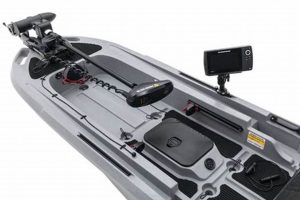
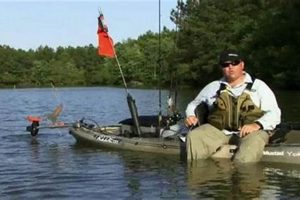
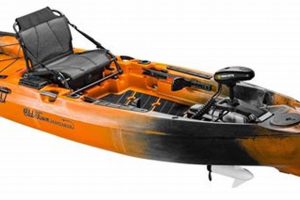
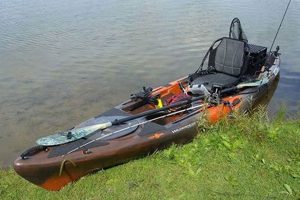
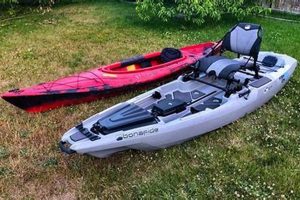
Specialized mounts designed to secure fishing rods to kayaks come in various forms, including flush-mounted, adjustable, and rotating models. These mounts typically employ durable materials like plastic or metal and may incorporate features such as leashes or locking mechanisms. An example would be a track-mounted adjustable holder enabling anglers to change the rod’s angle and position.
Secure rod storage and hands-free operation are vital for kayak anglers. These specialized mounts prevent rod loss or damage during navigation and allow for efficient lure retrieval or fish landing. Historically, anglers improvised with basic straps or clamps. The evolution to purpose-built designs significantly improved safety and fishing efficacy, reflecting a growing understanding of specialized angling needs.
This article will further explore the different types available, their key features, installation best practices, and factors to consider when selecting appropriate equipment for specific fishing styles and kayak configurations.
Tips for Selecting and Using Kayak Fishing Rod Holders
Proper selection and utilization of kayak fishing rod holders are crucial for a safe and productive angling experience. Consider these guidelines to optimize equipment choices.
Tip 1: Compatibility with Kayak and Fishing Style: Ensure the chosen holders are compatible with the kayak’s design and the angler’s preferred fishing techniques. Certain holders are better suited for trolling, while others excel for casting or still fishing.
Tip 2: Material and Construction Quality: Opt for robust, corrosion-resistant materials like marine-grade stainless steel or high-impact plastic. Evaluate the build quality for durability and longevity in harsh marine environments.
Tip 3: Mounting Options and Stability: Assess different mounting mechanisms, considering ease of installation and stability on the kayak. Track systems offer flexibility, while flush mounts provide a lower profile.
Tip 4: Adjustability and Positioning: Adjustable holders permit customization of rod angles and positions, catering to diverse fishing techniques and target species. This adaptability enhances fishing versatility.
Tip 5: Rod Security and Safety Features: Prioritize holders with features like leashes or locking mechanisms to prevent rod loss or damage during navigation or unexpected fish strikes.
Tip 6: Ease of Access and Rod Retrieval: Consider holder placement for easy access and swift rod retrieval while maintaining a balanced and stable kayak setup.
Tip 7: Maintenance and Care: Regular inspection and maintenance of holders are essential for ensuring continued performance and preventing corrosion or damage.
By adhering to these guidelines, anglers can select and utilize appropriate equipment, enhancing safety and maximizing fishing effectiveness. Proper holder usage contributes significantly to an enjoyable and successful kayak fishing experience.
These considerations guide anglers toward appropriate equipment choices, supporting informed decisions aligned with individual needs and fishing styles. The following section concludes the discussion by summarizing key insights and reinforcing the importance of proper equipment selection.
1. Types
Categorizing fishing kayak rod holders by type clarifies their distinct functionalities and aids in selecting appropriate equipment for specific fishing styles and kayak configurations. Understanding these distinctions is crucial for optimizing angling performance and safety.
- Flush Mount Rod Holders
These holders integrate seamlessly with the kayak’s surface, offering a low profile that minimizes interference with paddling or casting. Often installed directly into the kayak’s hull, they provide a secure and stable mounting solution, particularly suitable for trolling or still fishing. Examples include molded-in plastic holders or those installed with screws and sealant.
- Adjustable Rod Holders
These holders provide flexibility in rod positioning and angle adjustment, accommodating diverse fishing techniques and target species. They often feature a rotating or pivoting base, allowing anglers to quickly change rod angles for trolling, casting, or drifting. Examples include track-mounted holders or those with adjustable arms.
- Rotating Rod Holders
Rotating holders offer 360-degree rotation, enabling anglers to track fish and maintain optimal line tension. This type excels in scenarios requiring frequent rod angle adjustments, such as fighting active fish. Many incorporate locking mechanisms to secure the rod at the desired angle.
- Rail-Mounted Rod Holders
Designed for kayaks equipped with rails or tracks, these holders offer easy installation and removal without requiring permanent modifications to the kayak. They offer versatility in positioning along the track and may incorporate adjustable features for further customization. Examples include clamp-style mounts or those designed to slide into track systems.
The diverse range of fishing kayak rod holder types allows anglers to tailor their equipment to specific fishing styles and kayak setups. Considering the advantages and limitations of each type enables informed decisions that enhance both fishing effectiveness and overall safety on the water.
2. Mounting
Secure and appropriate mounting is paramount for fishing kayak rod holders, directly influencing both safety and angling effectiveness. Improper mounting can lead to equipment failure, rod loss, or even kayak instability. Several mounting methods exist, each with inherent benefits and drawbacks for specific applications.
Common methods include track mounting, flush mounting, and rail mounting. Track systems provide flexibility in positioning holders along the kayak, adapting to various fishing styles and angler preferences. Flush mounts integrate seamlessly with the kayak’s hull, offering a low profile and minimizing obstruction. Rail mounts utilize existing kayak rails, simplifying installation and offering moderate adjustability. For example, a track-mounted setup allows quick repositioning for trolling versus casting, while a flush-mounted configuration benefits sight fishing by reducing visual obstructions.
Selecting the appropriate mounting method requires careful consideration of kayak compatibility, fishing style, and desired adjustability. Each approach presents trade-offs in terms of stability, flexibility, and installation complexity. Prioritizing secure and appropriate mounting methods ensures equipment reliability, contributing to a safer and more productive kayak fishing experience.
3. Materials

Material selection significantly influences the performance, durability, and longevity of fishing kayak rod holders. Exposure to harsh marine environments necessitates careful consideration of material properties to ensure reliable and long-lasting equipment. Material choice directly impacts resistance to corrosion, UV degradation, and mechanical stress.
- Plastic
Plastic rod holders offer affordability and resistance to corrosion. High-impact plastics like ABS provide adequate durability for general fishing applications. However, some plastics may become brittle with prolonged UV exposure. Plastic holders are commonly used for recreational kayak fishing and offer a cost-effective solution for less demanding environments.
- Aluminum
Aluminum offers a balance of strength, light weight, and corrosion resistance. Marine-grade aluminum alloys provide enhanced protection against saltwater corrosion. While generally durable, aluminum holders can be susceptible to bending or deformation under heavy loads. They are commonly used in mid-range kayak fishing setups.
- Stainless Steel
Stainless steel provides exceptional strength and corrosion resistance, making it ideal for demanding saltwater environments. Marine-grade stainless steel alloys, such as 316 stainless steel, offer the highest level of corrosion protection. While more expensive, stainless steel holders provide superior durability and longevity, suitable for heavy-duty fishing applications.
- Composite Materials
Composite materials, such as fiberglass-reinforced polymers, offer high strength-to-weight ratios and excellent corrosion resistance. These materials provide a premium option with enhanced durability and performance characteristics. Composite holders are increasingly popular in high-end kayak fishing setups, offering a lightweight yet robust solution.
Understanding the properties and performance characteristics of different materials enables informed decisions aligned with specific fishing needs and budget constraints. Selecting appropriate materials ensures the longevity and reliability of fishing kayak rod holders, contributing to a safe and enjoyable angling experience.
4. Placement

Strategic placement of fishing kayak rod holders significantly impacts angling efficiency, safety, and overall kayak balance. Holder placement should optimize accessibility while minimizing interference with paddling and other onboard activities. Positioning holders too far forward can obstruct paddling strokes, while placement too far rearward may hinder casting or retrieving lines. Furthermore, uneven distribution of rod holders can create instability, particularly when navigating challenging waters or landing fish. For instance, positioning two holders slightly behind and angled outward from the angler’s position balances weight distribution and allows easy access for both casting and retrieving. Conversely, placing multiple holders directly behind the angler, though seemingly convenient, might create an unbalanced rear weight distribution and hinder paddling. Careful consideration of reach, casting angles, and potential obstructions ensures optimal placement.
Several factors influence optimal placement. Anglers frequently targeting larger species might prioritize positions enabling leverage during a fight, often further back on the kayak. Conversely, those focused on casting techniques might benefit from forward-placed holders facilitating accurate presentations. Kayak width and hull design also play significant roles. Wider, more stable kayaks offer greater flexibility in placement options compared to narrower designs. The chosen fishing technique also dictates placement needs. Trolling often necessitates rear-placed holders, while casting and jigging may benefit from more forward or side-mounted configurations.
Understanding the interplay of these elements allows for informed decisions regarding holder placement, maximizing both fishing effectiveness and safety. Improper placement can lead to frustration, reduced fishing success, and potentially hazardous situations. Strategic placement ensures efficient rod management, unobstructed paddling, and balanced weight distribution, contributing significantly to a positive and productive kayak fishing experience.
5. Security
Rod security is paramount in kayak fishing, preventing equipment loss and ensuring angler safety. Losing a rod overboard represents a financial setback, environmental hazard, and potential safety risk. Specialized holders with secure locking mechanisms, leashes, or straps minimize the risk of accidental loss due to sudden movements, unexpected strikes, or kayak instability. For example, a locking mechanism ensures the rod remains firmly in place even during a vigorous fight with a large fish. Similarly, a leash tethers the rod to the kayak, preventing complete loss should it be dislodged from the holder.
Various security measures cater to diverse fishing styles and environmental conditions. Locking mechanisms offer robust retention, ideal for challenging waters or aggressive fish. Leashes provide a secondary safety net, preventing rods from sinking if dislodged. Straps offer a simpler solution for calmer conditions, securing rods during transport or storage. Choosing appropriate security features requires careful consideration of target species, fishing environment, and individual angling techniques. For instance, anglers targeting large, powerful fish in rough waters benefit significantly from holders equipped with robust locking systems, while those fishing in calmer environments may find leashes or straps sufficient.
Prioritizing rod security significantly enhances the overall kayak fishing experience. Secure rod retention minimizes distractions and frustrations stemming from lost or damaged equipment, allowing anglers to focus on fishing. Furthermore, it reduces the environmental impact of lost fishing gear and promotes responsible angling practices. Implementing appropriate security measures contributes to a safer, more productive, and environmentally conscious angling experience.
Frequently Asked Questions
This section addresses common inquiries regarding the selection, installation, and utilization of fishing kayak rod holders.
Question 1: How many rod holders are recommended for a fishing kayak?
The optimal number depends on individual fishing styles and kayak capacity. Two to four holders generally suffice for most anglers, balancing accessibility and kayak stability. Exceeding four may create clutter and hinder paddling.
Question 2: Can rod holders be installed on any kayak?
While many kayaks accommodate aftermarket installations, certain designs may present limitations. Compatibility depends on hull construction and available mounting points. Consulting the kayak manufacturer’s guidelines is recommended.
Question 3: What maintenance is required for rod holders?
Regular rinsing with freshwater after each use minimizes saltwater corrosion. Periodic inspection for loose screws or damage ensures continued functionality. Lubricating moving parts, if applicable, enhances performance and longevity.
Question 4: Are rod holders universally compatible with all fishing rods?
Most holders accommodate a range of rod diameters. However, certain specialized holders cater to specific rod types, such as fly rods or heavy-duty trolling rods. Verifying holder specifications ensures compatibility.
Question 5: What safety precautions should be considered when using rod holders?
Ensuring secure rod placement and utilizing leashes or locking mechanisms prevents accidental loss. Balanced weight distribution across the kayak maintains stability, especially during navigation or fish retrieval.
Question 6: What are the key factors to consider when choosing rod holders?
Material durability, mounting method, adjustability, and compatibility with fishing style influence selection. Evaluating these elements ensures optimal performance and angler satisfaction.
Addressing these common queries empowers informed decisions regarding rod holder selection and usage. Thorough consideration of these factors contributes significantly to a safer and more productive kayak fishing experience.
The subsequent section delves into specific product recommendations and reviews, guiding readers towards appropriate choices based on individual needs and preferences.
Fishing Kayak Rod Holders
Fishing kayak rod holders are essential equipment for kayak anglers, impacting both safety and fishing efficacy. Selecting appropriate holders requires careful consideration of various factors, including kayak compatibility, fishing style, desired adjustability, mounting options, material durability, and security features. Understanding the interplay of these elements enables informed decisions, optimizing performance and enhancing the overall angling experience. Strategic placement balances accessibility with kayak stability, maximizing both fishing efficiency and safety. Proper material selection ensures longevity and reliable performance in demanding marine environments. Secure mounting and appropriate security features prevent equipment loss and contribute to responsible angling practices.
Investing in high-quality fishing kayak rod holders represents an investment in safety, efficiency, and enjoyment on the water. Appropriate equipment choices empower anglers to focus on the sport, enhancing the overall experience and fostering a deeper connection with the aquatic environment. Continuous advancements in design and materials promise further improvements in functionality and performance, enriching the kayak fishing experience for anglers of all skill levels. Careful consideration of individual needs and preferences, coupled with a thorough understanding of available options, leads to informed decisions that maximize fishing success and promote responsible angling practices.