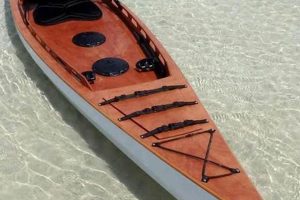
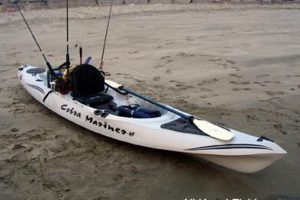
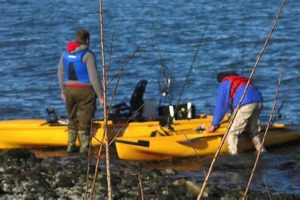
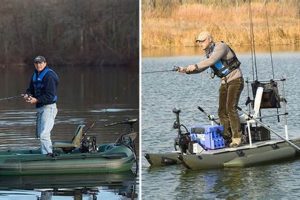
Angling from a small, non-specialized, human-powered watercraft offers a unique blend of mobility and affordability. This approach allows access to shallow, vegetated areas often inaccessible to larger motorized boats, providing opportunities to target a variety of fish species in diverse environments. A stable hull design and appropriate gear storage are crucial for a successful experience.
This method’s popularity stems from its low barrier to entry compared to motorized boating. The relatively low cost of kayaks and their ease of transport and storage make them accessible to a wider range of individuals. Historically, small boats have been employed for fishing in various cultures, demonstrating the enduring utility of this basic approach. The modern adaptation with kayaks leverages advancements in materials and design to enhance stability, comfort, and overall effectiveness.
This discussion will further explore key aspects, including selecting appropriate gear, techniques for different species, and safety considerations for a successful and enjoyable outing on the water. Specific topics include kayak selection and modification, essential equipment, casting methods, and navigation best practices.
Tips for Kayak Angling
Proper planning and execution are crucial for a safe and productive fishing experience from a kayak. The following tips offer guidance for anglers of all skill levels.
Tip 1: Prioritize Stability: Select a kayak with a wide, flat hull for enhanced stability, especially when casting or landing fish. Consider adding outriggers for increased stability in challenging conditions.
Tip 2: Plan Gear Placement Strategically: Organize essential equipment within easy reach, utilizing deck rigging and storage compartments to maximize space and efficiency.
Tip 3: Choose Appropriate Paddles: Opt for a lightweight, efficient paddle designed for kayaking to minimize fatigue and maximize maneuverability.
Tip 4: Utilize a Kayak-Specific Anchor: A lightweight anchor with an appropriate length of rope and a quick-release system allows for efficient anchoring in desired fishing locations.
Tip 5: Dress for Immersion: Wear appropriate clothing and consider a personal flotation device (PFD) designed for paddling. Prepare for potential changes in weather conditions.
Tip 6: Master Basic Kayak Maneuvers: Practice essential paddling strokes and turning techniques to ensure confident navigation and control in various water conditions.
Tip 7: Respect Wildlife and the Environment: Adhere to local fishing regulations and practice Leave No Trace principles. Handle fish carefully and minimize disturbance to the natural environment.
Adhering to these guidelines enhances safety, efficiency, and overall enjoyment on the water. Careful planning and preparation contribute significantly to a rewarding angling experience.
These tips provide a foundation for successful kayak angling. Further research and practice will refine techniques and contribute to a deeper understanding of this specialized fishing approach.
1. Stable Kayak Selection

Stable kayak selection forms the foundation of successful angling from a standard, non-specialized kayak. A stable platform directly influences casting accuracy, hook sets, and fish landing. Instability compromises these actions, potentially leading to lost catches and even unsafe situations. Kayak stability derives from hull design, width, and length. Wider, flatter hulls generally offer greater initial stability, crucial for anglers frequently shifting weight during casting or reeling. Longer kayaks tend to track straighter, beneficial for trolling or maintaining position in currents. For example, a wide, sit-on-top kayak provides inherent stability suitable for novice anglers, while a longer, sit-inside model might benefit experienced anglers seeking efficient paddling over long distances.
Consideration of intended fishing locations further refines stable kayak selection. Calm lakes and slow-moving rivers allow for shorter, wider kayaks optimized for maneuverability and stability. Conversely, open water or faster currents necessitate longer, narrower kayaks prioritizing tracking and speed. The angler’s body weight and gear also play a role; heavier individuals and substantial gear loads require kayaks with higher weight capacities and wider beams to maintain optimal stability. Failure to consider these factors can result in a precarious fishing experience, impacting both safety and effectiveness. For instance, attempting to stand and cast in a narrow, unstable kayak designed for recreational paddling invites disaster, potentially leading to capsizing and equipment loss.
In conclusion, stable kayak selection represents a critical element of successful angling from a standard kayak. Careful consideration of hull design, length, width, intended fishing environment, and individual needs ensures a safe and productive experience. A stable platform maximizes fishing effectiveness and minimizes risks, contributing significantly to overall enjoyment on the water. Ignoring this crucial aspect can compromise both safety and the ability to land desired catches.
2. Essential Gear Organization

Effective angling from a standard kayak necessitates meticulous gear organization. Limited space and the dynamic nature of kayak fishing demand strategic placement of rods, reels, tackle, safety equipment, and other essentials. Efficient organization directly impacts both safety and fishing success. A cluttered kayak impedes casting, increases retrieval time, and presents safety hazards, while a well-organized system maximizes efficiency and enhances the overall angling experience.
- Accessibility of Essential Items
Rapid access to frequently used items like pliers, line cutters, and lures proves crucial in the dynamic kayak fishing environment. Storing these items within easy reach, such as on a PFD or in a readily accessible deck bag, minimizes disruptive movements and lost fishing time. For example, fumbling for pliers while a hooked fish thrashes beside the kayak can lead to line breakage or even injury. Conversely, swift access to necessary tools facilitates efficient hook removal and release, or quick line adjustments for changing conditions.
- Rod and Tackle Management
Rod holders and strategically placed tackle boxes maintain order and prevent equipment entanglement. Rod holders secure rods while paddling or landing fish, minimizing the risk of breakage or loss. Organized tackle boxes allow for quick lure changes, preventing wasted time searching through a jumbled assortment. Consider, for instance, a scenario where a sudden change in fish activity necessitates a swift lure switch. A well-organized tackle system allows the angler to adapt immediately, maximizing opportunities, while a disorganized system leads to frustration and missed chances.
- Safety Equipment Placement
Safety equipment, including a PFD, whistle, and bilge pump, requires immediate accessibility in emergencies. Storing these items in designated locations ensures rapid deployment when needed. A PFD tucked away in a rear hatch provides little benefit in a capsize situation. Conversely, a readily accessible PFD, coupled with a quickly deployable bilge pump, can significantly improve outcomes in such events.
- Minimizing Movement and Weight Distribution
Careful weight distribution and minimizing unnecessary movement enhance kayak stability, a critical factor in successful angling. Evenly distributing gear weight throughout the kayak minimizes rocking and tipping. Securing loose items prevents shifting weight, which can compromise balance, particularly during casting or landing. For example, a heavy tackle box placed at one end of the kayak can create instability, making casting difficult and increasing the risk of capsize. A balanced load enhances stability, enabling more effective angling and a safer overall experience.
These organizational principles, when applied effectively, transform a standard kayak into a highly efficient fishing platform. The synergy between accessibility, safety, and efficient movement directly translates to increased fishing success and a more enjoyable experience on the water. A well-organized kayak allows anglers to focus on the task at handcatching fishrather than struggling with tangled lines, misplaced gear, or an unstable platform. This attention to detail elevates kayak angling from a recreational pastime to a focused pursuit.
3. Efficient Paddling Techniques

Efficient paddling techniques are integral to successful angling from a standard kayak. Maneuverability and positioning are crucial for accessing optimal fishing locations and maintaining advantageous angles for casting and retrieval. Fatigue reduction through efficient paddling conserves energy for the primary objective: fishing. Mastery of these techniques enhances overall effectiveness and enjoyment on the water.
- Forward Stroke
The forward stroke propels the kayak efficiently across the water. A proper forward stroke utilizes core muscles and body rotation for power, minimizing fatigue and maximizing propulsion. For example, a strong forward stroke allows anglers to cover greater distances to reach promising fishing spots or to navigate against currents. Conversely, an inefficient stroke wastes energy, limiting range and potentially impacting fishing success.
- Reverse Stroke
The reverse stroke stops forward momentum and allows for precise backward movement. This technique proves invaluable for backing away from obstacles, repositioning for a better casting angle, or controlling drift in currents. Consider an angler attempting to position the kayak upstream of a submerged log. A controlled reverse stroke allows for precise placement, while an uncontrolled drift might snag the line or spook fish.
- Sweep Stroke
The sweep stroke turns the kayak efficiently. A well-executed sweep stroke utilizes a wide arc to maximize turning force, minimizing the need for multiple strokes and conserving energy. For instance, a swift sweep stroke allows an angler to quickly turn and face a hooked fish, improving line control and increasing the likelihood of a successful landing.
- Draw Stroke
The draw stroke moves the kayak sideways, essential for precise positioning alongside structure or other features. This technique allows anglers to maintain proximity to target areas without paddling forward or backward, maximizing fishing opportunities. Consider an angler attempting to maintain position alongside a weed bed. A series of draw strokes allows for subtle adjustments in position, keeping the kayak within casting range of the target zone without disturbing the fish.
These core paddling techniques, when mastered, significantly enhance kayak angling effectiveness. Precise boat control allows anglers to access productive fishing locations, maintain advantageous positions, and conserve energy for the demanding task of fighting and landing fish. The synergy between efficient paddling and focused angling contributes significantly to a successful and enjoyable experience on the water. This proficiency distinguishes a skilled kayak angler from a novice, maximizing their potential for success.
4. Appropriate Fishing Methods
Appropriate fishing methods are intrinsically linked to the unique characteristics of angling from a standard kayak. The confined space, inherent instability, and reliance on human-powered propulsion necessitate adaptations in technique compared to fishing from larger, motorized boats. Selecting methods aligned with these constraints significantly impacts success and safety. For example, trolling with heavy tackle designed for deep-sea fishing proves impractical and potentially hazardous in a kayak. Conversely, lighter tackle and techniques like casting or jigging align with the kayak’s maneuverability and stability, maximizing effectiveness and minimizing risk.
The choice of appropriate methods also depends on the target species and the fishing environment. In shallow, weedy areas, techniques like flipping or pitching with weedless lures prevent snags and target species inhabiting these environments. In open water, trolling with lighter lines and lures proves effective for pelagic species. Consider an angler targeting bass in a shallow, heavily vegetated lake. Using a heavy Carolina rig designed for deep water retrieves results in constant snags and frustration. However, employing a weedless topwater lure and a delicate presentation technique significantly increases the likelihood of success. This example illustrates the importance of tailoring methods to specific conditions within the context of kayak fishing.
Mastery of kayak-specific angling techniques further enhances effectiveness. Learning to cast effectively from a seated position, managing a hooked fish alongside the kayak, and landing fish efficiently without compromising stability are crucial skills. These specialized techniques directly address the challenges and opportunities presented by the kayak fishing environment. Failure to adapt methods appropriately not only limits success but also increases risks. For instance, attempting to fight a large, powerful fish with heavy tackle from an unstable kayak can lead to capsize or equipment damage. Adapting techniques to match the kayak’s limitations maximizes safety and optimizes the angling experience.
5. Respectful Environmental Practices

Respectful environmental practices are integral to sustainable kayak angling. The low-impact nature of kayak fishing offers a unique opportunity to minimize disturbance to aquatic ecosystems. However, this advantage hinges on responsible angler behavior. Direct contact with the water and proximity to shorelines necessitate heightened awareness of potential environmental impacts. Discarded fishing line, improperly disposed of bait containers, and careless handling of fish can all negatively affect water quality and aquatic life. For example, discarded fishing line entangles wildlife, leading to injury or death, while leftover bait can introduce invasive species or disrupt the natural food chain. Conversely, mindful practices, such as packing out all trash and using biodegradable fishing line, preserve the integrity of these delicate environments.
Understanding the interconnectedness of aquatic ecosystems underscores the importance of respectful practices. Kayak anglers often access shallow, vegetated areas crucial for fish spawning and juvenile development. Disturbing these habitats through careless navigation or excessive noise can disrupt breeding cycles and negatively impact fish populations. Furthermore, improper catch-and-release techniques can injure or stress fish, reducing their survival rates. Employing best practices, such as using barbless hooks and minimizing handling time, demonstrates a commitment to conservation and ensures the long-term health of fish populations. Consider the impact of repeatedly dragging a kayak through a sensitive spawning bed. This action can damage vegetation and crush eggs, directly impacting future fish populations. A respectful approach involves navigating around such areas, minimizing disturbance and preserving these critical habitats.
Minimizing environmental impact ultimately safeguards the future of kayak fishing. Protecting water quality, preserving habitats, and practicing responsible catch-and-release methods ensures the sustainability of this rewarding recreational activity. This stewardship ethic benefits not only the environment but also the anglers who rely on healthy ecosystems for continued enjoyment. The practical significance of this understanding translates directly into responsible actions on the water. Choosing biodegradable lures, properly disposing of waste, and adhering to Leave No Trace principles demonstrates a commitment to environmental stewardship and ensures the long-term viability of kayak angling. This conscious approach preserves the natural beauty and ecological integrity of aquatic environments for future generations of anglers.
Frequently Asked Questions
This section addresses common inquiries regarding angling from standard kayaks, offering concise and informative responses.
Question 1: What type of standard kayak is best suited for fishing?
Wider, more stable kayak models are generally preferred for fishing, particularly for less experienced paddlers. Sit-on-top kayaks offer inherent stability and ease of re-entry after a potential capsize. Longer kayaks provide better tracking in open water but may be less maneuverable in tight spaces.
Question 2: What essential safety gear should one carry when kayak fishing?
Essential safety gear includes a properly fitted personal flotation device (PFD), a whistle, a visual signaling device, a bilge pump or bailing sponge, and a communication device such as a waterproof VHF radio or a cell phone in a waterproof case. A first-aid kit and basic repair kit are also recommended.
Question 3: How does one manage fishing rods and tackle effectively in a kayak?
Rod holders, either flush-mounted or adjustable, are crucial for securing rods while paddling or landing fish. Tackle boxes or bags should be organized and readily accessible, preferably within arm’s reach. Utilizing deck rigging and bungee cords can secure loose items and prevent equipment loss.
Question 4: Are there specific fishing techniques best suited for kayaks?
Casting and jigging are generally well-suited to kayak fishing. Trolling can be effective with lighter tackle and appropriate speeds. Adapting techniques to the specific fishing environment and target species is essential.
Question 5: What environmental considerations are relevant to kayak angling?
Minimizing environmental impact includes adhering to Leave No Trace principles, packing out all trash, using biodegradable fishing line when possible, practicing proper catch-and-release techniques, and avoiding sensitive habitats like spawning beds.
Question 6: How does one choose an appropriate paddle for kayak fishing?
Paddle selection depends on individual paddling style and kayak dimensions. A lighter paddle reduces fatigue during longer trips. Paddle length should be appropriate for the paddler’s height and the kayak’s width. A paddle leash prevents loss in the event of a capsize.
Careful consideration of these frequently asked questions enhances preparedness and contributes to a safer and more productive kayak angling experience. Understanding these basic principles allows for informed decision-making and fosters responsible enjoyment of this popular recreational activity.
This concludes the FAQ section. The following section will delve into advanced techniques for experienced kayak anglers.
Conclusion
Angling from standard kayaks offers a distinctive approach to sport fishing, demanding careful consideration of equipment selection, paddling techniques, fishing methods, and environmental stewardship. A stable platform, efficient gear organization, and practiced paddling strokes enhance both safety and fishing success. Adapting techniques to the specific environment and target species maximizes effectiveness, while adherence to responsible practices ensures the sustainability of this accessible and rewarding pursuit.
Successful integration of these elements transforms a simple kayak into a highly effective fishing platform. This approach underscores the importance of thoughtful preparation and mindful execution, rewarding anglers with a deeper connection to the aquatic environment and the thrill of the catch. The future of this increasingly popular activity relies on continued emphasis on safe and sustainable practices, ensuring its enjoyment for generations to come.