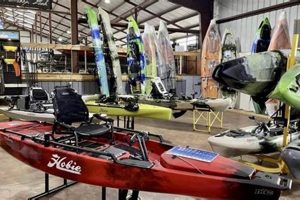
Kayaks designed specifically for angling offer features tailored to the needs of female anglers. These may include a lighter weight for easier transport and maneuverability, a shorter frame for better fit, and specialized seating systems for enhanced comfort during long hours on the water. Such adaptations also often accommodate shorter torso lengths and limb reach. For example, a kayak might feature adjustable footrests and a higher seat back for improved posture and paddling efficiency.
The development of such specialized watercraft signifies the growing recognition of women in the sport of fishing. Historically, fishing gear has been predominantly designed for men. The availability of kayaks specifically engineered for women contributes to a more inclusive and accessible angling experience, allowing more individuals to enjoy the activity comfortably and effectively. This enhanced comfort can lead to improved performance, greater endurance, and an overall more enjoyable fishing experience.
The subsequent sections will delve into specific features to consider when selecting a fishing kayak, popular models currently available, essential safety gear, and recommended fishing techniques. This information aims to provide a complete guide for those interested in pursuing or enhancing their kayak fishing experience.
Tips for Selecting and Using a Fishing Kayak
Choosing and utilizing a fishing kayak tailored to individual needs enhances safety, comfort, and overall angling success. Careful consideration of several key factors contributes significantly to a positive on-the-water experience.
Tip 1: Consider Body Size and Weight: Kayak dimensions and weight capacity should be appropriate for the user’s physique. A properly fitted kayak ensures stability and efficient paddling.
Tip 2: Evaluate Storage Capacity: Ample storage is crucial for fishing gear, safety equipment, and personal items. Assess storage compartments’ size, placement, and accessibility.
Tip 3: Choose the Right Hull Type: Sit-on-top kayaks offer greater stability and ease of entry and exit, while sit-inside kayaks provide better protection from the elements. The choice depends on the intended fishing environment and personal preferences.
Tip 4: Prioritize Stability and Maneuverability: Stability is paramount for fishing, particularly in challenging conditions. Maneuverability impacts the ease of navigating tight spots and changing directions efficiently.
Tip 5: Test the Seat: Comfort is essential for long hours on the water. A well-designed seat provides adequate support and adjustability for optimal posture and reduced fatigue.
Tip 6: Consider Propulsion Options: Paddle kayaks offer excellent exercise and control, while pedal-powered versions provide hands-free fishing and increased speed. Motorized kayaks offer the greatest range and speed, allowing anglers to access distant fishing spots.
Tip 7: Don’t Overlook Safety Gear: Essential safety equipment includes a personal flotation device (PFD), a whistle, a first-aid kit, and a communication device. A float plan filed with a responsible individual is also strongly recommended.
Proper preparation and informed decision-making contribute significantly to a rewarding and enjoyable fishing experience. Addressing these considerations before selecting a kayak enhances both comfort and performance on the water.
By considering these tips, individuals can select appropriate equipment and practices to optimize their fishing experience. The next section will provide detailed information on maintaining and caring for a fishing kayak, ensuring its longevity and continued performance.
1. Comfort

Comfort plays a pivotal role in the overall fishing experience, particularly during extended periods on the water. A comfortable kayak allows for greater focus on fishing, reduces fatigue, and enhances overall enjoyment. This is especially critical for women anglers, as traditional kayak designs often lack appropriate ergonomic considerations for varying body types and sizes.
- Seat Design
A well-designed seat is paramount for comfort. Features such as adjustable backrests, breathable padding, and ample lumbar support contribute significantly to reducing strain and fatigue. High-quality materials promote airflow, preventing overheating and discomfort. For example, kayaks with adjustable backrests allow anglers to customize the seat to their preferred posture, preventing backaches during prolonged fishing trips.
- Legroom and Footrests
Adequate legroom and adjustable footrests accommodate varying leg lengths and promote proper posture, crucial for both comfort and paddling efficiency. Fixed footrests can cause cramping and discomfort, especially for individuals with shorter legs. Adjustable systems provide flexibility, ensuring a comfortable and ergonomic paddling position regardless of leg length. This customization can significantly reduce fatigue and prevent muscle strain during longer outings.
- Kayak Width and Stability
Kayak width directly influences stability, a crucial factor for comfort and safety, particularly for anglers. A wider kayak generally offers enhanced stability, reducing the likelihood of tipping, especially in choppy waters. This stability allows anglers to feel secure and focus on fishing rather than maintaining balance, creating a more comfortable and confident experience.
- Lightweight Construction
The weight of the kayak influences portability and maneuverability. Lighter kayaks are easier to transport to and from the water, reducing strain and fatigue. This is particularly beneficial for individuals who may have difficulty handling heavier kayaks. Easier maneuverability also contributes to a more comfortable paddling experience, requiring less exertion to navigate the water.
These comfort-focused elements contribute significantly to a more enjoyable and productive fishing experience for women. By prioritizing these features, manufacturers acknowledge the specific needs and preferences of women anglers, creating kayaks that promote both performance and long-lasting comfort on the water.
2. Stability
Stability is a paramount concern in kayak fishing, particularly for activities like casting, reeling, and landing fish, where balance is frequently challenged. For women anglers, who may have a lower center of gravity or be using lighter paddles, stability becomes even more critical for a safe and enjoyable experience. A stable kayak instills confidence, allows for greater focus on fishing, and reduces the risk of capsizing, especially in challenging conditions.
- Hull Design
Hull design significantly influences kayak stability. Wider, flatter hulls generally provide greater initial stability, making them less prone to tipping. Conversely, narrower, V-shaped hulls offer greater speed and tracking but sacrifice some stability. Pontoon hulls, with their multiple contact points with the water, provide exceptional stability, making them ideal for activities requiring frequent movement. Understanding the trade-offs between stability, speed, and maneuverability is crucial for selecting a kayak appropriate for individual needs and intended fishing environments.
- Center of Gravity
A lower center of gravity enhances stability. Kayaks designed with a lower seat position and wider beam contribute to a lower center of gravity, increasing resistance to tipping. Proper weight distribution within the kayak also plays a crucial role in maintaining stability. Positioning heavier items lower in the hull and distributing weight evenly enhances balance and prevents tipping, especially during movement or when encountering external forces like waves or currents.
- Kayak Width and Length
Wider kayaks generally offer greater stability than narrower models. Shorter kayaks are often more maneuverable but can be less stable than longer kayaks. Finding the optimal balance between width and length is crucial for achieving both stability and maneuverability. For example, a wider, shorter kayak might be ideal for fishing in calm, shallow waters where maneuverability is key, while a longer, narrower kayak might be better suited for open water where stability in rougher conditions is more critical.
- Water Conditions
Calm, flat water requires less inherent stability than choppy water or strong currents. Selecting a kayak with appropriate stability for anticipated water conditions is essential for safety and enjoyment. A kayak designed for calm lakes might be unstable in ocean conditions, while a highly stable kayak intended for rough water might feel sluggish and less responsive in calmer environments. Matching the kayak’s stability characteristics to the intended fishing environment is crucial for a positive experience.
These facets of stability significantly influence the performance and safety of a fishing kayak, particularly for women anglers. By carefully considering these factors, individuals can select a kayak that provides the necessary stability for a confident and enjoyable fishing experience, regardless of the fishing environment or conditions encountered. This enhanced stability allows for greater focus on fishing techniques and reduces the risk of accidents, ultimately contributing to a more successful and rewarding outing.
3. Maneuverability
Maneuverability is a critical aspect of fishing kayak performance, directly influencing an angler’s ability to navigate various water conditions and access desired fishing spots. For women anglers, often navigating kayaks designed for diverse body types and potentially using lighter paddles, maneuverability takes on heightened significance. A highly maneuverable kayak allows for efficient navigation through tight spaces, swift turns in currents, and precise positioning for optimal casting and retrieval. This responsiveness translates to greater control and efficiency on the water, ultimately contributing to a more successful and enjoyable fishing experience. For example, navigating narrow creeks or maneuvering around obstacles like fallen trees or dense vegetation requires a kayak that responds quickly and precisely to paddle strokes. A less maneuverable kayak might hinder access to prime fishing locations or create difficulties in challenging conditions.
Several factors contribute to kayak maneuverability. Shorter kayaks generally turn more quickly than longer ones, making them ideal for navigating tight spaces and complex waterways. Hull design also plays a significant role. A kayak with a more defined keel or tracking fin will track straighter and resist turning, while a flatter-bottomed hull allows for quicker turns but sacrifices some tracking ability. The placement of the seat and the angler’s paddling technique also influence maneuverability. A seat positioned closer to the center of the kayak allows for greater control and responsiveness. Efficient paddling techniques, including proper stroke mechanics and blade angle, maximize maneuverability regardless of kayak design. For instance, a shorter, wider kayak with a flatter hull and a centrally located seat would be ideal for maneuvering in shallow, vegetated areas, while a longer, narrower kayak with a defined keel would be better suited for open water paddling where straight tracking is more important.
Understanding the factors influencing maneuverability empowers informed decisions when selecting a fishing kayak. Prioritizing maneuverability, especially in contexts requiring navigation through complex environments or precise positioning for fishing, enhances an angler’s control, efficiency, and overall fishing success. Balancing maneuverability with other essential factors like stability and comfort ensures a kayak is well-suited to the individual’s needs and the intended fishing environment. This balanced approach leads to a more positive and productive experience on the water, allowing anglers to focus on the enjoyment and challenge of fishing rather than struggling with an unwieldy vessel. Selecting a kayak with appropriate maneuverability characteristics can be the difference between easily reaching a secluded fishing spot and being frustrated by the inability to navigate challenging waters.
4. Weight Capacity

Weight capacity is a crucial factor to consider when selecting a fishing kayak, especially for women anglers. It directly impacts safety, performance, and the overall fishing experience. A kayak’s weight capacity refers to the maximum combined weight of the paddler, gear, and any additional equipment it can safely carry without compromising stability or performance. Exceeding this limit can lead to instability, decreased maneuverability, and potentially dangerous situations, such as capsizing. For women anglers, understanding weight capacity is particularly important, as they may be carrying lighter loads compared to their male counterparts. Choosing a kayak with an appropriate weight capacity ensures optimal performance and safety on the water.
The practical implications of weight capacity are significant. A kayak loaded beyond its capacity sits lower in the water, increasing drag and reducing paddling efficiency. This can make it more difficult to maneuver, especially in challenging conditions such as wind or currents. Furthermore, an overloaded kayak is more susceptible to taking on water, increasing the risk of capsizing. For example, a kayak with a weight capacity of 300 lbs. carrying a 150 lb. paddler, 50 lbs. of fishing gear, and a 20 lb. dog is within its safe operating limit. However, adding another 100 lbs. of equipment would exceed the capacity, significantly compromising stability and safety. Therefore, accurately estimating the total weight to be carried, including personal weight, gear, and any potential catches, is crucial for selecting a kayak with the appropriate weight capacity.
In conclusion, selecting a kayak with the correct weight capacity is essential for ensuring a safe and enjoyable fishing experience. Understanding the relationship between weight capacity and kayak performance empowers informed decision-making. This awareness allows anglers to choose a kayak that balances stability, performance, and safety, ultimately contributing to a more rewarding time on the water. Neglecting weight capacity considerations can compromise safety and negatively impact the overall fishing experience, highlighting the practical significance of this often-overlooked factor. Accurately assessing anticipated loads and choosing a kayak with ample capacity are crucial steps in preparing for a successful fishing trip.
5. Storage

Storage capacity is a critical consideration in fishing kayaks designed for women, directly impacting organization, efficiency, and overall fishing success. Ample and well-designed storage allows anglers to carry essential gear, safety equipment, and personal items comfortably and securely. This contributes to a more organized and efficient fishing experience, minimizing clutter and maximizing time spent focusing on angling. For example, dedicated compartments for tackle boxes, rods, and safety gear prevent equipment from shifting or becoming damaged during transit or while on the water. This organization also facilitates quick access to necessary items, enhancing efficiency and responsiveness while fishing. Practical examples include integrated rod holders, sealed hatches for electronics and valuables, and bungee systems for securing dry bags or other gear. The lack of adequate storage can lead to a disorganized and frustrating experience, highlighting the practical significance of this often-overlooked aspect.
Furthermore, storage considerations in women’s fishing kayaks often extend beyond simply maximizing capacity. Designers often incorporate features specifically tailored to the needs and preferences of women anglers. This may include strategically placed compartments for smaller items, such as sunscreen, lip balm, or personal communication devices. Ergonomic considerations, such as easily accessible hatches and storage positioned within comfortable reach, further enhance the user experience. These design elements demonstrate a focus on practicality and user-friendliness, recognizing the specific requirements of women in the sport of fishing. For instance, a kayak designed with a recessed storage area specifically sized for a small tackle box or a waterproof bag for personal items demonstrates a thoughtful approach to storage solutions. Such specialized compartments enhance organization and efficiency, allowing anglers to focus on their fishing experience rather than managing gear.
In conclusion, adequate and well-designed storage is essential for a positive and productive kayak fishing experience. Considering the specific needs and preferences of women anglers in storage design contributes significantly to comfort, efficiency, and overall enjoyment on the water. Prioritizing storage solutions that are both functional and accessible enhances organization and minimizes clutter, allowing for a more focused and rewarding fishing trip. This attention to detail highlights the importance of storage as a key component in selecting a women’s fishing kayak. The practical implications of efficient storage directly translate to a more enjoyable and successful fishing experience.
6. Portability
Portability is a significant factor influencing the accessibility and enjoyment of kayak fishing, particularly for women. Kayak weight, dimensions, and available transport solutions directly impact the ease of getting on and off the water. Lighter kayaks, often constructed from materials like rotomolded polyethylene or composites, reduce the physical strain of transporting the vessel, making them easier to load onto vehicles, carry across distances, and launch from various locations. This ease of transport is particularly beneficial for individuals with limited physical strength or those facing logistical challenges such as limited access to launch sites. For example, a lighter kayak can be easily car-topped by a single individual, expanding access to remote or less accessible fishing spots. Conversely, heavier kayaks can necessitate specialized trailers or assistance, limiting options and potentially increasing the physical demands of the activity. The practical implications are clear: enhanced portability translates to greater freedom and independence in choosing fishing locations and reduces barriers to entry for individuals who might otherwise find transporting a kayak too challenging. This can be particularly relevant for women, who may, on average, have less upper body strength than men.
Further enhancing portability are design features that facilitate transport and handling. Integrated carrying handles, strategically placed for balance and leverage, are essential for comfortable and efficient carrying. Built-in wheels, while adding some weight, can significantly simplify transport across longer distances, such as from a parking area to a launch site. Similarly, the kayak’s dimensions play a role. Shorter kayaks, while potentially sacrificing some tracking ability, are generally easier to manage on land and require less storage space. These features demonstrate a focus on user-friendliness and accessibility, making kayak fishing more appealing to a wider range of individuals. Consider a scenario where an angler needs to carry their kayak down a steep embankment to reach a river. A kayak equipped with well-placed handles and a lightweight design significantly eases this task, while a heavier, more cumbersome kayak might make the descent challenging or even dangerous.
In summary, portability is a key consideration for women selecting a fishing kayak. A lighter, easily transportable kayak expands access to fishing locations, reduces physical strain, and enhances overall enjoyment. Features such as integrated handles, built-in wheels, and compact dimensions contribute significantly to portability, facilitating ease of use and encouraging participation in the sport. Addressing portability challenges effectively broadens access to kayak fishing, promoting inclusivity and making the activity more enjoyable for a wider range of individuals. The selection of a portable kayak directly translates to greater independence and flexibility in exploring diverse fishing environments. This connection underscores the significance of portability as a defining factor in the overall fishing experience.
7. Adjustability
Adjustability in fishing kayaks designed for women is paramount for comfort, performance, and injury prevention. Women exhibit a wider range of body sizes and proportions compared to men, necessitating adaptable equipment to ensure a proper fit. Key adjustable features include seat positioning, backrest height and angle, footrest placement, and thigh brace positioning. These elements accommodate varying torso lengths, leg lengths, and overall body size. A properly adjusted kayak promotes efficient paddling, reduces strain on joints and muscles, and enhances stability. For example, adjustable footrests allow shorter individuals to maintain proper leg extension and leverage while paddling, preventing knee strain and maximizing power transfer. Similarly, an adjustable backrest provides crucial lumbar support, reducing back fatigue during long hours on the water.
The practical implications of adjustability extend beyond mere comfort. A well-fitted kayak significantly improves paddling efficiency, allowing for greater speed, endurance, and maneuverability. Proper posture, facilitated by adjustable components, minimizes fatigue and maximizes power output. This is particularly relevant for women anglers who may have less upper body strength compared to men. An adjustable kayak allows them to optimize their paddling technique and conserve energy, enhancing their overall fishing experience. Consider a scenario where a woman angler is paddling against a strong current. A properly adjusted kayak allows her to maintain an efficient paddling posture, maximizing power and minimizing fatigue, enabling her to reach her desired fishing spot more easily.
In summary, adjustability is a crucial feature in women’s fishing kayaks, contributing significantly to comfort, performance, and injury prevention. Adaptable seating systems, footrests, and thigh braces accommodate a wider range of body sizes and proportions, promoting efficient paddling and reducing strain. This enhanced ergonomics translates to greater comfort, improved performance, and a more enjoyable fishing experience, particularly for women facing physical challenges or navigating demanding conditions. The practical significance of adjustability underscores its importance as a key factor in selecting a women’s fishing kayak, ultimately promoting inclusivity and enhancing the accessibility of the sport.
Frequently Asked Questions
This section addresses common inquiries regarding kayaks designed for women anglers, providing concise and informative responses.
Question 1: How do kayaks designed for women differ from unisex models?
Kayaks tailored for women typically feature narrower cockpits, shorter lengths, lighter weights, and seating systems designed to accommodate differences in average body size and proportions. These adaptations enhance comfort, stability, and paddling efficiency.
Question 2: Are “women’s” kayaks suitable for all women?
Not necessarily. Individual body types and preferences vary significantly. While kayaks marketed for women address average differences, it’s crucial to prioritize individual fit and comfort during the selection process. Testing various models is recommended.
Question 3: Do these specialized kayaks compromise performance for comfort?
No. Ergonomic design enhances performance by promoting efficient paddling posture and reducing fatigue. Features like adjustable seating and footrests contribute to both comfort and effective power transfer during paddling.
Question 4: Are these kayaks more expensive than unisex options?
Pricing depends on the brand, features, and materials. Kayaks designed for women are not inherently more expensive. Comparable models in terms of features and quality are generally priced similarly, regardless of target demographic.
Question 5: What key features should be prioritized when choosing a fishing kayak?
Essential features include stability, maneuverability, storage capacity, comfort, and portability. Prioritizing these aspects ensures a safe, efficient, and enjoyable fishing experience. Individual needs and the intended fishing environment will influence the relative importance of each feature.
Question 6: Can men use kayaks designed for women?
While physically possible, the ergonomic design might not be optimal for larger individuals. Comfort, stability, and paddling efficiency could be compromised if the kayak’s dimensions and weight capacity are not suitable for the user.
Careful consideration of individual needs and preferences, alongside the information provided, facilitates informed decision-making when selecting a fishing kayak.
The following section delves into specific kayak models and brands recommended for women anglers, offering a more detailed overview of available options.
Conclusion
Kayaks designed for women represent a significant advancement in fishing accessibility and inclusivity. This specialized equipment addresses the unique needs and preferences of female anglers, enhancing comfort, stability, and overall performance on the water. Factors such as adjustable seating systems, lighter weight construction, and thoughtfully designed storage solutions contribute to a more positive and productive fishing experience. Understanding the nuances of kayak design empowers informed decision-making, allowing individuals to select equipment optimized for their physique and fishing style.
The evolution of fishing kayak design reflects a growing recognition of diverse needs within the angling community. As technology and design continue to advance, further innovations promise to enhance the accessibility and enjoyment of the sport for all. This focus on inclusivity fosters greater participation and appreciation for the rewarding experience of kayak fishing.