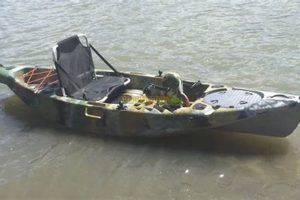
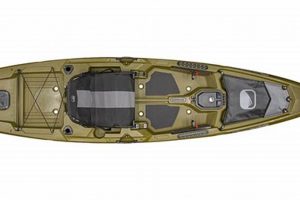
Choosing between a kayak and a canoe for fishing involves considering various factors related to stability, maneuverability, and capacity. A kayak, characterized by its enclosed cockpit and double-bladed paddle, offers enhanced speed and control in windy conditions, making it suitable for navigating rivers and open water. Canoes, with their open design and single-bladed paddles, provide greater stability and carrying capacity, often preferred for calm waters and transporting larger amounts of gear or additional anglers.
The selection of appropriate watercraft for angling contributes significantly to the overall fishing experience. Historically, canoes served diverse purposes, from transportation and trade to hunting and fishing, highlighting their versatility and adaptability. Kayaks, initially developed for hunting in Arctic waters, have evolved into popular recreational and sporting vessels. The distinct characteristics of each watercraft type offer advantages and disadvantages depending on the fishing environment and individual angler preferences.
This exploration will delve into the key distinctions between these two popular fishing platforms, analyzing factors such as stability, maneuverability, speed, storage capacity, and comfort to assist anglers in making informed decisions.
Tips for Choosing Between a Kayak and a Canoe for Fishing
Selecting appropriate fishing watercraft requires careful consideration of individual needs and intended fishing environments. The following tips offer guidance for making informed decisions.
Tip 1: Assess Stability Needs: Canoes generally offer greater initial stability, beneficial for anglers new to fishing from watercraft or those prioritizing a stable casting platform. Kayaks, while initially less stable, can offer greater secondary stability (resistance to tipping when leaned). Consider individual balance and comfort levels.
Tip 2: Evaluate Maneuverability Requirements: Kayaks excel in maneuverability, particularly in windy conditions or moving water. Canoes offer less precise handling but can be more efficient for straight-line paddling across calm lakes.
Tip 3: Consider Fishing Environment: Calm lakes and slow-moving rivers are well-suited for canoes, allowing anglers to cover larger areas efficiently. Kayaks are advantageous in rivers with currents, surf zones, and open water environments.
Tip 4: Determine Gear Storage Needs: Canoes provide ample storage space for gear, coolers, and additional anglers. Kayaks offer more limited storage, often requiring specialized gear organization and potentially limiting the amount of equipment carried.
Tip 5: Factor in Transportation and Storage: Kayaks are typically easier to transport and store due to their smaller size and lighter weight. Canoes may require specialized roof racks or trailers for transportation and more extensive storage space.
Tip 6: Evaluate Comfort and Seating: Consider the duration of planned fishing trips. Kayaks offer seated positions, while canoes allow for sitting or kneeling. Evaluate personal comfort preferences for extended periods on the water.
Tip 7: Consider Fishing Style: Trolling and casting in open water are often easier from a kayak. Still fishing or fly fishing from a stationary position might be better suited to a canoe’s stability.
Careful consideration of these factors contributes to selecting the optimal watercraft for a safe and productive fishing experience, maximizing enjoyment and success on the water.
By evaluating these core aspects, individuals can select the ideal watercraft for their specific fishing requirements, ensuring a comfortable and successful experience.
1. Stability

Stability plays a crucial role in the “kayak vs canoe fishing” debate. It directly impacts an angler’s ability to cast, reel, and land fish effectively, as well as overall safety and comfort on the water. Canoes, with their wider beam and open design, generally offer greater initial stability. This makes them well-suited for beginners or anglers fishing in calm conditions. A canoe’s flat bottom provides a stable platform for standing, though caution is always advised. However, canoes can be more susceptible to tipping in windy conditions or rough water due to their higher center of gravity.
Kayaks, on the other hand, typically have a narrower beam and lower center of gravity, offering less initial stability but greater secondary stability. This means they are initially more prone to tipping but become more stable when leaned. Kayaks are generally less affected by wind and waves due to their lower profile. This characteristic makes them suitable for more challenging conditions, including open water and rivers. For example, an angler fishing in a choppy sea might find a kayak more stable than a canoe due to its lower center of gravity and resistance to rolling.
Understanding the nuances of stability is paramount when choosing between a kayak and a canoe for fishing. While initial stability is often prioritized by beginners, experienced anglers might value the secondary stability of a kayak in challenging conditions. The choice ultimately depends on the intended fishing environment, the angler’s experience level, and individual comfort preferences. Neglecting the stability factor can lead to a less enjoyable and potentially unsafe fishing experience. Careful consideration of stability characteristics contributes significantly to selecting the appropriate watercraft for a successful and enjoyable outing.
2. Maneuverability

Maneuverability represents a critical factor in the kayak versus canoe discussion, significantly influencing fishing effectiveness and overall experience. A vessel’s responsiveness and ease of directional control directly impact an angler’s ability to navigate varying water conditions, access desired fishing locations, and react to changing circumstances. Kayaks, propelled by double-bladed paddles and typically featuring a rudder or skeg system, offer superior maneuverability compared to canoes. This advantage allows for precise adjustments in direction and efficient navigation through complex waterways, including narrow creeks, winding rivers, and areas with significant currents or obstacles. Consider a scenario where an angler needs to navigate through dense vegetation or quickly change direction to pursue a moving school of fish; a kayak’s maneuverability becomes essential in such situations.
Canoes, propelled by single-bladed paddles, offer less precise maneuverability. Their design, while providing stability, makes turning and navigating tight spaces more challenging. Canoes are better suited for traversing open water or calm rivers where precise maneuvering is less critical. For instance, an angler fishing a large, open lake might find a canoe’s straight-line tracking more advantageous than a kayak’s agility. However, in situations requiring quick turns or navigating obstacles, a canoe’s limited maneuverability can be a significant drawback. Adding a motor to a canoe can enhance maneuverability but introduces additional complexity and cost.
Understanding the distinct maneuverability characteristics of kayaks and canoes is essential for informed decision-making. Selecting the appropriate craft depends heavily on the intended fishing environment and the angler’s specific needs. Prioritizing maneuverability favors kayaks for dynamic environments requiring precise control, while prioritizing stability might favor canoes for calmer waters. Matching the vessel’s maneuverability to the fishing context significantly contributes to a more productive and enjoyable fishing experience. Failure to consider maneuverability can lead to frustration and limit access to prime fishing areas.
3. Storage Capacity

Storage capacity represents a pivotal factor in the kayak versus canoe selection process for fishing. The ability to transport essential gear, including tackle boxes, rods, coolers, and safety equipment, directly impacts an angler’s preparedness and overall fishing experience. Canoes, with their open design and larger deck space, offer significantly greater storage capacity compared to kayaks. This expansive capacity allows anglers to carry more equipment, accommodate additional passengers, and potentially transport larger catches. For example, a multi-day fishing trip necessitates ample storage for camping gear, food supplies, and fishing equipment, making a canoe the more practical choice. Similarly, anglers targeting larger fish species benefit from the canoe’s ability to transport bulky landing nets and other specialized gear.
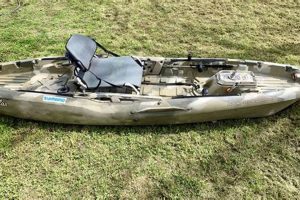
Kayaks, while offering more limited storage, provide specialized compartments and rigging options for securing essential gear. Dry hatches and bungee cords allow anglers to store smaller items securely, protecting them from water damage. However, the limited overall capacity restricts the amount of equipment carried, particularly on longer expeditions. An angler prioritizing minimalist fishing or targeting smaller species might find a kayak’s storage sufficient. However, scenarios requiring larger or more diverse gear selections necessitate careful packing and potentially compromise on the amount of equipment carried. Specialized kayak fishing models often incorporate built-in rod holders and tackle storage compartments to maximize space utilization.
Careful evaluation of storage needs is essential when choosing between a kayak and a canoe for fishing. The type and duration of fishing trips, target species, and individual preferences regarding gear quantity all influence the optimal choice. Prioritizing storage capacity favors canoes for longer expeditions and larger gear requirements, while prioritizing portability and maneuverability might favor kayaks for shorter trips or minimalist approaches. Failure to adequately assess storage needs can lead to insufficient gear capacity or compromised vessel performance due to overloading. Understanding the storage limitations and advantages of each watercraft type empowers anglers to make informed decisions that align with their specific fishing objectives and enhance their overall experience.
4. Speed
Speed, a critical factor in fishing, significantly influences an angler’s ability to cover water efficiently, reach desired locations, and respond to changing conditions. In the context of kayak versus canoe fishing, speed differentials stemming from hull design, propulsion methods, and water resistance play a crucial role in determining the suitability of each craft for specific fishing styles and environments.
- Hull Design and Water Resistance
Kayaks, with their streamlined hulls and lower profiles, generally experience less water resistance than canoes. This design characteristic translates to greater speed potential, allowing kayakers to cover greater distances with less effort. Canoes, characterized by their broader beams and higher profiles, encounter greater water resistance, resulting in lower overall speeds. The difference in hull design impacts not only maximum speed but also the effort required to maintain a given speed, affecting fatigue levels over longer fishing trips. For example, a kayak’s sleeker profile allows it to cut through the water more efficiently, enabling faster travel to distant fishing spots.
- Propulsion Methods
Kayaks utilize double-bladed paddles, providing continuous propulsion and enabling higher speeds compared to canoes, which typically employ single-bladed paddles. The double-bladed paddle’s symmetrical stroke allows for consistent power application throughout the paddling cycle. While single-bladed paddling can be efficient for straight-line travel in a canoe, it necessitates switching sides, creating a momentary pause in propulsion. This difference in paddling technique further contributes to the kayak’s speed advantage. The use of specialized paddles designed for speed and efficiency can further enhance the performance of both kayaks and canoes, although the inherent design differences remain influential.
- Impact on Fishing Styles
Speed considerations directly influence the suitability of kayaks and canoes for specific fishing styles. Kayaks, with their speed advantage, excel in techniques like trolling, where covering large areas of water quickly is essential. Canoes, while slower, provide a stable platform for still fishing or fly fishing, where maintaining a stationary position or slow, controlled movements is prioritized. For instance, an angler trolling for pelagic fish species benefits from a kayak’s speed and maneuverability to cover vast expanses of open water efficiently. Conversely, an angler fly fishing in a slow-moving river might prioritize a canoe’s stability over speed.
- Environmental Factors
Wind and current significantly impact the speed and efficiency of both kayaks and canoes. Kayaks, with their lower profiles, are generally less affected by wind resistance than canoes. However, strong currents can pose challenges for both vessel types. Understanding the prevailing environmental conditions is crucial for selecting the appropriate craft and planning fishing strategies. Navigating a windy lake in a canoe requires significant effort and careful paddle technique to maintain course, whereas a kayak might handle the same conditions more efficiently due to its lower profile and responsiveness to paddle input.
The speed differentials between kayaks and canoes significantly impact their suitability for various fishing scenarios. Careful consideration of speed, alongside other factors like stability and maneuverability, empowers anglers to choose the optimal watercraft for their specific needs and the prevailing environmental conditions. Selecting the appropriate craft enhances fishing efficiency, expands access to diverse fishing locations, and ultimately contributes to a more successful and enjoyable experience on the water.
5. Comfort

Comfort significantly influences fishing experience, particularly during longer outings. Discomfort can detract from focus and enjoyment, impacting overall success. In the context of kayak versus canoe fishing, comfort considerations encompass seating design, adjustability, legroom, and overall ergonomics. Understanding these factors aids informed decision-making, ensuring a comfortable and productive fishing experience.
- Seating Design and Adjustability
Kayak seating typically involves a molded seat or adjustable framed seat integrated into the hull. These designs prioritize stability and paddling efficiency. Canoe seating traditionally involves benches or removable seats, offering varying levels of support and adjustability. Anglers prioritizing back support and postural adjustment might favor kayaks with adjustable seating systems, while those valuing freedom of movement might prefer the open seating arrangement of a canoe. Custom seat modifications or additions can enhance comfort in both vessel types.
- Legroom and Positioning
Kayaks, with their enclosed cockpits, often offer limited legroom, particularly for taller individuals. Canoes, due to their open design, provide more flexibility in leg positioning and stretching, contributing to comfort during extended trips. Anglers prone to leg cramps or discomfort might find a canoe’s spaciousness advantageous. Kayak designs vary in cockpit dimensions, and choosing a model that accommodates individual leg length is essential for comfort.
- Ergonomics and Physical Strain
Both kayaking and canoeing involve repetitive paddling motions that can strain muscles and joints. Kayaks, due to their lower seating position and double-bladed paddles, can place stress on the back and shoulders. Canoes, with their higher seating position and single-bladed paddles, can strain the arms and shoulders. Proper paddling technique and ergonomic considerations are essential for minimizing physical strain and maximizing comfort in both vessel types. Stretching before and after fishing trips can help alleviate potential discomfort.
- Environmental Factors
Exposure to elements like sun, wind, and water can significantly impact comfort. Kayaks, with their lower profiles, offer less wind resistance but potentially greater exposure to splashing water. Canoes, with their higher sides, provide more wind protection but can be more susceptible to rocking in waves. Appropriate clothing, sun protection, and spray skirts for kayaks can enhance comfort in various weather conditions. The choice between a kayak and a canoe often involves balancing protection from elements with stability and maneuverability considerations.
Comfort considerations play a crucial role in selecting between a kayak and a canoe for fishing. Analyzing seating design, legroom, ergonomics, and environmental factors allows anglers to choose a vessel that maximizes comfort and minimizes physical strain, contributing to a more enjoyable and productive fishing experience. Prioritizing comfort, alongside factors like stability and maneuverability, empowers informed decision-making and enhances overall satisfaction on the water.
6. Fishing Style
Fishing style significantly influences watercraft selection. Different techniques demand specific vessel characteristics, impacting effectiveness and overall experience. Understanding the interplay between fishing style and vessel choice is crucial for optimizing angling success.
- Trolling
Trolling involves dragging lures or bait behind a moving vessel. Kayaks, due to their speed and maneuverability, excel in this technique, allowing anglers to cover extensive areas and target specific depths efficiently. Canoes, while capable of trolling, are less efficient due to lower speeds and reduced maneuverability. For example, trolling for pelagic species in open water favors kayaks, while trolling in smaller, calmer lakes might be suitable for canoes. The choice depends on the target species and the fishing environment.
- Casting and Spinning
Casting and spinning involve repeatedly casting and retrieving lures. Both kayaks and canoes can accommodate these techniques, but stability and maneuverability play key roles. Kayaks offer greater maneuverability for navigating complex shorelines and targeting specific structures. Canoes provide a stable platform for casting in calm conditions. A kayak’s responsiveness allows anglers to quickly reposition for optimal casting angles, while a canoe’s stability benefits anglers casting larger lures or fighting stronger fish.
- Still Fishing
Still fishing involves presenting bait or lures in a stationary position. Canoes, due to their inherent stability, offer an ideal platform for still fishing, allowing anglers to maintain position and focus on detecting bites. Kayaks can also be used for still fishing, particularly with the use of anchors or drift socks, but maintaining a stationary position requires more effort. Fishing from a stationary position in a river or lake often favors a canoe’s inherent stability.
- Fly Fishing
Fly fishing necessitates casting specialized lightweight lures with precise movements. Canoes, with their open design and stability, provide ample space for casting and maneuvering fly lines. Kayaks, while adaptable for fly fishing with specialized setups, can present challenges due to limited space and the potential for line entanglement. The stability of a canoe provides a comfortable platform for casting delicate fly lines, while a kayak’s lower profile might be advantageous in windy conditions.
Matching fishing style to watercraft type optimizes angling success. Consideration of technique-specific needs, including speed, maneuverability, and stability, ensures efficient and enjoyable fishing experiences. The choice between a kayak and a canoe ultimately depends on the preferred fishing style and the intended environment.
Frequently Asked Questions
This section addresses common inquiries regarding kayak and canoe selection for fishing, providing concise and informative responses to facilitate informed decision-making.
Question 1: Which type of watercraft is better suited for beginners?
Canoes generally offer greater initial stability, making them potentially more suitable for individuals new to fishing from a watercraft. However, kayak familiarity can be readily acquired with practice.
Question 2: Which option offers better performance in windy conditions?
Kayaks, with their lower profile and greater maneuverability, typically handle wind more effectively than canoes. However, experienced canoeists can employ techniques to mitigate wind impact.
Question 3: What factors influence storage capacity considerations?
Trip duration, gear requirements, and the potential for carrying additional passengers or larger catches influence storage capacity needs. Canoes generally offer greater storage space.
Question 4: How do speed and maneuverability considerations intersect?
Kayaks generally offer superior speed and maneuverability, beneficial for covering larger areas and navigating complex waterways. Canoes prioritize stability over speed, suitable for calmer environments.
Question 5: How does seating comfort vary between kayaks and canoes?
Kayak seating typically prioritizes stability and paddling efficiency, often featuring molded or adjustable seats. Canoe seating often involves benches or removable seats, offering greater flexibility in positioning.
Question 6: How does fishing style influence watercraft choice?
Trolling and casting often favor kayaks due to their maneuverability and speed. Still fishing and fly fishing might benefit from a canoe’s stability. Specific techniques and environmental factors play crucial roles.
Careful evaluation of individual needs, fishing style preferences, and intended fishing environments is crucial for informed watercraft selection. Understanding the advantages and limitations of each vessel type contributes to a more productive and enjoyable fishing experience.
For further information on specific kayak and canoe models and accessories, consult specialized retailers or online resources dedicated to fishing equipment.
Kayak vs Canoe Fishing
Selecting between a kayak and a canoe for fishing presents a nuanced decision, influenced by a confluence of factors. This exploration has analyzed key distinctions, encompassing stability, maneuverability, storage capacity, speed, comfort, and fishing style. Each characteristic significantly impacts on-the-water performance and overall angling experience. Canoes generally offer greater initial stability and storage capacity, advantageous for calm waters and transporting substantial gear. Kayaks excel in maneuverability and speed, beneficial for navigating challenging conditions and covering larger distances efficiently. Comfort considerations, influenced by seating design and individual preferences, further contribute to informed decision-making.
Ultimately, the optimal choice between a kayak and a canoe hinges on careful assessment of individual needs, intended fishing environments, and preferred fishing styles. Understanding these fundamental distinctions empowers anglers to make informed decisions, maximizing both enjoyment and success on the water. Careful consideration of these elements promises a more rewarding and productive fishing experience, tailored to individual preferences and objectives.