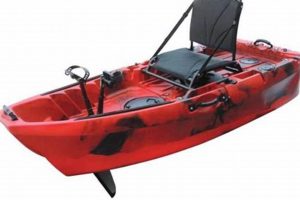
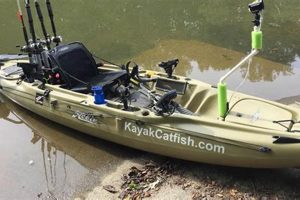
A comfortable and supportive structure designed for angler use in a kayak plays a crucial role in overall fishing experience. Ergonomic designs often feature adjustable backrests, breathable fabrics, and elevated platforms to improve casting, paddling, and overall comfort during long hours on the water. Specialized versions may incorporate features like swivel capabilities or elevated perches for sight fishing.
Proper postural support and cushioning are essential for preventing fatigue and back pain, allowing anglers to focus on fishing. A well-designed structure also enhances stability and balance within the kayak, which is particularly important when casting, reeling, or landing fish. Historically, kayak anglers made do with basic padding or improvised seating. The evolution to specialized seating reflects the growth and specialization of kayak fishing as a popular sport and recreational activity.
Considerations for selecting an appropriate seating solution include factors like intended fishing style, kayak compatibility, desired comfort level, and budget. This article will further explore these considerations, examining various types, materials, and features commonly available. Subsequent sections will delve into the installation process, maintenance tips, and customization options to optimize on-the-water comfort and performance.
Tips for Selecting Kayak Fishing Seating
Choosing appropriate seating is crucial for comfort and performance in a fishing kayak. These tips offer guidance for selecting and utilizing seating effectively.
Tip 1: Consider Fishing Style: Different fishing styles necessitate different seating features. Still-water anglers might prioritize comfort and stability, while those fishing in moving water may require enhanced maneuverability and a higher vantage point.
Tip 2: Evaluate Kayak Compatibility: Ensure compatibility between the chosen seating and the kayak model. Check mounting points, dimensions, and weight capacity for a proper fit.
Tip 3: Prioritize Adjustability: Adjustable backrests, seat height, and leg support contribute significantly to long-term comfort and proper posture.
Tip 4: Assess Material and Construction: Durable, weather-resistant materials are essential. Consider breathability for comfort in warm climates.
Tip 5: Test Seating Before Purchase: Whenever possible, physically test potential seating options for comfort and stability. Consider factors like height, weight, and body type.
Tip 6: Think About Storage and Accessibility: Integrated storage within the seating can be advantageous for keeping essential gear readily accessible.
Tip 7: Factor in Installation and Maintenance: Choose seating that offers straightforward installation and requires minimal maintenance.
Selecting appropriate kayak fishing seating significantly enhances comfort, stability, and overall fishing performance. Careful consideration of these tips contributes to a more enjoyable and productive on-the-water experience.
By understanding these elements, anglers can make informed decisions about seating choices, leading to enhanced comfort and fishing success. The following section will delve into frequently asked questions regarding kayak fishing seating.
1. Comfort

Comfort in a fishing kayak directly impacts angling effectiveness and overall enjoyment. An uncomfortable seating arrangement can lead to fatigue, reduced focus, and a shorter time on the water. Conversely, a comfortable setup allows anglers to concentrate on fishing, maximizing their time and potential for success. This section explores key facets of comfort related to kayak fishing seating.
- Back Support
Adequate back support is crucial for maintaining proper posture and preventing back pain, especially during long hours on the water. Lumbar support and adjustable backrests are key features to consider. A poorly supported back can lead to discomfort and premature fatigue, hindering fishing performance. High-quality kayak seats often incorporate adjustable lumbar support to accommodate individual preferences and body types, promoting proper spinal alignment and reducing strain.
- Cushioning
Effective cushioning minimizes pressure points and enhances comfort. Closed-cell foam padding provides both comfort and resistance to water absorption. Insufficient cushioning can result in discomfort and numbness, particularly during extended fishing trips. Materials like high-density foam offer superior comfort and durability compared to basic padding, contributing to a more enjoyable experience.
- Breathability
Breathable materials promote airflow, reducing heat and moisture buildup, particularly in warm climates. Mesh or ventilated fabrics enhance comfort and prevent discomfort caused by perspiration. Non-breathable materials can lead to discomfort and skin irritation, especially during hot weather conditions. Seats designed with breathable fabrics promote air circulation and moisture wicking, keeping anglers cool and dry.
- Stability
A stable and secure seating position is essential for comfort and safety, particularly when casting, reeling, or landing fish. A well-designed seat minimizes shifting and movement within the kayak. Instability can lead to discomfort and compromise safety, especially in challenging conditions. Features like adjustable straps and secure mounting points contribute to enhanced stability and a more comfortable fishing experience.
These facets of comfort contribute significantly to the overall fishing experience. A comfortable angler is a more focused and effective angler, capable of spending longer hours on the water and maximizing their chances of success. Selecting seating with appropriate back support, cushioning, breathability, and stability is a crucial investment for any serious kayak angler.
2. Stability

Stability forms a critical link between angler performance and kayak fishing success. A stable seating platform contributes significantly to balance, efficient casting, and safe fish retrieval. Compromised stability, conversely, can lead to difficulties in maintaining balance, inaccurate casts, and an increased risk of capsizing, particularly when battling larger fish or navigating challenging water conditions. A secure and stable platform enables anglers to confidently perform maneuvers like casting, hooking, and landing fish, minimizing the risk of tipping. For example, a high-backed seat with adjustable straps and a non-slip surface provides a secure foundation, even in rough waters or during sudden movements.
Several factors influence seating stability. Seat design, including features like width, height, and backrest angle, plays a crucial role. Integration with the kayak, considering mounting points and adjustability, also significantly impacts stability. Individual factors, such as angler weight and center of gravity, further contribute to the overall stability equation. Kayak design features, such as hull shape and width, also interact with the seating to influence the overall stability profile. A wider, flatter hull typically offers greater initial stability, while a narrower hull may provide more maneuverability at the expense of some primary stability. The interaction between seat design and kayak design must be considered to achieve optimal performance. For example, a low-profile seat mounted close to the kayak’s center of gravity enhances stability, whereas a higher seat might improve visibility but potentially compromise balance.
Understanding the relationship between seating and stability is paramount for optimizing fishing performance and ensuring safety. Selecting appropriate seating based on individual needs, fishing style, and kayak compatibility significantly contributes to a stable and enjoyable fishing experience. Addressing stability through appropriate seat selection and adjustments allows anglers to focus on fishing rather than constantly adjusting their balance. This understanding enables informed choices regarding seat features, adjustments, and kayak compatibility, ultimately enhancing safety and maximizing the potential for a successful outing.
3. Adjustability

Adjustability in kayak fishing seating plays a pivotal role in optimizing comfort, enhancing fishing effectiveness, and accommodating diverse angler needs and preferences. A static, non-adjustable seat restricts anglers to a single, potentially uncomfortable position, whereas an adjustable design allows customization based on individual body type, fishing style, and on-the-water conditions. This adaptability contributes significantly to long-term comfort, reduced fatigue, and improved fishing performance.
Consider the scenario of an angler transitioning from casting for bass in shallow water to trolling for trout in deeper water. An adjustable seat facilitates this transition by allowing the angler to lower the seat for increased stability during casting and then raise it for improved visibility while trolling. Similarly, adjustable back support caters to individual preferences and postural needs, mitigating discomfort during long fishing trips. The ability to fine-tune seat height, backrest angle, and leg support contributes significantly to comfort and stability throughout diverse fishing scenarios. For example, a forward-leaning posture might be preferable for active casting, while a more relaxed, reclined position may be desired during periods of waiting or observing. Adjustability empowers anglers to personalize their seating configuration to match these varying demands.
The practical implications of seat adjustability extend beyond mere comfort. Proper posture, facilitated by adjustable seating, improves casting accuracy and reduces strain on muscles and joints. Enhanced stability, achieved through customizable seat positioning, contributes to safer fish handling and maneuvering in challenging conditions. Ultimately, the ability to adapt seating to individual needs and changing fishing situations optimizes performance, maximizes comfort, and promotes a safer, more enjoyable experience on the water. Investing in a kayak seat with comprehensive adjustability options represents a significant contribution to long-term angling satisfaction and success.
4. Durability
Durability stands as a critical factor in the evaluation of kayak fishing seating. Exposure to harsh environmental conditions, including UV radiation, moisture, and saltwater, necessitates robust construction. A durable seat withstands these rigors, maintaining its structural integrity and functional performance over extended periods. Conversely, a poorly constructed seat may deteriorate rapidly, compromising comfort, stability, and safety. Consider a scenario where an angler regularly fishes in saltwater environments. A seat constructed from corrosion-resistant materials, such as marine-grade stainless steel hardware and UV-resistant fabrics, will demonstrably outperform a seat made with less durable materials, ensuring longevity and reliable performance despite the corrosive effects of saltwater.
The practical implications of durability extend beyond mere longevity. A durable seat provides consistent support and comfort, crucial for long fishing trips. Robust construction resists wear and tear from regular use, including repeated mounting, dismounting, and adjustments. This sustained performance translates to enhanced angler comfort and reduced long-term replacement costs. For instance, a seat with reinforced stitching and high-quality fasteners will better withstand the stresses of repeated use and movement compared to a seat with weaker construction, ultimately providing greater value and longevity.
Evaluating seat durability requires consideration of materials, construction techniques, and manufacturer reputation. High-quality materials, such as UV-resistant fabrics and corrosion-resistant hardware, contribute significantly to long-term durability. Reinforced stitching, robust frame construction, and quality fasteners further enhance resistance to wear and tear. Reputable manufacturers often offer warranties and demonstrate a commitment to quality control, providing further assurance of durability and long-term performance. Understanding these factors allows informed purchasing decisions, ensuring a durable, reliable seat capable of withstanding the demands of regular kayak fishing use.
5. Material

Material selection significantly influences the performance, comfort, and longevity of kayak fishing seating. The chosen materials directly impact crucial characteristics such as durability, breathability, water resistance, and overall comfort. Consider the choice between closed-cell foam and open-cell foam. Closed-cell foam, resistant to water absorption, provides buoyancy and maintains its insulating properties even when wet, making it suitable for wet conditions. Open-cell foam, while offering greater initial comfort, absorbs water, losing its insulating capacity and becoming heavier, making it less suitable for frequent immersion. This distinction highlights the importance of material selection based on anticipated usage.
Further illustrating material impact, consider UV resistance. Prolonged sun exposure degrades certain materials, leading to fading, cracking, and reduced structural integrity. Choosing UV-resistant fabrics and components ensures longevity and sustained performance in sunny climates. Similarly, the choice of hardware material influences corrosion resistance. Stainless steel or other corrosion-resistant metals are essential in saltwater environments to prevent rust and maintain structural integrity, unlike less resistant metals which degrade quickly in saltwater. These examples underscore the direct relationship between material properties and long-term seat performance.
Understanding material properties empowers informed decision-making when selecting kayak fishing seating. Evaluating material characteristics based on anticipated usage conditions, including exposure to water, sunlight, and other environmental factors, ensures appropriate selection. This careful consideration of material properties contributes directly to long-term seat durability, comfort, and overall performance, maximizing the value of the investment and contributing to a more enjoyable and productive fishing experience. Choosing appropriate materials, therefore, is not merely a matter of preference but a crucial factor in optimizing seating performance and ensuring its suitability for the intended fishing environment.
6. Installation

Proper installation is crucial for maximizing the performance and longevity of kayak fishing seating. Incorrect installation can compromise stability, comfort, and even safety. A poorly installed seat may shift or detach during use, leading to discomfort, difficulty maintaining balance, and potentially even capsizing. Conversely, a correctly installed seat provides a secure and stable platform, enhancing angler comfort, control, and overall fishing effectiveness. Consider, for example, an angler who installs a seat without properly tightening the mounting hardware. This oversight could result in the seat shifting during casting or reeling, compromising balance and potentially leading to a fall. However, meticulous adherence to manufacturer instructions, ensuring all mounting points are secure and correctly aligned, creates a stable and reliable seating platform, maximizing comfort and safety.
Different kayak models utilize various mounting systems for seating, ranging from simple straps and buckles to integrated track systems and specialized hardware. Understanding the specific mounting system of the kayak and the corresponding requirements of the chosen seat is essential for correct installation. Consulting manufacturer instructions and seeking expert advice when necessary ensures compatibility and proper installation procedures are followed. For instance, some kayaks utilize track systems that allow for adjustable seat positioning, while others rely on fixed mounting points. Selecting a seat compatible with the kayak’s mounting system and adhering to the manufacturer’s installation guidelines ensures a secure and functional fit. Attempting to force an incompatible seat onto a kayak can damage both the seat and the kayak, compromising safety and performance.
Precise installation directly influences angler comfort, safety, and overall fishing experience. A stable and secure seat enhances comfort and reduces fatigue during long hours on the water. Proper installation also contributes to enhanced stability, minimizing the risk of tipping or capsizing, especially in challenging conditions. Furthermore, correct installation maximizes the lifespan of the seating system by minimizing stress on materials and components. Understanding and adhering to proper installation procedures represents a fundamental aspect of responsible kayak fishing equipment management, ensuring a safe, comfortable, and productive experience on the water. Overlooking installation details, however seemingly minor, can have significant repercussions on safety and performance, underscoring the importance of meticulous attention to this critical aspect of kayak fishing seating.
Frequently Asked Questions
This section addresses common inquiries regarding kayak fishing seating, providing concise and informative responses to facilitate informed decision-making and enhance on-the-water experiences.
Question 1: How does one determine the appropriate seat height for kayak fishing?
Optimal seat height depends on individual preferences and fishing styles. A higher seat offers improved visibility but may compromise stability. A lower seat enhances stability but can restrict visibility. Testing various heights is recommended to determine the optimal balance between visibility and stability.
Question 2: What materials are commonly used in kayak fishing seat construction?
Common materials include high-density polyethylene (HDPE) for frames, closed-cell foam for padding, and UV-resistant fabrics for coverings. Material selection influences durability, comfort, and water resistance.
Question 3: Can existing kayak seats be upgraded or replaced?
Many kayaks allow for seat upgrades or replacements. Compatibility with existing mounting points is crucial. Consulting manufacturer specifications or seeking expert advice ensures proper fit and functionality.
Question 4: How does one maintain and clean a kayak fishing seat?
Regular cleaning with mild soap and water removes dirt and grime. Rinsing with fresh water after saltwater exposure prevents corrosion. Storing the seat in a dry, protected location prolongs its lifespan.
Question 5: Are there specific seating considerations for anglers with back problems?
Individuals with back problems should prioritize seats with adjustable lumbar support and ample cushioning. Ergonomic designs and proper posture contribute to comfort and minimize strain.
Question 6: What safety precautions should be considered regarding kayak fishing seating?
Ensuring proper seat installation and secure attachment is paramount for safety. Maintaining a low center of gravity and avoiding sudden movements enhances stability and reduces the risk of capsizing.
Understanding these frequently asked questions empowers informed decisions regarding kayak fishing seating, contributing to enhanced comfort, safety, and overall fishing enjoyment. Careful consideration of these factors allows anglers to optimize their on-the-water experience.
The following section will offer concluding thoughts and recommendations on selecting the ideal kayak fishing seat.
Conclusion
Appropriate kayak fishing seating is integral to a successful and enjoyable angling experience. This exploration has highlighted the critical interplay between seating characteristicscomfort, stability, adjustability, durability, material composition, and installationand overall fishing performance. Optimal seating enhances comfort, reduces fatigue, improves stability, and promotes proper posture, enabling anglers to focus on the task at hand. Informed selection based on individual needs, fishing style, and kayak compatibility maximizes long-term satisfaction and on-the-water success. Careful consideration of these factors contributes significantly to a more productive and fulfilling fishing experience. Neglecting these elements can compromise not only comfort but also safety and fishing effectiveness.
Investing in appropriate kayak fishing seating represents an investment in long-term angling enjoyment and success. Prioritizing these considerations empowers informed decisions, fostering a safer, more comfortable, and ultimately more rewarding connection with the sport. Continued exploration of advancements in seating design and technology promises further enhancements to on-the-water experiences, underscoring the enduring significance of appropriate seating in the pursuit of angling excellence.