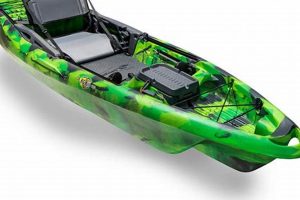
This specific model designates a recreational watercraft designed for angling. A kayak of this type is typically compact, measuring twelve feet in length, and manufactured under the “Eagle Run” model name by the “Field & Stream” brand, a recognizable name in outdoor recreation. Such kayaks are usually constructed from durable, lightweight materials suitable for freshwater environments like lakes and rivers.
Compact fishing kayaks offer advantages in maneuverability and portability, allowing access to shallower waters and easier transport. A vessel of this size often includes features tailored for angling, such as rod holders, storage compartments for tackle, and perhaps even a dedicated anchor system. The “Field & Stream” brand carries a history in outdoor sporting goods, suggesting a focus on practicality and affordability in their product lines.
Further exploration of this particular kayak model might include a detailed examination of its construction, features, performance characteristics, target user, and comparisons with similar products on the market. Analysis of its price point and user reviews could also provide valuable insights.
Tips for Utilizing a Compact Fishing Kayak
Effective use of a compact fishing kayak maximizes enjoyment and safety on the water. These tips provide guidance for leveraging the advantages of such a vessel.
Tip 1: Prioritize Stability: Understand the kayak’s weight capacity and maintain a low center of gravity. Avoid sudden movements or leaning excessively to prevent capsizing.
Tip 2: Plan and Pack Efficiently: Limited storage necessitates careful selection of essential gear. Organize tackle and equipment for easy access while minimizing clutter.
Tip 3: Practice Paddling Technique: Master efficient paddling strokes to conserve energy and maneuver effectively in various water conditions. Consider a double-bladed paddle for enhanced control.
Tip 4: Choose Appropriate Waters: Smaller kayaks are best suited for calm lakes, slow-moving rivers, and protected coastal areas. Avoid strong currents, open ocean, or challenging weather conditions.
Tip 5: Prioritize Safety Gear: Always wear a personal flotation device (PFD). Carry a whistle, signaling device, and basic first-aid kit. Inform someone of your paddling plans and estimated return time.
Tip 6: Respect Wildlife and the Environment: Maintain a safe distance from wildlife and avoid disturbing natural habitats. Adhere to “Leave No Trace” principles by packing out all trash and minimizing environmental impact.
Tip 7: Regular Maintenance: Rinse the kayak with fresh water after each use, especially in saltwater environments. Inspect for damage and address any necessary repairs promptly to ensure continued performance and safety.
Adhering to these guidelines enhances safety, improves fishing success, and prolongs the lifespan of the kayak. Careful preparation and mindful practices contribute to a more enjoyable experience on the water.
These practical tips offer a foundation for successful outings. Further research into specific fishing techniques and kayak handling skills will enhance overall proficiency.
1. Brand

“Field & Stream” represents a legacy brand in outdoor recreation, specializing in hunting, fishing, and camping equipment. Association with this brand implies a focus on practicality, durability, and affordability within the target market. The “Field & Stream 12′ Eagle Run Fishing Kayak” leverages this brand recognition, suggesting a product designed for recreational anglers seeking functional features without a premium price tag. This connection influences consumer perception, potentially impacting purchasing decisions based on established brand trust and perceived value. For example, an angler familiar with “Field & Stream” waders or fishing rods might be predisposed to consider their kayaks due to positive prior experiences. This brand association creates a framework of expectations regarding quality and performance.
The “Field & Stream” brand, historically associated with print publications and retail stores, has expanded into broader product lines. This diversification leverages existing brand loyalty to introduce products like the “Eagle Run” kayak to a wider audience. The brand’s established presence in the outdoor market offers a competitive advantage, facilitating market penetration and potentially influencing consumer perceptions of quality and value compared to lesser-known brands. Strategic marketing campaigns leveraging the brand’s heritage can further enhance product visibility and appeal, contributing to market success. This strategic brand extension positions the kayak within a familiar context for consumers already aligned with the “Field & Stream” ethos.
Understanding the brand’s history and market positioning provides context for evaluating the “Field & Stream 12′ Eagle Run Fishing Kayak.” While brand recognition alone does not guarantee product quality, it serves as a significant factor in consumer perception and purchasing decisions. Further research into specific product features, user reviews, and comparisons with competitors remains essential for a comprehensive assessment. However, the “Field & Stream” brand association establishes a baseline expectation of value and practicality, influencing the kayak’s perceived position within the broader recreational fishing market. This understanding enables more informed evaluations and comparisons, ultimately contributing to more confident purchasing decisions.
2. Model
“Eagle Run” designates the specific model within the Field & Stream kayak lineup. This distinction is crucial for differentiating this particular kayak from other models offered by the same brand, each designed with varying features, performance characteristics, and target users. Understanding the “Eagle Run” designation provides a framework for evaluating its intended purpose and suitability for specific angling needs. The model name itself often conveys certain connotations, potentially suggesting design features or intended use cases.
- Target User:
The “Eagle Run” likely targets recreational anglers seeking a balance of affordability, functionality, and ease of use. The model name, evoking images of a bird of prey gracefully navigating waterways, suggests a focus on maneuverability and perhaps a connection to nature-focused angling experiences. This presumed target user influences design choices, impacting features such as seating comfort, storage capacity, and integrated fishing accessories.
- Features and Construction:
Determining the materials used in the “Eagle Run’s” construction (e.g., single- or triple-layer polyethylene) is essential for evaluating its durability and performance. Likewise, specific features like rod holders, storage compartments, and the seating system directly impact its suitability for fishing. For example, adjustable seating positions and ample storage for tackle contribute to an angler’s overall comfort and efficiency on the water. These elements directly relate to the kayak’s practical value for its intended purpose.
- Performance Characteristics:
The “Eagle Run’s” 12-foot length suggests a balance between stability and maneuverability. Evaluating its tracking (ability to maintain a straight course) and responsiveness to paddle input reveals its suitability for different water conditions. For example, a kayak that tracks well is preferable for paddling longer distances, whereas a highly maneuverable design excels in tight spaces. These characteristics directly influence its performance as a fishing platform.
- Market Positioning:
The “Eagle Run” occupies a specific niche within the broader fishing kayak market. Comparing its features, price point, and target user to similar models from competing brands clarifies its competitive advantages and disadvantages. This market positioning analysis reveals the intended value proposition and clarifies its suitability for different angling styles and budgets. Such comparisons help prospective buyers determine the “Eagle Run’s” overall value within the available options.
Considering these facets in relation to the “Field & Stream 12′ Eagle Run Fishing Kayak” provides a more complete understanding of its intended purpose and suitability for various fishing scenarios. By analyzing the “Eagle Run” model within the context of its target user, construction, performance, and market position, potential buyers can make informed decisions based on their individual needs and preferences. Further research, including user reviews and expert comparisons, can supplement this foundational understanding to facilitate a well-informed purchasing decision.
3. Length

The 12-foot length of the Field & Stream Eagle Run fishing kayak significantly influences its performance characteristics and suitability for various angling scenarios. This length represents a compromise between stability and maneuverability, impacting tracking, speed, and ease of transport. A longer kayak generally tracks straighter and glides more efficiently, covering greater distances with less effort. Conversely, shorter kayaks offer enhanced maneuverability, enabling navigation through tight spaces like narrow creeks or shallow, obstacle-filled waters. The 12-foot length positions the Eagle Run within a moderate range, aiming to balance these competing attributes. For example, a 12-foot kayak might be suitable for navigating a moderately winding river while still providing reasonable tracking for traversing open lake areas. This length also impacts portability; while longer kayaks offer advantages in speed and tracking, they are more challenging to transport and store.
The practical implications of the 12-foot length are evident in various fishing situations. Consider an angler targeting bass in a vegetated shoreline. The kayak’s moderate length allows for relatively straightforward paddling between fishing spots while retaining sufficient maneuverability to navigate around obstacles like fallen trees or emergent vegetation. Conversely, a significantly longer kayak might struggle in such confined areas. Alternatively, consider an angler fishing open water for species like trout. The 12-foot length offers adequate tracking for maintaining course in light wind and chop, although it might be less efficient than a longer touring kayak for covering vast distances. Understanding the relationship between kayak length and intended fishing environment is crucial for maximizing efficiency and enjoyment on the water. For smaller individuals or those fishing predominantly in confined spaces, a shorter kayak might be preferable, whereas larger individuals or those prioritizing open-water performance might benefit from a longer vessel.
In summary, the 12-foot length of the Field & Stream Eagle Run fishing kayak represents a deliberate design choice aimed at balancing stability, maneuverability, and portability. This length impacts performance characteristics relevant to various fishing scenarios, influencing tracking, speed, and ease of transport. Understanding the practical implications of this length in relation to intended fishing environments and individual angler needs is paramount for maximizing the kayak’s effectiveness as a fishing platform. While a 12-foot length offers versatility for a range of conditions, careful consideration of personal paddling style, target fishing locations, and transportation logistics is essential for optimizing kayak selection and ensuring a successful on-the-water experience. Ultimately, selecting the appropriate kayak length significantly contributes to both comfort and fishing success.
4. Purpose

The explicit designation of the Field & Stream 12′ Eagle Run as a “fishing kayak” underscores its primary design objective: to provide a stable, efficient, and feature-rich platform for angling activities. This purpose directly influences design choices, from hull shape and stability to integrated features like rod holders and storage compartments. Analyzing the “fishing” purpose provides insights into how this particular kayak model caters to the specific needs and demands of anglers.
- Specialized Features:
Fishing kayaks often incorporate features absent in recreational models. Rod holders, strategically positioned for easy access and secure rod storage, are a prime example. Recessed tackle storage compartments protect gear from the elements while maintaining organization. These features directly enhance fishing efficiency, allowing anglers to focus on the task at hand rather than managing equipment. The presence and design of these specialized features on the Eagle Run speak directly to its intended purpose.
- Stability and Performance:
Stability is paramount in a fishing kayak. The ability to cast, reel, and land fish without compromising balance requires a stable platform. Hull design, width, and weight capacity contribute to stability. The Eagle Run’s performance characteristics, particularly its stability in various water conditions, directly relate to its suitability for fishing activities. For example, a wider, flatter hull provides enhanced stability compared to a narrower, V-shaped hull, potentially making it more suitable for stand-up fishing.
- Ergonomics and Comfort:
Long hours on the water demand comfort. Fishing kayaks often prioritize ergonomic seating designs with adjustable backrests and ample legroom. Comfort features contribute to an angler’s overall endurance and focus, directly impacting fishing success. An uncomfortable seating arrangement can detract from the experience, leading to fatigue and potentially curtailing fishing time. Analysis of the Eagle Run’s seating system and overall ergonomics reveals its suitability for extended fishing trips.
- Target Species and Environments:
The intended fishing environment and target species influence kayak design. A kayak designed for river fishing might prioritize maneuverability over straight-line tracking, while a kayak for lake fishing might emphasize stability for open-water conditions. The Eagle Run’s design characteristics, including its length and hull design, suggest its suitability for particular environments and fishing styles. Understanding this connection allows anglers to assess whether the Eagle Run aligns with their specific fishing needs.
The convergence of these facets demonstrates how the “fishing” purpose shapes the design and functionality of the Field & Stream 12′ Eagle Run. By analyzing its specialized features, stability, ergonomics, and suitability for different fishing environments, prospective buyers can assess its alignment with their individual angling needs and preferences. This targeted analysis provides a comprehensive understanding of how the Eagle Run’s design and features contribute to its effectiveness as a dedicated fishing platform, ultimately enabling informed purchasing decisions based on practical considerations and angling objectives.
5. Type
Categorizing the Field & Stream 12′ Eagle Run as a “kayak” distinguishes it within the broader spectrum of watercraft. This classification immediately establishes fundamental characteristics related to its design, functionality, and intended usage. Understanding the implications of the “kayak” designation provides a foundation for evaluating its suitability for specific activities, particularly fishing.
- Hull Design and Stability:
Kayaks typically feature a closed-deck design with a cockpit where the paddler sits. This design element, along with the kayak’s hull shape (e.g., flat-bottom, V-shaped, pontoon), significantly influences its stability. The Eagle Run’s hull design contributes to its stability and performance characteristics, influencing its suitability for various water conditions and fishing styles. For example, a flatter hull enhances primary stability (initial resistance to tipping), making it suitable for calmer waters and activities like casting. In contrast, a V-shaped hull offers greater secondary stability (resistance to capsizing once tipped), beneficial in rougher conditions.
- Propulsion and Maneuverability:
Kayaks are propelled using a double-bladed paddle, requiring a specific paddling technique distinct from canoeing or rowing. The paddler’s position and the kayak’s design influence maneuverability, affecting its responsiveness to paddle strokes and its ability to navigate tight spaces or changing currents. The Eagle Run’s length and hull design contribute to its maneuverability, impacting its performance in various fishing environments, such as navigating shallow, vegetated areas.
- Capacity and Storage:
Kayaks offer limited onboard storage compared to larger vessels. This constraint necessitates careful gear selection and efficient packing, especially for fishing excursions. The Eagle Run’s dedicated storage compartments, designed to accommodate fishing gear, address this inherent limitation within the “kayak” classification. Analyzing storage capacity informs decisions about what equipment can be comfortably and safely carried onboard.
- Transportation and Portability:
Kayaks are generally smaller and lighter than other watercraft, enhancing portability and ease of transport. Many kayaks, including the Eagle Run, can be transported on roof racks or trailers, facilitating access to various waterways. This portability expands fishing opportunities, allowing anglers to reach remote locations or quickly switch between different fishing spots. However, the kayak’s size and weight still require consideration during transport and storage.
These facets inherent to the “kayak” classification directly impact the Field & Stream 12′ Eagle Run’s functionality as a fishing platform. Its hull design contributes to stability while paddling and casting, the double-bladed paddle provides propulsion and maneuverability, limited storage necessitates careful gear selection, and portability expands access to diverse fishing locations. Understanding these elements within the context of the “kayak” designation clarifies the Eagle Run’s capabilities and limitations, enabling informed evaluations of its suitability for specific fishing scenarios and angler preferences. This comprehensive understanding empowers potential buyers to make informed decisions based on practical considerations and desired fishing experiences.
6. Stability
Stability is a critical performance characteristic for any kayak, especially one designed for fishing, like the Field & Stream 12′ Eagle Run. A stable platform is essential for casting, reeling, and landing fish without compromising balance or risking capsize. Various factors contribute to kayak stability, including hull design, width, length, and weight distribution. Understanding these factors and their interplay within the context of the Eagle Run provides crucial insights into its suitability for different fishing environments and angler preferences. Stability directly impacts angler confidence and safety, influencing overall fishing success and enjoyment on the water.
- Primary Stability:
Primary stability refers to a kayak’s initial resistance to tipping. A kayak with high primary stability feels very stable when sitting flat, providing a secure platform for casting and reeling. Wider, flatter hulls generally offer greater primary stability, making them suitable for calm water conditions and activities requiring less dynamic movement. The Eagle Run’s 12-foot length and presumed hull design (information requiring verification from manufacturer specifications) likely contribute to its primary stability, influencing its suitability for activities like still-water fishing or casting from a stationary position.
- Secondary Stability:
Secondary stability describes a kayak’s resistance to capsizing once it’s leaned or tilted beyond its initial stable position. Kayaks with rounded or more V-shaped hulls tend to offer higher secondary stability, providing a sense of security in rougher conditions or when leaning into turns. While primary stability is crucial for stationary activities, secondary stability becomes increasingly important in dynamic situations or challenging water conditions. Understanding the Eagle Run’s secondary stability is crucial for assessing its performance in wind, chop, or when navigating moving water. This information is best obtained from manufacturer specifications or reputable reviews.
- Factors Affecting Stability:
Several factors influence a kayak’s overall stability. Hull design, width, length, and weight capacity all play significant roles. Wider kayaks are generally more stable than narrower ones. Longer kayaks tend to track better but can be less maneuverable and potentially less stable in certain conditions. Weight distribution within the kayak also impacts stability. Properly distributing gear and maintaining a low center of gravity enhance stability. Analyzing these factors in relation to the Eagle Run, considering its specific dimensions and weight capacity, provides a more complete understanding of its stability characteristics.
- Stability and Fishing Performance:
The connection between stability and fishing performance is direct and significant. A stable kayak allows anglers to confidently cast, reel, and fight fish without constantly worrying about balance. This enhanced stability translates to improved fishing efficiency and enjoyment. For example, standing to cast in a kayak requires exceptional stability. Understanding the Eagle Run’s stability characteristics, particularly in relation to standing or leaning, informs anglers about its suitability for various fishing techniques and target species. This information is crucial for anglers who prefer active fishing styles involving frequent casting and retrieval or those targeting larger fish that might require more dynamic movements during the fight.
The stability of the Field & Stream 12′ Eagle Run fishing kayak significantly influences its suitability for various fishing scenarios and angler preferences. Analyzing its primary and secondary stability, considering the factors that contribute to overall stability, and understanding the direct link between stability and fishing performance provides a comprehensive framework for evaluating this critical characteristic. Combining this understanding with information from manufacturer specifications and user reviews allows anglers to assess the Eagle Run’s stability characteristics in relation to their individual needs and fishing styles, ultimately contributing to a more informed purchasing decision and enhanced on-the-water experiences.
7. Maneuverability

Maneuverability, a critical performance attribute for fishing kayaks, directly impacts an angler’s ability to navigate various water conditions and access prime fishing locations. For the Field & Stream 12′ Eagle Run, maneuverability influences its suitability for navigating tight spaces, responding to changing currents, and positioning effectively for optimal casting angles. Analyzing the factors contributing to maneuverability provides crucial insights into the Eagle Run’s performance characteristics and its suitability for specific fishing environments.
- Hull Design and Length:
Hull design significantly influences a kayak’s maneuverability. Shorter kayaks with a more rounded hull tend to turn more quickly and require less effort to change direction. The Eagle Run’s 12-foot length represents a moderate size, suggesting a balance between maneuverability and tracking performance. A shorter kayak might be more agile in tight spaces, while a longer kayak might track straighter in open water. The Eagle Run’s specific hull design, a detail requiring confirmation from manufacturer specifications, further contributes to its maneuverability profile.
- Water Conditions and Currents:
Maneuverability becomes especially critical in challenging water conditions. Navigating strong currents, windy conditions, or obstacle-filled waterways demands a kayak that responds quickly and efficiently to paddle input. The Eagle Run’s maneuverability in such conditions dictates its suitability for river fishing, navigating coastal areas, or handling windy lake environments. For example, a highly maneuverable kayak excels in navigating swift-moving streams or dodging submerged obstacles, while a less maneuverable kayak might struggle in such environments.
- Fishing Techniques and Target Species:
Different fishing techniques and target species often necessitate varying degrees of maneuverability. Anglers targeting bass in vegetated shorelines require a kayak capable of navigating tight spaces and making precise adjustments in position. Conversely, trolling in open water might prioritize tracking performance over quick turning. The Eagle Run’s maneuverability influences its suitability for specific fishing styles and target species, impacting an angler’s ability to effectively position the kayak for optimal casting angles and presentations.
- Paddler Skill and Experience:
While inherent kayak design influences maneuverability, paddler skill and experience also play a significant role. Experienced paddlers can often maneuver even less agile kayaks effectively through challenging conditions, while novice paddlers might find highly maneuverable kayaks initially unstable. The Eagle Run’s maneuverability characteristics, combined with the paddler’s skill level, ultimately determine its performance in various fishing scenarios. For novice paddlers, a moderately maneuverable kayak might offer a good balance of control and stability.
The maneuverability of the Field & Stream 12′ Eagle Run fishing kayak is a complex interplay of design, environment, and angler skill. Analyzing hull design, considering intended water conditions and fishing techniques, and factoring in paddler experience provides a comprehensive understanding of its maneuverability characteristics. This knowledge empowers anglers to assess the Eagle Run’s suitability for their specific fishing needs and preferences, ultimately contributing to informed purchasing decisions and enhanced on-the-water performance. Further research, including user reviews and expert comparisons, can provide additional insights into the Eagle Run’s real-world maneuverability in various fishing scenarios.
Frequently Asked Questions
This section addresses common inquiries regarding the Field & Stream 12′ Eagle Run Fishing Kayak, providing concise and informative responses to facilitate informed purchasing decisions and enhance user experience.
Question 1: What is the weight capacity of the Eagle Run?
The weight capacity varies depending on the specific model year and manufacturing specifications. Consulting the manufacturer’s documentation or contacting an authorized retailer provides the most accurate weight capacity information. Exceeding the specified weight capacity can compromise stability and safety.
Question 2: What materials are used in its construction?
The Eagle Run is typically constructed from single or triple-layer polyethylene. Specific material details, including density and layer construction, should be verified through manufacturer resources. Material choice impacts durability, weight, and overall kayak performance.
Question 3: Does the Eagle Run come with a paddle?
Paddle inclusion varies depending on retailer and specific purchase agreements. Clarification regarding paddle inclusion should be sought at the point of purchase. If not included, selecting an appropriate paddle length and style is crucial for efficient paddling and maneuverability.
Question 4: Is the Eagle Run suitable for saltwater fishing?
While the Eagle Run can be used in saltwater environments, thorough rinsing with fresh water after each use is essential to prevent corrosion and maintain the kayak’s integrity. Additional precautions, such as applying marine-grade protectants, might be advisable for extended saltwater usage.
Question 5: What type of rod holders are included?
Specific rod holder details, including type, quantity, and placement, should be confirmed through manufacturer resources or product images. Rod holder designs vary, impacting rod security and angler accessibility.
Question 6: How does the Eagle Run perform in windy conditions?
Performance in wind depends on various factors, including wind speed, water conditions, and paddling experience. Due to its shorter length and lighter weight, the Eagle Run might be more susceptible to wind drift than longer, heavier kayaks. User reviews and expert comparisons can offer further insights into its wind performance.
Addressing these frequently asked questions provides a foundational understanding of the Field & Stream 12′ Eagle Run Fishing Kayak. However, consulting manufacturer specifications and seeking expert advice remains crucial for personalized guidance tailored to individual needs and intended usage.
Further exploration of user reviews and comparisons with competitor models provides additional perspectives for comprehensive evaluation and informed decision-making.
Conclusion
This exploration has provided a comprehensive overview of the Field & Stream 12′ Eagle Run Fishing Kayak, encompassing its key features, performance characteristics, and suitability for various angling scenarios. Analysis of the brand’s reputation, model designation, length, purpose, type, stability, and maneuverability offers valuable insights for prospective buyers. Understanding these elements facilitates informed decision-making based on individual needs and preferences.
Careful consideration of intended fishing environments, target species, and personal paddling styles remains crucial for maximizing the kayak’s effectiveness as a fishing platform. Further research, including in-depth reviews and comparisons with competitor models, empowers informed choices and enhances the potential for successful and enjoyable fishing experiences. Ultimately, selecting appropriate equipment contributes significantly to angler success and fosters a deeper appreciation for the sport.