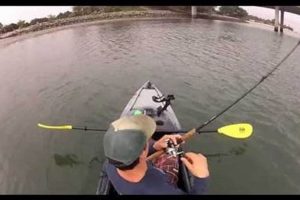
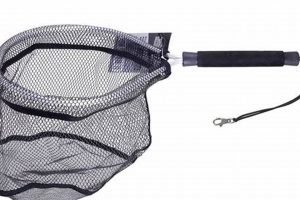
A compact, portable net designed for anglers in kayaks offers convenient storage and deployment. This type of net typically features a collapsible frame and handle, allowing it to be easily stowed when not in use, maximizing space on smaller vessels. These nets are generally constructed from lightweight, durable materials like aluminum or reinforced nylon to withstand the rigors of fishing and exposure to the elements.
Efficient storage and quick deployment are critical for kayak anglers, especially in situations requiring rapid maneuvering. A streamlined design minimizes interference with paddles and other gear, allowing for a more efficient and enjoyable fishing experience. Historically, anglers in small watercraft faced challenges with bulky netting solutions until the advent of modern, collapsible designs. This innovation significantly improved both safety and practicality, contributing to the growing popularity of kayak fishing.
The subsequent sections will delve into specific features to consider when selecting this essential piece of equipment, covering aspects such as materials, handle length, hoop size, and netting material. Further discussion will explore proper usage techniques and maintenance practices to ensure longevity and optimal performance.
Tips for Utilizing Collapsible Nets in Kayaks
Optimizing the use of a compact, portable net designed for kayak fishing enhances efficiency and ensures a successful angling experience. The following tips offer valuable insights into selecting and utilizing this crucial piece of equipment.
Tip 1: Prioritize Net Size and Shape: Consider the target species when selecting hoop size and net depth. Larger hoops are suitable for larger fish, while teardrop shapes facilitate easier retrieval in confined spaces.
Tip 2: Choose Appropriate Handle Length: Handle length dictates reach and leverage. Shorter handles offer better control in close quarters, while longer handles are advantageous for reaching fish further from the kayak.
Tip 3: Opt for Durable, Lightweight Materials: Select nets constructed from corrosion-resistant materials like aluminum or reinforced nylon. Lightweight construction minimizes fatigue during prolonged use.
Tip 4: Practice Swift Deployment and Secure Storage: Familiarize oneself with the net’s deployment mechanism to ensure rapid deployment when needed. Secure storage prevents entanglement and maximizes space.
Tip 5: Employ Proper Netting Techniques: Lead the fish into the net headfirst to prevent escape and minimize stress on the fish. Avoid scooping from underneath, which can cause the fish to spook and potentially break the line.
Tip 6: Regularly Inspect and Maintain the Net: Check for damage to the netting, frame, and handle after each use. Rinse with fresh water to remove salt and debris, and allow to dry completely before storage to prevent corrosion and mildew.
Tip 7: Consider a Net with Rubberized Mesh: Rubberized mesh is gentler on fish, reducing scale damage and promoting catch-and-release practices.
Adhering to these guidelines ensures efficient net deployment, minimizes fish stress, and prolongs the lifespan of this essential piece of kayak fishing equipment.
By incorporating these practical tips, anglers can significantly enhance their kayak fishing experience. The concluding section will summarize key takeaways and reinforce the importance of proper net selection and usage.
1. Portability

Portability is a paramount consideration for kayak anglers due to the inherent space limitations of their vessels. A folding kayak fishing net addresses this constraint directly, enabling anglers to carry essential equipment without sacrificing valuable storage space or maneuverability. This design feature significantly enhances the overall fishing experience by minimizing clutter and maximizing efficiency.
- Compact Storage:
Folding mechanisms allow the net to collapse into a smaller, more manageable form. This compact size facilitates storage in tight compartments, under seats, or attached to gear tracks, ensuring the net remains readily accessible without impeding paddling or casting. Examples include telescopic handles that retract and hinged frames that fold flat, significantly reducing the net’s overall footprint.
- Lightweight Construction:
Modern folding nets frequently utilize lightweight materials like aluminum or reinforced nylon in their construction. This minimizes the overall weight burden on the kayak, contributing to improved stability and maneuverability. The lighter the net, the less impact it has on the kayak’s performance and the angler’s fatigue levels. This is particularly important during longer fishing trips or when navigating challenging waters.
- Ease of Deployment:
Efficient deployment is essential for landing fish quickly and minimizing stress on both the fish and the angler. Folding nets often incorporate quick-release mechanisms or simple unfolding designs that allow for rapid deployment with a single hand. This speed is crucial in dynamic fishing situations where timing is of the essence. Examples include spring-loaded mechanisms or simple locking pins that secure the net in both its folded and deployed configurations.
- Balanced Design:
While portability emphasizes compact storage, a well-designed folding net also considers balance and weight distribution. The folded configuration should not create an uneven load in the kayak, which could compromise stability. The design should distribute the weight evenly, even when stowed, allowing for a smooth and balanced kayaking experience.
These elements of portability collectively contribute to a more streamlined and efficient kayak fishing experience. By minimizing bulk and maximizing functionality, a folding kayak fishing net allows anglers to focus on the task at hand catching fish without the encumbrance of unwieldy equipment.
2. Durability

Durability is a critical factor in evaluating a folding kayak fishing net’s suitability for the demanding marine environment. These nets experience significant stress from fish handling, exposure to saltwater, and potential impacts against the kayak or other gear. A durable net ensures reliable performance over extended periods, minimizing the risk of failure at crucial moments and reducing the need for frequent replacements.
- Frame Construction
The frame material significantly influences the net’s overall durability. Aluminum frames offer a balance of strength and lightweight properties, resisting corrosion and withstanding regular use. Reinforced nylon frames provide flexibility and impact resistance, but may be susceptible to wear over time. High-quality construction, including robust joints and reinforcements, is essential for long-term structural integrity.
- Netting Material
The netting material itself plays a crucial role in the net’s ability to withstand the stresses of capturing and retaining fish. Rubberized mesh offers excellent durability and fish-friendly properties, minimizing scale damage and promoting catch-and-release practices. Knotless nylon netting provides strength and resistance to tearing, ensuring fish are secured effectively. Coated nylon netting adds an extra layer of protection against abrasion and UV degradation, further enhancing durability.
- Handle Robustness
The handle must withstand the forces applied during fish retrieval. A sturdy handle, often constructed from aluminum or reinforced fiberglass, provides the necessary strength and rigidity for lifting fish without bending or breaking. Ergonomic grips enhance comfort and control, reducing the likelihood of accidental drops. Telescoping handles should feature secure locking mechanisms to prevent collapse under pressure.
- Hardware and Fasteners
Corrosion-resistant hardware and fasteners are essential for maintaining the net’s structural integrity in saltwater environments. Stainless steel or anodized aluminum components resist rust and degradation, ensuring smooth operation and longevity. Reinforced stitching and secure connections between the net, frame, and handle are crucial for preventing separation under stress.
A durable folding kayak fishing net offers a reliable and long-lasting solution for anglers. By prioritizing robust construction and high-quality materials, anglers can invest in a net that withstands the rigors of kayak fishing, ensuring consistent performance and minimizing the need for replacements. This contributes to a more enjoyable and sustainable fishing experience.
3. Net Material
Net material is a crucial aspect of a folding kayak fishing net, directly influencing its performance, fish handling, and overall longevity. Appropriate material selection balances the need for strength, durability, and minimal environmental impact, contributing significantly to a positive and responsible fishing experience. Different materials offer varying benefits and drawbacks, requiring careful consideration based on individual fishing styles and target species.
- Durability and Abrasion Resistance
The net material must withstand the abrasive forces encountered during fish retrieval, contact with sharp teeth or spines, and potential snags on rocks or vegetation. Rubberized netting provides excellent abrasion resistance, minimizing wear and tear, and extending the net’s lifespan. Traditional nylon netting, while strong, can be susceptible to abrasion over time, especially with repeated use and exposure to harsh conditions. Coated nylon options offer improved abrasion resistance compared to standard nylon, providing a balance of strength and durability.
- Fish-Friendliness and Conservation
For anglers practicing catch and release, the net material’s impact on fish health is paramount. Rubberized or rubber-coated meshes are gentler on fish scales and slime coats, reducing the risk of injury and infection. These materials also tend to be less likely to tangle hooks, facilitating quicker and less stressful releases. Traditional nylon, while effective for securing fish, can be more abrasive, potentially removing scales and increasing the chance of harm, particularly for delicate species.
- Water Absorption and Drying Time
Netting material affects water absorption and drying time, which are important considerations for maintaining the net’s condition and preventing mildew or odor. Rubberized nets tend to absorb less water and dry faster than nylon, minimizing the risk of bacterial growth and unpleasant smells. Quick-drying materials also contribute to easier storage and transport, as a damp net can be inconvenient and potentially damage other equipment in the kayak.
- Knotted vs. Knotless Construction
The construction of the netting itself, whether knotted or knotless, influences its strength, fish handling, and potential for hook snagging. Knotless netting is generally preferred for catch and release, as it minimizes the chance of hooks becoming entangled. Knotted netting, while potentially stronger, can be more prone to hook snags, increasing the difficulty of releasing fish and potentially causing injury. The choice between knotted and knotless construction often depends on the target species and the angler’s fishing practices.
Careful consideration of net material properties ensures the selection of a folding kayak fishing net that aligns with individual fishing needs and conservation practices. A balance of durability, fish-friendliness, and practicality contributes to a more efficient, enjoyable, and responsible fishing experience from a kayak.
4. Handle Length

Handle length is a critical design element in folding kayak fishing nets, directly influencing an angler’s reach and leverage during fish retrieval. Optimal handle length balances the need for extended reach with the constraints of kayak fishing, where space and maneuverability are paramount. An improperly sized handle can hinder net deployment, compromise fish landing, and potentially create an imbalance, affecting kayak stability.
Shorter handles offer advantages in close-quarters situations, common in kayak fishing. They provide enhanced control and precision, allowing for quicker net maneuvers around the kayak’s confined cockpit. This is particularly beneficial when targeting smaller fish or when fishing in tight spaces, such as mangrove tunnels or shallow creeks. However, shorter handles limit reach, making it challenging to land larger fish that may be further from the kayak’s side. For instance, a short-handled net might prove inadequate for landing a large salmon or pike that requires a wider net arc and greater reach for successful retrieval.
Conversely, longer handles extend the angler’s reach, enabling retrieval of fish further from the kayak. This is advantageous when targeting larger species or fishing in open water, where fish may be hooked at a greater distance. However, longer handles can be cumbersome in the confined space of a kayak, potentially interfering with paddling, casting, or other onboard activities. They also increase the risk of entanglement with fishing lines or other gear. For example, a long-handled net might be impractical for fishing in dense vegetation or when navigating tight turns in a river, as it could easily snag on branches or create an imbalance in the kayak.
The optimal handle length for a folding kayak fishing net often involves a compromise between reach and maneuverability. Telescoping handles offer a versatile solution, allowing anglers to adjust the handle length as needed. This adaptability provides the benefits of both short and long handles, maximizing efficiency in diverse fishing scenarios. Ultimately, handle length selection should consider the target species, fishing environment, and personal preferences, ensuring a balanced and effective approach to fish landing from a kayak.
5. Hoop Size

Hoop size is a critical consideration when selecting a folding kayak fishing net. The hoop, which forms the net’s opening, directly influences the effective catch area and dictates the size of fish that can be landed successfully. An appropriately sized hoop balances the need for a wide catch radius with the constraints of maneuverability and storage within a kayak’s limited space. Selecting the correct hoop size optimizes landing efficiency and minimizes fish stress during retrieval.
A larger hoop provides a wider target area, increasing the chances of successfully scooping a fish, particularly when dealing with fast-moving or larger species. For instance, a larger hoop is advantageous when targeting salmon or steelhead, as their size and agility necessitate a larger catch radius for efficient landing. Conversely, a smaller hoop offers enhanced maneuverability in tight spaces, such as when fishing in dense vegetation or navigating narrow waterways. Smaller hoops are also generally lighter and less cumbersome, reducing fatigue during prolonged use and minimizing interference with other kayak gear. For example, a smaller hoop is often preferable when targeting panfish or trout in smaller streams or ponds.
The relationship between hoop size and target species is paramount. A hoop too small for the intended quarry increases the risk of losing the fish during retrieval or causing injury due to prolonged struggling within the confined net. Conversely, an excessively large hoop can be cumbersome and difficult to maneuver in a kayak’s limited space. Furthermore, hoop shape also contributes to net performance. Teardrop-shaped hoops offer a larger opening at the front, tapering towards the handle, facilitating easier scooping and reducing fish escape. This shape is particularly beneficial for kayak anglers, as it aids in maneuvering the net in confined spaces. Careful consideration of hoop size and shape, in conjunction with the target species and fishing environment, ensures a balanced and effective approach to fish landing from a kayak, optimizing efficiency and promoting responsible angling practices.
6. Ease of Use

Ease of use is a paramount factor influencing the effectiveness and enjoyment of kayak fishing. Within the confined space of a kayak, efficient gear deployment and operation are crucial for a successful and safe angling experience. A folding kayak fishing net, designed specifically for this environment, addresses these challenges through features that prioritize streamlined deployment, secure storage, and intuitive handling. These design elements contribute significantly to an angler’s overall efficiency and enjoyment on the water.
Rapid deployment is often essential in kayak fishing, where opportunities to land a fish can be fleeting. A folding net’s quick-release mechanisms, such as spring-loaded hinges or simple locking pins, allow for swift one-handed deployment, crucial for capturing fish before they escape or break the line. Secure locking systems, both in the deployed and collapsed positions, prevent accidental opening or closing, ensuring the net remains ready for use and doesn’t interfere with other activities. Furthermore, a lightweight and balanced design facilitates easy handling and reduces fatigue during prolonged fishing trips. The net’s construction should allow for comfortable grip and maneuverability, minimizing strain on the wrist and arm, even with a heavier fish. For instance, a well-designed handle with an ergonomic grip and a smooth deployment mechanism significantly reduces the physical effort required to land a fish, enhancing overall comfort and efficiency.
Compact storage is another critical aspect of ease of use in kayak fishing. Folding nets, by their very nature, address this constraint by collapsing into a smaller, more manageable form. This allows for convenient storage in limited onboard space, minimizing clutter and maximizing available room for other essential gear. The net’s folded profile should be designed to minimize entanglement with other equipment, ensuring quick and easy access when needed. Efficient storage not only streamlines the fishing experience but also contributes to kayak stability by preventing shifting weight and maintaining a balanced center of gravity. This ease of use translates directly to a safer and more enjoyable fishing experience, allowing anglers to focus on the task at hand rather than wrestling with cumbersome equipment. The integration of these design features emphasizes the importance of ease of use in a folding kayak fishing net, demonstrating a clear understanding of the specific challenges and demands of kayak angling.
Frequently Asked Questions
This section addresses common inquiries regarding folding kayak fishing nets, providing concise and informative responses to aid selection and usage.
Question 1: What materials are best suited for kayak fishing net construction?
Aluminum and reinforced nylon are frequently chosen for frames due to their balance of strength, light weight, and corrosion resistance. Rubberized or coated nylon netting offers durability and fish-friendliness.
Question 2: How does one determine the appropriate handle length?
Handle length depends on fishing style and target species. Shorter handles offer better control in close quarters, while longer handles extend reach. Telescoping handles provide adjustable length for versatility.
Question 3: What hoop size is recommended for kayak fishing?
Hoop size should correspond to the target species. Larger hoops are suitable for larger fish, while smaller hoops offer better maneuverability in tight spaces. Teardrop shapes facilitate easier scooping.
Question 4: What are the key advantages of a folding net over a fixed-frame net in a kayak?
Folding nets offer superior portability and space-saving efficiency in kayaks. Their collapsible design allows for convenient storage without compromising onboard space or maneuverability.
Question 5: How should a folding kayak fishing net be maintained?
Regular rinsing with fresh water after each use removes salt and debris. Thorough drying prevents corrosion and mildew. Periodic inspection for damage ensures continued functionality.
Question 6: Are there specific netting materials that are more beneficial for catch-and-release fishing?
Rubberized mesh is generally preferred for catch-and-release, as it minimizes damage to fish scales and slime coats, promoting healthier releases.
Understanding these key aspects of folding kayak fishing nets empowers informed decision-making, contributing to a more efficient and enjoyable fishing experience.
The subsequent sections will delve further into specific net models and recommended accessories, providing a comprehensive guide to outfitting a kayak for optimal fishing performance.
Folding Kayak Fishing Nets
Folding kayak fishing nets represent a significant advancement in angling equipment, specifically designed for the unique challenges and opportunities presented by kayak fishing. This exploration has highlighted the critical factors influencing net selection, emphasizing the importance of portability, durability, net material, handle length, hoop size, and ease of use. Each element contributes to the net’s overall effectiveness and the angler’s ability to efficiently and responsibly land fish from a kayak. Proper material selection and design features minimize environmental impact while maximizing functionality within the confined space of a kayak.
Careful consideration of these factors empowers informed purchasing decisions, leading to a more productive and enjoyable kayak fishing experience. The correct folding kayak fishing net becomes an indispensable tool, seamlessly integrating with the angler’s technique and contributing to successful and sustainable fishing practices. This thoughtful approach to equipment selection reflects a deeper understanding of the sport and a commitment to responsible angling, ensuring the preservation of aquatic ecosystems for future generations.