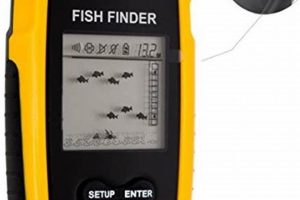
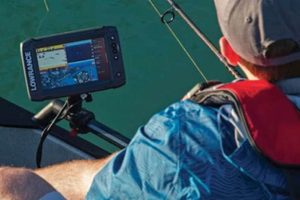
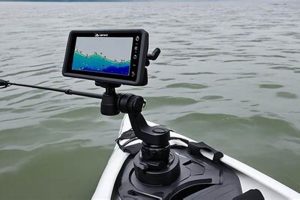
A sonar device mounted on a kayak utilizes sound waves to locate fish and underwater structures. The device emits a cone-shaped pulse of sound waves into the water. These waves travel downward until they encounter an object, such as the bottom, vegetation, or a fish. The object reflects some of the sound waves back towards the transducer, which then converts these echoes into electrical signals. The device interprets these signals, calculating the depth and distance to the object based on the time it took for the sound waves to travel down and back. This information is then displayed on a screen, typically showing depth readings, bottom contours, and the presence of fish as icons or arches.
Locating fish efficiently conserves time and resources, leading to a more successful and enjoyable angling experience. Knowing the depth and underwater topography assists in identifying ideal fishing locations, such as drop-offs, submerged structures, and vegetation beds where fish tend to congregate. This technology has revolutionized recreational fishing, providing anglers with a powerful tool to understand the underwater environment and improve their chances of a catch. Early fish finders were bulky and expensive, primarily used by commercial fishing vessels. Advancements in electronics have led to smaller, more affordable, and portable units suitable for kayaks and other small watercraft.
The following sections will detail the different types of sonar technology available for kayaks, the key features to consider when selecting a unit, and best practices for installation and operation.
Tips for Utilizing Sonar on a Kayak
Effective sonar use requires understanding key operational principles and techniques. The following tips provide guidance for maximizing the benefits of a fish finder while kayaking.
Tip 1: Transducer Placement: Optimal transducer placement is crucial for accurate readings. Mounting the transducer too close to the kayak’s hull or other sources of turbulence can create interference. Choose a location that minimizes disturbance, typically near the stern or on a dedicated mounting arm.
Tip 2: Sensitivity Adjustment: Adjust the sensitivity to match the water conditions and target depth. Higher sensitivity is beneficial in deeper water or when searching for smaller fish, while lower sensitivity reduces clutter in shallow water or areas with heavy vegetation.
Tip 3: Understanding Sonar Readings: Interpreting the information displayed on the screen is essential for identifying fish and structure. Learn to distinguish between fish arches, bottom contours, and vegetation. Consulting the device’s manual can provide valuable insights into interpreting specific readings.
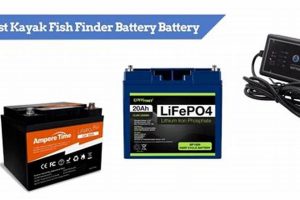
Tip 4: Battery Management: Fish finders consume power. Ensure adequate battery capacity for the duration of the fishing trip. Carry spare batteries or utilize a kayak-specific power supply for extended outings.
Tip 5: Regular Maintenance: Keep the transducer clean and free of debris for optimal performance. Periodically check the wiring and connections for any signs of damage. Consult the manufacturer’s instructions for specific maintenance recommendations.
Tip 6: Combining with Other Tools: Integrate sonar data with other tools like GPS and mapping software to create a comprehensive understanding of the fishing environment. Mark waypoints for productive fishing spots and track movements throughout the day.
Tip 7: Practice and Patience: Proficiency in using a fish finder requires practice and patience. Experiment with different settings and learn how to interpret the readings effectively. Over time, this knowledge will translate into improved fishing success.
By understanding these essential tips, anglers can significantly enhance their ability to locate fish, understand the underwater environment, and ultimately improve their fishing results.
The following section concludes with recommendations for selecting the appropriate sonar unit and accessories to suit individual needs and budgets.
1. Sonar Technology

Sonar technology forms the foundation of fish finder operation on kayaks. The principle involves emitting pulsed sound waves into the water via a transducer. These waves travel through the water column until they encounter an object. Upon contact, a portion of the sound waves reflects back towards the transducer. The transducer then converts these returned echoes into electrical signals, which the fish finder processes and displays as visual information on the screen. The time elapsed between transmission and reception, coupled with the speed of sound in water, allows the device to calculate the distance to the object. This process effectively maps the underwater environment, revealing depth, bottom contours, and the presence of fish. Different sonar frequencies offer varying characteristics; higher frequencies provide detailed images of the water column and are effective in shallower depths, while lower frequencies penetrate deeper but offer less detail.
Consider a kayak angler searching for fish near a drop-off. The fish finder, employing sonar technology, emits sound waves downwards. These waves strike the bottom and return to the transducer, allowing the device to determine the depth and display the bottom contour on the screen. As the kayak approaches the drop-off, the displayed depth readings change rapidly, indicating the sudden change in the underwater terrain. If fish are present near the drop-off, they will reflect some of the sonar waves, appearing as arches or icons on the screen, alerting the angler to their presence and location. This practical application of sonar technology enables strategic fishing by identifying promising locations and focusing efforts where fish are most likely to congregate.
Understanding the principles of sonar technology is crucial for effective fish finder utilization. Adjusting the sonar frequency based on the target depth and water clarity allows for optimal performance. Recognizing how sonar interacts with various underwater features enhances data interpretation. This knowledge empowers anglers to distinguish between fish, vegetation, and bottom structure, ultimately maximizing their fishing success. While sonar offers significant advantages, limitations exist. Factors like water temperature, salinity, and turbulence can influence sonar performance. Awareness of these factors and appropriate adjustments contribute to accurate readings and effective angling.
2. Transducer Placement

Transducer placement significantly influences the effectiveness of a fish finder on a kayak. Correct placement ensures accurate readings and maximizes the device’s potential. Improper placement can lead to interference, inaccurate depth readings, and missed fish. Understanding the factors influencing optimal transducer location is crucial for successful kayak fishing.
- Location and Interference:
Turbulence created by the kayak’s hull, motor, or other protruding accessories can disrupt sonar signals. Positioning the transducer away from these interference sources, typically near the stern or on a dedicated mounting arm, improves data accuracy. Mounting inside the hull, for specific transducer types, offers protection but may require specific hull materials for optimal signal penetration.
- Depth and Angle:
The transducer’s angle and depth affect the sonar cone’s coverage area. A slight downward angle ensures the sonar beam reaches the desired depth range. In shallower water, a narrower cone may suffice, while deeper water often benefits from a wider cone. Adjusting the transducer’s angle and depth maximizes the area covered by the sonar, increasing the chances of detecting fish and accurately mapping the bottom.
- Mounting Methods:
Various mounting methods exist, each with advantages and disadvantages. Transom mounts are common and relatively easy to install, while through-hull mounts offer the cleanest installation and minimize interference. Kayak-specific mounting arms allow for flexible positioning and are often adjustable, catering to different hull shapes and fishing styles.
- Kayak Type Considerations:
Kayak design influences transducer placement. Sit-on-top kayaks offer more mounting options due to their open design, while sit-inside kayaks may require specialized mounting solutions. The hull material also plays a role; some materials, like fiberglass, transmit sonar signals more effectively than others. Adapting the mounting strategy to the specific kayak type ensures optimal sonar performance.
Optimal transducer placement is integral to maximizing a fish finder’s capabilities on a kayak. Careful consideration of location, angle, mounting method, and kayak type ensures accurate readings, clear images, and improved fishing success. By understanding the connection between transducer placement and sonar performance, anglers can effectively utilize their fish finders to locate fish and navigate the underwater environment. This knowledge translates into a more efficient and rewarding fishing experience.
3. Data Interpretation

Data interpretation is fundamental to utilizing a fish finder effectively on a kayak. The sonar device transmits and receives sound waves, translating these into visual representations on the screen. Understanding these visual cues allows anglers to identify fish, locate structures, and navigate underwater terrain. Accurate data interpretation directly correlates with fishing success.
- Depth Readings:
The most basic information displayed is the water’s depth. This is crucial for determining suitable fishing locations, avoiding shallow areas, and targeting specific depth ranges where fish may congregate. Depth readings appear numerically and are often represented visually by a line across the screen that fluctuates with changes in depth.
- Fish Arches and Icons:
Fish typically appear as arches or icons on the screen. The shape and strength of the arch can indicate the size and position of the fish relative to the kayak. A distinct, clear arch suggests a fish directly beneath the transducer, while a fainter, elongated arch might indicate a fish moving through the sonar cone. Some fish finders differentiate between fish and other objects by assigning specific icons.
- Bottom Structure:
The fish finder depicts bottom contours, revealing changes in depth, drop-offs, humps, and other underwater features. These structures often attract fish and understanding their location is essential for strategic angling. Variations in bottom hardness also appear; a harder bottom may display as a thicker, denser line compared to a softer, muddier bottom.
- Vegetation and Thermoclines:
Submerged vegetation and thermoclines (layers of water with different temperatures) appear as distinct patterns on the fish finder display. Vegetation might show as irregular clusters or lines, while thermoclines appear as horizontal bands separating different temperature zones. Fish often congregate near vegetation and along thermoclines, making their identification crucial.
Synthesizing these data points depth, fish indicators, bottom structure, and vegetation creates a comprehensive underwater picture. This understanding allows anglers to pinpoint optimal fishing spots, predict fish behavior based on their location relative to structures and temperature gradients, and adjust fishing techniques accordingly. Effective data interpretation transforms the fish finder from a simple depth gauge into a powerful tool for strategic angling, maximizing the chances of a successful catch.
4. Power Management
Power management is a critical aspect of operating a fish finder on a kayak. Fish finders require a consistent power supply for operation, and kayaks, unlike larger vessels, have limited power resources. Effective power management ensures continuous operation throughout the fishing trip, maximizing the angler’s ability to locate fish and navigate the underwater environment. Understanding power consumption, battery options, and conservation techniques is essential for successful kayak fishing with a fish finder.
- Battery Selection:
Choosing the correct battery type and capacity is paramount. Fish finders typically operate on 12V DC power. Deep-cycle marine batteries are recommended due to their ability to provide sustained power over extended periods. Battery capacity, measured in Ampere-hours (Ah), determines the duration of use. Higher capacity batteries offer longer run times but may be heavier and more expensive. Consider the fish finder’s power draw, the anticipated fishing trip length, and the kayak’s weight capacity when selecting a battery.
- Power Consumption:
Fish finder power consumption varies based on screen size, sonar frequency, and features. Larger screens and higher frequencies generally consume more power. Consult the manufacturer’s specifications for the fish finder’s power draw to estimate battery life. Adjusting screen brightness and disabling unnecessary features can conserve power and extend battery life in the field.
- Power Saving Modes:
Many fish finders offer power-saving modes that reduce power consumption by adjusting screen refresh rates, sonar pulse frequency, and other settings. Utilizing these modes can significantly extend battery life without compromising essential functionality. These modes are particularly beneficial during longer fishing trips or when using smaller capacity batteries.
- Alternative Power Sources:
Beyond traditional batteries, alternative power sources exist for kayak fish finders. Portable power packs offer a lightweight and convenient option, while solar panels provide a renewable energy solution, especially useful for multi-day trips. Kayak-specific power systems, integrating batteries and wiring solutions, offer a streamlined approach to power management.
Effective power management ensures uninterrupted fish finder operation throughout the fishing trip, maximizing its utility. Careful consideration of battery type, capacity, and power-saving features, combined with potential utilization of alternative power sources, enables anglers to maintain continuous operation of their fish finders and concentrate on the fishing experience. By integrating power management strategies into kayak fishing practices, anglers can fully leverage the benefits of fish finder technology without the concern of power depletion.
5. Kayak Integration

Kayak integration is crucial for the effective operation of a fish finder. A fish finder’s utility depends not only on its technical capabilities but also on its seamless incorporation into the kayak’s structure and systems. Integration encompasses several key aspects: mounting the transducer and display unit, routing cables, and managing power supply. Consider a scenario where the transducer is poorly mounted, subject to turbulence from the kayak’s hull. This can generate inaccurate readings, rendering the fish finder less effective. Proper integration ensures the transducer receives clean signals, leading to accurate depth readings and fish identification.
Several mounting options exist, each with specific advantages and disadvantages. Transom mounts are common due to their simplicity, while through-hull mounts provide optimal performance but require more complex installation. Kayak-specific mounting arms offer flexibility and adjustability. Cable routing must be planned carefully to prevent interference with paddling and to protect the cables from damage. Power supply integration involves choosing an appropriate battery and incorporating it safely and efficiently into the kayak’s setup. A dedicated power system designed for kayaks offers a streamlined solution. For example, using a lithium-ion battery integrated with a dedicated wiring harness provides reliable power without cluttering the kayak.
Effective kayak integration optimizes fish finder performance and enhances the overall fishing experience. A well-integrated system ensures reliable data acquisition, minimizes interference, and streamlines operation. This allows anglers to focus on fishing rather than troubleshooting technical issues. Choosing the right mounting method, carefully routing cables, and implementing a robust power solution are essential components of successful kayak integration. Addressing these aspects ensures the fish finder functions as intended, providing accurate information and contributing to a more productive and enjoyable fishing trip.
Frequently Asked Questions
This section addresses common queries regarding the operation and utilization of fish finders on kayaks.
Question 1: How does sonar frequency affect performance?
Higher sonar frequencies (e.g., 200 kHz) provide detailed images and are effective in shallower water. Lower frequencies (e.g., 83 kHz) offer greater depth penetration but with less detail. Selecting the appropriate frequency depends on the target depth and water clarity.
Question 2: Can a fish finder be used in saltwater?
Specific fish finders are designed for saltwater use. These models utilize corrosion-resistant materials and compensate for the higher conductivity of saltwater. Always verify a fish finder’s suitability for saltwater environments before purchase.
Question 3: What is the impact of transducer placement on accuracy?
Optimal transducer placement minimizes interference from the kayak’s hull and maximizes sonar cone coverage. Incorrect placement can lead to inaccurate depth readings and reduced fish detection capabilities. Mounting near the stern or on a dedicated arm is generally recommended.
Question 4: How does one interpret the information displayed on the screen?
Fish typically appear as arches or icons. Depth is indicated numerically and visually by a line across the screen. Bottom contours and vegetation appear as distinct patterns. Understanding these visual cues is essential for effective fish finding.
Question 5: What are the power requirements for operating a fish finder on a kayak?
Fish finders typically require a 12V DC power source. Battery capacity should be chosen based on the fish finder’s power draw and the anticipated fishing trip length. Power-saving modes and alternative power sources, such as solar panels, can extend operational time.
Question 6: How does kayak integration affect fish finder performance?
Proper integration optimizes performance. Secure transducer mounting, protected cable routing, and a reliable power system contribute to accurate readings and a streamlined fishing experience.
Addressing these frequently asked questions provides a comprehensive understanding of key aspects related to fish finder operation on kayaks. This knowledge empowers anglers to make informed decisions regarding equipment selection, installation, and utilization, ultimately enhancing their fishing experience.
Further information on advanced fish finder features and techniques can be found in the following section.
Conclusion
This exploration detailed how a fish finder operates within the specialized context of a kayak. Key operational principles, including sonar technology, transducer placement considerations, data interpretation techniques, and power management strategies, were examined. Effective kayak integration, encompassing transducer mounting, cable management, and power supply solutions, was highlighted as crucial for optimal performance. Understanding these elements allows anglers to maximize the benefits of fish finder technology, transforming a kayak into a highly efficient fishing platform.
Technological advancements continue to refine fish finder capabilities, offering increasingly sophisticated tools for anglers. Integrating these tools effectively into the kayak fishing experience requires a comprehensive understanding of their operation and strategic application. This knowledge empowers anglers to navigate the underwater world with greater precision, locate fish effectively, and ultimately enhance their connection with the aquatic environment.