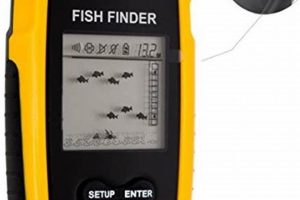
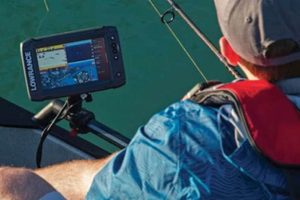
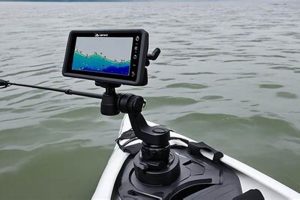
A compact, battery-powered sonar device designed for anglers in kayaks offers a convenient way to locate fish and underwater structures. These units typically include a transducer, display, and mounting hardware adaptable to kayak setups. An example would be a small sonar unit clamped to the side of a fishing kayak, displaying depth, water temperature, and fish locations on a high-contrast screen.
Such devices provide significant advantages for kayak anglers. Knowing the location of fish and underwater features like drop-offs and vegetation significantly increases angling success. The portability of these units allows anglers to easily move them between different kayaks or even other small watercraft. Historically, kayak anglers relied heavily on experience and guesswork. Modern electronics like these compact sonar units have revolutionized the sport, providing real-time data that empowers anglers to make informed decisions.
This discussion will further explore key aspects of these devices, including types of sonar technology, power options, mounting solutions, and features best suited for various fishing environments.
Tips for Effective Sonar Use in Kayaks
Optimizing sonar effectiveness requires understanding device capabilities and employing appropriate techniques. The following tips offer guidance for maximizing the benefits of these devices in a kayak fishing environment.
Tip 1: Transducer Placement is Crucial: Correct transducer placement is paramount for accurate readings. Avoid mounting near sources of turbulence or obstructions. Optimal placement often involves submerging the transducer just below the waterline.
Tip 2: Understand Sonar Settings: Familiarization with device settings, such as sensitivity and frequency, allows anglers to tailor performance to specific conditions. Experimentation and practice are key to interpreting data effectively.
Tip 3: Consider Kayak-Specific Mounts: Specialized mounts designed for kayaks offer stability and ease of use. These mounts often allow for quick adjustments and secure transducer positioning.
Tip 4: Battery Management: Compact sonar units rely on battery power. Carrying spare batteries or utilizing a rechargeable power source ensures uninterrupted operation during longer outings.
Tip 5: Interpret Data Carefully: Sonar readings require interpretation. Distinguishing between fish, vegetation, and bottom structure requires practice and understanding of sonar principles.
Tip 6: Utilize GPS Functionality (if available): Integrated GPS enhances sonar data by providing location information. This feature allows anglers to mark productive fishing spots and navigate effectively.
Tip 7: Regularly Update Software: Manufacturers often release software updates that improve device performance and add new features. Keeping software current ensures optimal functionality.
By understanding these tips, anglers can significantly enhance their ability to locate fish and understand underwater terrain, leading to a more productive and enjoyable kayaking experience.
These tips provide a foundation for effective sonar use. Further exploration of advanced techniques and specific device features will be addressed in the following sections.
1. Portability

Portability is a defining characteristic of these specialized sonar devices, directly influencing their practicality and usability in kayak fishing. This characteristic encompasses several key facets crucial for effective operation in a mobile fishing environment.
- Compact Form Factor
Compactness minimizes space requirements, a critical consideration in the limited confines of a kayak. Smaller units are easier to stow, transport, and mount without disrupting the angler’s balance or paddling stroke. For example, a unit with a small footprint can be easily mounted on a kayak’s console or gunwale.
- Lightweight Construction
Reduced weight contributes to overall kayak stability and maneuverability. Lightweight units minimize the impact on the kayak’s performance, ensuring a responsive and efficient paddling experience. A lighter unit also reduces fatigue during transport to and from the water.
- Simplified Setup and Deployment
Quick and easy setup is essential for maximizing fishing time. Portable units typically feature straightforward mounting mechanisms and intuitive interfaces, allowing for rapid deployment and adjustment on the water. For instance, clamp-on transducer mounts and quick-release power cables facilitate efficient setup.
- Flexible Power Options
Portable units typically utilize battery power, offering independence from external power sources. Rechargeable batteries or 12V power adapters provide flexibility for varying trip durations. This self-contained power supply eliminates the need for complex wiring or access to shore power.
These facets of portability collectively contribute to the overall effectiveness and convenience of these sonar units in kayak fishing. The ability to quickly deploy, easily stow, and operate independently from external power sources enhances the angler’s mobility and adaptability on the water.
2. Sonar Technology
Sonar technology forms the core functionality of portable kayak fish finders, enabling anglers to visualize underwater environments. Understanding the nuances of sonar types and their respective capabilities is crucial for effective fish finding and navigation.
- CHIRP Sonar
CHIRP (Compressed High-Intensity Radar Pulse) sonar transmits a range of frequencies simultaneously, resulting in higher resolution and greater target separation compared to traditional sonar. This allows anglers to distinguish individual fish within tight schools, and clearly identify bottom structure intricacies. For example, CHIRP sonar can differentiate between a rocky bottom and submerged vegetation, crucial for identifying potential ambush points for predatory fish. In portable kayak fish finders, CHIRP offers significant advantages for interpreting complex underwater environments.
- Traditional Sonar
Traditional sonar transmits a single frequency pulse, offering a broader coverage area but with lower resolution than CHIRP. While less detailed, traditional sonar is effective for determining depth, locating large fish arches, and identifying general bottom contours. This technology remains relevant in portable units due to its lower power consumption and simpler signal processing. For less demanding fishing scenarios or budget-conscious anglers, traditional sonar can still provide valuable underwater insights.
- Down-Imaging/DownScan Imaging
Down-imaging utilizes high-frequency sonar pulses to create a near-photographic representation of the area directly beneath the transducer. This technology excels at revealing bottom structure details, such as rocks, logs, and vegetation, providing a clear picture of the underwater terrain. While not ideal for identifying fish directly, understanding the bottom composition is essential for locating likely fish-holding areas. In portable kayak fish finders, down-imaging supplements traditional or CHIRP sonar by adding a visual layer of bottom detail.
- Side-Imaging/SideScan Imaging
Side-imaging uses sonar beams directed outwards from the transducer to scan the area to the sides of the kayak. This creates a wider view of the underwater environment, allowing anglers to cover more water and locate structures or fish beyond the area directly beneath the kayak. Side-imaging is highly effective for finding submerged points, drop-offs, and other fish-holding features that might be missed with traditional down-looking sonar. While some portable units offer side-imaging, it’s more common in larger, higher-end systems due to its higher processing demands.
The selected sonar technology significantly impacts a portable kayak fish finder’s effectiveness. Understanding the strengths and limitations of each type empowers anglers to choose the best fit for their specific fishing style and target species. Combining these technologies, such as CHIRP with down-imaging, further enhances underwater awareness and maximizes angling success.
3. Power Source

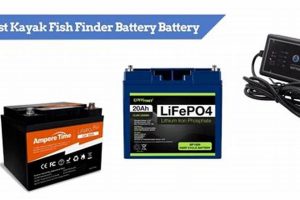
Power source selection significantly impacts the operational effectiveness of a portable kayak fish finder. These units typically rely on independent power supplies, necessitating careful consideration of battery type, capacity, and management strategies. The chosen power solution directly affects operational duration and overall user experience. For instance, a unit powered by a high-capacity lithium-ion battery offers extended runtime compared to one using alkaline batteries. Understanding power consumption rates and available power options is essential for ensuring uninterrupted operation during fishing trips.
Several power options exist, each with distinct advantages and disadvantages. Rechargeable lithium-ion batteries offer high energy density and long lifespans, making them a popular choice. Traditional alkaline batteries provide a readily available and cost-effective alternative, but with shorter runtimes and the added environmental impact of disposal. Some units offer compatibility with 12V power sources, allowing connection to a kayak’s onboard battery system. The optimal choice depends on individual needs and fishing trip durations. Consider a longer kayak fishing trip requiring several hours of continuous sonar operation: a lithium-ion battery with a high mAh rating provides the necessary endurance, while a shorter outing might suffice with alkaline batteries.
Effective power management is crucial for maximizing operational time. Adjusting screen brightness, minimizing unnecessary features, and powering down the unit during periods of inactivity can significantly extend battery life. Carrying spare batteries or utilizing a portable charging solution ensures continued operation during longer excursions. Understanding the interplay between power source, consumption, and management techniques is essential for a seamless kayak fishing experience. Overlooking power considerations can lead to premature battery depletion, interrupting sonar functionality and hindering angling success.
4. Mounting Options
Secure and adaptable mounting solutions are essential for maximizing the effectiveness of portable kayak fish finders. The mounting system directly influences transducer stability, ease of adjustment, and overall user experience. A stable mount ensures accurate sonar readings and minimizes interference from kayak movement or vibrations. Adaptability is crucial for accommodating various kayak designs and angler preferences. Improper mounting can lead to inaccurate readings, transducer damage, or interference with paddling. Choosing the right mounting solution is crucial for seamless integration and optimal performance.
- Track Mounts
Track mounts utilize pre-installed tracks commonly found on many fishing kayaks. These tracks offer standardized mounting points, allowing for quick and secure attachment of fish finder components. For example, a transducer arm can be slid into the track and locked into the desired position, providing a robust and easily adjustable mounting platform. Track mounts offer excellent stability and flexibility, facilitating quick repositioning of the fish finder as needed.
- Clamp Mounts
Clamp mounts provide a versatile solution for kayaks without dedicated mounting tracks. These mounts utilize adjustable clamps to secure the fish finder to the kayak’s gunwale, side, or other suitable locations. A clamp mount can be quickly attached and detached, making it convenient for temporary installations or use on multiple kayaks. However, clamp mounts may be less stable than track mounts, especially in rough water conditions.
- Suction Cup Mounts
Suction cup mounts offer a temporary, non-permanent mounting solution. These mounts adhere to smooth surfaces using suction cups, providing a quick and easy way to attach a fish finder. While convenient for short trips or testing different transducer locations, suction cup mounts are generally less stable than track or clamp mounts and are susceptible to detachment in turbulent water or during impacts.
- Portable Mounting Systems
Portable mounting systems provide a complete, self-contained solution often incorporating a transducer arm, mounting base, and battery storage. These systems are designed for quick setup and removal, ideal for anglers who frequently switch between kayaks or fishing locations. Some portable systems incorporate a floatation device to prevent loss of the fish finder in the event of capsizing. These systems offer a high degree of portability and convenience, but may be less adaptable to specific kayak configurations compared to individual track or clamp mounts.
The selected mounting option significantly impacts the overall usability and effectiveness of a portable kayak fish finder. Considering factors such as kayak compatibility, desired stability, and ease of adjustment ensures a secure and functional installation that enhances the angling experience. The correct mounting solution contributes to optimal transducer performance and ensures reliable sonar readings, ultimately maximizing the chances of angling success.
5. Target Identification

Target identification represents a crucial aspect of effective portable kayak fish finder utilization. Distinguishing fish from other underwater features, such as vegetation, rocks, or debris, directly impacts angling success. Accurate target identification relies on interpreting sonar returns, considering factors like signal strength, shape, and movement. For example, a strong, arched sonar return often indicates a fish, while a more diffuse, irregular return might suggest vegetation. The ability to discern these nuances allows anglers to focus efforts on promising areas and avoid unproductive locations. Portable kayak fish finders equipped with advanced features, like CHIRP sonar and down-imaging, significantly enhance target identification capabilities.
The practical significance of target identification extends beyond simply locating fish. Understanding the composition of the underwater environment informs lure selection, retrieval techniques, and overall fishing strategy. For instance, identifying a rocky bottom suggests the potential presence of bottom-dwelling species, influencing lure choice and presentation. Similarly, recognizing submerged vegetation indicates potential ambush points for predatory fish, informing retrieval speed and depth. Effective target identification empowers anglers to make informed decisions, maximizing their chances of hooking and landing target species. Failing to differentiate between fish and other underwater objects leads to wasted time and effort, underscoring the importance of this skill.
Target identification presents ongoing challenges, particularly in complex underwater environments. Factors like water clarity, thermocline presence, and bottom composition influence sonar returns, requiring anglers to adapt their interpretation. Continuous learning and practice are essential for refining target identification skills. Integrating knowledge gained from sonar readings with other environmental observations, like surface activity or water temperature changes, further enhances accuracy. Mastering target identification is an iterative process, contributing significantly to successful kayak angling outcomes.
Frequently Asked Questions
This section addresses common inquiries regarding portable kayak fish finders, providing concise and informative responses to facilitate informed decision-making and effective utilization.
Question 1: What is the typical battery life of a portable kayak fish finder?
Battery life varies depending on factors like screen brightness, sonar usage, and battery type. Lithium-ion batteries generally offer longer runtimes compared to alkaline batteries. Typical usage ranges from 4 to 8 hours on a single charge.
Question 2: Can these units be used in saltwater environments?
Most portable kayak fish finders are designed for both freshwater and saltwater use. However, it is essential to rinse the unit with fresh water after each saltwater use to prevent corrosion.
Question 3: How deep can portable kayak fish finders typically scan?
Depth capability varies depending on the unit’s sonar power and frequency. Many portable units can effectively scan depths up to 200-300 feet, sufficient for most kayak fishing scenarios.
Question 4: Are these units difficult to install and operate?
Most portable kayak fish finders are designed for user-friendly installation and operation. They typically feature intuitive interfaces and straightforward mounting mechanisms. Consulting the user manual provides detailed instructions for specific models.
Question 5: What is the difference between CHIRP and traditional sonar?
CHIRP sonar transmits a range of frequencies, providing higher resolution and better target separation compared to traditional single-frequency sonar. CHIRP allows for clearer identification of fish and underwater structures.
Question 6: What factors should be considered when choosing a transducer mounting location?
Optimal transducer placement minimizes interference from turbulence and obstructions. Mounting the transducer below the waterline, away from the kayak’s hull and motor (if applicable), ensures accurate sonar readings.
Addressing these common queries provides a foundational understanding of portable kayak fish finders. Further research into specific models and features is recommended before making a purchase decision.
The subsequent section will explore advanced features available in certain models, such as GPS integration and mapping capabilities.
Conclusion
Compact sonar devices tailored for kayak angling significantly enhance underwater awareness, enabling informed decisions regarding fish location and habitat. Critical factors influencing device effectiveness include sonar technology (CHIRP, traditional), power source selection (battery type, capacity), mounting stability (track, clamp, portable systems), and accurate target identification (differentiating fish from structure). Careful consideration of these aspects ensures optimal performance and integration with kayak fishing setups.
As technology continues to evolve, advancements in portability, sonar capabilities, and data integration promise further refinement of these valuable tools. Anglers embracing these advancements gain a distinct advantage, leveraging technology to enhance on-the-water experiences and promote responsible fishing practices.