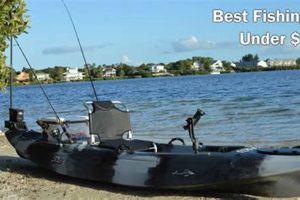
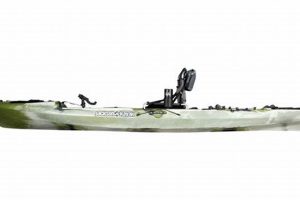
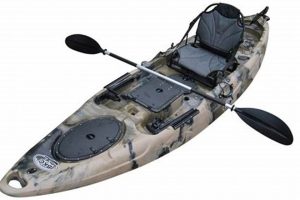
Selecting appropriate vessels for saltwater angling involves careful consideration of stability, capacity, and specialized features. A suitable craft should provide a stable platform in varying sea conditions, offer ample storage for gear and catches, and incorporate design elements like rod holders, fish finders, and anchor trolleys. For example, a longer, wider kayak with a sit-on-top design generally offers superior stability compared to a shorter, narrower sit-inside model, making it more suitable for the ocean environment. The “sit-on-top” style also allows for easier re-entry in case of capsizing, a crucial safety consideration in open water.
Utilizing well-designed watercraft for marine angling enhances safety, improves fishing success, and contributes to a more enjoyable experience overall. Stable platforms allow anglers to focus on fishing rather than maintaining balance, while specialized features optimize efficiency and organization. Historically, anglers relied on traditional boats for offshore excursions. However, advancements in kayak design and technology have made them increasingly popular for accessing nearshore fishing grounds and exploring diverse marine environments, offering a cost-effective and engaging alternative.
The following sections delve into the key features to consider when choosing a saltwater fishing kayak, including hull design, length and width, propulsion systems, storage options, and essential safety equipment. Additionally, various popular models will be reviewed and compared to assist anglers in making informed decisions based on their individual needs and fishing styles.
Tips for Selecting Ocean Fishing Kayaks
Choosing an appropriate kayak for ocean fishing requires careful consideration of several factors to ensure safety, performance, and enjoyment on the water. The following tips provide guidance for making informed decisions.
Tip 1: Prioritize Stability. Wider hulls and sit-on-top designs generally offer greater stability, particularly in challenging conditions. Consider the typical sea state in the intended fishing area.
Tip 2: Evaluate Capacity. Sufficient weight capacity is crucial for accommodating anglers, gear, and potential catches. Overloading can compromise stability and safety.
Tip 3: Consider Length and Width. Longer kayaks typically track better in open water, while shorter kayaks offer enhanced maneuverability in tighter spaces. Wider kayaks provide more stability, but may be slower.
Tip 4: Assess Propulsion Options. Paddle kayaks offer excellent exercise and maneuverability, while pedal-powered kayaks provide greater speed and range. Motorized kayaks offer the greatest range but may be subject to regulations.
Tip 5: Examine Storage Features. Ample storage space is essential for carrying fishing gear, safety equipment, and catches. Dedicated compartments for specific items can enhance organization and accessibility.
Tip 6: Inspect Rod Holders and Mounting Options. Ensure sufficient rod holders are strategically placed for convenient access and secure storage during transit. Consider mounting options for fish finders, GPS units, and other accessories.
Tip 7: Check Safety Features. Essential safety features include a comfortable seat, multiple grab handles, and secure anchor trolley systems. Consider incorporating additional safety equipment such as a VHF radio, personal locator beacon (PLB), and signaling devices.
By carefully considering these factors, anglers can select kayaks that best suit their individual needs and enhance their ocean fishing experiences. Appropriate selection improves safety, maximizes fishing success, and ensures enjoyment on the water.
The subsequent section provides a detailed overview of popular ocean fishing kayak models, outlining their key features, advantages, and disadvantages to further aid the selection process.
1. Stability

Stability represents a critical factor in selecting kayaks for ocean fishing. Ocean conditions can change rapidly, presenting challenges such as waves, currents, and wind. A stable platform allows anglers to maintain balance and focus on fishing, rather than constantly correcting for instability. This is crucial not only for casting and retrieving lines effectively but also for ensuring angler safety. For example, when battling a strong fish, a stable kayak provides the necessary leverage and control, minimizing the risk of capsizing. Similarly, in choppy conditions, a stable kayak maintains a secure platform, allowing the angler to navigate safely and confidently.
Several design elements contribute to kayak stability. Hull width, hull shape, and the center of gravity play significant roles. Wider hulls generally offer more initial stability, while specific hull shapes, such as a flatter bottom, contribute to secondary stability (stability when leaning). A lower center of gravity enhances overall stability. Sit-on-top kayaks tend to offer superior stability compared to sit-inside kayaks, particularly in rough conditions, as they are less affected by wind and waves. Furthermore, their open design allows for easier re-entry in the event of a capsize. Choosing a kayak with appropriate stability features directly impacts the angler’s ability to handle various sea states and contributes significantly to overall safety and fishing success.
Prioritizing stability in kayak selection ultimately enhances safety and fishing performance in dynamic ocean environments. Considering factors such as hull design, center of gravity, and kayak type allows anglers to make informed decisions aligned with anticipated conditions and fishing styles. This understanding empowers anglers to choose vessels that maximize both on-the-water safety and overall fishing experience.
2. Capacity (Weight)

Weight capacity represents a critical factor influencing kayak performance and safety, especially in the context of ocean fishing. This specification denotes the maximum combined weight of the angler, gear, and potential catch a kayak can safely support. Exceeding this limit compromises stability, maneuverability, and freeboardthe distance between the waterline and the top edge of the hull. Reduced freeboard increases the risk of swamping, particularly in rough conditions. Conversely, selecting a kayak with ample weight capacity ensures safe and efficient operation even with a full load of gear and a substantial catch. For example, an angler planning extended offshore trips with heavy tackle and potential large catches requires a kayak with significantly higher weight capacity compared to an angler targeting smaller inshore species. Careful consideration of anticipated loads is thus essential in selecting appropriate vessels.
Understanding the relationship between kayak weight capacity and intended use is fundamental for informed decision-making. Manufacturers provide weight capacity ratings, and exceeding these recommendations poses significant safety risks. Furthermore, even within the rated capacity, heavier loads impact performance. Increased weight reduces maneuverability, making paddling and maneuvering more challenging, particularly in currents or wind. It also affects speed and efficiency, requiring greater effort to cover the same distance. Therefore, selecting a kayak with ample weight capacity not only ensures safety but also optimizes performance and fishing effectiveness. Calculating the total weight of anticipated gear, including fishing rods, tackle boxes, safety equipment, and potential catches, provides a baseline for assessing required capacity. Adding a safety margin to this calculation ensures optimal performance and safety even under unexpected circumstances.
Appropriate weight capacity selection directly influences kayak stability, maneuverability, and overall safety. A thorough assessment of individual needs and fishing styles, coupled with careful consideration of manufacturer recommendations, empowers anglers to make informed decisions. This proactive approach maximizes on-the-water safety and ensures the kayak performs optimally under varying conditions and fishing scenarios. Neglecting weight capacity considerations, however, risks compromising both safety and fishing effectiveness, potentially leading to hazardous situations and a diminished fishing experience.
3. Hull Design

Hull design significantly influences a kayak’s performance in ocean environments, directly impacting stability, speed, maneuverability, and tracking. Specific hull characteristics cater to varying fishing styles and conditions, making informed selection crucial for optimal performance and safety. Three primary hull typesflat bottom, rounded, and V-shapedeach exhibit distinct performance characteristics. Flat-bottomed hulls offer excellent initial stability, making them suitable for calm waters and sight fishing, but compromise tracking and performance in rough conditions. Rounded hulls provide better maneuverability and efficiency in choppy water but offer less initial stability. V-shaped hulls excel in tracking and cutting through waves, making them well-suited for open ocean paddling and challenging conditions, though they may feel less stable initially. Consider a kayak with a flatter hull for fishing in sheltered bays or estuaries, whereas a V-shaped hull proves advantageous when paddling longer distances in open water or rougher conditions. Beyond these primary categories, variations such as pontoon hulls and multi-chine hulls further refine performance characteristics, offering enhanced stability or speed in specific scenarios.
Understanding the relationship between hull design and intended usage facilitates informed kayak selection. Anglers frequently targeting calm, sheltered waters might prioritize initial stability offered by flatter hulls. Conversely, those venturing into open ocean or consistently facing challenging conditions would likely benefit from the tracking and wave-cutting capabilities of a V-shaped hull. Length and width further influence hull performance. Longer kayaks generally track better in a straight line, while shorter kayaks offer enhanced maneuverability. Wider kayaks provide greater stability but sacrifice speed. Specific design elements, such as chines (longitudinal ridges along the hull), also affect performance. Hard chines improve secondary stabilitystability when leaningwhile soft chines promote smoother turning. Considering these nuances allows anglers to fine-tune kayak selection based on individual needs and prevailing conditions. For instance, a longer, narrower kayak with a V-shaped hull excels in covering distance and maintaining course in open ocean, while a shorter, wider kayak with a flatter hull and hard chines proves more stable and maneuverable in tight, shallow areas.
Appropriate hull design selection optimizes kayak performance and safety in diverse ocean environments. Careful consideration of intended use, prevailing conditions, and individual preferences enables informed choices, enhancing both fishing effectiveness and overall on-the-water experience. Matching hull characteristics to specific fishing styles and environmental conditions allows anglers to maximize stability, maneuverability, tracking, and speed, ultimately contributing to a safer and more successful fishing excursion. Failure to account for hull design implications can compromise performance, reduce safety margins, and diminish the overall enjoyment of ocean fishing. Therefore, a thorough understanding of these principles proves essential for responsible and effective kayak selection.
4. Propulsion System
Propulsion systems represent a crucial aspect of kayak selection for ocean fishing, directly impacting range, speed, and fishing effectiveness. Choosing an appropriate propulsion system depends on individual fishing styles, physical capabilities, target fishing areas, and prevailing conditions. Understanding the advantages and disadvantages of various propulsion methods allows for informed decisions that optimize on-the-water performance and enhance the overall fishing experience. The following facets outline key considerations related to kayak propulsion for ocean fishing.
- Paddle Propulsion
Traditional paddle propulsion offers excellent maneuverability and control, particularly in tight spaces and shallow water. Paddle kayaks require physical exertion, offering a good workout but potentially limiting range and speed. This method excels in navigating complex environments like mangrove forests or rocky shorelines. However, paddling necessitates using both hands, which can interfere with fishing activities. Consider paddle propulsion for shorter trips, calmer waters, and situations requiring precise maneuvering. For instance, targeting inshore species in shallow estuaries often favors paddle kayaks.
- Pedal Propulsion
Pedal-powered kayaks utilize leg muscles for propulsion, freeing up hands for fishing. This system offers greater speed and range compared to paddling, reducing fatigue on longer trips. Pedal drives come in two main varieties: propeller-based and fin-based. Propeller drives excel in open water, while fin drives offer better performance in shallow water and over obstacles. The hands-free nature of pedal propulsion enhances fishing efficiency, particularly when trolling or maintaining position in a current. However, pedal kayaks typically come at a higher price point and can be less maneuverable than paddle kayaks in tight spaces. Consider pedal propulsion for longer trips, open water fishing, or techniques requiring hands-free operation, such as trolling or sight casting.
- Motorized Propulsion
Motorized kayaks provide the greatest speed and range, minimizing physical exertion and maximizing time on the water. Electric motors are the most common type used on fishing kayaks due to their quiet operation and environmental friendliness. Motorized kayaks offer access to distant fishing grounds and facilitate covering large areas quickly. However, they require battery management and may be subject to specific regulations depending on local waterways. Furthermore, motorized kayaks tend to be heavier and more expensive than paddle or pedal kayaks. Consider motorized propulsion for extensive exploration, challenging conditions, or when physical limitations restrict paddling or pedaling.
- Considerations for Ocean Conditions
When selecting a propulsion system for ocean fishing, carefully consider typical sea states and prevailing conditions. Paddle propulsion may prove challenging in strong winds or currents, while pedal drives and motors offer greater control and efficiency. For example, targeting offshore reefs in open ocean might favor a pedal or motorized kayak due to the distances involved and potential rough conditions. Conversely, fishing sheltered bays or estuaries might lend itself well to paddle propulsion. Assessing the anticipated environment and matching the propulsion system to these conditions optimizes both safety and fishing effectiveness.
Selecting an appropriate propulsion system directly contributes to a successful and enjoyable ocean fishing experience. Matching propulsion type to individual needs, fishing styles, and anticipated conditions maximizes efficiency, expands access to diverse fishing grounds, and enhances overall safety on the water. Careful consideration of these factors empowers anglers to choose the most suitable propulsion method, contributing to a more rewarding and productive fishing adventure.
5. Storage Space
Ample and well-designed storage space is integral to the functionality and effectiveness of kayaks designed for ocean fishing. The ability to securely transport essential gear, including rods, reels, tackle boxes, safety equipment, and potential catches, directly impacts fishing success and overall safety. Insufficient storage can lead to cluttered decks, hindering movement and potentially compromising stability. Conversely, well-organized storage facilitates efficient access to equipment, minimizing disruption during critical moments and maximizing fishing time. For example, dedicated rod holders prevent tangling and damage, while dry storage compartments protect sensitive electronics and personal items from saltwater exposure. Consider a scenario where an angler hooks a large fish offshore. Easy access to a landing net, pliers, and other essential tools, facilitated by organized storage, significantly increases the chances of successfully landing and securing the catch. Similarly, readily available safety equipment, such as a bilge pump or signaling devices, stored in designated compartments, can prove crucial in emergency situations.
Several factors influence storage requirements, including fishing style, target species, and trip duration. Anglers targeting larger pelagic species require more robust storage solutions for heavier tackle and potentially larger catches. Similarly, longer expeditions necessitate greater capacity for food, water, and additional safety gear. Kayak design significantly influences storage options. Sit-on-top kayaks often feature integrated storage wells and tank wells, offering convenient access and ample capacity. Sit-inside kayaks typically provide smaller storage compartments within the hull, suitable for protecting sensitive items but potentially limiting overall capacity. Evaluating storage features involves considering both capacity and accessibility. Well-placed hatches, readily accessible compartments, and dedicated storage solutions for specific items, such as rod holders and tackle organizers, contribute significantly to efficient organization and retrieval. For instance, a kayak equipped with a forward-facing hatch allows quick access to essential gear while maintaining a stable fishing position, whereas a rear storage well proves ideal for stowing larger items or catches.
Optimized storage solutions maximize efficiency, safety, and overall fishing success in the demanding ocean environment. Careful consideration of individual needs, target species, and trip duration allows anglers to select kayaks with appropriate storage capacity and configurations. This proactive approach ensures essential gear remains organized, accessible, and protected, enhancing both fishing effectiveness and on-the-water safety. Failure to adequately address storage requirements can lead to compromised stability, hindered access to critical equipment, and a diminished overall fishing experience. Therefore, prioritizing storage considerations during kayak selection is paramount for responsible and successful ocean fishing.
6. Fishing Features
Specialized fishing features distinguish purpose-built fishing kayaks from recreational models, significantly enhancing angling effectiveness and overall on-the-water experience. These features cater specifically to the demands of fishing, optimizing functionality, efficiency, and safety in diverse marine environments. Careful consideration of these features is crucial when selecting the best kayak for ocean fishing, as they directly impact an angler’s ability to target specific species, manage gear effectively, and maintain a safe and productive fishing platform.
- Rod Holders
Integrated rod holders secure fishing rods, freeing hands for other tasks like paddling, maneuvering, or handling tackle. Various rod holder configurations exist, including flush-mounted, adjustable, and rotating holders. Flush-mounted holders offer a streamlined profile, minimizing interference while paddling. Adjustable holders allow for customized rod positioning based on fishing techniques and target species. Rotating holders facilitate trolling and adjusting line angles. The number and placement of rod holders should align with individual fishing styles and target species. For example, an angler targeting multiple species might require numerous rod holders configured for different fishing techniques. Conversely, an angler specializing in fly fishing might prioritize a single, easily accessible rod holder.
- Tackle Storage
Dedicated tackle storage solutions maintain organization and facilitate efficient access to essential gear. Integrated tackle boxes, trays, and compartments within easy reach minimize disruptions during critical fishing moments. Specific storage solutions for lures, hooks, weights, and other small items prevent tangling and damage, optimizing efficiency and streamlining tackle management. For example, a kayak equipped with a dedicated lure storage system allows for quick and easy lure changes without rummaging through a large tackle box, maximizing fishing time and minimizing disruption. Similarly, readily accessible compartments for pliers, cutters, and other essential tools enhance efficiency and preparedness. Adequate tackle storage directly impacts fishing success by ensuring essential gear remains organized, protected, and readily available.
- Fish Finders and Electronics Mounts
Integrating electronics like fish finders and GPS units enhances fishing effectiveness by providing crucial information about water depth, bottom structure, fish location, and navigation. Dedicated mounting systems ensure secure placement and optimal viewing angles for these devices. Transducers, the underwater components of fish finders, require careful placement for accurate readings. Some kayaks offer integrated transducer scuppers, simplifying installation and optimizing performance. For example, a kayak equipped with a fish finder can help anglers locate productive fishing grounds, identify underwater structures holding fish, and track fish movement. GPS units aid navigation, particularly in unfamiliar waters or during low visibility conditions. Seamless integration of these electronics enhances situational awareness and significantly improves fishing success.
- Anchor Trolleys and Other Specialized Features
Anchor trolleys allow controlled drifting and precise positioning, particularly in current or wind. This system facilitates maintaining an optimal fishing position relative to structure or target areas. Other specialized features like live wells, bait tanks, and cutting boards cater to specific fishing styles. Live wells keep baitfish or caught fish alive, while bait tanks provide readily accessible bait. Cutting boards offer convenient surfaces for preparing bait or cleaning fish. For example, an angler targeting bottom-dwelling species might utilize an anchor trolley to maintain position over a productive reef, while a kayak angler fishing for live bait might prioritize a live well to keep baitfish fresh and active. These specialized features further enhance fishing effectiveness and cater to diverse angling preferences.
The selection of fishing features directly impacts the overall effectiveness and enjoyment of ocean fishing from a kayak. Carefully considering individual fishing styles, target species, and preferred techniques guides informed decision-making. Prioritizing essential features like rod holders, tackle storage, electronics mounts, and specialized accessories enhances functionality, efficiency, and safety on the water. A well-equipped fishing kayak transforms a simple vessel into a highly effective fishing platform, maximizing success and creating a more rewarding angling experience.
7. Safety Equipment

Safety equipment stands as a paramount concern in ocean kayaking, inextricably linked to responsible angling practices. The inherent risks associated with open water environments necessitate meticulous preparation and a comprehensive understanding of essential safety gear. Proper equipment selection and utilization significantly mitigate potential hazards, ensuring angler well-being and fostering a secure environment for pursuing the sport. The following facets delve into crucial safety considerations for ocean kayak fishing.
- Personal Flotation Devices (PFDs)
PFDs are non-negotiable safety essentials for any ocean kayaking excursion. Properly fitted and consistently worn PFDs provide essential buoyancy in the event of capsizing or unexpected immersion, significantly increasing survival chances. Selecting a PFD designed specifically for kayaking ensures optimal comfort and range of motion while paddling and fishing. Inflatable PFDs offer greater comfort and freedom of movement but require regular maintenance and inspection to ensure proper function. For example, an angler encountering unexpected rough seas and capsizing benefits immensely from a properly worn PFD, which keeps them afloat and aids rescue efforts. Neglecting this fundamental safety precaution significantly increases the risk of drowning.
- Signaling Devices
Visual and auditory signaling devices are crucial for attracting attention and communicating distress in emergency situations. Whistles, air horns, flares, and signal mirrors provide effective means of alerting nearby vessels or rescuers. Understanding proper usage and carrying multiple signaling devices enhances preparedness for various scenarios. For instance, an angler experiencing equipment failure or encountering hazardous weather conditions can utilize a signal mirror to attract the attention of distant vessels or a whistle to alert nearby boaters. Multiple signaling options increase redundancy and the likelihood of successful communication in diverse emergency situations.
- Communication Equipment
Reliable communication equipment enables contact with shore or other vessels, facilitating assistance in emergencies or unforeseen circumstances. VHF radios provide direct communication with the Coast Guard and other boaters, enabling efficient transmission of distress calls and coordination of rescue efforts. Mobile phones, while potentially unreliable in remote areas, can serve as a secondary communication option. Waterproof cases or pouches protect electronic devices from saltwater damage. For example, an angler experiencing disorientation or requiring medical assistance can utilize a VHF radio to contact emergency services or nearby vessels, expediting rescue and ensuring timely intervention. Maintaining a charged and accessible communication device can prove life-saving in critical situations.
- Navigation and Safety Gear
Navigational tools, such as GPS units and charts, aid in route planning, maintaining course, and preventing disorientation, particularly in unfamiliar waters or during low visibility conditions. Carrying a compass provides a backup navigation method should electronic devices fail. Essential safety gear includes a first-aid kit for treating minor injuries, a bilge pump for removing water from the kayak, and a paddle leash to prevent paddle loss in rough conditions. For example, an angler navigating through a dense fog can rely on a GPS unit and compass to maintain course and reach their destination safely. A bilge pump becomes essential for removing water from the kayak in the event of swamping, preventing capsizing. These tools significantly enhance safety margins and preparedness for various on-the-water challenges.
Appropriate safety equipment is indispensable for mitigating inherent risks associated with ocean kayak fishing. Careful consideration of individual needs, anticipated conditions, and potential hazards informs equipment selection. Consistent and proper utilization of PFDs, signaling devices, communication equipment, and navigation tools significantly enhances angler safety, fostering a secure environment for pursuing the sport responsibly. Prioritizing safety ultimately contributes to a more enjoyable and rewarding ocean kayaking experience, allowing anglers to focus on fishing with peace of mind.
Frequently Asked Questions
This section addresses common inquiries regarding kayak selection for ocean fishing, providing concise and informative responses to facilitate informed decision-making and enhance angler preparedness.
Question 1: What differentiates ocean fishing kayaks from recreational kayaks?
Ocean fishing kayaks typically exhibit enhanced stability, specialized features like rod holders and storage compartments, and higher weight capacities compared to recreational models. These design elements optimize performance and safety in demanding open-water environments.
Question 2: How crucial is kayak stability for ocean fishing?
Stability is paramount for ocean fishing kayaks. Enhanced stability ensures angler safety and facilitates effective fishing techniques, particularly in challenging conditions such as waves, currents, and wind. Wider hulls, lower centers of gravity, and sit-on-top designs generally contribute to increased stability.
Question 3: What propulsion system best suits ocean fishing kayaks?
Optimal propulsion depends on individual needs and fishing styles. Paddle propulsion offers maneuverability but limits range. Pedal drives provide speed and hands-free fishing, while motorized kayaks maximize range but may be subject to regulations. Consider anticipated conditions and target fishing areas when selecting a propulsion system.
Question 4: How much storage space is necessary on an ocean fishing kayak?
Adequate storage space is essential for carrying fishing gear, safety equipment, and potential catches. Required capacity depends on trip duration, target species, and individual preferences. Prioritize organized storage solutions to maximize efficiency and maintain a clutter-free deck.
Question 5: What safety equipment is essential for ocean kayak fishing?
Essential safety equipment includes a properly fitted PFD, signaling devices (whistle, flares, mirror), communication equipment (VHF radio, mobile phone), navigation tools (GPS, compass, charts), a first-aid kit, a bilge pump, and a paddle leash. Thorough preparation enhances safety and preparedness for unforeseen circumstances.
Question 6: How does hull design influence ocean kayak performance?
Hull design significantly affects stability, speed, maneuverability, and tracking. Flat-bottomed hulls offer initial stability, rounded hulls enhance maneuverability, and V-shaped hulls excel in tracking and wave-cutting performance. Consider anticipated conditions and fishing styles when evaluating hull design.
Careful consideration of these frequently asked questions empowers anglers to make informed decisions regarding kayak selection, equipment choices, and safety practices, ultimately contributing to a more successful and secure ocean fishing experience.
The subsequent section offers concluding remarks and recommendations for embarking on rewarding ocean kayak fishing adventures.
Conclusion
Optimal kayak selection for ocean fishing hinges on a comprehensive understanding of key factors influencing performance, safety, and overall angling effectiveness. Careful consideration of hull design, propulsion systems, storage capacity, specialized fishing features, and essential safety equipment empowers informed decision-making. Matching these elements to individual fishing styles, target species, and anticipated conditions ensures a secure and productive on-the-water experience. Prioritizing stability, maneuverability, and ample storage capacity contributes significantly to efficient gear management and angler safety in dynamic ocean environments.
Responsible ocean kayak fishing necessitates a proactive approach to safety and preparedness. Consistent utilization of appropriate safety equipment, coupled with a thorough understanding of prevailing conditions and potential hazards, mitigates inherent risks and fosters a secure environment for pursuing the sport. Informed kayak selection, coupled with diligent safety practices, unlocks the full potential of ocean kayak fishing, transforming each excursion into a rewarding and memorable adventure.