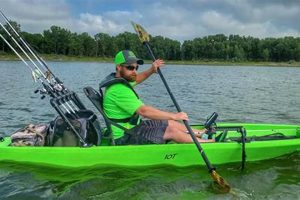
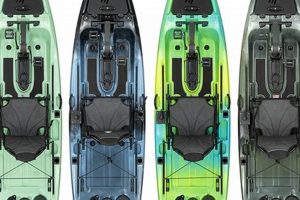
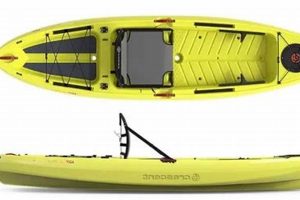
A fishing kayak propelled by a propeller and measuring approximately twelve feet in length offers a distinct approach to angling. This type of watercraft combines the maneuverability and stability of a kayak with the speed and range of a motorized vessel. The integration of a propeller system allows anglers to cover more water with less physical exertion, accessing distant fishing spots or navigating currents efficiently.
The advantages of this powered approach are numerous. It reduces fatigue, particularly beneficial for longer fishing trips or challenging water conditions. It frees the angler’s hands for fishing activities rather than paddling, facilitating techniques like trolling or casting. Historically, kayak fishing has relied on human power, limiting range and speed. The advent of motorized propulsion systems, including propeller drives, expands the possibilities of kayak fishing, opening up new waters and enhancing the overall experience.
The subsequent sections will delve deeper into specific aspects of propeller-driven fishing kayaks, including motor options, battery life, maintenance considerations, and suitable fishing environments. Further discussion will also cover the impact of this technology on fishing practices and the evolution of kayak design.
Tips for Utilizing Propeller-Driven Fishing Kayaks
Effective use of a propeller-driven fishing kayak maximizes its advantages and ensures safety and enjoyment on the water. The following tips offer guidance for both novice and experienced anglers.
Tip 1: Battery Management: Regularly inspect and charge the battery according to manufacturer recommendations. Carry a spare battery for extended trips. Consider factors like wind, current, and speed when estimating battery life.
Tip 2: Pre-Trip Checks: Before each outing, inspect the propeller for damage or entanglement. Ensure the drive system is properly secured and functioning correctly. Verify proper operation of the rudder and steering mechanisms.
Tip 3: Navigation and Safety: Familiarize oneself with local waterway regulations regarding motorized vessels. Carry appropriate safety gear, including a personal flotation device, a whistle, and navigation lights, especially when fishing in low-light conditions.
Tip 4: Fishing Techniques: Adapt fishing techniques to the capabilities of a powered kayak. Trolling becomes significantly easier, allowing for covering larger areas. The increased speed also facilitates quick relocation to promising fishing spots identified with fish finders.
Tip 5: Maintenance: Regularly rinse the propeller and drive system with fresh water after each use, especially in saltwater environments. Periodically lubricate moving parts as instructed by the manufacturer. Address any damage promptly to prevent further issues.
Tip 6: Environmental Awareness: Operate the kayak responsibly to minimize environmental impact. Avoid disturbing sensitive habitats such as shallow spawning areas or nesting sites. Adhere to noise restrictions in designated quiet zones.
Tip 7: Transportation and Storage: Securely transport the kayak using appropriate roof racks or trailers. Store the kayak in a protected location, away from direct sunlight and extreme temperatures, when not in use. Remove the battery during extended storage periods.
By adhering to these guidelines, anglers can enhance their fishing experience, ensure safety, and prolong the lifespan of their equipment. Proper planning and responsible operation contribute to a more enjoyable and sustainable approach to fishing.
This compilation of practical advice provides a solid foundation for leveraging the advantages offered by propeller-driven fishing kayaks. The concluding section will summarize key findings and offer final recommendations for prospective buyers and current owners.
1. Size

The twelve-foot length of a “12′ ranger propeller drive fishing kayak” represents a crucial design element impacting performance, stability, and usability. This dimension influences maneuverability within various water environments, storage capacity, and overall transportability. Understanding the implications of this length is essential for informed selection and effective utilization.
- Maneuverability and Tracking:
A twelve-foot kayak generally offers a balance between maneuverability and tracking. Shorter kayaks often turn more quickly in tight spaces, while longer kayaks typically track straighter, especially beneficial in open water or currents. The twelve-foot length represents a compromise suitable for diverse fishing environments, from narrow creeks to larger lakes and rivers. This length allows for reasonable agility while maintaining directional stability.
- Stability and Capacity:
A twelve-foot kayak provides adequate stability for standing and casting, a significant advantage for anglers. This length generally correlates with a wider beam, further enhancing stability. The increased deck space accommodates essential fishing gear, including tackle boxes, rod holders, and fish finders. The added volume contributes to buoyancy, supporting heavier loads and enhancing safety.
- Portability and Storage:
While offering advantages in stability and capacity, the twelve-foot length necessitates considerations for transport and storage. Roof racks or trailers become necessary for transportation, impacting vehicle compatibility and requiring additional equipment. Storage space requirements are also greater compared to smaller kayaks. Assessing available storage and transport options is crucial before acquisition.
- Speed and Efficiency:
The twelve-foot length provides a suitable platform for propeller propulsion. It offers sufficient surface area for mounting the motor and battery while maintaining hydrodynamic efficiency. The length contributes to a reasonable hull speed, allowing for efficient travel to fishing locations and coverage of larger areas. The propeller’s effectiveness is thus enhanced by the kayak’s dimensions.
The twelve-foot length of the “12′ ranger propeller drive fishing kayak” represents a carefully considered design choice optimizing various performance characteristics relevant to angling. Understanding the implications of this size for maneuverability, stability, portability, and propulsion efficiency facilitates informed decisions regarding kayak selection, transport, storage, and overall utilization. The interplay of these factors contributes significantly to the kayak’s suitability for specific fishing environments and individual angler preferences.
2. Brand

The “Ranger” brand designation within the context of a “12′ ranger propeller drive fishing kayak” carries specific connotations regarding design philosophy, manufacturing standards, and target market. “Ranger” frequently signifies a focus on durability, performance, and features tailored for outdoor pursuits, often implying a higher price point reflecting these attributes. This brand association influences consumer perception and purchasing decisions, impacting market positioning and overall value proposition.
Ranger boats, known for their bass fishing models, have established a reputation for robust construction and performance-oriented designs. Applying the “Ranger” brand to a kayak leverages this established reputation, suggesting a similar commitment to quality and suitability for demanding fishing environments. This branding strategy creates a perceived link between the well-regarded bass boats and the kayak, attracting anglers seeking comparable attributes in a smaller, more versatile watercraft. A “Ranger” branded kayak may, therefore, command a premium price reflecting the perceived value associated with the brand’s legacy. However, its crucial for consumers to verify if the kayak lives up to the brand promise through independent reviews and comparisons.
Understanding the relationship between the “Ranger” brand and the “12′ ranger propeller drive fishing kayak” provides valuable context for evaluating the product’s intended market, expected performance, and overall value. While brand recognition can serve as a useful initial indicator, thorough research remains essential for discerning actual product quality and suitability for individual angler needs. This analysis should encompass construction materials, motor specifications, features, and user reviews to validate the brand’s implied performance and durability claims.
3. Propulsion

The propulsion system, specifically the propeller drive, constitutes a defining characteristic of the 12′ ranger propeller drive fishing kayak, distinguishing it from paddle-powered alternatives. This system directly impacts performance, usability, and the overall fishing experience. Understanding its components, functionality, and implications is crucial for evaluating its suitability for diverse fishing environments and angler preferences.
- Mechanism:
A propeller, typically driven by an electric motor powered by a rechargeable battery, generates thrust by displacing water. This mechanism provides hands-free propulsion, allowing anglers to focus on fishing rather than paddling. The propeller’s pitch and diameter influence speed and efficiency, impacting battery life and overall performance. Variable speed controls offer adjustments for different fishing conditions and navigation needs.
- Advantages:
Propeller propulsion offers several advantages compared to traditional paddling. Increased speed allows covering larger distances, accessing distant fishing spots efficiently. Reduced physical exertion conserves energy, especially beneficial in challenging conditions or for extended trips. Hands-free operation facilitates techniques like trolling and casting. These advantages significantly enhance the fishing experience, particularly in larger bodies of water or strong currents.
- Limitations:
Despite its benefits, propeller propulsion presents certain limitations. Battery life constrains operational range, requiring careful management and potentially limiting extended trips. Vegetation or debris can foul the propeller, necessitating regular cleaning and maintenance. Shallow water operation requires caution to avoid propeller damage or ground contact. Understanding these limitations informs responsible usage and mitigates potential issues.
- Impact on Fishing Practices:
The integration of a propeller drive fundamentally alters kayak fishing practices. It expands accessible fishing grounds, allowing exploration of previously unreachable areas. Trolling becomes significantly easier and more effective, covering more water with various lures. Quick relocation between fishing spots optimizes time spent actively fishing. This evolution in propulsion technology reshapes the possibilities of kayak angling.
The propeller drive system fundamentally defines the capabilities and limitations of the 12′ ranger propeller drive fishing kayak. Its advantages in speed and hands-free operation significantly enhance fishing effectiveness and access, while limitations related to battery life and maintenance require careful consideration. The interplay of these factors determines the suitability of this kayak for specific fishing styles, environments, and individual angler preferences. A thorough understanding of the propulsion system is therefore essential for informed evaluation and effective utilization.
4. Purpose

The explicit designation of “fishing” as the core purpose fundamentally shapes the design and features of the 12′ ranger propeller drive fishing kayak. This purpose dictates design choices prioritizing functionality and performance in angling scenarios. Cause and effect relationships between the intended use and specific features are evident throughout the kayak’s construction and components. For instance, rod holders, tackle storage compartments, and transducer mounts directly result from the “fishing” designation. These specialized features would be absent in kayaks designed for recreational paddling or other on-water activities. The integration of a propeller drive system itself aligns with the fishing purpose, enabling hands-free operation for casting and trolling, features irrelevant to non-angling applications.
The “fishing” purpose serves as the central organizing principle, influencing every aspect of the kayak’s design, from hull shape to accessory placement. Consider the impact on stability. A fishing kayak prioritizes stability for standing and casting, a requirement less critical in recreational kayaks. This need influences hull design, often favoring wider beams and flatter bottoms. Similarly, the inclusion of features like anchor trolleys or livewells directly stems from the fishing purpose. Real-life examples abound: an angler targeting bass in a large lake benefits from the propeller drive’s speed and range, while the integrated rod holders facilitate trolling. An angler pursuing shallow-water species utilizes the stability afforded by the kayak’s design for sight fishing. These examples demonstrate the practical significance of understanding the “fishing” purpose as a driving force behind design choices.
In conclusion, the “fishing” purpose is not merely a descriptive label but a core design principle influencing every aspect of the 12′ ranger propeller drive fishing kayak. Understanding this central focus clarifies the rationale behind specific features and their practical application in diverse fishing scenarios. Recognizing the direct link between intended use and design elements allows anglers to evaluate the kayak’s suitability for their specific fishing styles and target species. This comprehension facilitates informed purchasing decisions and enhances the overall fishing experience by ensuring alignment between equipment and angling objectives. Addressing the challenges specific to fishing, such as variable water conditions and the need for specialized gear storage, underscores the critical role of “purpose” in shaping this specialized watercraft.
5. Type

Categorization as a “kayak” fundamentally defines the 12′ ranger propeller drive fishing kayak’s form, function, and operational characteristics. This classification distinguishes it from other watercraft, establishing inherent limitations and advantages. Understanding the implications of this categorization provides a framework for evaluating its suitability for specific fishing applications.
- Hull Design and Stability:
Kayaks typically feature a narrow hull design, contributing to efficient movement through the water. This characteristic, however, influences stability, particularly in challenging conditions or when standing. The 12′ ranger propeller drive fishing kayak likely incorporates design adaptations, such as a wider beam or a flatter hull bottom, to enhance stability for fishing activities, addressing a key consideration stemming from its “kayak” classification. This adaptation reflects a compromise between maneuverability and stability inherent in kayak design.
- Propulsion Integration:
Traditional kayaks rely on paddle-based propulsion. Integrating a propeller drive system into a kayak requires careful consideration of weight distribution, hull balance, and motor placement. The “kayak” type influences the design and implementation of this system, necessitating modifications to accommodate the added weight and ensure efficient operation without compromising stability or maneuverability. The propeller’s positioning and integration with the rudder system reflect adaptations specific to the kayak’s form.
- Sit-on-Top vs. Sit-Inside Configuration:
Kayaks exist in both sit-on-top and sit-inside configurations. The “fishing” purpose of the 12′ ranger propeller drive kayak likely favors a sit-on-top design for enhanced angler mobility, ease of entry and exit, and improved stability. This choice directly relates to the “kayak” type, as it dictates the available design options and their respective advantages and disadvantages for fishing applications. The sit-on-top configuration provides superior access for casting and fighting fish, a key advantage stemming from the “kayak” classification.
- Storage and Gear Management:
Kayaks inherently offer limited storage space compared to larger vessels. The “fishing” purpose, coupled with the “kayak” type, necessitates innovative storage solutions for rods, tackle boxes, and other fishing gear. Recessed compartments, integrated rod holders, and strategically placed bungee cords exemplify adaptations addressing the storage limitations imposed by the kayak’s form factor. These features optimize space utilization and ensure essential gear remains accessible while maintaining balance and stability.
The “kayak” classification significantly influences the 12′ ranger propeller drive fishing kayak’s design, features, and performance characteristics. Understanding the implications of this categorization, specifically regarding hull design, propulsion integration, configuration, and storage solutions, provides essential context for evaluating its suitability for diverse fishing scenarios. These interconnected factors underscore the fundamental relationship between “type” and intended use in shaping this specialized watercraft.
6. Target user

The “12′ ranger propeller drive fishing kayak” explicitly targets anglers, influencing design choices and feature integration. This focus drives development decisions, prioritizing functionality relevant to fishing activities. Cause-and-effect relationships link the target user to specific design elements. For example, integrated rod holders, tackle storage, and transducer mounts directly address angler needs. These features would be superfluous in kayaks designed for recreational paddling or other water sports. The propeller drive itself aligns with the angler’s need for hands-free operation, facilitating techniques like trolling and casting. Without the “angler” as the target user, the kayak’s design would fundamentally differ.
The angler’s needs and preferences form the central design philosophy. Stability requirements for standing and casting influence hull design, favoring wider beams and flatter bottoms. Features like anchor trolleys, livewells, and specialized seating arrangements further demonstrate angler-centric design. Real-life examples illustrate this connection: an angler targeting bass in open water benefits from the propeller drive’s speed and range, while integrated rod holders facilitate trolling. An angler pursuing shallow-water species utilizes the stability afforded by the kayak’s design for sight fishing and maneuvering in tight spaces. These examples highlight the practical implications of targeting anglers in design decisions.
Understanding “anglers” as the target user provides a crucial lens for interpreting the 12′ ranger propeller drive fishing kayak’s design and functionality. This focus explains the inclusion of specialized features and their practical application in diverse fishing scenarios. Recognizing the direct link between target user and design elements allows potential buyers to evaluate the kayak’s suitability for their specific fishing styles and target species. This understanding facilitates informed purchasing decisions and maximizes the kayak’s utility as a specialized fishing platform, addressing the unique challenges anglers face in various aquatic environments.
Frequently Asked Questions
This section addresses common inquiries regarding 12′ propeller-driven fishing kayaks, providing concise and informative responses to facilitate informed decision-making.
Question 1: What are the advantages of a propeller drive over paddle propulsion in a fishing kayak?
Propeller drives offer increased speed and range, reducing travel time to fishing locations and enabling coverage of larger areas. They eliminate the need for paddling, conserving energy and allowing anglers to focus on fishing. Hands-free operation facilitates techniques like trolling.
Question 2: What are the typical battery life expectations for a 12′ propeller-driven fishing kayak?
Battery life varies depending on factors like motor power, battery capacity, speed, and environmental conditions. Anglers can typically expect several hours of operation on a single charge, but consulting manufacturer specifications for specific models is crucial.
Question 3: How does one maintain a propeller drive system in a fishing kayak?
Regular rinsing with fresh water after each use, especially in saltwater, is essential. Periodic lubrication of moving parts and prompt attention to any damage prevent long-term issues. Consulting the manufacturer’s maintenance guidelines is recommended.
Question 4: Are there specific safety considerations associated with using a propeller-driven fishing kayak?
Awareness of local waterway regulations concerning motorized vessels is crucial. Carrying appropriate safety gear, including a personal flotation device and navigation lights, is essential, especially in low-light conditions. Caution should be exercised in shallow water to avoid propeller damage or ground contact.
Question 5: What are the transportation and storage requirements for a 12′ propeller-driven fishing kayak?
Due to their size and weight, these kayaks typically require roof racks or trailers for transportation. Secure storage in a protected location, away from direct sunlight and extreme temperatures, is recommended when not in use. Removing the battery during extended storage periods is advisable.
Question 6: What are the key factors to consider when choosing a propeller-driven fishing kayak?
Key considerations include motor power and battery life, hull design and stability, storage capacity, seating comfort, and integrated features like rod holders and fish finder mounts. Individual fishing styles, target species, and typical fishing environments should influence selection criteria.
Careful consideration of these frequently asked questions provides a comprehensive understanding of the key aspects associated with 12′ propeller-driven fishing kayaks. This knowledge empowers informed purchasing decisions and promotes responsible and enjoyable kayak fishing experiences.
The next section will offer a concluding summary of the key benefits and considerations discussed throughout this article.
Conclusion
Analysis of the 12′ ranger propeller drive fishing kayak reveals a specialized watercraft designed for anglers seeking enhanced mobility and fishing effectiveness. The integration of a propeller drive system addresses limitations inherent in traditional paddle-powered kayaks, enabling greater speed, range, and hands-free operation. These advantages facilitate access to distant fishing locations, efficient trolling, and reduced physical exertion, particularly beneficial in challenging conditions or for extended trips. However, considerations regarding battery life, maintenance requirements, and transportation logistics remain relevant. Careful evaluation of these factors, alongside an assessment of individual fishing styles and target species, informs appropriate selection and utilization. The interplay between design elements, propulsion technology, and angler-centric features defines the 12′ ranger propeller drive fishing kayak’s capabilities and limitations within the broader context of kayak fishing.
The evolution of kayak fishing continues, driven by technological advancements and evolving angler needs. Propeller-driven kayaks represent a significant step forward, offering enhanced capabilities and reshaping the possibilities of on-water angling. Careful consideration of the factors discussed herein empowers informed decisions and contributes to responsible and successful fishing experiences. The future of kayak fishing likely holds further innovation, promising continued enhancement of this dynamic and evolving pursuit.