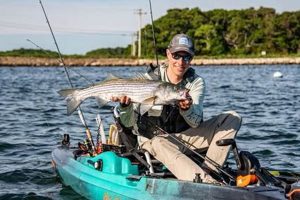
Selecting appropriate fishing rod length for kayak angling depends on several factors, including the targeted species, fishing techniques employed, and the kayak’s size and stability. For instance, a shorter rod (6-7 feet) offers better maneuverability in the confined space of a kayak and is suitable for lighter species or techniques like vertical jigging. Longer rods (7-8 feet or more) provide greater casting distance and leverage for larger fish, but can be cumbersome in tight quarters. The chosen length impacts casting accuracy, fish fighting control, and overall angling experience from a kayak.
Optimal rod length contributes significantly to successful kayak fishing. A well-suited rod allows anglers to cast effectively, manage lines efficiently, and control fish during the fight, all within the limited space of a kayak. Historically, kayak fishing relied on adaptations of existing fishing equipment. However, the growing popularity of the sport has led to the development of specialized rods designed specifically for the unique demands of kayak angling. These modern rods often incorporate features like shorter handles, increased portability, and enhanced sensitivity.
The following sections will explore these considerations in greater depth, outlining the benefits and drawbacks of various rod lengths and actions, as well as recommending specific rod types for different kayak fishing scenarios.
Tips for Selecting the Right Kayak Fishing Rod
Choosing the correct fishing rod length significantly enhances kayak angling effectiveness. These tips offer guidance for selecting the optimal rod length based on specific fishing situations.
Tip 1: Consider Target Species: Smaller species like panfish or trout require shorter, lighter rods (5-7 feet), offering greater sensitivity for detecting subtle bites. Larger, stronger species like salmon or stripers benefit from longer rods (7-8+ feet) providing leverage and backbone for fighting powerful runs.
Tip 2: Match Rod to Fishing Technique: Techniques like vertical jigging or drop-shotting often favor shorter rods for better control, while casting lures or trolling requires longer rods for increased casting distance and line management.
Tip 3: Factor in Kayak Size and Stability: Anglers in smaller, less stable kayaks benefit from shorter rods for enhanced maneuverability and balance. Larger, more stable kayaks can accommodate longer rods without compromising stability.
Tip 4: Prioritize Rod Action: A fast action rod bends primarily at the tip, offering greater sensitivity and faster hooksets, suitable for techniques requiring quick reactions. A slower action rod bends throughout its length, providing more forgiving power for fighting larger fish.
Tip 5: Evaluate Rod Power: Rod power refers to the rod’s lifting strength. Ultralight or light power rods suit smaller species, while medium-heavy or heavy power rods handle larger, more aggressive fish.
Tip 6: Account for Storage and Transportation: Collapsible or two-piece rods offer greater portability and easier storage, making them ideal for kayak anglers with limited space.
Tip 7: Test Before Purchasing (If Possible): Testing different rod lengths and actions, if feasible, allows anglers to determine the most comfortable and effective setup for their kayak fishing style.
By considering these factors, anglers can select the rod length that best suits their individual needs and maximizes their chances of success on the water.
Proper rod selection contributes substantially to a positive and productive kayak fishing experience. The next section will offer concluding thoughts and reinforce the significance of rod choice in this specialized angling discipline.
1. Length

Rod length stands as a critical factor in kayak fishing, directly influencing casting distance, maneuverability within the kayak, and the ability to effectively fight fish. Choosing the appropriate length requires careful consideration of the fishing environment and target species.
- Short Rods (5-6.5 feet):
These rods excel in confined spaces, offering superior control for techniques like vertical jigging and close-quarters casting. Their shorter length facilitates accurate casts around overhanging branches or in tight creeks, while also proving advantageous when battling fish near the kayak. However, they sacrifice casting distance compared to longer rods.
- Medium Rods (6.5-7.5 feet):
Representing a versatile compromise, these rods balance maneuverability and casting distance. Suitable for a wider range of techniques and species, they offer adequate casting control while still providing sufficient leverage for fighting larger fish. This length proves particularly effective in moderately open waters.
- Long Rods (7.5+ feet):
These rods maximize casting distance, making them ideal for open water or surf launching where reaching distant fish is crucial. Their increased length provides substantial leverage for battling strong fish. However, they can be cumbersome in tight spaces and require more experience to manage effectively from a kayak.
- Collapsible/Telescopic Rods:
Designed for portability and convenience, these rods offer adjustable lengths, allowing anglers to adapt to different fishing scenarios. While their versatility is advantageous, some models may compromise sensitivity or strength compared to fixed-length rods.
Selecting the appropriate rod length requires assessing the specific demands of the fishing environment. Balancing casting distance, maneuverability, and fish-fighting capability, informed by the typical target species and kayak size, ensures an optimized kayak fishing experience.
2. Action
Rod action, denoting where a rod flexes along its length, plays a crucial role in kayak fishing effectiveness. This characteristic significantly impacts hook setting power, casting accuracy, lure presentation, and the ability to manage fish around a kayak. Understanding the nuances of rod action enables anglers to make informed decisions aligning with their target species and fishing techniques.
Fast action rods, bending primarily in the top third, provide enhanced sensitivity for detecting subtle bites and deliver swift hook sets, crucial for techniques like drop-shotting or using topwater lures where immediate reaction is essential. They excel with braided lines, transmitting feedback directly to the angler’s hand. However, their stiff nature can make casting lighter lures challenging and may not provide optimal shock absorption when fighting larger fish. Conversely, slow action rods, bending throughout most of their length, offer superior casting distance and load-bearing capacity for heavier lures and larger fish. Their parabolic bend provides a cushion during fights, minimizing the risk of line breakage or hook pulls. While they provide greater forgiveness for less experienced anglers, they lack the sensitivity and responsiveness of faster action rods.
Moderate action rods represent a compromise between fast and slow action, bending in the top half or two-thirds. This versatile action suits a broad range of techniques and species, offering a balance of sensitivity, casting distance, and fish-fighting power. In the context of kayak fishing, where space is limited and versatility is often prized, moderate action rods frequently prove a suitable choice. Matching rod action to fishing style and target species enhances angler performance and enjoyment. Consideration of rod action, alongside length and power, contributes significantly to selecting the optimal rod for specific kayak fishing scenarios.
3. Power
Rod power, a measure of a rod’s lifting strength, plays a crucial role in determining appropriate rod choice for kayak fishing. This attribute directly influences the size and type of lures that can be effectively cast, the size of fish that can be successfully handled, and the overall fishing experience. Selecting the correct power ensures efficient hook sets, reduces the risk of line breakage, and maximizes control during fish fights, all critical elements within the confined space of a kayak.
Rod power classifications range from ultralight to extra heavy, each suited to specific fish species and fishing styles. Ultralight power rods, designed for smaller fish like panfish and trout, utilize lighter lines and smaller lures. Conversely, heavy power rods, designed for larger game fish such as tuna or muskies, handle heavier lines and larger lures, providing the necessary backbone to control powerful runs and lift heavy fish. Matching rod power to target species is crucial. Using a rod with insufficient power can lead to lost fish due to line breakage or inability to set the hook effectively. Conversely, using an overly powerful rod for smaller fish can result in a less enjoyable experience, sacrificing sensitivity and making it difficult to detect subtle bites.
Consideration of rod power must align with the intended fishing techniques. Finesse techniques like drop-shotting or fishing with light jigs often require lighter power rods for optimal lure presentation and bite detection. Techniques involving larger lures, heavier lines, and stronger fish, such as trolling or bottom fishing, necessitate rods with greater power. Understanding the interplay between rod power, target species, and fishing techniques allows anglers to select the most suitable rod for their kayak fishing needs. This selection contributes significantly to successful hookups, controlled fish fights, and a more rewarding experience on the water. Choosing appropriate rod power, alongside considerations of length and action, forms a fundamental component of effective kayak fishing tackle selection.
4. Weight
Rod weight significantly influences angler fatigue and comfort, especially during extended kayak fishing trips. A lighter rod allows for prolonged casting and retrieving with reduced strain, enhancing overall fishing enjoyment and preventing premature fatigue. This factor becomes particularly crucial in kayak fishing, where anglers often hold the rod for extended periods while simultaneously managing the kayak and other equipment. A heavy rod can quickly become tiresome, hindering casting accuracy and fish-fighting effectiveness. While lighter rods, often constructed from materials like graphite, generally offer greater sensitivity and responsiveness, they can also be more expensive and potentially less durable than heavier fiberglass alternatives. Balancing weight with other essential rod characteristics, such as power and action, is key to selecting the optimal setup for individual needs and fishing styles. For instance, an ultralight rod, ideal for smaller species and finesse techniques, minimizes fatigue during long sessions targeting panfish or trout. Conversely, a heavier rod, while more tiring to hold, provides the necessary strength and durability required for offshore kayak fishing targeting larger pelagic species.
The weight distribution along the rod also affects balance and handling. A rod with a balanced feel reduces strain on the wrist and forearm, facilitating precise casts and effective lure manipulation. This balance is often achieved through careful rod design and component selection, including the type of handle material and reel seat placement. Furthermore, rod weight interacts with reel weight. A balanced rod and reel combination minimizes fatigue and maximizes control, particularly important when fighting strong fish from a kayak. Consideration of the combined weight of the rod and reel, alongside individual rod weight, contributes to a more comfortable and effective kayak fishing experience. For example, pairing a lighter rod with a lightweight reel creates a well-balanced setup suitable for extended periods of active fishing, whereas a heavier rod might be paired with a heavier reel to maintain balance when targeting larger species offshore.
Careful consideration of rod weight, in conjunction with other critical factors such as length, action, and power, is essential for optimizing kayak fishing performance and enjoyment. Selecting a rod with appropriate weight enhances angler comfort, reduces fatigue, and allows for more effective casting and fish fighting, ultimately contributing to a more successful and enjoyable day on the water. Striking the right balance between weight, performance, and durability remains a key consideration in choosing the ideal kayak fishing rod.
5. Material

Rod material significantly influences performance characteristics relevant to kayak fishing, impacting sensitivity, durability, weight, and cost. The primary materials used in rod constructiongraphite and fiberglass, along with composites blending botheach offer distinct advantages and disadvantages. Selecting the appropriate material requires careful consideration of fishing style, target species, and budget.
- Graphite
Graphite rods offer superior sensitivity, transmitting even the slightest vibrations to the angler’s hand. This heightened sensitivity allows for better detection of subtle bites, crucial for finesse techniques and light-biting fish. Graphite’s lightweight nature reduces angler fatigue during long fishing sessions, a significant advantage in kayak fishing. However, graphite rods tend to be more brittle and susceptible to damage from impacts compared to fiberglass, requiring careful handling and storage in the confined space of a kayak. Higher-modulus graphite offers increased sensitivity and lighter weight but often comes at a premium price. For example, a high-modulus graphite rod may excel in detecting light strikes from panfish, while its lighter weight improves handling during extended retrieves.
- Fiberglass
Fiberglass rods provide greater durability and affordability compared to graphite. Their robust construction withstands rough handling and accidental impacts, making them suitable for challenging kayak fishing environments. Fiberglass also offers greater lifting power, making it suitable for targeting larger, stronger fish. However, fiberglass rods are generally heavier and less sensitive than graphite rods, potentially hindering bite detection and casting accuracy with lighter lures. For example, a fiberglass rod might be preferred for trolling or bottom fishing for larger species where sensitivity is less critical than durability and strength.
- Composite
Composite rods combine graphite and fiberglass, seeking to balance the advantages of both materials. These rods often aim to offer a blend of sensitivity, durability, and affordability. The specific blend of materials influences the rod’s performance characteristics. A composite rod with a higher graphite content will lean towards greater sensitivity, while a higher fiberglass content prioritizes durability. This blended approach allows anglers to tailor rod characteristics to their specific needs and budget. For instance, a composite rod might be a suitable choice for kayak anglers seeking a balance of sensitivity for detecting bites and durability to withstand the rigors of kayak fishing.
- Other Materials
While less common, other materials like boron or Kevlar sometimes find application in rod construction, often in combination with graphite or fiberglass. These materials can enhance specific performance characteristics such as strength, sensitivity, or responsiveness. For example, boron may be added to increase lifting power without adding significant weight, while Kevlar can enhance impact resistance. These specialized materials often come at a higher price point, but offer performance benefits for specific fishing applications. They might find use in high-end kayak fishing rods designed for specific techniques or targeting exceptionally strong fish.
The choice of rod material significantly impacts the kayak angler’s experience, influencing sensitivity, durability, weight, and cost. Careful consideration of these factors, alongside the intended fishing style, target species, and budget, leads to a rod selection optimized for kayak fishing. Understanding the strengths and weaknesses of each material allows anglers to make informed decisions, ultimately enhancing their performance and enjoyment on the water.
6. Portability

Portability represents a critical factor in selecting a fishing rod for kayak angling. Kayaks, by nature, offer limited storage space, necessitating compact and easily manageable gear. Rod portability directly influences ease of transport to and from the water, storage within the kayak, and overall maneuverability while fishing. A cumbersome or unwieldy rod can hinder casting, impede navigation, and increase the risk of entanglement or breakage, particularly in challenging conditions. Therefore, rod length and design directly impact portability. Shorter rods, typically under 7 feet, offer inherent advantages in portability compared to longer rods exceeding 8 feet. Furthermore, multi-piece or telescoping rods, designed for compact storage and transport, provide significant portability benefits for kayak anglers.
The practical significance of portability becomes readily apparent in various kayak fishing scenarios. Transporting longer, one-piece rods to remote fishing locations, often involving hiking or navigating uneven terrain, presents logistical challenges. Storing longer rods securely within a kayak, especially during transit or in rough water, can prove difficult and potentially compromise stability. Multi-piece rods address these challenges, allowing for easier transport and secure storage within the kayak’s limited confines. For instance, a four-piece travel rod breaks down into compact sections, fitting easily within a backpack or kayak storage compartment, while maintaining adequate fishing performance once assembled. This portability becomes invaluable when navigating challenging terrain or accessing remote fishing spots, expanding angling opportunities from a kayak. Furthermore, shorter rods, even in a one-piece configuration, inherently offer greater portability and maneuverability within the kayak itself, facilitating easier casting and fish fighting in tight quarters.
Prioritizing portability in rod selection optimizes the kayak fishing experience. A portable rod simplifies transport, facilitates efficient storage, and enhances on-the-water maneuverability. These factors contribute directly to safety, efficiency, and overall fishing enjoyment. While portability remains paramount, balancing this attribute with desired rod length, action, and power requires careful consideration. Ultimately, the optimal rod choice depends on the individual angler’s needs, target species, and fishing style, recognizing that portability significantly influences the practicality and enjoyment of kayak fishing.
7. Target Species

Target species significantly influence rod selection for kayak angling. Different species present unique challenges regarding size, fighting strength, and habitat, necessitating specific rod characteristics for optimal performance. Matching rod capabilities to target species ensures effective hook sets, manageable fights, and minimizes fish loss, ultimately enhancing angling success and enjoyment.
- Smaller Fish (e.g., panfish, trout)
Smaller species typically require lighter rods with softer actions. These rods offer increased sensitivity for detecting subtle bites and provide adequate flexibility for casting lighter lures. Shorter lengths, typically between 5 and 7 feet, enhance maneuverability within the confined space of a kayak. For example, a 6-foot, light-power, fast-action rod excels in presenting small jigs or lures for crappie or trout in tight quarters.
- Medium-Sized Fish (e.g., bass, walleye)
Medium-sized species benefit from medium-power rods with moderate to fast actions. These rods offer a balance of sensitivity and power, capable of handling heavier lines and lures while maintaining adequate sensitivity for detecting bites. Rod lengths between 6.5 and 7.5 feet provide suitable casting distance and leverage for fish control. For example, a 7-foot, medium-power, fast-action rod suits a variety of bass fishing techniques, from casting crankbaits to flipping jigs.
- Larger Fish (e.g., salmon, redfish)
Larger, stronger species demand heavier rods with moderate to fast actions. These rods offer the necessary backbone to handle heavier lines, larger lures, and powerful runs. Lengths exceeding 7.5 feet provide greater casting distance and leverage for controlling large fish near the kayak. For instance, an 8-foot, medium-heavy power, fast-action rod provides the necessary strength and control for battling powerful saltwater species like redfish or snook in open water.
- Specialized Techniques (e.g., trolling, fly fishing)
Specific fishing techniques may necessitate specialized rod choices regardless of target species. Trolling often requires longer, heavier rods with slower actions to handle the strain of multiple lines and lures. Fly fishing from a kayak demands specialized fly rods designed for shorter casts and specific fly line weights. For example, a 9-foot fly rod designed for 8-weight lines balances casting performance with the need for maneuverability in a kayak environment.
Careful consideration of target species, alongside desired fishing techniques and kayak limitations, informs effective rod selection. Matching rod capabilities to the specific demands of the target species ensures an optimized fishing experience, maximizing hook-up ratios, minimizing fish loss, and ultimately enhancing enjoyment on the water. By understanding the interplay between target species and rod choice, kayak anglers can effectively target a wider range of species and refine their approach to specific fishing scenarios.
Frequently Asked Questions
This section addresses common inquiries regarding fishing rod selection for kayak angling, providing concise yet informative responses to guide informed decision-making.
Question 1: What rod length is generally recommended for kayak fishing?
Rod lengths between 6 and 7.5 feet generally prove suitable for kayak fishing, balancing maneuverability within the kayak’s confined space with adequate casting distance. Shorter rods excel in tight quarters, while slightly longer rods offer increased casting range.
Question 2: Does kayak stability influence rod length choice?
Kayak stability factors into rod length selection. Anglers in smaller, less stable kayaks often benefit from shorter rods for enhanced balance and control, while those in larger, more stable kayaks can comfortably handle longer rods.
Question 3: How does target species affect ideal rod length?
Target species significantly influences rod choice. Smaller species typically require shorter, lighter rods, whereas larger species benefit from longer rods with greater lifting power to manage stronger fights.
Question 4: What rod action is best suited for kayak fishing?
Moderate to fast action rods generally perform well in kayak fishing. Moderate action offers versatility, while fast action provides greater sensitivity and faster hook sets, particularly advantageous in confined spaces.
Question 5: Are two-piece rods a good option for kayak angling?
Two-piece or collapsible rods offer significant advantages for kayak anglers due to their enhanced portability and ease of storage within the kayak’s limited space.
Question 6: How does rod power relate to line and lure selection?
Rod power must align with line and lure weight. Lighter power rods utilize lighter lines and smaller lures, while heavier power rods handle heavier lines and larger lures, ensuring effective casting and fish fighting capabilities.
Careful consideration of these frequently asked questions empowers anglers to make informed rod selections optimized for their specific kayak fishing needs and enhances their prospects for a successful and enjoyable experience on the water.
For a deeper exploration of specific rod recommendations tailored to various fishing styles and target species, consult the following section.
Appropriate Rod Size for Kayak Fishing
Appropriate fishing rod size selection for kayak angling necessitates careful evaluation of several interconnected factors. Rod length influences casting distance and maneuverability within the kayak’s limited space. Action dictates the rod’s bend, impacting hook setting power and fish-fighting control. Power determines the rod’s strength for handling different fish sizes and fighting styles. Material affects sensitivity, durability, and weight, influencing angler fatigue and responsiveness. Portability considerations, crucial for kayak anglers, often favor shorter, multi-piece, or telescoping rods. Finally, target species significantly influence rod choice, as different species present unique challenges related to size, fighting strength, and preferred habitat.
Effective kayak angling requires a rod that balances these critical attributes to optimize performance and enjoyment on the water. Informed rod selection enhances an angler’s ability to effectively target desired species, manage fish efficiently in a confined environment, and maximize overall fishing success from a kayak. Careful consideration of these factors empowers anglers to make informed decisions and elevate their kayak fishing experience.