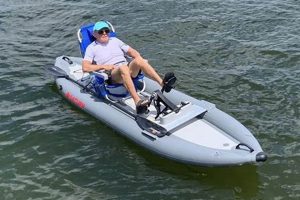
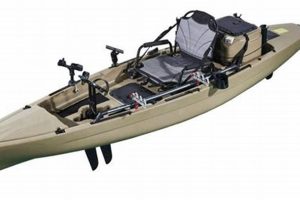
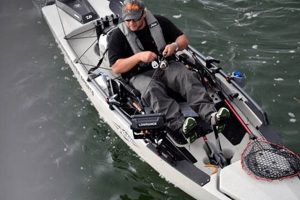
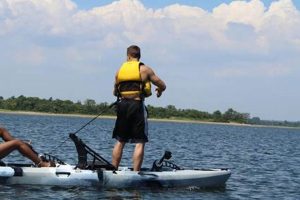
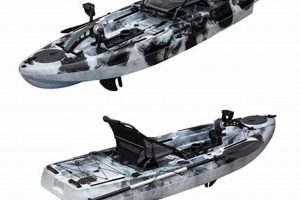
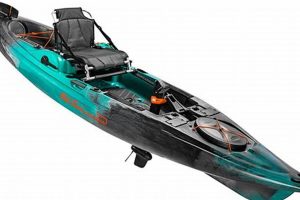
This specific type of watercraft combines the stability and load capacity of a sit-on-top kayak with the efficiency and speed of a pedal-powered propulsion system. Anglers can maintain a hands-free fishing experience, allowing them to focus on casting, retrieving, and landing fish. The manufacturer is recognized for producing durable and well-designed kayaks.
Hands-free propulsion offers significant advantages for fishing, allowing anglers to cover more water with less effort and maintain precise boat control. This is particularly beneficial in currents, wind, or when targeting specific locations. Furthermore, these vessels often feature specialized design elements for anglers, such as rod holders, tackle storage, and even livewells. The evolution of these watercraft reflects a growing demand for specialized equipment catering to specific outdoor pursuits.
Further exploration will delve into specific models, features, user experiences, and comparisons with other fishing kayak propulsion systems.
Tips for Pedal Kayak Fishing
Optimizing the use of a pedal-driven fishing kayak involves understanding its unique features and employing appropriate techniques. The following tips enhance fishing success and overall experience.
Tip 1: Master Pedal Control: Familiarize oneself with the nuances of the pedal system. Practice maneuvering in various water conditionscalm lakes, moving rivers, and windy areasto gain proficiency in speed control and turning radius.
Tip 2: Strategic Positioning: Approach fishing spots quietly and strategically. Pedal propulsion allows for subtle adjustments in position without disturbing the water or spooking fish. Consider wind direction and current when choosing an anchoring spot.
Tip 3: Hands-Free Fishing Advantage: Maximize the benefit of hands-free propulsion by preparing fishing gear and accessories in advance. This ensures quick and efficient casting and retrieval without the need to constantly adjust paddling strokes.
Tip 4: Tackle and Gear Organization: Organize tackle and gear within easy reach to maintain efficient workflow while fishing. Utilize onboard storage compartments and accessories to keep essential items readily accessible.
Tip 5: Safety First: Always prioritize safety by wearing a personal flotation device (PFD) and carrying essential safety equipment. Be mindful of weather conditions and water traffic.
Tip 6: Regular Maintenance: Extend the lifespan of the pedal drive system and the kayak itself through regular cleaning and maintenance. Rinse the kayak and pedal drive with fresh water after each use, especially in saltwater environments. Lubricate moving parts according to manufacturer recommendations.
Tip 7: Understanding Water Depth and Bottom Structure: Familiarize oneself with the water depth and bottom structure of the fishing area. This knowledge assists in identifying ideal fishing locations and avoiding potential obstacles or hazards.
By implementing these strategies, anglers can significantly improve their fishing effectiveness, safety, and overall enjoyment on the water.
This foundational knowledge equips anglers to fully leverage the advantages of a pedal kayak. The following sections will provide further detail on specific models and features.
1. Pedal-Powered Propulsion

Pedal-powered propulsion represents a pivotal advancement in fishing kayak design, directly impacting the functionality and effectiveness of models like those offered by Old Town. This system replaces traditional paddle propulsion with a bicycle-style pedal drive, enabling hands-free operation. This fundamental shift offers several key advantages for anglers. Eliminating the need for paddling frees hands for casting, retrieving lines, and handling fish, significantly enhancing fishing efficiency. Maintaining continuous, controlled movement, even against currents or wind, becomes substantially easier with pedal power. This precise control proves crucial for targeting specific locations and maintaining optimal lure presentation. The pedal drive’s efficiency also allows anglers to cover more water with less physical exertion, expanding fishing range and opportunities.
Consider a scenario where an angler targets fish near a structure in a moderately flowing river. Maintaining position and precise boat control with traditional paddles requires constant adjustment and effort. Pedal-powered propulsion, however, allows the angler to maintain position effortlessly, focusing entirely on fishing technique. This advantage extends to various fishing environments, from still lakes to coastal areas, providing greater flexibility and efficiency. Specific Old Town models, such as the Topwater series, integrate this technology to provide a stable and maneuverable fishing platform.
Understanding the implications of pedal-powered propulsion proves crucial for maximizing the potential of an Old Town fishing kayak. This technology addresses fundamental challenges associated with traditional paddle kayaks, enhancing fishing efficiency and overall experience. This innovation represents a significant step forward in fishing kayak design, enabling anglers to focus more on the art of fishing and less on boat control.
2. Hands-free fishing

Hands-free fishing represents a core advantage of the Old Town pedal fishing kayak, fundamentally altering the angling experience. Traditional paddle kayaks require constant hand adjustments for propulsion and maneuvering, diverting attention from fishing tasks. Pedal-powered kayaks, conversely, liberate anglers’ hands, enabling simultaneous boat control and fishing activities. This capability significantly enhances fishing efficiency and effectiveness. Consider the scenario of fighting a fish while simultaneously needing to adjust boat position due to wind or current. In a traditional kayak, this presents a complex, potentially compromising situation. With an Old Town pedal kayak, however, anglers maintain full control of the vessel while managing the fish, resulting in a significant advantage. This fundamental shift in operational dynamics directly impacts angling success.
The practical significance of hands-free fishing extends beyond simply handling fish. It streamlines lure retrieval, allows for quicker adjustments to changing conditions, and facilitates immediate response to fish strikes. Imagine working a lure along a weed bed, requiring precise boat control to maintain the optimal presentation. With a pedal kayak, anglers maintain this precision effortlessly, hands remaining free to manage the rod and react instantly to a bite. This level of control and responsiveness significantly increases the likelihood of a successful hookset and landing. Furthermore, hands-free operation allows for more efficient use of fishing accessories, such as depth finders and GPS units, optimizing the fishing process.
Hands-free fishing, facilitated by the pedal-drive system in Old Town kayaks, presents a notable evolution in angling technology. This feature directly addresses challenges inherent in traditional paddle kayaks, improving fishing efficiency and overall experience. By understanding the practical implications of this capability, anglers can fully leverage the advantages offered by these specialized watercraft, enhancing their ability to navigate waterways, control their vessel, and ultimately, increase their fishing success.
3. Old Town Brand Reputation

Old Town’s established reputation for quality and innovation significantly influences the perception and value of its pedal fishing kayaks. The company’s long history in the canoe and kayak industry, coupled with a focus on durable construction and user-friendly design, fosters consumer trust. This positive brand image translates into higher perceived value, often justifying a premium price point for Old Town products. Customers frequently associate the brand with reliability and performance, contributing to purchase decisions. Specifically, the reputation for stability and thoughtful design features, honed over decades of manufacturing experience, directly benefits the pedal fishing kayak line. This legacy reinforces the perception of these kayaks as dependable, high-performing vessels tailored to the demands of fishing.
Consider the impact of brand reputation on consumer choice within the competitive fishing kayak market. A novice angler researching kayak options might feel overwhelmed by the numerous brands and models available. Old Town’s established reputation provides a sense of assurance, simplifying the decision-making process. The brand’s history and positive reviews often sway purchasing decisions toward an Old Town pedal kayak, even when competing products offer similar features at a lower price point. This brand loyalty reflects the tangible value of a positive reputation built over time. Furthermore, established brands often invest more in research and development, leading to continuous product improvements and innovation. Old Town’s commitment to innovation, reflected in its pedal-drive technology and specialized fishing features, reinforces its position as a leading brand in the kayak fishing segment.
The connection between Old Town’s brand reputation and its pedal fishing kayaks represents a significant factor in the product’s market success. This positive brand image, built on a foundation of quality, innovation, and customer satisfaction, contributes directly to consumer confidence and purchasing decisions. Understanding this connection provides valuable insights into the dynamics of the fishing kayak market and the importance of brand equity in a competitive landscape. It underscores the value proposition of an Old Town pedal fishing kayak, extending beyond specific features to encompass the brand’s legacy of performance and reliability.
4. Enhanced Fishing Features

Enhanced fishing features distinguish specialized fishing kayaks, such as those offered by Old Town, from recreational models. These purpose-built additions cater specifically to angling needs, improving efficiency, organization, and overall fishing success. These features represent a crucial consideration for anglers evaluating kayak options, directly impacting functionality and on-the-water experience.
- Rod Holders:
Integrated rod holders secure fishing rods, freeing hands for other tasks like paddling, maneuvering, or handling fish. Multiple rod holders accommodate diverse fishing techniques and allow anglers to switch between setups quickly. Flush-mounted rod holders minimize line tangling and interference, while adjustable rod holders offer flexibility in positioning rods for optimal presentation. This feature is particularly advantageous in pedal kayaks where hands-free operation is paramount. For example, an angler trolling with multiple lines can benefit significantly from strategically placed rod holders, maximizing fishing coverage and efficiency.
- Tackle Storage:
Dedicated tackle storage compartments within easy reach maintain organization and streamline lure and bait changes. Dry storage compartments protect sensitive electronics and gear from water damage. Customizable storage systems accommodate specific tackle configurations, maximizing space efficiency. Consider an angler needing to quickly switch lures based on changing fish behavior. Efficient tackle storage facilitates rapid lure changes, minimizing disruption to the fishing process. This organizational aspect significantly impacts fishing efficiency and success.
- Mounting Systems:
Mounting systems provide attachment points for fish finders, GPS units, cameras, and other accessories. These systems enhance situational awareness, navigation, and data collection, crucial for informed fishing decisions. Consider an angler using a fish finder to identify underwater structures or schools of fish. Secure mounting ensures consistent transducer contact with the water, providing accurate readings. This information informs decisions regarding lure selection, retrieval techniques, and overall fishing strategy.
- Rudder and Steering Systems:
While not strictly exclusive to fishing kayaks, rudder and steering systems become particularly valuable when combined with hands-free propulsion. These systems enhance maneuverability and course correction, particularly in windy or current-prone environments. For a pedal kayak angler, precise steering allows for maintaining position and approach angles without interrupting the fishing process. This level of control proves crucial for targeting specific locations and navigating complex waterways effectively.
These enhanced features collectively elevate the functionality of an Old Town pedal fishing kayak beyond basic watercraft. They demonstrate a thoughtful design approach, catering specifically to the needs of anglers. By integrating these specialized elements, Old Town reinforces its commitment to providing high-performance fishing platforms that optimize efficiency, organization, and ultimately, angling success. This strategic integration of features differentiates Old Town kayaks within a competitive market, offering anglers a compelling combination of performance, comfort, and specialized functionality.
5. Stability and Maneuverability

Stability and maneuverability represent critical performance characteristics for fishing kayaks, particularly those employing pedal-driven propulsion like Old Town models. These attributes directly influence the angler’s ability to maintain balance, navigate effectively, and execute fishing techniques efficiently. The following facets explore the significance of stability and maneuverability within the context of Old Town pedal fishing kayaks.
- Primary Stability:
Primary stability refers to a kayak’s resistance to tipping when at rest or moving slowly. A stable platform is essential for activities like casting, retrieving, and landing fish, especially in pedal kayaks where anglers operate hands-free. A wide hull and low center of gravity typically contribute to greater primary stability. For example, an angler standing to cast in an Old Town Topwater benefits from its inherent stability, minimizing the risk of capsizing. This inherent stability allows for greater freedom of movement and enhances fishing effectiveness.
- Secondary Stability:
Secondary stability describes a kayak’s ability to remain upright when leaned or tilted, crucial for maneuvering in currents, wind, or waves. Kayaks with rounded hulls generally offer better secondary stability. This characteristic enables anglers to navigate challenging water conditions effectively while maintaining balance and control. Consider an angler navigating through a shallow, rocky stream. The kayak’s secondary stability allows it to lean and conform to the water’s surface, preventing capsizing and ensuring safe passage.
- Maneuverability in Confined Spaces:
Maneuverability in tight quarters, such as shallow creeks, weed beds, or around docks, directly impacts fishing effectiveness. Shorter kayaks with responsive rudders or steering systems generally excel in these environments. The ability to execute tight turns and precise adjustments in position proves crucial for navigating complex waterways and targeting specific fish-holding locations. For instance, an angler pursuing fish in a mangrove forest requires a highly maneuverable kayak to navigate the intricate channels and reach secluded fishing spots effectively.
- Tracking and Speed:
Tracking, a kayak’s ability to maintain a straight course, and speed influence efficient travel across open water. Longer kayaks generally track better, while hull design and pedal-drive efficiency impact speed. Consider an angler traversing a large lake to reach a distant fishing spot. Efficient tracking and a reasonable speed minimize travel time and maximize time spent fishing. In this context, the pedal drive’s efficiency combined with a well-designed hull contributes significantly to overall fishing productivity.
The interplay between stability and maneuverability defines the performance characteristics of an Old Town pedal fishing kayak. These attributes influence not only the angler’s safety and comfort but also their ability to effectively navigate diverse water environments and execute fishing techniques. Old Town designs its pedal kayaks with careful consideration for these factors, aiming to provide a balanced platform suitable for various fishing scenarios. Understanding these interconnected aspects allows anglers to appreciate the nuanced design elements that contribute to a positive and productive fishing experience.
Frequently Asked Questions
This section addresses common inquiries regarding pedal-powered fishing kayaks manufactured by Old Town, providing concise and informative responses.
Question 1: What are the primary advantages of a pedal-powered fishing kayak compared to a traditional paddle kayak?
Pedal kayaks offer hands-free propulsion, allowing anglers to focus on fishing while maintaining precise boat control. This advantage proves particularly beneficial in currents, wind, or when fighting fish. Pedal drives also generally offer greater speed and range compared to paddling.
Question 2: How durable are Old Town pedal kayaks, and what kind of maintenance do they require?
Old Town kayaks are known for their durable construction. Regular maintenance, including rinsing after each use (especially in saltwater) and periodic lubrication of moving parts, ensures long-term performance and prevents premature wear. Specific maintenance recommendations vary by model and pedal-drive system.
Question 3: Are Old Town pedal kayaks suitable for all water types?
While adaptable to various environments, specific model suitability depends on conditions. Some models excel in calm lakes and rivers, while others are designed for coastal fishing or navigating challenging currents. Researching specific model specifications is essential to determine appropriate usage.
Question 4: What is the typical weight capacity of an Old Town pedal fishing kayak?
Weight capacity varies by model, generally ranging from 400 to 500 pounds, including angler weight, gear, and any catch. Exceeding the specified weight capacity can compromise stability and performance. Consulting manufacturer specifications for the specific model of interest is crucial.
Question 5: How does the pedal-drive system in an Old Town kayak function, and what happens if it malfunctions on the water?
Old Town utilizes proprietary pedal-drive systems, typically employing either propeller or fin-based propulsion. In the event of a malfunction, most systems allow for switching to paddle propulsion. Understanding the specific drive system of a chosen model and its backup options is essential before venturing onto the water.
Question 6: What factors should one consider when choosing between different Old Town pedal kayak models?
Key considerations include intended fishing environment (lakes, rivers, or ocean), desired features (rod holders, storage capacity), budget, and angler physical characteristics (height and weight). Researching various models, comparing specifications, and seeking expert advice are recommended steps in the selection process.
Addressing these common inquiries provides a foundational understanding of Old Town pedal fishing kayaks. Further research and consultation with authorized dealers can assist in making informed purchase decisions aligned with individual angler needs and preferences.
The next section will delve deeper into specific Old Town pedal kayak models and their unique features.
Conclusion
This exploration has provided a comprehensive overview of Old Town pedal fishing kayaks, encompassing key features, benefits, and considerations. Pedal-powered propulsion, coupled with specialized design elements, enhances angling effectiveness and overall on-the-water experience. The brand’s established reputation for quality and innovation contributes to consumer confidence. Factors such as stability, maneuverability, and integrated fishing features distinguish these kayaks within a competitive market.
The evolution of fishing kayak technology continues to refine the angling experience, driving innovation and specialized design. Careful consideration of individual needs, fishing style, and target environments will guide appropriate kayak selection. Continued exploration of available models and features empowers anglers to make informed decisions, optimizing their pursuit of fishing success and enjoyment on the water.