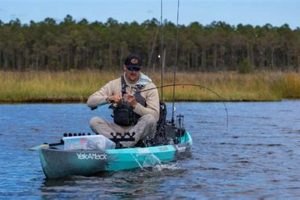
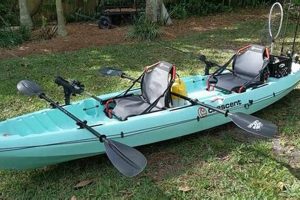
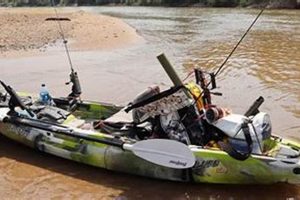
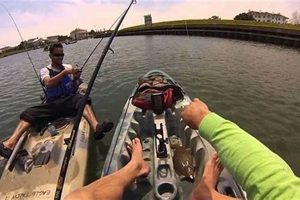
A guide focused on angling from a kayak typically covers topics such as selecting appropriate watercraft and gear, effective paddling techniques, locating fish from a kayak, specialized rigging and tackle, safety procedures, and ethical considerations. An example might include detailed instructions on how to rig a kayak for trolling or how to land a large fish from a small, unstable platform.
Such resources are invaluable for anglers looking to explore this increasingly popular sport. They offer a structured approach to learning essential skills, promoting safe practices on the water, and maximizing the chances of a successful fishing experience. Historically, knowledge transfer in angling relied heavily on mentorship and personal experience. Publications dedicated to this specialized niche fill a critical gap by providing readily accessible information and expert advice, fostering a broader and more informed community of kayak anglers.
Further exploration of specific topics, such as kayak selection, fishing techniques, safety equipment, or regional fishing guides, will provide readers with a more comprehensive understanding of the subject and its various nuances.
Essential Kayak Fishing Tips
These tips, often highlighted in specialized guides, provide valuable insights for both novice and experienced anglers.
Tip 1: Stability is paramount. Consider kayak design and personal comfort levels when selecting a vessel. Wider kayaks offer greater initial stability, while longer, narrower designs excel in tracking and speed. Practice entering and exiting the kayak in shallow water before venturing into deeper areas.
Tip 2: Paddle efficiently. Proper paddling technique conserves energy and allows for longer fishing excursions. Learning basic strokes like the forward stroke, reverse stroke, and sweep stroke enhances maneuverability and control.
Tip 3: Rigging is key. Customize the kayak’s setup with rod holders, fish finders, and storage compartments to optimize fishing efficiency. Ensure all equipment is securely fastened to prevent loss or damage.
Tip 4: Safety first. Always wear a personal flotation device (PFD) and carry essential safety gear, including a whistle, signaling device, and first-aid kit. Inform someone of the planned fishing location and estimated return time.
Tip 5: Respect the environment. Practice catch-and-release whenever possible, and avoid disturbing sensitive habitats. Adhere to local fishing regulations and dispose of waste responsibly.
Tip 6: Choose appropriate tackle. Opt for lures and tackle suitable for the targeted species and the specific fishing environment. Kayak anglers often favor lighter tackle and shorter rods for ease of use and maneuverability.
Tip 7: Plan and prepare. Research potential fishing spots, considering tides, currents, and weather conditions. Pack essential supplies, including water, sunscreen, and insect repellent.
By implementing these strategies, anglers can enhance their safety, improve their fishing success, and contribute to a more sustainable and enjoyable experience.
Ultimately, combining theoretical knowledge with practical experience leads to greater proficiency and a deeper appreciation of the sport.
1. Kayak Selection

Comprehensive guides dedicated to kayak angling often dedicate significant portions to kayak selection due to its profound impact on the overall fishing experience. Choosing the right kayak influences stability, maneuverability, storage capacity, and ultimately, fishing success. A thorough understanding of hull designs, lengths, widths, and propulsion systems is crucial for informed decision-making. For instance, a sit-on-top kayak offers advantages in warmer climates and calmer waters, allowing for easier entry and exit after an accidental capsize. Sit-in kayaks, conversely, provide greater protection from the elements and increased storage capacity for longer expeditions, though they require more skill to manage in the event of a capsize. These distinctions are often clearly delineated within specialized literature.
Further, the chosen fishing style heavily influences kayak selection. Anglers targeting larger game fish in offshore environments benefit from longer, more stable kayaks designed for tracking and speed. Conversely, anglers fishing smaller rivers or lakes may prioritize shorter, more maneuverable kayaks for navigating tight spaces and shallow water. Matching kayak selection to fishing style, as emphasized in many guides, optimizes efficiency and maximizes the chances of a successful outing. Consider an angler targeting trout in a mountain stream; a short, highly maneuverable kayak allows for navigating shallow, rocky areas inaccessible to larger vessels. This targeted approach, often highlighted in specialized guides, underscores the connection between kayak selection and fishing effectiveness.
In conclusion, kayak selection serves as a cornerstone of effective kayak angling. Guides dedicated to the sport offer invaluable insights into navigating the complexities of kayak choices, empowering anglers to make informed decisions tailored to their individual needs and fishing goals. This foundational knowledge contributes significantly to angler safety, fishing success, and overall enjoyment on the water. Recognizing the subtle yet critical interplay between kayak attributes and fishing styles, as outlined in dedicated guides, ultimately leads to a more rewarding and fulfilling experience.
2. Essential Gear

A kayak fishing guide’s discussion of essential gear directly impacts an angler’s safety and success. Understanding recommended equipment, its proper use, and its relevance to various fishing scenarios is paramount. Such guides serve as valuable resources for both novice and experienced anglers seeking to optimize their kayak fishing setup.
- Personal Flotation Device (PFD)
A PFD is non-negotiable. Guides emphasize its critical role in ensuring angler safety. Different PFD types exist, each with varying features and levels of buoyancy. Inflatable PFDs offer greater comfort and freedom of movement while fishing, whereas inherently buoyant PFDs provide immediate flotation. Choosing the right PFD and understanding its proper use are key aspects highlighted in these guides. A guide might compare different PFD designs, explaining the advantages and disadvantages of each for specific kayaking conditions. This information enables anglers to select the most appropriate PFD for their needs.
- Paddle
Paddle selection significantly influences paddling efficiency and maneuverability. Guides often discuss blade shapes, shaft lengths, and materials. A longer, narrower blade provides greater speed and efficiency in open water, whereas a shorter, wider blade offers increased maneuverability in tight spaces. Understanding these nuances, as detailed in dedicated guides, allows anglers to choose a paddle optimized for their kayak and fishing environment. For instance, a guide might explain how paddle length relates to torso height and kayak width, offering specific recommendations for different body types and kayak designs. This personalized approach enhances paddling comfort and reduces fatigue.
- Rod and Reel
Rod and reel selection depends heavily on the target species and fishing techniques. Guides provide insights into rod action, reel types (spinning, baitcasting, fly), and appropriate line weights. A guide might compare the advantages of a baitcasting reel for accuracy and power versus a spinning reel for ease of use and versatility. Understanding these distinctions allows anglers to make informed choices based on their fishing preferences and target species. An example within a guide might illustrate how a medium-action rod with a spinning reel suits finesse fishing for smaller species, while a heavy-action rod with a baitcasting reel provides the power necessary for larger game fish.
- Safety Equipment
Beyond the PFD, essential safety gear includes a whistle, signaling device (mirror or flare), first-aid kit, and bilge pump. Guides stress the importance of carrying this equipment and knowing how to use it effectively in emergencies. A guide might provide step-by-step instructions on how to use a bilge pump to remove water from a flooded kayak, emphasizing the importance of regular practice. This practical knowledge can prove invaluable in critical situations, enhancing angler safety and preparedness.
These gear selections, when informed by the insights presented within kayak fishing guides, contribute significantly to a safer and more productive experience. By understanding the nuances of each piece of equipment, anglers can optimize their setup, enhance their safety, and maximize their chances of fishing success. The guide’s role in elucidating these connections underscores its value as an essential resource for any kayak angler.
3. Safety Procedures

Safety procedures form a critical component of any comprehensive kayak fishing guide. Understanding and implementing these procedures significantly reduces risks associated with this increasingly popular sport. A well-structured guide emphasizes the importance of proactive safety measures, equipping anglers with the knowledge and skills necessary to navigate potential hazards and respond effectively in emergencies. This focus on safety underscores the guide’s role in promoting responsible angling practices and fostering a culture of safety within the kayak fishing community.
- Pre-Trip Planning
Guides emphasize the importance of thorough pre-trip planning. This includes checking weather forecasts, informing someone of the planned fishing location and estimated return time, and understanding local regulations and potential hazards such as currents, tides, and boat traffic. For example, planning a fishing trip during periods of stable weather and minimal wind reduces the risk of capsizing or encountering unexpected challenges. Similarly, informing a friend or family member of the intended route and return time ensures that someone knows the angler’s whereabouts, facilitating a prompt response in case of an emergency. These preemptive measures, often highlighted in dedicated guides, significantly contribute to angler safety.
- Essential Safety Equipment
Carrying essential safety equipment is paramount. Guides typically detail the importance of a properly fitted personal flotation device (PFD), a signaling device (whistle, mirror, or flare), a first-aid kit, and a bilge pump. Understanding the function and proper use of each piece of equipment is critical. A guide might provide step-by-step instructions on how to use a bilge pump effectively or how to signal for help using a mirror or flare. This practical knowledge empowers anglers to respond effectively in emergencies, enhancing their safety and self-reliance. For instance, knowing how to signal for help could prove crucial if an angler becomes stranded or injured in a remote location.
- Capsize Recovery
Guides often dedicate significant sections to capsize recovery techniques. Learning how to re-enter a kayak after a capsize, both with and without assistance, is a fundamental skill for any kayak angler. Practicing these techniques in a controlled environment, such as a swimming pool or shallow water area, builds confidence and prepares anglers for unexpected situations. Guides might illustrate different re-entry methods, highlighting the advantages and disadvantages of each for various kayak designs and physical abilities. This practical instruction enhances angler safety and preparedness by equipping them with the skills to self-rescue in the event of a capsize.
- Navigation and Awareness
Maintaining situational awareness and practicing safe navigation techniques are vital aspects of kayak fishing safety. Guides emphasize the importance of being aware of one’s surroundings, including other boat traffic, potential obstacles, and changing weather conditions. Understanding navigational aids, such as buoys and markers, and practicing proper paddling techniques enhances safety and prevents collisions. For instance, a guide might explain how to interpret different buoy markers or how to adjust paddling technique in strong currents or windy conditions. This knowledge empowers anglers to navigate safely and avoid potential hazards, minimizing the risk of accidents.
By emphasizing these safety procedures, kayak fishing guides play a crucial role in educating anglers and promoting responsible practices on the water. The integration of these safety measures into comprehensive guides transforms them from mere instructional manuals into essential tools for enhancing angler safety, preparedness, and overall enjoyment of the sport. This focus on safety ensures that anglers can confidently explore the waters, knowing they possess the knowledge and skills to navigate potential challenges and mitigate risks effectively. Ultimately, prioritizing safety, as emphasized in these guides, leads to a more sustainable and rewarding kayak fishing experience.
4. Fishing Techniques

A kayak fishing guide’s treatment of fishing techniques directly influences an angler’s success on the water. Understanding how specific techniques adapt to the unique constraints and advantages of kayak fishing is paramount. These guides bridge the gap between general angling knowledge and the specialized skills required for effective fishing from a kayak. This specialized knowledge distinguishes a kayak fishing guide from general angling literature, highlighting its value to those seeking to refine their techniques in this specific context.
- Trolling
Trolling from a kayak presents unique opportunities and challenges. Guides often detail techniques for controlling speed and direction while managing multiple lines. Examples include using a drift sock to slow the kayak’s drift or employing a paddle leash to maintain control while fighting a fish. The guide might compare different trolling techniques, explaining the advantages of each for specific species or environments. This detailed information empowers anglers to adapt trolling methods effectively to the kayak fishing environment, maximizing their chances of success. For instance, a guide might explain how to use a fish finder to identify underwater structures or schools of baitfish, enhancing trolling effectiveness.
- Casting
Casting from a kayak requires balance and precision. Guides often provide instructions on casting techniques that minimize the risk of capsizing while maximizing accuracy and distance. Examples include using a sidearm or underhand cast to avoid overhead obstructions or employing a seated casting position for increased stability. The guide might compare different casting techniques, highlighting their suitability for various lure types and fishing environments. This targeted instruction equips anglers with the skills necessary to cast effectively from a kayak, increasing their chances of hooking and landing fish. For instance, a guide might illustrate the benefits of using a shorter rod for casting in tight spaces, a common scenario in kayak fishing.
- Drift Fishing
Drift fishing from a kayak allows anglers to cover a wider area and present baits naturally. Guides frequently discuss techniques for controlling drift speed and maintaining position using anchors, drift socks, or paddle strokes. They might also explain how to read water currents and identify productive drift zones. Examples include using a drift sock to slow the kayak’s drift in faster currents or anchoring in a strategic location to target specific structures or fish-holding areas. By providing detailed explanations of drift fishing techniques, guides equip anglers with the knowledge to maximize their effectiveness while maintaining control and safety in various water conditions. For instance, a guide might describe how to position the kayak upstream of a submerged log or rock pile, allowing the current to carry the bait naturally into the target zone.
- Jigging and Vertical Fishing
Jigging and vertical fishing from a kayak offer precise control over lure presentation. Guides often detail techniques for maintaining position and detecting subtle bites. They might compare different jigging techniques, explaining the advantages of each for specific species or depths. Examples include using a GPS anchor to maintain position over a specific structure or employing a sensitive rod and line to detect subtle bites from bottom-dwelling fish. This focused instruction allows anglers to effectively target fish in specific locations, maximizing their chances of success. For instance, a guide might explain how to use sonar to identify bottom contours and fish-holding areas, enhancing the effectiveness of jigging and vertical fishing techniques.
By addressing these technique adaptations specific to kayak fishing, specialized guides empower anglers to maximize their fishing success. These detailed explanations and practical examples transform theoretical knowledge into actionable skills, enabling anglers to approach the water with confidence and effectively target a variety of species. The guide’s role in bridging this knowledge gap highlights its value as an essential resource for any serious kayak angler. This tailored approach distinguishes kayak fishing guides from general angling literature, reinforcing their importance for those seeking to optimize their techniques and elevate their kayak fishing experience.
5. Location Strategies

Effective location strategies are integral to successful kayak angling, and dedicated guides often emphasize their importance. These strategies leverage the kayak’s unique advantages maneuverability and shallow-water access to reach areas inaccessible to larger vessels. A kayak fishing guide typically details how to identify productive fishing zones, considering factors such as water depth, structure, vegetation, currents, and prevailing wind conditions. This information empowers anglers to select locations with higher probabilities of encountering target species. For example, a guide might explain how to identify drop-offs, points, or weed beds that attract specific fish species, or how to use current breaks and eddies to one’s advantage. Understanding these nuances significantly enhances fishing success from a kayak.
Furthermore, these guides often provide region-specific advice, including maps, access points, and local fishing regulations. This localized knowledge proves invaluable, especially for anglers exploring unfamiliar waters. For instance, a guide focused on coastal kayak fishing might detail preferred launch sites, tidal influences on fish behavior, and potential navigation hazards. Similarly, a guide dedicated to river fishing might highlight prime fishing holes, access restrictions, and safety considerations specific to riverine environments. This tailored approach enhances the practical utility of the guide, providing anglers with the information necessary to plan successful outings and maximize their time on the water. The guide’s focus on location strategies, therefore, translates directly into improved fishing outcomes.
In conclusion, location strategies represent a critical aspect of kayak fishing, and dedicated guides provide anglers with the knowledge and tools to identify productive fishing zones. This emphasis on strategic location selection enhances fishing success by increasing the likelihood of encountering target species. By combining general principles with region-specific insights, these guides empower anglers to navigate diverse environments effectively and maximize their kayak fishing experience. Ultimately, understanding location strategies, as presented in these guides, distinguishes successful kayak anglers from those who simply paddle and hope for the best.
6. Species-specific advice

Species-specific advice forms a cornerstone of effective kayak angling literature. Guides dedicated to this pursuit often dedicate substantial sections to the nuances of targeting particular species from a kayak. This specialized information proves invaluable, as it directly influences tackle selection, fishing techniques, and location strategies. Understanding the behavioral patterns, preferred habitats, and feeding habits of target species significantly increases the likelihood of a successful fishing experience. For example, pursuing largemouth bass in a weedy lake requires different tackle and techniques than targeting trout in a fast-flowing stream. A quality guide acknowledges these distinctions, providing tailored advice for various species commonly sought by kayak anglers. This targeted approach differentiates a comprehensive kayak fishing guide from more generalized angling literature.
Furthermore, species-specific advice often extends beyond basic biology and behavior. Effective guides might detail specific rigging techniques, lure choices, and retrieval methods optimized for particular species. This granular level of detail empowers anglers to fine-tune their approach, maximizing their chances of enticing a strike. For instance, a guide might recommend using topwater lures during the early morning hours for targeting bass in shallow water, while suggesting switching to deeper-diving crankbaits as the sun rises and the fish move to cooler depths. This nuanced approach, based on an understanding of species-specific behavior, often distinguishes successful kayak anglers from those who rely on less-informed strategies. Practical examples, such as these, enrich the guide’s content and translate directly into improved fishing outcomes.
In conclusion, the inclusion of species-specific advice significantly enhances the value and utility of a kayak fishing guide. By providing targeted information tailored to the pursuit of individual species, these guides empower anglers to refine their techniques, optimize their gear selection, and ultimately, increase their chances of success on the water. This specialized knowledge, often lacking in more general angling resources, underscores the importance of species-specific advice as a key component of any comprehensive kayak fishing guide. This focus on targeted strategies transforms a basic guide into an invaluable tool for any angler seeking to maximize their kayak fishing experience.
7. Conservation Practices
Conservation practices represent a crucial aspect of responsible kayak angling, and dedicated guides often highlight their importance. Integrating these practices into educational resources reflects a commitment to environmental stewardship and the long-term sustainability of the sport. A kayak fishing guide that emphasizes conservation promotes an ethical approach to angling, encouraging readers to minimize their impact on the aquatic environment and contribute to its preservation. This focus on responsible angling distinguishes a comprehensive guide from one solely focused on fishing techniques and equipment.
- Catch-and-Release
Guides often advocate for catch-and-release fishing, particularly for species facing conservation concerns. Proper handling techniques, such as using wet hands or a rubberized net, minimize stress on the fish and increase its chances of survival after release. Detailed explanations of how to remove hooks quickly and efficiently, minimizing tissue damage, are commonly included. For example, a guide might illustrate the proper way to hold a fish for a quick photo before releasing it back into the water. Promoting catch-and-release, as advocated in many guides, contributes to healthy fish populations and ensures the future of the sport.
- Habitat Preservation
Respecting aquatic habitats is paramount. Guides often emphasize the importance of avoiding sensitive areas, such as spawning beds or nesting sites, and minimizing disturbance to vegetation and bottom structures. Practical advice, such as anchoring responsibly to avoid damaging underwater features or paddling quietly to minimize disturbance to wildlife, is commonly provided. For example, a guide might recommend using a shallow-water anchor or drift sock instead of a traditional anchor in areas with sensitive vegetation. This emphasis on habitat preservation reflects a commitment to minimizing the impact of kayak fishing on the aquatic environment.
- Proper Waste Disposal
Responsible waste disposal is a fundamental aspect of conservation. Guides emphasize the importance of packing out all trash, including fishing line, hooks, and plastic packaging. Disposing of these items properly prevents pollution and protects wildlife from entanglement or ingestion. For example, a guide might recommend carrying a dedicated trash bag or container on the kayak for collecting waste throughout the fishing trip. This emphasis on proper waste disposal underscores the angler’s role in maintaining clean and healthy waterways.
- Invasive Species Awareness
Guides frequently address the issue of invasive species, highlighting the importance of preventing their spread. This includes cleaning kayaks and gear thoroughly after each fishing trip to remove any attached plant fragments or organisms. Detailed explanations of how to identify and report invasive species are often included. For example, a guide might provide images and descriptions of common invasive aquatic plants, educating anglers on how to recognize and avoid spreading them. Raising awareness of invasive species empowers anglers to contribute actively to the protection of native ecosystems.
By incorporating these conservation practices, kayak fishing guides promote a more sustainable and responsible approach to the sport. These practices, when adopted by anglers, contribute directly to the preservation of aquatic environments and the long-term health of fish populations. The inclusion of conservation principles elevates a guide from a simple instructional manual to a resource that fosters environmental stewardship and encourages anglers to become active participants in conservation efforts. This commitment to sustainability reinforces the connection between responsible angling and the enjoyment of the sport for future generations.
Frequently Asked Questions
This section addresses common inquiries regarding kayak fishing, providing concise yet informative responses designed to clarify potential uncertainties and enhance understanding of the sport.
Question 1: What type of kayak is best suited for fishing?
The optimal kayak depends on individual needs and fishing environments. Sit-on-top kayaks offer stability and ease of re-entry after a capsize, making them suitable for warmer climates and calmer waters. Sit-in kayaks provide greater protection from the elements and increased storage capacity, though they require more skill to manage in the event of a capsize. Fishing style also influences kayak selection. Longer kayaks excel in open water and tracking, while shorter, wider kayaks offer maneuverability in tight spaces.
Question 2: What essential safety gear should one carry while kayak fishing?
Essential safety gear includes a properly fitted personal flotation device (PFD), a signaling device (whistle, mirror, or flare), a first-aid kit, a bilge pump, and a paddle leash. Navigation lights are crucial for low-light conditions. Carrying a communication device, such as a VHF radio or waterproof cell phone, is highly recommended for emergencies.
Question 3: How does one rig a kayak for fishing?
Rigging options vary based on fishing style and target species. Common additions include rod holders, fish finders, anchor trolleys, and storage compartments for tackle and gear. Ensuring all equipment is securely fastened and readily accessible enhances efficiency and safety. Specialized guides often detail recommended rigging configurations for specific kayak models and fishing techniques.
Question 4: What are the basic kayak fishing techniques?
Fundamental techniques include trolling, casting, drift fishing, and jigging. Trolling involves dragging lures behind the moving kayak. Casting targets specific locations with lures or bait. Drift fishing utilizes natural currents to present bait. Jigging involves vertically presenting lures to attract fish. Adapting these techniques to the kayak’s unique characteristics and the target species’ behavior maximizes success.
Question 5: How does one choose a suitable fishing location from a kayak?
Consider factors such as water depth, structure, vegetation, currents, and prevailing wind conditions when selecting a location. Consult local fishing reports and maps to identify productive areas. Prioritize areas accessible by kayak that might be difficult to reach by larger boats, such as shallow flats, creeks, or protected coves. Understanding tidal influences and seasonal fish behavior patterns enhances location selection effectiveness.
Question 6: What are the essential conservation practices in kayak fishing?
Essential practices include catch-and-release fishing, proper fish handling techniques to minimize stress, respecting aquatic habitats by avoiding sensitive areas, responsible waste disposal including fishing line and tackle, and preventing the spread of invasive species by cleaning kayaks and equipment thoroughly after each trip.
Understanding these fundamental aspects enhances safety and promotes a more rewarding and responsible kayak fishing experience. Consulting dedicated resources, such as specialized guides or instructional materials, provides further insights and refines angling skills within this specialized domain.
Exploring specific fishing techniques or regional considerations further expands one’s knowledge and enhances preparedness on the water.
Conclusion
Exploration of the subject of a publication dedicated to kayak angling reveals the multifaceted nature of this pursuit. From equipment selection and safety procedures to advanced fishing techniques and conservation practices, the breadth of knowledge encompassed within such a resource proves invaluable for anglers of all skill levels. The guide’s role in synthesizing this information and presenting it in a structured, accessible format underscores its significance in fostering a safer, more successful, and environmentally responsible approach to kayak fishing. Key takeaways include the importance of selecting appropriate gear, understanding and implementing essential safety procedures, mastering fundamental fishing techniques, and adhering to conservation principles.
The continued growth and evolution of kayak angling necessitate a commitment to ongoing learning and adaptation. Embracing the insights and guidance provided within dedicated literature equips anglers with the knowledge and skills necessary to navigate the complexities of this dynamic sport. Ultimately, a well-informed angler contributes not only to personal fishing success but also to the long-term sustainability and preservation of aquatic environments. Continued exploration of advanced techniques, regional considerations, and evolving conservation practices will further enhance the kayak fishing experience and contribute to the growth of this engaging and rewarding pursuit.