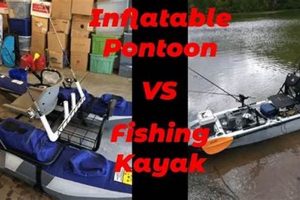
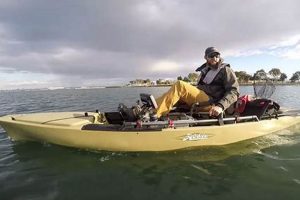
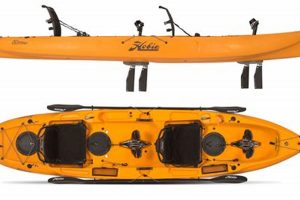
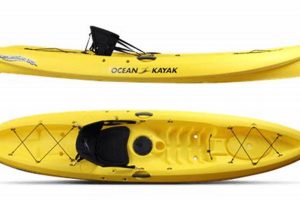
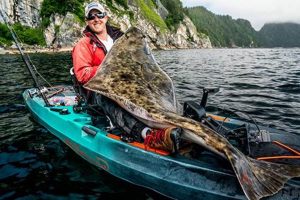
This specific type of watercraft is designed for anglers, blending stability and maneuverability for optimal fishing experiences. It typically features specialized components such as rod holders, tackle storage, and potentially a pedal or motor drive system for hands-free navigation. Such vessels often prioritize comfort and functionality, allowing individuals to access diverse fishing locations, from calm lakes to flowing rivers.
The ability to quietly and efficiently navigate various waterways contributes significantly to successful angling. This type of specialized craft empowers anglers to reach secluded fishing spots often inaccessible by larger boats, maximizing opportunities to discover prime locations. Historically, small, human-powered watercraft have been essential tools for fishing. Modern designs leverage advanced materials and technologies to enhance performance, durability, and user experience, building upon this legacy.
Further exploration of specific features, popular models, user reviews, and maintenance recommendations will provide a comprehensive understanding of this category of fishing vessel. A detailed analysis of its suitability for different fishing styles and water conditions is also crucial for potential users.
Tips for Enhanced Kayak Fishing Experiences
Preparation and mindful practices contribute significantly to successful and enjoyable fishing excursions. The following recommendations offer valuable insights for optimizing on-the-water experiences.
Tip 1: Pre-Trip Planning: Researching potential fishing locations, including water conditions and species presence, allows for strategic gear selection and efficient time management on the water. Checking weather forecasts is crucial for safety and comfort.
Tip 2: Safety First: Wearing a personal flotation device (PFD) is paramount for personal safety. Carrying a whistle, signaling devices, and a first-aid kit are also essential precautions.
Tip 3: Efficient Gear Organization: Utilizing designated storage compartments and readily accessible tackle boxes streamlines retrieval and minimizes disruptions during fishing.
Tip 4: Mastering Paddle Techniques: Developing proficient paddling skills enhances maneuverability and reduces fatigue, allowing for extended exploration and precise positioning.
Tip 5: Understanding Water Conditions: Awareness of currents, tides, and wind patterns ensures safe navigation and informed fishing strategies.
Tip 6: Respecting the Environment: Practicing catch-and-release principles and proper waste disposal preserves the natural ecosystem and ensures sustainable fishing practices.
Tip 7: Regular Maintenance: Periodic cleaning and inspection of the vessel, including checking for damage and ensuring proper functioning of all components, contributes to longevity and optimal performance.
Implementing these strategies promotes safe, productive, and environmentally responsible fishing practices. Prioritizing safety, preparation, and mindful interaction with the natural environment enhances overall enjoyment.
By incorporating these tips, anglers can elevate their skills and experiences on the water. Further exploration of specific techniques and advanced strategies can contribute to even greater success and enjoyment.
1. Stability

Stability is a critical factor in kayak fishing, directly influencing angler safety, comfort, and effectiveness. A stable platform is essential for casting, reeling, and landing fish, especially in challenging conditions. For a vessel like the Freedom Hawk, designed specifically for fishing, stability considerations are paramount in its design and construction.
- Hull Design:
The hull design significantly impacts stability. Wider hulls generally provide greater initial stability, resisting tipping. A flatter hull bottom enhances stability at rest, while a slightly rounded or V-shaped hull improves tracking and performance in moving water. The specific hull design of this kayak type must balance stability with maneuverability for optimal fishing performance.
- Center of Gravity:
A lower center of gravity contributes to increased stability. The distribution of weight within the kayak, including the angler, gear, and any onboard accessories, influences the center of gravity. Proper weight distribution, with heavier items positioned lower and centrally, enhances stability. Kayak anglers must consider weight distribution when loading their vessels.
- Water Conditions:
Water conditions, including currents, waves, and wind, significantly impact stability. Calm, flat water generally presents fewer stability challenges. Rougher conditions require increased vigilance and potentially adjustments in angler positioning and paddling technique. Understanding how different water conditions affect stability is crucial for safe and effective kayak fishing.
- Angler Behavior:
Angler movements, such as casting, reaching, and fighting fish, can affect stability. Smooth, deliberate movements minimize disruptions to the kayak’s balance. Maintaining a low center of gravity while performing these actions further enhances stability. Practicing techniques for maintaining balance while fishing contributes significantly to safety and success.
The interplay of these factors determines the overall stability of a fishing kayak. A well-designed fishing kayak, considering these elements, provides a secure and effective platform for angling activities, enabling anglers to focus on the task at hand. Understanding these elements allows for informed decision-making when selecting a fishing kayak and adapting to varying on-the-water conditions.
2. Maneuverability

Maneuverability is a defining characteristic of effective fishing kayaks, enabling anglers to navigate diverse water environments and access prime fishing locations. For the Freedom Hawk, designed specifically for angling, maneuverability directly influences its utility and effectiveness on the water. Precise and efficient movement allows anglers to explore shallow coves, navigate tight river bends, and position themselves strategically for optimal casting opportunities.
- Hull Design:
The hull design significantly impacts maneuverability. A shorter hull generally allows for tighter turns and greater responsiveness. A longer hull, while potentially faster in a straight line, may require more effort to turn. The specific hull design of the Freedom Hawk balances maneuverability with stability for optimal performance in various fishing environments. For example, a shorter, slightly rockered hull may excel in tight spaces, while a longer hull with a moderate rocker might be preferred for open water with some current.
- Waterline Length:
The length of the hull in contact with the water affects turning efficiency. A shorter waterline length generally results in increased maneuverability, allowing for quicker turns. Conversely, a longer waterline length may provide greater tracking but require more effort to maneuver. The waterline length of the Freedom Hawk is optimized for responsiveness while maintaining sufficient tracking ability.
- Rudder or Skeg:
A rudder or skeg can enhance directional stability and tracking, particularly in windy or current-prone conditions. While not all Freedom Hawk models may include these features, their presence can significantly improve maneuverability in challenging environments. A rudder provides active control over steering, while a skeg improves straight-line tracking, reducing the need for constant corrective strokes.
- Paddle Length and Technique:
The length and type of paddle, coupled with proper paddling technique, contribute significantly to maneuverability. A shorter paddle offers greater control for quick turns, while a longer paddle may provide more power for straight-line paddling. Efficient paddling techniques, such as sweep strokes and draws, allow for precise maneuvering in various situations. Effective paddle usage enhances the inherent maneuverability of the Freedom Hawk.
The interplay of these factors contributes to the overall maneuverability of the Freedom Hawk fishing kayak. Its design considerations and features enable anglers to navigate diverse waterways efficiently and position themselves effectively for successful fishing. This capability enhances the angler’s ability to exploit various fishing environments and increases the likelihood of positive outcomes.
3. Fishing Features
Specialized fishing features distinguish a dedicated fishing kayak from recreational models. These features directly impact angling efficiency and overall success. In the context of the Freedom Hawk fishing kayak, these integrated elements are central to its purpose and value proposition. They represent a deliberate design focus, optimizing the vessel for angling activities. Examples include rod holders, strategically positioned for easy access and secure rod storage; tackle storage compartments, designed to organize and protect essential gear; and mounting points for fish finders and other electronics, enhancing situational awareness and fishing strategy. These features, integral to the Freedom Hawk design, transform it from a simple watercraft into a dedicated fishing platform.
The presence and design of these fishing features significantly impact practical use. Well-placed rod holders allow anglers to manage multiple rods efficiently, while dedicated storage compartments keep tackle organized and readily accessible. The ability to mount electronics enhances fishing strategy and efficiency. Consider a scenario where an angler is trolling with two rods while simultaneously searching for underwater structure using a fish finder mounted on the kayak. Integrated rod holders secure the rods, preventing loss or damage. Organized tackle storage allows for quick lure changes without disrupting the fishing process. The fish finder provides crucial information about water depth and bottom structure, guiding the angler to promising fishing locations. This scenario illustrates the practical significance of integrated fishing features, contributing directly to angling success and enjoyment.
The thoughtful integration of fishing features distinguishes the Freedom Hawk fishing kayak. These elements, ranging from rod holders and tackle storage to mounting points for electronics, are not mere add-ons but core components of its design. They transform a basic kayak into a specialized fishing platform, enhancing angler efficiency, effectiveness, and overall experience. Understanding the function and practical significance of these features is crucial for maximizing their utility and appreciating the value they bring to angling pursuits. This understanding ultimately contributes to a more informed selection process and enhanced on-the-water performance for anglers.
4. Compact Design
The compact design of the Freedom Hawk fishing kayak significantly influences its transportability, storage, and overall usability. This characteristic, often overlooked, plays a crucial role in the kayak’s practicality and accessibility. A smaller footprint simplifies transport on vehicle roof racks or in truck beds, reducing the need for specialized trailers. Compact dimensions also facilitate storage in garages, sheds, or even apartments, maximizing convenience and minimizing space requirements. This inherent portability expands access to diverse fishing locations, from remote ponds and small streams to larger lakes and rivers. Consider an angler living in an urban environment with limited storage space. The compact design of the Freedom Hawk allows them to easily store the kayak in their apartment and transport it on their vehicle’s roof rack to nearby waterways. This convenience expands their fishing opportunities without requiring significant logistical adjustments.
The practical implications of a compact design extend beyond transport and storage. On the water, a shorter length can enhance maneuverability, particularly in confined spaces such as narrow creeks or shallow coves. This agility allows anglers to navigate challenging environments and access secluded fishing spots often inaccessible to larger vessels. However, compact dimensions can also influence stability and storage capacity. Careful consideration of these trade-offs is essential when evaluating the suitability of a compact fishing kayak for individual needs and intended uses. An angler targeting large, open-water species might prioritize stability and storage capacity over extreme maneuverability. Conversely, an angler fishing small streams and rivers would likely prioritize the maneuverability afforded by a compact design.
The compact design of the Freedom Hawk fishing kayak represents a deliberate balance between portability, maneuverability, and storage capacity. Understanding the implications of this design characteristic is crucial for informed decision-making and optimal utilization. While a compact design offers clear advantages in terms of transport, storage, and access to diverse fishing locations, it also presents potential trade-offs in terms of stability and storage space. A comprehensive evaluation of these factors, in conjunction with individual angling needs and preferences, ensures the selection of a fishing kayak best suited for specific requirements and intended applications. This understanding ultimately contributes to enhanced fishing experiences and successful outcomes.
5. Durability

Durability is a critical factor influencing the lifespan and overall value of a fishing kayak. For the Freedom Hawk, operating in diverse and often challenging environments, robust construction is essential for withstanding impacts, abrasion, and exposure to the elements. A durable kayak ensures reliable performance over extended periods, minimizing maintenance requirements and maximizing time on the water. This discussion explores key aspects of durability related to the Freedom Hawk fishing kayak.
- Material Selection:
The choice of construction material significantly impacts a kayak’s durability. High-density polyethylene (HDPE) is commonly used due to its impact resistance and UV stability. Other materials, such as rotomolded plastic or composites, offer varying degrees of durability and performance characteristics. Understanding the properties of different materials is crucial for assessing long-term durability. HDPE, for instance, offers excellent impact resistance, making it suitable for navigating rocky shorelines or shallow rivers. However, it may be more susceptible to scratches than composite materials.
- Construction Methods:
Manufacturing techniques influence the structural integrity and overall durability of a kayak. Rotomolding, a common process for producing plastic kayaks, creates a seamless, one-piece hull with uniform wall thickness, enhancing strength and impact resistance. Other construction methods, such as thermoforming or hand-laid composites, offer varying degrees of strength and durability. The construction method employed in the Freedom Hawk contributes significantly to its ability to withstand the rigors of on-the-water use.
- UV Resistance:
Exposure to sunlight can degrade certain materials, leading to fading, cracking, and reduced structural integrity. UV-resistant coatings and additives protect kayaks from the damaging effects of prolonged sun exposure, extending their lifespan. For the Freedom Hawk, often stored outdoors, UV resistance is a crucial factor in maintaining long-term durability and appearance. A kayak with superior UV resistance will retain its structural integrity and color vibrancy even after extended periods of sun exposure.
- Hardware and Fittings:
The quality and durability of hardware components, such as handles, latches, and deck rigging, also contribute to overall kayak longevity. Corrosion-resistant materials, like stainless steel or marine-grade aluminum, are essential for withstanding exposure to saltwater and other corrosive elements. Durable hardware ensures reliable functionality over time, minimizing maintenance and replacement needs. For the Freedom Hawk, exposed to various environmental conditions, robust hardware is crucial for long-term performance.
The durability of the Freedom Hawk fishing kayak is a product of material selection, construction methods, UV resistance, and hardware quality. These factors collectively influence its ability to withstand the demands of regular use and exposure to diverse environmental conditions. A durable kayak provides reliable performance over extended periods, maximizing its value and contributing to positive angling experiences. Understanding the interplay of these factors empowers informed decision-making and ensures the selection of a kayak suited for long-term use and enjoyment.
6. Portability

Portability significantly enhances the usability and accessibility of the Freedom Hawk fishing kayak. This characteristic enables anglers to readily transport the vessel to various fishing locations, expanding access to diverse waterways, regardless of vehicle type or storage limitations. The relatively lightweight and compact design of the Freedom Hawk facilitates transport on car roof racks, in truck beds, or even by hand over short distances. This eliminates the need for trailers or specialized transport equipment, reducing logistical barriers and associated costs. For instance, an angler with a compact car can easily transport a Freedom Hawk to a remote lake or river, expanding their fishing opportunities beyond easily accessible locations. This inherent portability contributes significantly to the kayak’s versatility and appeal, particularly for anglers with limited storage space or those seeking access to less frequented fishing spots.
The practical implications of portability extend beyond simply reaching the water’s edge. The ease of transport allows anglers to adapt quickly to changing conditions or explore multiple locations within a single outing. Consider an angler fishing a river system. The portability of the Freedom Hawk allows them to easily portage around obstacles like rapids or dams, accessing different sections of the river and maximizing fishing opportunities. Furthermore, the ability to quickly load and unload the kayak streamlines the overall fishing experience, reducing setup time and maximizing time spent on the water. This efficiency is particularly valuable for anglers with limited time or those seeking a more spontaneous and adaptable approach to fishing.
In summary, portability represents a defining characteristic of the Freedom Hawk fishing kayak. This attribute enhances its versatility, accessibility, and overall usability. The ease of transport expands fishing opportunities, allowing anglers to explore diverse waterways and adapt to changing conditions. While factors like weight capacity and storage space influence portability, its benefits contribute significantly to the Freedom Hawk’s appeal as a practical and efficient fishing platform. Understanding the practical significance of portability empowers informed purchasing decisions and facilitates optimal utilization of this specialized angling vessel.
7. Affordability
Affordability plays a significant role in the accessibility and appeal of the Freedom Hawk fishing kayak. Cost considerations often influence purchasing decisions, particularly for those entering the sport or seeking a balance between performance and budget. Exploring the affordability of this specific kayak requires an examination of its price point relative to competitors, features offered, and potential long-term cost savings.
- Initial Purchase Price:
The initial purchase price of the Freedom Hawk positions it within a specific market segment. Comparing its price to similar fishing kayaks from other manufacturers provides a benchmark for assessing its affordability. Lower initial cost can broaden access to the sport, making kayak fishing feasible for a wider range of individuals. However, excessively low prices may indicate compromises in quality or features. A balanced assessment of price versus features is crucial for informed decision-making.
- Cost of Ownership:
Beyond the initial purchase price, considering long-term ownership costs provides a comprehensive perspective on affordability. Factors such as maintenance requirements, repair costs, and potential upgrades contribute to the overall expense. Durable construction and readily available replacement parts can minimize long-term ownership costs. For the Freedom Hawk, durable materials and simple design can contribute to lower maintenance requirements, enhancing its long-term affordability.
- Value Proposition:
Assessing the value proposition involves comparing the features and performance of the Freedom Hawk to its price point. A kayak offering comparable features and performance at a lower price represents a strong value proposition. Conversely, a higher price may be justified by premium features, superior construction, or enhanced performance characteristics. Understanding the value proposition allows for informed comparisons and optimal allocation of resources.
- Accessibility:
Affordability directly influences accessibility within the kayak fishing community. Lower cost of entry expands participation opportunities, making the sport more inclusive and diverse. The perceived affordability of the Freedom Hawk can contribute to its popularity and broaden access to kayak fishing, fostering community growth and participation.
The affordability of the Freedom Hawk fishing kayak is a multifaceted consideration encompassing initial purchase price, cost of ownership, value proposition, and accessibility. A comprehensive assessment of these factors, relative to individual budgetary constraints and angling requirements, empowers informed purchasing decisions and facilitates optimal resource allocation. Balancing cost considerations with desired features and performance ensures a satisfying and sustainable approach to kayak fishing.
Frequently Asked Questions
This section addresses common inquiries regarding the Freedom Hawk fishing kayak, providing concise and informative responses to facilitate informed decision-making and enhance user understanding.
Question 1: What differentiates the Freedom Hawk from other fishing kayaks?
Key differentiators may include specific design elements like a flatter hull for enhanced stability, portability features for easy transport, or affordability relative to comparable models. Precise distinctions depend on the specific Freedom Hawk model and competitive landscape.
Question 2: How stable is the Freedom Hawk, and is it suitable for standing while fishing?
Stability varies depending on the specific Freedom Hawk model and individual angler characteristics. While some models provide sufficient stability for standing, caution is always advised. Consulting manufacturer specifications and user reviews provides further insight into stability considerations.
Question 3: What is the weight capacity of a Freedom Hawk kayak?
Weight capacity varies among Freedom Hawk models. Exceeding the specified weight limit compromises stability and performance. Consulting manufacturer specifications for the specific model of interest is crucial for safe and effective operation.
Question 4: What materials are used in the construction of Freedom Hawk kayaks?
Freedom Hawk kayaks typically utilize high-density polyethylene (HDPE) due to its durability and UV resistance. Specific materials and construction methods may vary depending on the model. Manufacturer specifications provide detailed information regarding construction materials and processes.
Question 5: What are the recommended maintenance procedures for a Freedom Hawk kayak?
Regular rinsing with fresh water after each use, especially in saltwater environments, helps prevent corrosion and material degradation. Periodic inspection of hardware and fittings, along with proper storage practices, contributes to longevity. Consulting the owner’s manual provides detailed maintenance recommendations specific to the model.
Question 6: Where can replacement parts or accessories be obtained for a Freedom Hawk kayak?
Authorized dealers and online retailers often carry replacement parts and accessories. Contacting the manufacturer directly can provide information regarding authorized service centers and parts availability. Maintaining a record of the kayak’s model number facilitates efficient parts identification and acquisition.
Addressing these common inquiries provides a foundational understanding of the Freedom Hawk fishing kayak. Further research and consultation with experienced anglers or retailers can provide additional insights and facilitate informed purchasing decisions.
Moving forward, exploring specific model comparisons and user reviews provides a more granular understanding of the Freedom Hawk’s capabilities and suitability for individual angling needs.
Freedom Hawk Fishing Kayak
This exploration of the Freedom Hawk fishing kayak encompassed key attributes contributing to its utility and appeal within the angling community. Stability, maneuverability, specialized fishing features, compact design, durability, portability, and affordability were examined in detail. Each characteristic contributes to the overall value proposition, influencing suitability for diverse fishing styles and environments. Understanding the interplay of these factors empowers informed decision-making for prospective buyers and enhances user experiences.
The Freedom Hawk fishing kayak represents a specialized tool designed to enhance angling pursuits. Careful consideration of individual needs, fishing styles, and target environments is crucial for maximizing its utility and potential. Continued exploration of specific models, user experiences, and evolving kayak fishing techniques will further refine understanding and contribute to successful on-the-water adventures.