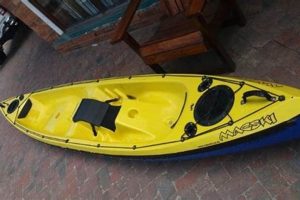
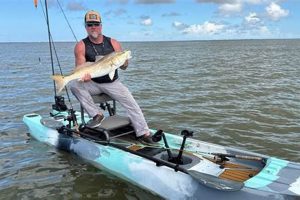
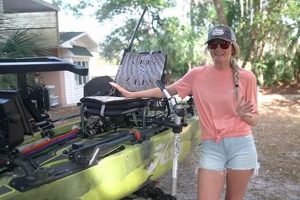
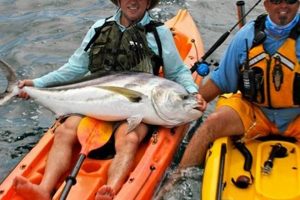
Small, self-propelled watercraft designed for angling often incorporate built-in tanks for keeping caught fish alive. These tanks, typically integrated into the kayak’s hull, provide a convenient and humane way to store catches until they can be properly processed. This feature allows anglers to continue fishing without immediately returning to shore, maximizing time on the water and increasing the potential for a successful outing. An example would be a sit-on-top kayak molded with a rectangular well in the deck equipped with a pump and drain system for water circulation.
Maintaining the vitality of captured fish offers several advantages. It ensures freshness for consumption, preserving the quality of the meat. Furthermore, it allows for selective harvesting, giving anglers the option to release smaller or undesired species while keeping only those meeting specific criteria. This practice contributes to sustainable fishing by minimizing environmental impact. Historically, keeping catches alive was challenging for kayak anglers who relied on cumbersome external containers or stringers. Integrated livewells represent a significant advancement in kayak fishing technology, enhancing both convenience and ethical practices.
The subsequent sections will explore various aspects of these specialized watercraft, including design considerations, popular features, maintenance best practices, and relevant regulations. Furthermore, different types of livewell systems will be examined, highlighting their respective advantages and disadvantages. This comprehensive analysis aims to provide readers with a thorough understanding of how these kayaks can enhance the fishing experience.
Tips for Utilizing Kayaks Equipped with Livewells
Optimal use of kayak-integrated livewells ensures fish remain healthy and contributes to a successful and ethical fishing experience. The following tips offer guidance on maximizing the benefits of this feature.
Tip 1: Regular Maintenance: Livewells require consistent cleaning to prevent the buildup of bacteria and debris. Periodic flushing with fresh water and occasional disinfection are essential for maintaining water quality.
Tip 2: Appropriate Aeration: Adequate oxygen levels are crucial for fish survival. Ensure the livewell’s pump and aeration system function correctly and provide sufficient oxygen flow, especially in warmer water temperatures.
Tip 3: Proper Water Management: Maintain appropriate water levels within the livewell. Overfilling can stress fish, while underfilling may restrict movement and oxygen availability.
Tip 4: Responsible Fish Handling: Minimize handling time and use wet hands or a landing net to reduce stress on captured fish. Avoid overcrowding the livewell, providing ample space for each individual.
Tip 5: Temperature Control: Extreme water temperatures can negatively impact fish health. Consider adding ice or utilizing insulated livewells to maintain a suitable temperature range, particularly during hot weather.
Tip 6: Adhere to Regulations: Familiarize oneself with local fishing regulations regarding livewell usage and size limits for specific species. Compliance with these regulations ensures responsible and sustainable fishing practices.
Tip 7: Pre-Trip Preparation: Before embarking on a fishing trip, check the livewell for leaks, ensure the pump functions correctly, and pre-fill the well with fresh water to minimize the time fish spend in a less-than-ideal environment.
By adhering to these guidelines, anglers can ensure their catches remain healthy while maximizing the advantages of on-board livewells. This responsible approach contributes to a more enjoyable and sustainable fishing experience.
These practical tips provide a framework for effectively utilizing livewell-equipped kayaks. The concluding section will reiterate key takeaways and offer final recommendations for optimizing the fishing experience.
1. Kayak Stability

Kayak stability is paramount when incorporating a livewell into the design, particularly for angling. The added weight of water and fish within the livewell significantly alters the kayak’s center of gravity and buoyancy. This shift can increase the risk of capsizing, especially during movement or when landing a fish. A stable platform is essential for maintaining balance and control, enabling anglers to focus on fishing rather than constantly compensating for instability. For instance, a kayak with a lower center of gravity and wider beam generally exhibits greater stability, even with a full livewell. Conversely, a narrower, higher-sitting kayak becomes inherently less stable with the added weight, increasing the likelihood of tipping. Understanding this relationship allows informed decisions regarding kayak selection and safe operation.
Several factors influence kayak stability in this context. Hull design plays a critical role; wider, flatter hulls generally offer more initial stability. Outrigger systems or stabilizers can enhance stability, counteracting the destabilizing effect of the livewell. Weight distribution also becomes crucial. Evenly distributing gear and ensuring proper placement of the livewell within the kayak minimizes the risk of imbalance. For example, positioning the livewell near the center of the kayak, rather than towards the bow or stern, helps maintain a more balanced center of gravity. Neglecting these considerations can compromise safety and fishing effectiveness.
Selecting a kayak with appropriate stability for livewell integration is essential for a safe and productive fishing experience. Prioritizing stability contributes to angler confidence and reduces the risk of capsizing, particularly during critical moments like landing a fish. Understanding the impact of livewell weight and its interaction with kayak design empowers informed choices, promoting a more secure and enjoyable angling experience. Further investigation into specific hull designs and stability enhancement features can provide additional insights for anglers seeking to optimize their kayak fishing setup.
2. Livewell Capacity
Livewell capacity represents a critical factor influencing the practicality and effectiveness of fishing kayaks equipped with these systems. Appropriate capacity directly impacts the angler’s ability to retain desired catches while adhering to ethical fishing practices and size regulations. Understanding the relationship between livewell capacity and overall kayak design, as well as target species, is crucial for an informed purchase decision.
- Species Size and Quantity:
Target species significantly influence required livewell capacity. Anglers pursuing larger fish, such as pike or redfish, necessitate larger livewells than those targeting panfish or smaller trout species. Furthermore, the desired quantity of retained fish directly impacts capacity needs. For example, a tournament angler aiming to keep multiple large bass requires significantly greater capacity than a recreational angler keeping a few smaller catches. Mismatched capacity can lead to overcrowding, stressing or even harming fish.
- Kayak Size and Weight:
Livewell capacity directly impacts overall kayak size and weight. Larger livewells increase the kayak’s overall dimensions and weight, potentially affecting portability and maneuverability. Kayak anglers must balance desired capacity with practical considerations regarding transport, launch, and on-water handling. For example, a larger, heavier kayak with a high-capacity livewell may be impractical for anglers accessing remote fishing locations or those requiring frequent portaging.
- Aeration System Effectiveness:
Livewell capacity and aeration system effectiveness are inherently linked. Larger livewells require more robust aeration systems to maintain adequate oxygen levels, particularly with a full well. Insufficient aeration in a large-capacity livewell can lead to fish mortality, negating the livewell’s purpose. For instance, a larger livewell may necessitate a higher-flow pump or multiple aeration points to ensure sufficient oxygen distribution.
- Impact on Kayak Stability:
The weight of water and fish in a livewell significantly impacts kayak stability. Larger livewells, when full, contribute more weight, potentially increasing the risk of capsizing, especially in less stable kayak designs. Anglers must consider this stability impact when selecting a kayak, particularly if opting for a larger livewell capacity. For example, a kayak with limited inherent stability may become unsafe with a full, high-capacity livewell, requiring additional stability enhancements such as outriggers or careful weight management.
These interconnected factors highlight the importance of careful consideration when selecting a fishing kayak with a livewell. Balancing desired capacity with practical constraints related to kayak size, species targets, and stability ensures a safe and effective fishing experience. Optimizing livewell capacity for individual needs and target species contributes to responsible angling practices while maximizing on-the-water success.
3. Aeration System

Aeration systems represent a crucial component of effective livewells in fishing kayaks, directly impacting the health and survival of captured fish. These systems introduce oxygen into the livewell water, counteracting oxygen depletion caused by fish respiration and metabolic processes. Without adequate aeration, dissolved oxygen levels within the confined livewell environment can rapidly decline, leading to fish stress, injury, and ultimately, mortality. The effectiveness of an aeration system is paramount for maintaining fish vitality, ensuring ethical angling practices and preserving catch quality. For example, a recirculating system with a high-output pump and aerator effectively maintains oxygen levels even with multiple large fish in the livewell. Conversely, a passive system relying solely on water exchange through small openings provides minimal oxygenation, suitable only for short-term holding of small fish or in highly oxygenated waters.
Several factors influence aeration system effectiveness. Pump flow rate dictates the volume of water circulated and oxygenated. Aerator design impacts oxygen transfer efficiency. Livewell size and shape influence water circulation patterns and oxygen distribution. Water temperature plays a significant role; warmer water holds less dissolved oxygen, increasing the demand on the aeration system. For instance, a venturi aerator, which injects air into the water stream created by the pump, provides more efficient oxygenation than a simple bubbler system. Understanding these factors allows anglers to select and optimize aeration systems for specific needs and environmental conditions.
Effective aeration directly contributes to responsible angling by ensuring fish health and survival within the livewell environment. This responsible practice aligns with conservation efforts and ethical treatment of captured fish. Challenges associated with maintaining adequate aeration in kayaks, such as limited space and power availability, necessitate careful system selection and management. Integrating high-efficiency pumps, advanced aeration technologies, and proper livewell design maximizes oxygenation, promoting fish well-being and preserving catch quality. This understanding underscores the critical role of aeration systems in responsible and successful kayak fishing.
4. Hull Design

Hull design significantly influences the performance and practicality of fishing kayaks equipped with livewells. The integration of a livewell, with its inherent weight and space requirements, necessitates careful consideration of hull characteristics to maintain stability, maneuverability, and overall fishing effectiveness. Specific design elements directly impact the kayak’s behavior on the water, influencing tracking, speed, and responsiveness, particularly with the added weight of a filled livewell. For example, a pontoon-style hull, characterized by its wide, flat bottom, offers exceptional stability, accommodating the shifting weight of water and fish within the livewell. However, this design often compromises maneuverability and speed compared to a displacement hull, which prioritizes efficient tracking and speed but may exhibit less stability with a full livewell.
Several key hull design features warrant attention when considering livewell integration. Hull width directly affects stability; wider hulls generally offer greater initial stability, counteracting the destabilizing effect of the livewell. Hull length influences tracking and speed; longer kayaks typically track straighter and glide more efficiently, but may be less maneuverable in tight spaces. The hull’s shape, whether flat-bottomed, rounded, or V-shaped, impacts its performance in various water conditions. A flatter hull excels in calm waters, providing stability for stationary fishing, while a V-shaped hull handles chop and waves more effectively, maintaining directional control even with the added weight of the livewell. For instance, a kayak designed for river fishing, with a rockered hull and defined chines for maneuverability, might prioritize a smaller, strategically placed livewell to minimize impact on agility. Conversely, a kayak intended for offshore fishing, with a longer, displacement hull for stability and speed, might accommodate a larger livewell, prioritizing catch capacity over extreme maneuverability.
Understanding the interplay between hull design and livewell integration is essential for optimizing kayak performance and fishing success. The chosen hull design must balance the need for stability, provided by wider, flatter hulls, with the desire for maneuverability and speed, often associated with narrower, more streamlined designs. Furthermore, the specific fishing environment, whether calm lakes, flowing rivers, or open ocean, dictates the optimal hull characteristics. A carefully considered hull design, tailored to the demands of livewell integration and intended fishing application, ensures a balanced and effective platform for anglers seeking to maximize both comfort and catch potential.
5. Portability

Portability represents a critical factor influencing the practical usability of fishing kayaks equipped with livewells. Transporting these specialized kayaks, often to remote locations with limited access, requires careful consideration of weight, size, and available transport methods. The added weight of a livewell system, even when empty, further complicates transport, requiring appropriate handling techniques and potentially specialized equipment. Understanding the impact of portability limitations on kayak selection and usage is crucial for anglers seeking to maximize their fishing experience. Balancing portability with desired features, such as livewell capacity and stability, requires careful evaluation of individual needs and fishing locations.
- Kayak Weight and Dimensions:
The inherent weight and dimensions of the kayak, compounded by the added livewell system, significantly influence portability. Larger, heavier kayaks, while potentially offering greater stability and capacity, present challenges for transport and handling. For example, a longer, wider kayak with a large integrated livewell may require a roof rack with higher weight capacity and specialized loading assistance. Conversely, a shorter, lighter kayak, even with a smaller livewell, may be easily transported on a smaller vehicle or even carried short distances.
- Transportation Methods:
Available transportation methods directly impact the practical portability of a kayak with a livewell. Transporting larger, heavier kayaks may necessitate a truck or SUV with a roof rack system. Smaller, lighter kayaks might be transported using smaller vehicles, trailers, or even carried by hand to access remote launch points. For instance, accessing a secluded fishing spot across difficult terrain might require a lightweight, easily portable kayak, even if it necessitates a smaller livewell capacity. Conversely, anglers fishing from easily accessible locations might prioritize a larger kayak with a higher-capacity livewell, readily transported on a vehicle roof rack.
- Launch Site Accessibility:
Launch site accessibility significantly influences kayak portability considerations. Remote locations with limited access may necessitate carrying the kayak over uneven terrain or navigating narrow pathways, requiring a lighter, more manageable craft. Conversely, easily accessible launch sites, such as boat ramps or docks, accommodate larger, heavier kayaks with less difficulty. For example, anglers fishing in shallow, marshy areas might prioritize a lightweight kayak easily maneuvered through shallow water and over obstacles, potentially accepting a smaller livewell as a trade-off for enhanced portability.
- Storage Considerations:
Storage requirements also impact kayak portability. Larger kayaks require more storage space, potentially necessitating specialized storage solutions such as roof racks, trailers, or dedicated storage areas. Smaller, more compact kayaks offer greater flexibility, fitting in garages, sheds, or even within the home. For instance, anglers with limited storage space might prioritize a compact, foldable kayak, even if it necessitates a smaller or removable livewell system.
These interconnected factors highlight the significant influence of portability on the overall usability of fishing kayaks with livewells. Balancing portability with desired features like stability, capacity, and hull design requires careful consideration of individual needs, fishing locations, and available transportation methods. Prioritizing portability empowers anglers to access diverse fishing environments while minimizing transport and handling challenges, enhancing the overall fishing experience. Failing to adequately address portability can lead to frustration and limit access to prime fishing spots, underscoring its critical role in kayak selection and usage.
6. Maintenance Ease

Maintenance ease significantly impacts the long-term usability and performance of fishing kayaks equipped with livewells. Regular upkeep ensures optimal functionality, prevents premature wear, and minimizes the risk of component failure. Simplified maintenance procedures contribute to a more enjoyable and productive fishing experience by reducing downtime and preserving the kayak’s value. Neglecting routine maintenance can lead to costly repairs, decreased performance, and potential safety hazards, underscoring the importance of accessible and straightforward maintenance procedures.
- Livewell Cleaning:
Livewell hygiene is paramount for fish health and preventing the buildup of bacteria, algae, and odors. Ease of access for cleaning, including drain plugs, smooth interior surfaces, and removable components, simplifies maintenance. For example, a livewell with rounded corners and a large drain opening simplifies cleaning compared to one with tight corners and a small, difficult-to-access drain. Thorough cleaning after each use, facilitated by accessible design, ensures a healthy environment for captured fish and minimizes the risk of contamination.
- Pump and Aerator Maintenance:
The livewell’s pump and aeration system require regular inspection and maintenance to ensure proper function. Easily accessible pumps and aerators simplify cleaning, filter replacement, and troubleshooting. For instance, a pump with a quick-release fitting simplifies removal for cleaning or repair compared to one requiring complex disassembly. Regular maintenance, facilitated by accessible design, ensures optimal oxygenation and water circulation, promoting fish survival and preserving catch quality.
- Hull and Hardware Maintenance:
Maintaining the kayak’s hull and hardware is essential for preserving its structural integrity and performance. Durable, corrosion-resistant materials and readily accessible hardware simplify cleaning, inspection, and repair. For example, stainless steel hardware resists corrosion and requires minimal maintenance compared to less durable materials. Regular inspection and cleaning, facilitated by accessible design, prevent long-term damage and extend the kayak’s lifespan.
- Sealing and Leak Prevention:
Maintaining watertight seals within the livewell system is crucial for preventing leaks and ensuring proper function. Easily inspectable and replaceable seals simplify maintenance and minimize the risk of water loss. For instance, a livewell with readily accessible gaskets and seals simplifies inspection and replacement compared to one requiring complex disassembly. Regular inspection and preventative maintenance, facilitated by accessible design, prevent leaks, preserve water quality, and ensure efficient livewell operation.
Simplified maintenance procedures significantly enhance the overall ownership experience of fishing kayaks with livewells. Ease of access to critical components, durable materials, and intuitive design features contribute to reduced maintenance time and effort, allowing anglers to focus on fishing rather than upkeep. Prioritizing maintenance ease ensures optimal performance, extends the kayak’s lifespan, and contributes to a more enjoyable and rewarding fishing experience. This attention to detail ultimately enhances the value and practicality of these specialized kayaks, making them a worthwhile investment for serious anglers.
Frequently Asked Questions
This section addresses common inquiries regarding fishing kayaks equipped with livewells, providing concise and informative responses to facilitate informed decision-making and responsible angling practices. Understanding these key aspects contributes to a safer, more productive, and ethically sound fishing experience.
Question 1: How does livewell size impact kayak performance?
Livewell size directly influences kayak weight, stability, and maneuverability. Larger wells increase weight and potentially decrease stability and maneuverability, particularly when full. Conversely, smaller wells minimize these impacts but limit catch capacity.
Question 2: What maintenance is required for a kayak livewell?
Regular cleaning with fresh water and occasional disinfection are essential. Pump and aeration systems require periodic inspection and cleaning to ensure optimal function. Inspecting seals and fittings for leaks helps prevent water loss and maintain system efficiency.
Question 3: How does one choose the appropriate livewell size for their needs?
Consider target species size and quantity, desired fishing duration, and local regulations regarding catch limits. Balance desired capacity with the impact on kayak portability and maneuverability. Prioritize adequate space to avoid overcrowding and stress on captured fish.
Question 4: What are the key features of an effective livewell aeration system?
Effective systems utilize high-flow pumps, efficient aerators (e.g., venturi systems), and proper water circulation patterns. Consider water temperature and species oxygen requirements. Regularly inspect and maintain the system to ensure optimal performance.
Question 5: How does one ensure the ethical treatment of fish kept in a livewell?
Minimize handling time, avoid overcrowding, maintain appropriate water quality and temperature, and adhere to local regulations regarding catch limits and species restrictions. Prioritize fish health and survival, releasing fish promptly and responsibly when no longer needed.
Question 6: Can any kayak be outfitted with a livewell?
While aftermarket livewell systems exist, integrating a livewell often requires specific hull design considerations for optimal stability and performance. Retrofitting a kayak with a livewell can compromise stability if not carefully planned and executed. Factory-installed systems are generally optimized for the specific kayak model, offering better integration and performance.
Understanding these key aspects of kayak livewells contributes significantly to responsible and successful fishing. Proper selection, maintenance, and utilization ensure both angler satisfaction and the ethical treatment of captured fish.
This concludes the FAQ section. The subsequent section will delve into specific examples of popular fishing kayaks with integrated livewells, highlighting their key features and benefits.
Fishing Kayaks with Livewells
Specialized kayaks equipped with livewells represent a significant advancement in angling technology, offering distinct advantages for the serious angler. This exploration has highlighted key aspects of these vessels, emphasizing the importance of careful consideration regarding hull design, livewell capacity, aeration system effectiveness, portability, and maintenance ease. Each element plays a crucial role in determining overall performance, practicality, and ethical implications. The interplay between these factors dictates the suitability of a specific kayak for individual angler needs and target species. Appropriate selection ensures optimal on-the-water performance, promotes responsible fishing practices, and maximizes long-term satisfaction.
The continued evolution of kayak design and livewell technology promises further enhancements to angling experiences. Advancements in materials, aeration systems, and integration methods will likely yield lighter, more efficient, and ethically sound solutions for keeping catches vital. Anglers stand to benefit significantly from these ongoing developments, empowering them to pursue their passion with increased effectiveness and responsibility. A thorough understanding of these specialized kayaks and a commitment to responsible angling practices will ensure the sustainability of this rewarding pursuit for generations to come.