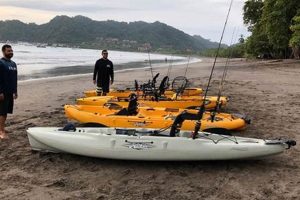
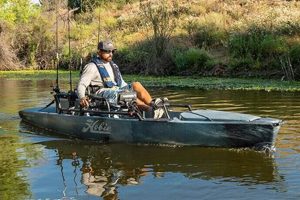
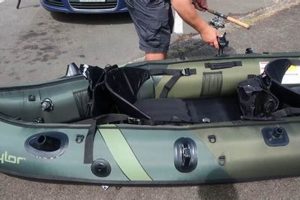
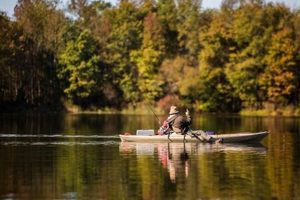
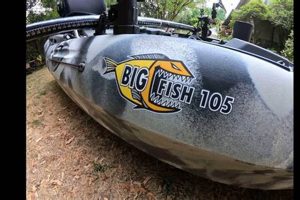
This sit-on-top vessel is designed specifically for angling, offering stability and features tailored to the needs of kayak fishermen. Typically, such kayaks incorporate specialized storage compartments for tackle and gear, rod holders, and often, a comfortable, elevated seating position. They are commonly constructed from durable, lightweight materials like high-density polyethylene (HDPE) or rotomolded plastic.
Angling from this type of watercraft provides a stealthy and efficient approach to accessing fishing spots often unreachable by larger boats. The relatively low profile and maneuverability allow navigation through shallow waters and tight spaces. Moreover, the hands-free nature of paddling offers anglers more opportunities to focus on their technique and respond quickly to bites. Over the years, the popularity of this fishing style has grown significantly, leading to ongoing innovations in design and features, improving comfort, stability, and overall fishing performance.
The following sections will explore the key characteristics of these specialized fishing platforms in more detail, examining design considerations, essential features, and popular models available to anglers.
Tips for Kayak Fishing Success
Preparation and technique are crucial for a successful and enjoyable fishing experience from a kayak. These tips offer guidance for maximizing efficiency and safety on the water.
Tip 1: Prioritize Stability: Choose a kayak with a stable hull design, especially for beginners or those fishing in rougher waters. Wider kayaks generally offer greater stability.
Tip 2: Organize Gear Strategically: Utilize storage compartments efficiently, placing frequently used items within easy reach. A well-organized kayak enhances both safety and fishing effectiveness.
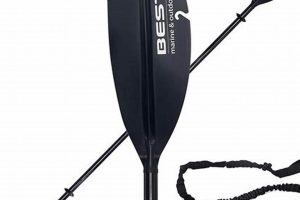
Tip 3: Master Paddle Strokes: Efficient paddling conserves energy and allows for precise maneuvering. Practice different strokes for various conditions.
Tip 4: Understand Water Conditions: Check weather forecasts and tides before heading out. Be aware of potential hazards like currents and wind.
Tip 5: Practice Safety First: Always wear a personal flotation device (PFD). Carry a whistle, signaling device, and basic first-aid kit.
Tip 6: Respect the Environment: Practice catch-and-release whenever possible. Dispose of fishing line and other waste responsibly.
Tip 7: Choose the Right Anchor: Select an anchor appropriate for the bottom conditions and the strength of the current. Practice anchoring techniques.
Tip 8: Dress Appropriately: Wear clothing suitable for the weather conditions, including sun protection and layers for changing temperatures.
By following these tips, anglers can enhance their fishing experience from a kayak, improving safety, efficiency, and overall enjoyment on the water.
These preparatory measures and practical techniques contribute significantly to a productive and enjoyable fishing trip, setting the stage for a successful outing.
1. Sit-on-top Design

The sit-on-top design is a defining characteristic of the Cobra Navigator fishing kayak, and a key element contributing to its suitability for angling. This design eliminates the enclosed cockpit found in traditional sit-inside kayaks, offering several advantages for fishing activities. Anglers benefit from increased freedom of movement, facilitating casting, reeling, and landing fish. The open design also simplifies entry and exit, a crucial factor for maneuvering in and out of the kayak in the water, especially when dealing with fish or gear. This ease of access proves particularly beneficial in situations requiring quick reactions, such as changing fishing spots or responding to unexpected conditions. The self-bailing scupper holes characteristic of sit-on-top kayaks further enhance the fishing experience by draining water that might splash onto the deck, contributing to stability and dryness.
The sit-on-top design enhances stability, a critical factor for anglers. The wider hull typical of sit-on-top kayaks, coupled with the higher center of gravity inherent in the seating position, contributes to a stable platform. This stability is especially advantageous in rough waters or when engaging with larger fish. Furthermore, the open deck allows for easier retrieval of dropped items and facilitates the installation of fishing-specific accessories like rod holders and fish finders. The ability to quickly adjust seating positions or even stand, depending on the kayak model and angler experience, provides additional flexibility and comfort for extended fishing trips. For instance, an angler might choose to stand for sight fishing in shallow waters or while casting in open areas.
The sit-on-top design’s impact on fishing functionality and safety is significant. The open deck and ease of movement create a versatile platform specifically suited to the demands of angling. Enhanced stability and self-bailing capabilities contribute to a safer and more comfortable experience. While sit-inside kayaks offer advantages in other areas, such as speed and protection from the elements, the sit-on-top design prioritizes features that directly benefit the angler, making it the preferred choice for dedicated fishing kayaks. The Cobra Navigator, by employing this design, capitalizes on these advantages, offering a platform optimized for anglers seeking stability, accessibility, and specialized features.
2. Fishing-Specific Features
Dedicated fishing kayaks differentiate themselves through integrated features designed to enhance angling effectiveness and convenience. These features represent crucial considerations for anglers evaluating kayak options, directly impacting fishing performance, comfort, and overall experience. The following facets illustrate key fishing-specific features commonly found in specialized kayaks like the Cobra Navigator.
- Rod Holders:
Rod holders, strategically positioned for easy access and secure rod storage, are essential for kayak fishing. Flush-mounted or adjustable rod holders accommodate various fishing techniques and prevent rod loss. Multiple rod holders allow anglers to switch between different setups quickly or employ multiple lines. Their presence frees up hands for other tasks, such as paddling, handling fish, or adjusting tackle.
- Storage Compartments:
Dedicated storage compartments, designed for tackle boxes, gear, and personal items, are vital for organization and efficiency. Dry storage hatches protect sensitive equipment from water damage. Easy-access storage within reach of the seated angler streamlines tackle changes and minimizes disruptions during fishing. Well-designed storage contributes significantly to a streamlined and productive fishing experience.
- Paddle Parks/Leashes:
Secure paddle parks or leashes provide a dedicated location to stow the paddle while fishing, preventing loss and minimizing interference with fishing activities. This feature allows anglers to focus on fishing without worrying about paddle drift or entanglement. Secure paddle storage contributes to safety and efficiency on the water.
- Anchor Systems:
Integrated anchor systems or anchor trolley setups are often included in fishing kayaks, allowing anglers to maintain position in specific fishing locations. Anchoring capabilities prove invaluable in currents, wind, or when targeting stationary structures. The ability to control kayak position significantly enhances fishing precision.
These integrated features distinguish fishing kayaks from recreational models, optimizing the angling experience. The Cobra Navigator exemplifies this specialization, offering features designed to enhance functionality, comfort, and on-the-water effectiveness. These features are essential considerations for anglers evaluating kayak options, contributing directly to fishing success and overall enjoyment.
3. Stability and Maneuverability

Stability and maneuverability are critical performance characteristics for fishing kayaks, directly influencing angler safety, comfort, and fishing effectiveness. A stable platform allows anglers to focus on fishing without constantly compensating for balance, while maneuverability facilitates precise positioning in diverse water conditions. In the context of the Cobra Navigator fishing kayak, these attributes contribute significantly to its suitability for various angling environments and techniques.
- Primary Stability:
Primary stability refers to a kayak’s initial resistance to tipping when at rest. A wider hull and lower center of gravity generally contribute to greater primary stability. This characteristic is crucial for activities like casting, retrieving, and landing fish, providing a secure platform that minimizes the risk of capsizing. The Cobra Navigator’s design prioritizes primary stability, allowing anglers to confidently perform these actions.
- Secondary Stability:
Secondary stability describes a kayak’s resistance to tipping when leaned or tilted. This comes into play during turns and maneuvering in waves or currents. Kayaks with a rounded or shallow-V hull often exhibit greater secondary stability. This allows the angler to lean into turns and maintain control even when the kayak is angled. Understanding the secondary stability characteristics of the Cobra Navigator informs paddling techniques and maneuvering strategies in different water conditions.
- Tracking and Turning:
Tracking refers to a kayak’s ability to maintain a straight course with minimal paddling input. A longer kayak generally tracks better than a shorter one. Turning performance is influenced by hull design and the use of rudders or skegs. A shorter kayak typically turns more easily. The Cobra Navigator’s design balances tracking and turning performance to suit various fishing environments, allowing anglers to navigate tight spaces and maintain course in open water.
- Influence of Hull Design:
Hull design significantly impacts both stability and maneuverability. Wider, flatter hulls prioritize stability, while narrower, more pointed hulls favor speed and maneuverability. The Cobra Navigator’s hull design represents a compromise between these characteristics, offering a balance suitable for fishing applications. Understanding the interplay of hull design elements provides insights into the kayak’s performance characteristics in different water conditions and fishing scenarios. For example, a flatter hull may be preferable in calm lakes, while a slightly more V-shaped hull might be advantageous in choppy coastal waters.
The interplay of these factors contributes significantly to the Cobra Navigator’s overall performance as a fishing kayak. The balanced approach to stability and maneuverability allows anglers to confidently navigate various water conditions, from calm lakes to flowing rivers, while maintaining a stable platform for fishing activities. This balance makes the Cobra Navigator a versatile choice for diverse fishing styles and environments.
4. Durable Construction

Durable construction is a critical aspect of the Cobra Navigator fishing kayak, directly impacting its longevity, performance, and overall value. The materials used and the manufacturing process significantly influence the kayak’s ability to withstand the rigors of fishing environments, including exposure to UV radiation, impacts with rocks or submerged objects, and the general wear and tear associated with regular use. A robust construction ensures the kayak remains functional and safe throughout its lifespan, providing a reliable platform for anglers.
High-density polyethylene (HDPE) is a common material choice for kayak construction due to its impact resistance, UV stability, and affordability. Rotomolded construction, a process involving molding molten plastic within a rotating mold, creates a seamless, one-piece hull with uniform thickness and exceptional strength. This manufacturing technique contributes to the overall durability of the kayak, minimizing weak points and enhancing resistance to impacts. The choice of HDPE and the rotomolding process contribute significantly to the Cobra Navigator’s ruggedness, allowing it to withstand the demands of diverse fishing environments, from rocky shorelines to open ocean waters. For example, the ability to withstand minor impacts without significant damage is crucial in shallow-water fishing scenarios where contact with submerged obstacles is more likely.
The practical significance of durable construction translates directly into a longer lifespan, reduced maintenance requirements, and enhanced safety for the angler. A robust kayak requires less frequent repairs, minimizing downtime and maximizing time on the water. The ability to withstand impacts and harsh conditions ensures the kayak remains a safe and reliable platform, even in challenging environments. This durability contributes to the overall value proposition of the Cobra Navigator, making it a sound investment for anglers seeking a long-lasting and dependable fishing platform. Furthermore, the robust construction allows anglers to confidently explore more remote or demanding fishing locations, expanding their angling opportunities.
5. Targeted Angler Comfort
Angler comfort directly impacts fishing effectiveness and enjoyment, particularly during extended trips. The Cobra Navigator fishing kayak addresses this crucial aspect through design elements specifically aimed at enhancing comfort and reducing fatigue. These features contribute to a more positive and productive fishing experience, allowing anglers to focus on their technique and the task at hand rather than physical discomfort.
- Seating System:
The seating system plays a pivotal role in overall comfort. Adjustable seating allows anglers to customize the position for optimal back support and paddling efficiency. Features like padded seats and adjustable backrests further enhance comfort, minimizing strain during long hours on the water. The Cobra Navigator’s seating system aims to provide a comfortable and supportive platform, reducing fatigue and promoting a more enjoyable fishing experience.
- Footrests:
Adjustable footrests provide essential leverage and support while paddling, contributing to both comfort and efficient power transfer. Proper foot placement enhances stability and reduces leg fatigue. The Cobra Navigator’s footrest system allows for customized positioning to accommodate anglers of varying heights, ensuring optimal comfort and paddling efficiency.
- Deck Design:
The deck design contributes to overall comfort and functionality. A spacious deck provides ample room for movement and gear storage within easy reach. Features like non-slip surfaces enhance stability and safety. The Cobra Navigator’s deck layout is designed to maximize angler comfort and facilitate easy access to essential gear, promoting a more efficient and enjoyable fishing experience.
- Carrying Handles:
Ergonomically designed carrying handles simplify transport to and from the water. Comfortable and strategically placed handles reduce strain during portage, making it easier to handle the kayak. The Cobra Navigator incorporates carrying handles designed for ease of transport, minimizing effort and enhancing overall convenience.
These comfort-focused features contribute significantly to the overall usability and enjoyment of the Cobra Navigator fishing kayak. By prioritizing angler comfort, the design facilitates longer, more productive fishing trips, allowing anglers to fully immerse themselves in the experience without the distractions of physical discomfort. This emphasis on comfort aligns with the kayak’s purpose-built design for dedicated fishing applications, enhancing its appeal to anglers seeking a comfortable and efficient platform for pursuing their passion.
Frequently Asked Questions
This section addresses common inquiries regarding kayaks designed for fishing, offering concise and informative responses to assist prospective buyers in making informed decisions.
Question 1: What weight capacity does this type of kayak typically offer?
Weight capacity varies depending on the specific model, but generally ranges from 300 to 500 pounds. This includes the combined weight of the angler, gear, and any potential catch.
Question 2: What is the typical length and width of such a kayak?
Length typically falls between 10 and 14 feet, while width ranges from 28 to 34 inches. These dimensions influence stability and maneuverability.
Question 3: Are these kayaks suitable for use in both freshwater and saltwater environments?
Yes, these kayaks are generally suitable for both freshwater and saltwater environments. However, rinsing the kayak with fresh water after saltwater use is recommended to prevent corrosion.
Question 4: What are the typical materials used in the construction of these kayaks?
High-density polyethylene (HDPE) is the most common material due to its durability and UV resistance. Some models utilize rotomolded plastic for enhanced strength and impact resistance.
Question 5: What additional equipment is essential for kayak fishing?
Essential equipment includes a personal flotation device (PFD), paddle, appropriate fishing gear, and safety equipment such as a whistle and signaling device. An anchor and anchor trolley system may also be beneficial depending on fishing location and technique.
Question 6: How does the maneuverability of a fishing kayak compare to that of a recreational kayak?
Fishing kayaks often prioritize stability over speed, resulting in slightly reduced maneuverability compared to recreational kayaks designed for speed and touring. However, fishing kayaks still offer sufficient maneuverability for navigating various water conditions and accessing fishing spots.
Understanding these key aspects contributes significantly to selecting the appropriate kayak for individual fishing needs and preferences. Careful consideration of weight capacity, dimensions, material, and required equipment ensures a safe and productive fishing experience.
This concludes the frequently asked questions section. The following section delves further into specific features and considerations for choosing the right fishing kayak.
Conclusion
This exploration of the Cobra Navigator fishing kayak has highlighted its purpose-built design, emphasizing features crucial for angling success. The sit-on-top configuration, coupled with specialized storage, rod holders, and an emphasis on stability, caters directly to the needs of kayak anglers. Durable construction ensures longevity and reliable performance in various fishing environments. Attention to angler comfort, through adjustable seating and footrests, further enhances the overall fishing experience. The analysis of stability and maneuverability underscores the kayak’s suitability for diverse water conditions, while the frequently asked questions section addresses practical considerations for prospective buyers.
The Cobra Navigator represents a considered approach to kayak fishing, offering a balanced platform that prioritizes functionality, durability, and angler comfort. Its specialized features and thoughtful design contribute to a more productive and enjoyable fishing experience. Potential buyers are encouraged to consider these discussed elements in relation to individual fishing styles and preferences. A thorough assessment of these factors will facilitate informed decisions and contribute to successful angling endeavors from a kayak.