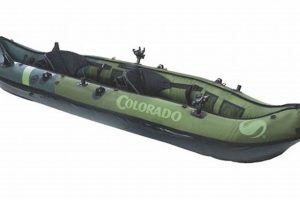
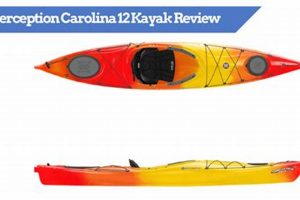
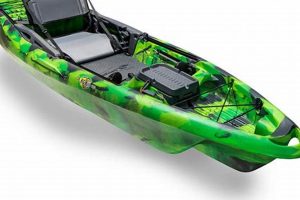
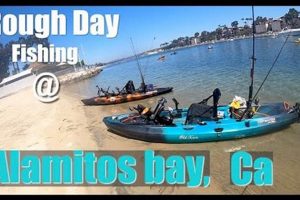
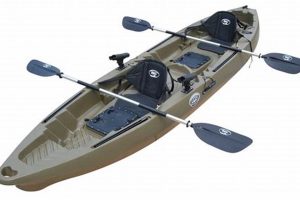
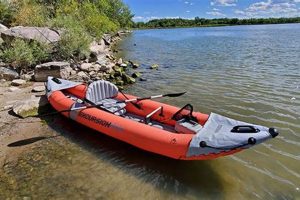
A small, human-powered watercraft designed specifically for angling typically includes oars for propulsion and maneuverability. These vessels often feature specialized storage for tackle and equipment, along with design elements that promote stability and ease of casting.
These specialized boats offer anglers enhanced access to shallow waters and secluded fishing spots often unreachable by larger motorized boats. Their relatively low cost, portability, and quiet operation contribute to their growing popularity. Historically, kayaks have served diverse purposes across cultures, ranging from transportation and hunting to recreation. Modern adaptations for angling reflect a continuous evolution in design and functionality, meeting the specific needs of the sport fisherman.
Further exploration will address various aspects of these specialized watercraft, including popular models, essential accessories, paddling techniques, and best practices for safe and enjoyable on-the-water experiences.
Tips for Kayak Fishing
Effective kayak angling requires careful planning and execution. The following tips offer guidance for a safe and productive experience.
Tip 1: Prioritize Stability: Select a kayak with a wide beam or consider outriggers for enhanced stability, especially in challenging conditions or when standing to cast.
Tip 2: Plan and Pack Strategically: Organize tackle and equipment within easy reach. Waterproof storage is essential for electronics and valuables.
Tip 3: Master Basic Paddle Strokes: Efficient paddling conserves energy and allows for precise maneuvering in currents or wind. Practice different strokes for optimal control.
Tip 4: Understand Water Conditions: Research tides, currents, and weather forecasts before venturing out. Be prepared for changing conditions.
Tip 5: Respect Wildlife and the Environment: Observe local regulations and minimize disturbance to aquatic ecosystems. Practice catch-and-release whenever possible.
Tip 6: Prioritize Safety: Always wear a personal flotation device (PFD) and carry essential safety equipment, including a whistle, signaling device, and first-aid kit.
Tip 7: Practice Proper Anchor Technique: Learn appropriate anchor deployment and retrieval methods to maintain position and prevent entanglement. Consider an anchor trolley system for optimal control.
Adhering to these guidelines promotes a safer, more efficient, and ultimately more rewarding experience on the water.
These practical considerations contribute significantly to angler success and overall enjoyment of the sport. The concluding section offers further resources and recommendations for continued learning and development.
1. Hull Design

Hull design significantly influences a fishing kayak’s performance, impacting stability, speed, maneuverability, and tracking. Understanding the nuances of various hull designs allows anglers to select a kayak best suited to their specific needs and fishing environments.
- Displacement Hulls
Displacement hulls, recognizable by their pointed bows and pronounced keels, excel in tracking and efficiency, making them well-suited for covering longer distances in open water. Their streamlined shape minimizes water resistance, allowing for efficient paddling and maintaining a straight course, particularly beneficial in currents or wind. However, this design often compromises stability, making them less ideal for standing or fishing in rough conditions.
- Planing Hulls
Planing hulls feature a flatter bottom and wider beam, prioritizing stability over speed. This design allows the kayak to rise up and plane across the water’s surface, providing a stable platform for casting and reeling, even in choppy conditions. While offering enhanced stability, planing hulls tend to be slower and less efficient for long-distance paddling compared to displacement hulls.
- Pontoon Hulls
Pontoon hulls utilize two separate inflatable tubes connected by a platform, offering exceptional stability and a large, open deck space. This design is highly stable, ideal for stand-up fishing and accommodating multiple anglers or substantial gear. However, pontoon hulls sacrifice speed and maneuverability, making them less suitable for navigating tight waterways or covering significant distances.
- Tunnel Hulls
Tunnel hulls incorporate a recessed channel running the length of the hull’s bottom, combining aspects of displacement and planing hulls. This design enhances stability while maintaining reasonable tracking and speed, offering a versatile option suitable for various fishing environments. The tunnel design reduces drag and improves shallow-water performance, allowing access to areas inaccessible to other hull types.
Careful consideration of hull design, balanced against individual fishing styles and target environments, ensures optimal performance and a more enjoyable on-the-water experience. Selecting the appropriate hull type contributes significantly to angler success and overall satisfaction with their fishing kayak.
2. Paddle Length

Paddle length significantly impacts paddling efficiency and comfort in a fishing kayak. An appropriately sized paddle allows for effective power transfer, reducing fatigue and maximizing propulsion. Conversely, an incorrectly sized paddle can lead to shoulder strain, decreased performance, and an overall less enjoyable experience. Several factors influence optimal paddle length, including paddler height, kayak width, and paddling style. Taller individuals generally require longer paddles, while wider kayaks necessitate longer paddles to reach the water effectively. High-angle paddlers, who hold their paddles higher and use a more vertical stroke, also benefit from longer paddles compared to low-angle paddlers. For example, a taller angler in a wide sit-on-top kayak using a high-angle paddling style will likely require a significantly longer paddle than a shorter angler in a narrow sit-in kayak employing a low-angle style.
The practical implications of proper paddle length extend beyond mere comfort. An efficient paddle stroke conserves energy, allowing anglers to cover greater distances and focus on fishing rather than battling fatigue. Moreover, correct paddle length contributes to better boat control and maneuverability, essential for navigating challenging currents, wind, or tight spaces. For instance, a paddle that is too short may necessitate excessive torso rotation, compromising balance and stability, while a paddle that is too long can lead to awkward strokes and reduced efficiency. Specialized paddle sizing charts and online calculators can assist anglers in determining the appropriate paddle length based on their individual characteristics and kayak dimensions.
Selecting the correct paddle length is a crucial aspect of optimizing performance and enjoyment in a fishing kayak. Understanding the factors that influence paddle length and utilizing available resources for accurate sizing empowers anglers to make informed decisions, enhancing their overall on-the-water experience. This attention to detail contributes significantly to efficient paddling, reduced fatigue, and improved boat control, ultimately leading to a more productive and satisfying fishing trip.
3. Seat Comfort

Seat comfort is a critical factor influencing the overall fishing kayak experience. Extended periods on the water necessitate a supportive and ergonomic seating system to minimize fatigue and maximize angler enjoyment. A comfortable seat enables anglers to focus on fishing rather than discomfort, contributing to a more productive and satisfying outing.
- Back Support
Adequate back support is essential for maintaining proper posture and preventing back pain during long hours on the water. Features such as adjustable lumbar support, high-back designs, and breathable mesh materials contribute to enhanced comfort and reduced strain. Kayaks with molded seats often provide superior back support compared to basic webbed seating systems. Proper back support enables anglers to maintain focus and effectively react to fish strikes, ultimately enhancing fishing success.
- Cushioning
Effective cushioning absorbs shock and vibrations, minimizing discomfort from rough water or prolonged sitting. Closed-cell foam padding provides durable and water-resistant cushioning, while inflatable seat options offer adjustable firmness for customized comfort. Ample cushioning minimizes fatigue and allows anglers to remain comfortable throughout the day, even in challenging conditions.
- Adjustability
Adjustable seating systems accommodate individual preferences and body types, ensuring optimal comfort and support. Features such as adjustable seat height, backrest angle, and leg length contribute to a customized fit, promoting proper posture and minimizing strain. The ability to adjust the seat position allows anglers to tailor the kayak’s ergonomics to their specific needs, optimizing comfort and performance. For example, taller anglers might require a higher seat position, while those with longer legs might prefer greater legroom.
- Breathability
Breathable seat materials enhance comfort, particularly in warm weather, by promoting airflow and reducing heat buildup. Mesh fabrics and strategically placed ventilation channels facilitate air circulation, preventing discomfort from perspiration and maintaining a cooler, drier seating surface. Breathability contributes significantly to overall comfort during extended fishing trips, especially in hot and humid climates.
Careful consideration of these seat comfort features contributes significantly to the overall enjoyment and effectiveness of a fishing kayak. A comfortable and supportive seat enables anglers to focus on the task at hand, maximizing their time on the water and enhancing their chances of a successful fishing experience. Prioritizing seat comfort translates to reduced fatigue, improved focus, and ultimately, a more rewarding fishing trip.
4. Storage Capacity
Ample and well-designed storage is a defining feature of fishing kayaks, directly influencing their practicality and effectiveness. Sufficient storage capacity allows anglers to carry essential gear, including tackle boxes, rods, safety equipment, and personal items, contributing to a more organized and productive fishing experience. The strategic placement and accessibility of storage compartments further enhance efficiency on the water.
- Tank Wells
Tank wells, typically located behind the seat, provide large, open storage areas ideal for bulky items like crates, tackle bags, and coolers. Their open design allows for quick access to frequently used equipment, while bungee cords or straps secure items during transport. Large tank wells contribute significantly to overall storage capacity and facilitate efficient organization of gear.
- Hatches
Hatches offer sealed, waterproof compartments suitable for protecting sensitive electronics, valuables, and extra clothing from the elements. These compartments provide secure storage for items requiring protection from water damage, ensuring essential gear remains dry and functional throughout the fishing trip. Multiple hatches, strategically placed throughout the kayak, offer organized storage solutions for various items.
- Rod Holders
Dedicated rod holders, either flush-mounted or adjustable, secure fishing rods while paddling or trolling, freeing the angler’s hands for other tasks. Rod holders minimize the risk of rod damage or loss and allow for convenient access when a fish strikes. Multiple rod holders accommodate various rod types and fishing techniques, enhancing versatility on the water.
- Side Storage
Side storage compartments, often located within easy reach of the paddler, provide convenient access to smaller items like pliers, lures, and leader line. These compartments keep essential tools and accessories organized and readily available, minimizing time spent searching for gear and maximizing fishing time.
Strategic storage solutions enhance the functionality and efficiency of a fishing kayak. Adequate and well-organized storage contributes significantly to a more productive and enjoyable fishing experience, allowing anglers to focus on the task at hand rather than managing gear. The combination of open tank wells, sealed hatches, dedicated rod holders, and accessible side storage ensures that all essential equipment remains secure, organized, and readily available, optimizing time on the water and maximizing fishing success.
5. Stability

Stability is a paramount consideration in fishing kayaks, directly impacting angler safety, comfort, and fishing effectiveness. A stable platform enables anglers to confidently cast, reel, and land fish without compromising balance or risking capsize. Various factors influence kayak stability, including hull design, width, and the angler’s center of gravity. Understanding these elements allows for informed decisions and contributes significantly to a safe and enjoyable on-the-water experience.
- Hull Design and Stability
Hull design significantly influences a kayak’s stability. Wider, flatter hulls, such as those found in pontoon or sit-on-top recreational kayaks, generally offer greater initial stability, resisting tipping and providing a secure platform, especially for beginners or those fishing in calm waters. Conversely, narrower hulls, like those found in touring or sea kayaks, prioritize speed and efficiency over initial stability, requiring more experience and balance but offering better performance in open water.
- Width and Stability
Kayak width directly correlates with stability. Wider kayaks provide a larger base of support, increasing resistance to tipping. This is particularly advantageous for anglers who prefer to stand while fishing or those who frequently shift their weight during casting or reeling. Narrower kayaks, while less stable, offer increased maneuverability and speed, making them suitable for navigating tight waterways or covering longer distances.
- Center of Gravity and Stability
An angler’s center of gravity plays a crucial role in kayak stability. Maintaining a low center of gravity enhances stability, reducing the likelihood of capsizing. Sitting lower in the kayak, distributing weight evenly, and avoiding sudden movements contribute to a more stable platform. Adding weight to the bottom of the kayak, such as tackle or gear stored below the deck, can further lower the center of gravity and improve stability.
- Secondary Stability
Secondary stability refers to a kayak’s ability to resist capsizing when leaned or tilted. Kayaks with rounded hulls generally exhibit better secondary stability, recovering more easily from a lean, while kayaks with hard chines or flatter bottoms may feel more stable initially but can capsize more abruptly when pushed beyond their initial stability limit. Understanding the interplay between initial and secondary stability is crucial for selecting a kayak appropriate for the intended fishing environment and angler experience level.
Prioritizing stability in a fishing kayak enhances safety, comfort, and overall fishing effectiveness. Understanding the interplay of hull design, width, center of gravity, and secondary stability empowers anglers to select a kayak best suited to their needs and the prevailing conditions. This careful consideration contributes significantly to a more confident and enjoyable on-the-water experience, allowing anglers to focus on fishing without compromising balance or safety.
6. Maneuverability
Maneuverability in a fishing kayak directly influences angling effectiveness and overall on-the-water experience. The ability to precisely position the vessel, navigate tight waterways, and efficiently respond to changing conditions contributes significantly to fishing success. Several factors influence kayak maneuverability, including hull design, length, and water conditions. Shorter kayaks with a more rockered hull (curved upwards at the bow and stern) generally offer enhanced maneuverability, enabling tighter turns and quicker pivoting. This characteristic proves advantageous when navigating narrow creeks, maneuvering around obstacles like submerged logs or rocks, or quickly repositioning to follow schooling fish. Conversely, longer kayaks with less rocker prioritize tracking and speed in open water but sacrifice maneuverability in confined spaces. Water conditions, such as currents and wind, also impact maneuverability. Strong currents or winds can challenge even the most maneuverable kayaks, requiring skilled paddling and appropriate techniques to maintain control and desired positioning.
Consider a scenario where an angler targets fish holding near a submerged structure in a narrow, winding creek. A highly maneuverable kayak allows precise positioning for optimal casting angles and lure presentation, maximizing chances of a successful hookup. Alternatively, a less maneuverable kayak might struggle to navigate the tight confines of the creek, hindering access to prime fishing spots and limiting angling effectiveness. Similarly, in windy conditions, a maneuverable kayak enables the angler to maintain boat control and position, facilitating accurate casts and preventing drift away from target areas. Understanding the impact of hull design and length on maneuverability empowers anglers to select a kayak best suited to their target fishing environments. For instance, an angler primarily fishing in open lakes might prioritize speed and tracking, while an angler focusing on small rivers or protected bays might prioritize maneuverability.
Maneuverability represents a critical performance characteristic in fishing kayaks. Its influence on angling effectiveness and overall on-the-water experience underscores the importance of selecting a kayak appropriate for the intended fishing environment. Understanding the factors that influence maneuverability and their practical implications allows anglers to make informed decisions, optimizing their kayak’s performance and maximizing their chances of fishing success. This knowledge empowers anglers to effectively navigate diverse water conditions and access prime fishing locations, ultimately enhancing their overall enjoyment and success on the water.
7. Propulsion (Paddles)
Paddle propulsion forms the core of human-powered fishing kayak operation. Effective paddling technique translates directly to efficient movement and precise boat control, crucial for accessing fishing locations, maintaining position against currents or wind, and executing specific angling maneuvers. Paddle selection significantly influences propulsion efficiency. Blade shape, size, and angle, along with shaft material and length, impact paddling performance. For example, a longer, narrower blade generates greater forward momentum with each stroke, suited for open-water paddling, while a shorter, wider blade offers enhanced maneuverability in tight spaces. Lightweight carbon fiber shafts reduce fatigue during extended paddling sessions, contributing to overall efficiency and enjoyment. Furthermore, understanding paddle angle and the biomechanics of efficient paddling technique maximizes power transfer and minimizes strain on joints and muscles.
Consider a scenario where an angler needs to navigate against a strong current to reach a promising fishing spot. Efficient paddle strokes, utilizing proper technique and an appropriately sized paddle, become essential for overcoming the current’s resistance and maintaining boat control. Conversely, inefficient paddling technique or an improperly sized paddle will result in wasted energy, reduced boat speed, and difficulty maintaining the desired position. Furthermore, specific paddling techniques, such as the draw stroke or sweep stroke, enable precise maneuvering in tight spaces or around obstacles, crucial for accessing secluded fishing locations or navigating complex shorelines. The interplay between paddle characteristics, paddling technique, and water conditions directly impacts fishing success, highlighting the practical significance of understanding paddle propulsion.
Mastery of paddle propulsion represents a fundamental skill for successful kayak angling. Efficient paddling technique, coupled with informed paddle selection, optimizes boat control, conserves energy, and expands access to productive fishing areas. This understanding allows anglers to effectively navigate diverse water conditions, precisely position their kayaks for optimal casting angles, and ultimately, enhance their overall fishing experience. Challenges such as fatigue, challenging currents, or wind can be mitigated through refined paddling technique and appropriate paddle selection, underscoring the direct link between propulsion and angling success in the context of human-powered fishing kayaks.
Frequently Asked Questions
This section addresses common inquiries regarding fishing kayaks equipped with paddles, providing concise and informative responses to facilitate informed decision-making and enhance understanding of key aspects.
Question 1: What are the primary advantages of using paddles for propulsion in a fishing kayak?
Paddle propulsion offers quiet operation, minimizing disturbance to fish and enhancing stealth. Paddles provide excellent maneuverability in shallow water and tight spaces inaccessible to motorized vessels. They eliminate fuel costs and engine maintenance, promoting an environmentally friendly approach to angling.
Question 2: How does one select the appropriate paddle length for a fishing kayak?
Optimal paddle length depends on factors such as paddler height, kayak width, and paddling style. Taller individuals and wider kayaks generally require longer paddles. Consult paddle sizing charts or online calculators for personalized recommendations.
Question 3: What safety precautions should one observe when operating a fishing kayak with paddles?
Always wear a personal flotation device (PFD). Inform someone of your planned route and estimated return time. Check weather forecasts before embarking. Carry essential safety equipment, including a whistle, signaling device, and first-aid kit.
Question 4: How does hull design influence the performance of a fishing kayak?
Hull design dictates stability, speed, and maneuverability. Wider, flatter hulls enhance stability, while longer, narrower hulls prioritize speed and tracking. Specialized hull designs, such as pontoon or tunnel hulls, cater to specific fishing styles and environments.
Question 5: What storage features should one consider when selecting a fishing kayak?
Prioritize ample storage capacity for tackle, gear, and personal items. Consider dedicated rod holders, waterproof hatches for electronics, and accessible side storage for frequently used tools. Evaluate the layout and accessibility of storage compartments for efficient organization on the water.
Question 6: How does one maintain and care for a fishing kayak and paddles?
Rinse the kayak and paddles with fresh water after each use to remove salt, sand, and debris. Store the kayak out of direct sunlight to prevent UV damage. Regularly inspect paddles for wear and tear, addressing any damage promptly. Proper maintenance ensures longevity and optimal performance.
Understanding these key aspects contributes significantly to informed decision-making and enhanced enjoyment of kayak fishing. Thorough research and careful consideration of individual needs and preferences ensure optimal equipment selection and promote a safe and successful on-the-water experience.
The following resources offer further guidance and in-depth information regarding fishing kayak selection, paddling techniques, and safety practices.
Conclusion
Exploration of the specialized fishing kayak with paddles reveals a compelling blend of functionality, versatility, and access. Careful consideration of hull design, stability features, storage capacity, and propulsion mechanics contributes significantly to informed selection and optimized performance. Matching vessel characteristics with individual angling styles and target environments ensures a productive and enjoyable experience. The quiet operation, enhanced maneuverability, and environmental consciousness inherent in human-powered watercraft further distinguish the fishing kayak with paddles within the angling community.
The evolution of kayak design continues to refine the angling experience, fostering greater accessibility and promoting human-powered exploration of aquatic ecosystems. Continued advancements promise further enhancement of stability, propulsion efficiency, and specialized features tailored to the diverse needs of anglers. Embracing the inherent advantages of these specialized vessels unlocks opportunities for deeper connection with nature and the pursuit of angling success.