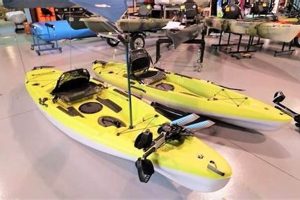
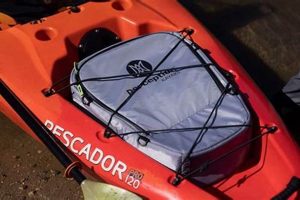
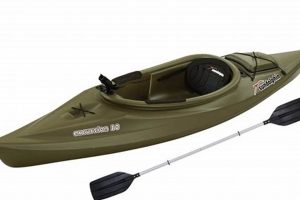
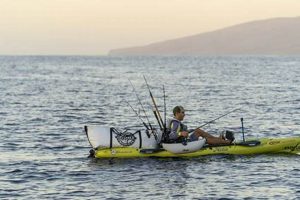
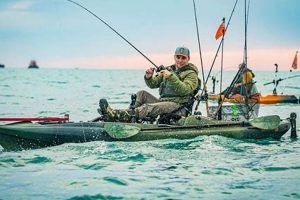
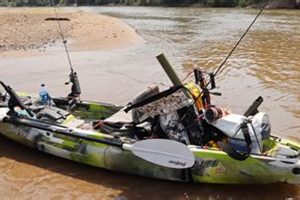
A kayak designed for angling, capable of supporting a substantial weight, offers enhanced stability and space for gear and anglers of varying sizes. This type of watercraft typically features specialized design elements like rod holders, tackle storage, and potentially anchor trolleys or other fishing-specific accessories. Such vessels provide a stable platform for casting, retrieving, and landing fish.
The ability to accommodate heavier loads expands the accessibility of kayak fishing to a wider range of individuals, while the added stability benefits all users, especially in challenging conditions. Historically, fishing kayaks were limited in capacity, restricting participation based on physical attributes. Advancements in design and materials have enabled the development of robust platforms capable of supporting larger anglers and their equipment, fostering inclusivity within the sport.
Further exploration may cover topics such as materials used in high-capacity kayak construction, stability and performance characteristics, key features for anglers, and selecting the appropriate model based on individual needs and intended fishing environment.
Tips for Selecting and Using a High-Capacity Fishing Kayak
Choosing and utilizing a kayak designed for heavier loads requires careful consideration of several factors to ensure safety, performance, and overall enjoyment on the water.
Tip 1: Verify Actual Capacity: Manufacturer specifications should be confirmed. Consider combined weight of angler, gear, and any potential catches. Exceeding stated limits compromises stability and safety.
Tip 2: Prioritize Stability: Wider hulls and lower centers of gravity generally enhance stability. Test stability before purchase, if possible, simulating on-water movements like casting and retrieving.
Tip 3: Evaluate Features for Angling: Rod holders, tackle storage, and anchor systems are key elements. Consider their placement and functionality for preferred fishing styles.
Tip 4: Choose Appropriate Materials: High-density polyethylene (HDPE) offers durability and affordability. Consider higher-end materials like fiberglass or carbon fiber for enhanced performance, if budget allows.
Tip 5: Assess Seat Comfort and Adjustability: Extended fishing trips necessitate a comfortable and supportive seat. Adjustability caters to individual preferences and promotes proper posture.
Tip 6: Practice Paddling and Maneuvering: Handling characteristics differ based on hull design and size. Practice basic paddling strokes and maneuvering techniques in calm water before venturing into more challenging environments.
Tip 7: Consider Transportation and Storage: Larger kayaks can be cumbersome. Factor in transportation and storage logistics based on available vehicle space and home storage solutions.
Careful consideration of these factors contributes significantly to a safe and successful angling experience. Selecting the appropriate vessel and understanding its capabilities enables anglers to focus on their passion and enjoy time on the water.
This information provides a foundation for making informed decisions about selecting and using a high-capacity fishing kayak. More specific details regarding features, materials, and manufacturers can be found in the following sections.
1. Stability

Stability is a critical performance characteristic in fishing kayaks, particularly those designed for higher weight capacities. A 400 lb capacity kayak, intended to accommodate larger anglers and substantial gear, must inherently prioritize stability to ensure safe and effective operation. A stable platform allows anglers to cast, retrieve, and land fish without compromising balance, even under challenging conditions such as currents or wind. The relationship between capacity and stability is directly correlated; a higher capacity necessitates greater inherent stability to counteract the increased potential for weight shifts and imbalances.
Several factors influence stability in these kayaks. Hull design plays a pivotal role; wider hulls generally provide greater initial stability, resisting tipping. A lower center of gravity also enhances stability by reducing the leverage of applied forces. Features like outriggers or pontoons can further augment stability, though these may impact maneuverability. Consider a scenario where an angler in a 400 lb capacity kayak hooks a large fish. The sudden force exerted by the fish could destabilize a less stable kayak. However, a kayak designed with stability as a priority, featuring a wide hull and a low center of gravity, allows the angler to maintain balance and control throughout the fight. Understanding the connection between capacity and stability enables informed choices regarding kayak selection and usage practices.
Prioritizing stability in high-capacity fishing kayaks is essential for safety and performance. While features like rod holders and storage contribute to angling functionality, a stable platform forms the foundational element for an effective and enjoyable experience. Selecting a kayak with appropriate stability characteristics ensures anglers can confidently navigate various water conditions and engage with the sport without undue risk of capsizing. Understanding the interplay of design elements, capacity, and stability ultimately empowers anglers to make informed decisions aligning with their individual needs and intended fishing environments.
2. Capacity (Weight)

Weight capacity is a fundamental specification for fishing kayaks, directly influencing stability, performance, and user suitability. A 400 lb capacity signifies the maximum combined weight of the angler, gear, and any potential catch the kayak can safely support. Understanding this metric is crucial for safe operation and optimal performance. Exceeding the specified capacity compromises stability, increases the risk of capsizing, and can damage the kayak.
- Total Weight Allowance:
This encompasses the combined weight of the angler, including clothing and personal items, all fishing gear (rods, reels, tackle boxes, etc.), and any fish caught during the outing. Accurate estimation of this total weight is essential for selecting an appropriate kayak. For example, an angler weighing 200 lbs with 50 lbs of gear and anticipating a potential 20 lb catch requires a kayak with a minimum capacity exceeding 270 lbs. A 400 lb capacity provides ample margin in such a scenario.
- Impact on Stability:
Weight capacity directly influences stability. Higher capacity kayaks generally require design features that enhance stability, such as wider hulls and lower centers of gravity. Distributing weight evenly within the kayak is crucial for maintaining balance, especially when nearing maximum capacity. Understanding the interplay between weight distribution and stability is critical for safe and effective operation.
- Material and Construction Considerations:
Kayak construction and materials contribute to weight capacity. High-density polyethylene (HDPE) is commonly used due to its durability and ability to support substantial loads. Other materials, like fiberglass or composites, may offer higher weight capacities and performance advantages but often come at a higher cost. Material selection reflects a balance between capacity, durability, and cost.
- Legal and Safety Regulations:
While not directly mandated by regulations in most areas, adhering to manufacturer-specified weight capacities is paramount for safety. Overloading a kayak jeopardizes stability and increases the risk of capsizing, potentially leading to dangerous situations, particularly in challenging conditions or open water. Respecting weight limits contributes to responsible and safe kayaking practices.
Selecting a kayak with appropriate weight capacity is paramount for safety and performance. A 400 lb capacity fishing kayak caters to a wider range of anglers and gear configurations, providing a stable platform for diverse fishing environments. Careful consideration of total weight, its impact on stability, and adherence to manufacturer specifications are vital for ensuring a safe and enjoyable fishing experience.
3. Fishing Features
Specialized features distinguish fishing kayaks from recreational models, enhancing angling effectiveness and overall experience. In the context of a 400 lb capacity fishing kayak, these features become even more critical due to the anticipated extended trips and heavier gear loads typically associated with anglers targeting larger fish species. These features are often integrated into the kayak’s design, capitalizing on the increased deck space afforded by the larger platform.
Rod holders, strategically positioned for easy access and secure rod storage, are essential. Flush-mounted rod holders offer a streamlined profile, minimizing interference with paddling, while adjustable rod holders accommodate various fishing techniques. Tackle storage solutions range from integrated compartments to removable tackle boxes, allowing anglers to organize and readily access lures, hooks, and other essential gear. A 400 lb capacity kayak often incorporates larger storage compartments compared to smaller models, accommodating the increased volume of equipment often carried by anglers pursuing larger game fish. For instance, an angler targeting large catfish might carry heavier lines, larger hooks, and substantial bait, necessitating ample storage space.
Other specialized features, such as anchor trolleys, further enhance angling capabilities. Anchor trolleys allow controlled drift fishing, keeping the kayak positioned optimally in relation to current and structure. Standing platforms, increasingly common in larger fishing kayaks, offer greater stability and leverage when casting and fighting fish. The stability inherent in a 400 lb capacity kayak makes incorporating a standing platform more feasible and safer. Understanding the interplay between weight capacity, stability, and specialized fishing features enables anglers to select a kayak optimized for their specific needs and target species. Prioritizing these features significantly contributes to a productive and enjoyable fishing experience, facilitating efficient gear management and enhanced on-the-water performance.
4. Material Durability
Material durability is paramount in 400 lb capacity fishing kayaks, directly impacting longevity, performance, and safety. These kayaks, designed for heavier loads and potentially challenging environments, necessitate robust construction to withstand stresses imposed by substantial weight, impacts, and environmental exposure. Material selection represents a crucial factor influencing a kayak’s ability to maintain structural integrity and resist degradation over time. High-density polyethylene (HDPE) is a prevalent choice due to its impact resistance, UV stability, and affordability. However, HDPE can be susceptible to abrasion. Rotational molding, a common manufacturing process for HDPE kayaks, produces a consistent thickness, contributing to overall durability. Consider a scenario where a fully loaded 400 lb capacity kayak is dragged across a rocky shoreline; HDPE’s impact resistance minimizes potential damage, ensuring the kayak remains functional despite the rough handling.
Alternative materials, such as fiberglass or composites (e.g., Kevlar, carbon fiber), offer enhanced strength and stiffness compared to HDPE, often translating to improved performance and lighter weight. However, these materials typically come at a premium cost. Fiberglass kayaks are more susceptible to cracking under impact but offer superior abrasion resistance compared to HDPE. Composites, while offering exceptional strength-to-weight ratios, require specialized repair techniques and can be less resistant to impacts depending on the specific composite layup. For instance, a fiberglass kayak might be preferable for navigating rocky rivers where abrasion resistance is paramount, whereas a composite kayak might be favored for open-water fishing where lighter weight and speed are advantageous.
Understanding the properties of various kayak construction materials enables informed decision-making, aligning material choice with anticipated usage and environmental conditions. Material durability directly influences the lifespan and overall performance of a 400 lb capacity fishing kayak. While HDPE offers a robust and affordable option, fiberglass and composites provide enhanced performance characteristics for specific applications. Balancing material properties, cost considerations, and intended usage ensures selection of a kayak capable of withstanding the rigors of heavy-duty fishing expeditions and providing years of reliable service.
5. Hull Design

Hull design fundamentally influences the performance and suitability of a 400 lb capacity fishing kayak. The hull’s shape dictates stability, tracking, maneuverability, and speed, directly impacting the angler’s experience. Given the increased weight capacity, hull design considerations become paramount for ensuring a safe and efficient fishing platform. Understanding the nuances of various hull designs empowers informed decision-making, aligning kayak selection with individual needs and intended fishing environments.
- Stability:
Hull width and shape significantly affect stability. Wider, flatter hulls generally offer greater initial stability, resisting tipping, which is crucial for activities like casting and landing fish in a 400 lb capacity kayak. A wider hull provides a larger base of support, counteracting the potential for instability introduced by the higher weight capacity and the dynamic movements associated with fishing. Conversely, narrower hulls tend to be less stable but offer improved speed and tracking, potentially advantageous for covering larger distances in open water. Pontoon hulls, featuring two separate hulls connected by a platform, offer exceptional stability but can be less maneuverable. The increased stability inherent in a pontoon design can be particularly beneficial for anglers in a 400 lb capacity kayak, providing a secure platform even with substantial gear and potential catches.
- Tracking:
Tracking refers to a kayak’s ability to maintain a straight course. Longer, narrower hulls with defined keels or chines generally track better, requiring fewer corrective strokes. This is advantageous for covering distance efficiently, particularly in open water or rivers. A 400 lb capacity fishing kayak, despite its larger size, can benefit from design elements that enhance tracking, reducing paddling effort and allowing anglers to focus on fishing. Shorter, wider hulls are typically less efficient at tracking but offer enhanced maneuverability, beneficial for navigating tight spaces or complex shorelines.
- Maneuverability:
Maneuverability describes the ease with which a kayak can be turned and controlled. Shorter, wider hulls with less pronounced keels or chines excel in maneuverability. This characteristic is advantageous for navigating tight spaces, maneuvering around obstacles, and positioning the kayak precisely for fishing. While a 400 lb capacity fishing kayak might prioritize stability, designs incorporating features like a shallow V-hull or a rounded hull with a slight rocker can balance stability and maneuverability. This allows anglers to navigate diverse environments while maintaining a secure and controllable platform.
- Speed:
Hull design directly influences kayak speed. Longer, narrower hulls with a displacement hull design (a pointed or rounded bow and stern) are generally faster, cutting through the water more efficiently. While a 400 lb capacity fishing kayak might not prioritize speed over stability, a design incorporating a moderate V-hull or a multi-chine hull can achieve a balance between speed, stability, and maneuverability. This allows anglers to cover reasonable distances without compromising stability, particularly beneficial when exploring larger bodies of water or navigating currents.
The relationship between hull design and the specific requirements of a 400 lb capacity fishing kayak is complex and interconnected. Balancing stability, tracking, maneuverability, and speed within the context of increased weight capacity requires careful consideration of design elements. Selecting a hull design optimized for intended fishing environments and individual preferences contributes significantly to a safe, efficient, and enjoyable fishing experience. Understanding these design principles allows anglers to make informed choices, maximizing both performance and on-the-water safety.
6. Comfort and Adjustability
Comfort and adjustability are critical factors in 400 lb capacity fishing kayaks, directly impacting the angler’s experience, particularly during extended trips. These kayaks, designed to accommodate larger individuals and substantial gear, must prioritize ergonomic design and adaptable features to mitigate fatigue and ensure sustained comfort. Proper seating, adjustable footrests, and customizable configurations contribute to a positive and productive fishing experience.
- Seating System:
The seating system plays a pivotal role in overall comfort. High-capacity kayaks often feature wider and more robust seats to accommodate larger anglers. Adjustable backrests, padded cushions, and breathable fabrics enhance comfort and support, reducing fatigue during long hours on the water. A well-designed seat allows anglers to maintain proper posture, minimizing strain and maximizing comfort. For example, an angler fishing for extended periods in a 400 lb capacity kayak benefits significantly from a seat with adjustable lumbar support, promoting proper spinal alignment and reducing backaches.
- Footrests and Leg Positioning:
Adjustable footrests are essential for maintaining proper paddling posture and maximizing efficiency. These footrests accommodate varying leg lengths and allow anglers to customize leg positioning for optimal comfort and power transfer during paddling. Secure and adjustable foot bracing contributes to stability and control, particularly important in larger kayaks with higher centers of gravity. For instance, an angler with longer legs can adjust the footrests in a 400 lb capacity kayak to achieve a comfortable and efficient paddling position, maximizing power and minimizing fatigue.
- Customization Options:
Customization options, such as adjustable rod holders, mounting tracks for accessories, and configurable storage compartments, enhance comfort and convenience. These features allow anglers to personalize their kayak setup, optimizing gear placement and access for individual preferences and fishing styles. The added space available in a 400 lb capacity kayak provides greater flexibility for customization, accommodating a wider range of accessories and gear configurations. An angler specializing in trolling, for example, can customize their 400 lb capacity kayak with rod holders and electronics mounts positioned for optimal functionality and accessibility.
- Weight Distribution and Balance:
Comfort is also influenced by weight distribution and balance within the kayak. Properly distributing gear and maintaining a balanced load enhances stability and reduces strain on the angler. A 400 lb capacity kayak offers ample space for gear storage, allowing for strategic weight distribution to optimize balance and comfort. An angler carrying a heavy cooler, for example, can position it centrally and low in the kayak to maintain a balanced center of gravity, enhancing stability and reducing paddling effort.
Comfort and adjustability are integral to the overall functionality and enjoyment of a 400 lb capacity fishing kayak. Prioritizing ergonomic design and adaptable features ensures anglers can comfortably spend extended periods on the water, maximizing fishing time and overall enjoyment. Selecting a kayak with appropriate seating, adjustable footrests, and ample customization options contributes significantly to a positive and productive fishing experience, particularly for larger anglers and those carrying substantial gear.
7. Transportation and Storage

Transportation and storage considerations are essential practical aspects of owning a 400 lb capacity fishing kayak. The increased size and weight inherent in these kayaks present logistical challenges compared to smaller, lighter models. Understanding these challenges and implementing appropriate solutions is crucial for ensuring safe and convenient transport and storage, preserving the kayak’s integrity, and maximizing its lifespan.
Transporting a 400 lb capacity kayak requires appropriate equipment and planning. Roof racks designed for kayaks, utilizing cradles or saddles to support the hull, are commonly employed. Due to the increased weight, loading and unloading require careful consideration of ergonomics and potentially the assistance of another person. Specialized kayak trailers offer another transport solution, particularly advantageous for longer distances or frequent transport. Improper loading or inadequate securing mechanisms can lead to damage during transit. For instance, failing to adequately secure the kayak to a roof rack can result in the kayak shifting or detaching during travel, posing a hazard to other motorists and potentially damaging the kayak. Similarly, dragging a heavy kayak across the ground without proper support can damage the hull. A real-world example of proper transport involves using a roof rack with appropriately sized cradles, securing straps positioned at designated tie-down points, and ensuring even weight distribution on the vehicle’s roof.
Storage solutions must also accommodate the kayak’s size and weight. Dedicated kayak storage racks, wall mounts, or ceiling hoists are effective options for long-term storage. Storing the kayak upside down, resting on its hull, protects it from UV exposure and prevents water accumulation. Improper storage can lead to warping or other structural damage over time. For example, storing a kayak exposed to direct sunlight for extended periods can degrade the material, particularly in HDPE kayaks. Storing the kayak on its side, unsupported, can lead to hull deformation. A practical storage solution involves suspending the kayak from a ceiling hoist in a garage or shed, protected from the elements and supported in a manner that prevents warping. Addressing transportation and storage challenges proactively ensures the kayak remains in optimal condition, maximizing its lifespan and minimizing the risk of damage. Failure to address these practical aspects can detract significantly from the overall enjoyment and long-term value of owning a 400 lb capacity fishing kayak.
Frequently Asked Questions
This section addresses common inquiries regarding kayaks designed for higher weight capacities, focusing on practical aspects of selection, usage, and maintenance.
Question 1: Does a 400 lb weight capacity mean two individuals totaling 400 lbs can safely occupy the kayak?
No. The specified weight capacity encompasses the combined weight of all occupants, gear, and any potential catch. Exceeding this limit compromises stability and safety. Two individuals totaling 400 lbs would likely exceed the safe operating limit when combined with their gear.
Question 2: Are these kayaks significantly slower than lower capacity models?
While increased size and weight can influence speed, hull design plays a more significant role. Longer kayaks with efficient hull designs can mitigate the impact of increased weight on speed. Maneuverability may be slightly reduced compared to shorter, narrower kayaks.
Question 3: What materials are typically used in the construction of 400 lb capacity kayaks?
High-density polyethylene (HDPE) is common due to its durability and affordability. Fiberglass and composite materials are also utilized, offering enhanced performance characteristics but often at a higher cost.
Question 4: How does one determine the appropriate weight capacity for individual needs?
Accurately estimate the combined weight of the angler, all gear (including clothing and personal items), and any potential catch. Select a kayak with a capacity exceeding this estimated total weight for optimal safety and performance.
Question 5: What are the primary safety considerations when operating a high-capacity kayak?
Adhering to the specified weight limit, wearing a personal flotation device (PFD), and understanding basic paddling techniques are crucial. Checking weather conditions before embarking and informing someone of intended paddling plans are also recommended safety practices.
Question 6: Are there specific maintenance requirements for these kayaks due to their higher weight capacity?
General kayak maintenance principles apply. Regular cleaning, inspection for damage, and proper storage are essential. Thorough rinsing after use in saltwater environments is particularly important to prevent corrosion of metal components.
Understanding these key aspects of high-capacity kayaks contributes significantly to informed selection, safe operation, and overall enjoyment on the water. Prioritizing safety and adhering to manufacturer recommendations ensures a positive and productive fishing experience.
For further information on specific models and features, please consult individual manufacturer specifications and reviews. The following section delves into specific product recommendations and comparisons.
Conclusion
Exploration of the 400 lb capacity fishing kayak reveals a specialized vessel designed to accommodate larger anglers, substantial gear, and diverse fishing environments. Key considerations encompass stability, material durability, specialized features, and hull design. Understanding the interplay of these factors empowers informed decision-making, aligning kayak selection with individual needs and intended usage. Transportation and storage practicalities, along with adherence to specified weight limits, contribute significantly to safe and responsible operation. Prioritizing comfort and adjustability enhances the overall fishing experience, particularly during extended trips.
Investing in a 400 lb capacity fishing kayak represents a commitment to enhanced angling capabilities and accessibility. Thorough research and careful consideration of the factors discussed herein ensure a safe, productive, and enjoyable experience on the water. The evolution of kayak design and materials continues to expand possibilities within the sport, fostering greater inclusivity and enabling anglers of all sizes and abilities to pursue their passion with confidence and comfort.