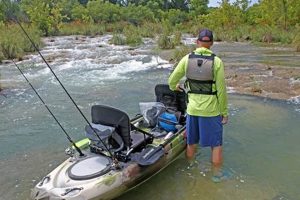
Within the realm of virtual fishing experiences, the combination of simulated angling and small watercraft offers a unique and immersive gameplay opportunity. This digital recreation allows players to explore diverse waterways and engage in angling activities from the perspective of a kayak, providing a distinct level of engagement compared to traditional shore-based or boat fishing simulations. This approach often includes realistic physics and handling, requiring players to manage balance and positioning while simultaneously attempting to hook and land virtual fish. Example scenarios might involve navigating narrow river channels, maneuvering through lily pads, or contending with wind and currents affecting both the kayak and fishing line.
This form of simulated angling provides several key advantages. The maneuverability of a virtual kayak allows access to shallows and secluded areas typically inaccessible to larger boats, expanding the range of potential fishing spots. The closer proximity to the water surface can also enhance the feeling of immersion and connection with the digital environment. Historically, this blend of virtual fishing and kayaking has emerged alongside advancements in gaming technology, reflecting a growing demand for realistic and engaging outdoor simulations. The incorporation of specialized equipment and techniques further elevates the realism, mirroring the nuances of real-world kayak fishing.
The following sections will explore specific aspects of simulated kayak angling in greater detail, including equipment selection, location choices, effective techniques, and the overall impact on the virtual fishing experience.
Tips for Kayak Fishing in Fishing Planet
Maximizing success in virtual kayak angling requires a strategic approach encompassing equipment choices, location selection, and refined techniques. The following tips offer guidance for enhanced performance and a more immersive experience.
Tip 1: Kayak Selection: Choosing the appropriate kayak is paramount. Consider stability versus maneuverability. Wider kayaks offer greater stability, crucial in challenging conditions, while narrower models provide superior maneuverability for navigating tight spaces.
Tip 2: Rod and Reel Pairing: Opt for a balanced rod and reel combination suited to the target species. Shorter rods enhance control in the confined space of a kayak, while appropriate reel size and line weight are essential for effective casting and retrieval.
Tip 3: Location Scouting: Utilize the in-game map and sonar to identify promising fishing locations. Shallow areas, weed beds, and drop-offs often hold significant concentrations of fish. Kayak accessibility provides an advantage in reaching these otherwise inaccessible areas.
Tip 4: Tackle Selection: Adapt lure choices to the target species and prevailing conditions. Consider factors such as water clarity, depth, and prevalent forage. Experimentation is key to discovering effective patterns.
Tip 5: Kayak Positioning: Position the kayak strategically to optimize casting angles and minimize drift. Utilizing anchor features or utilizing natural structures as current breaks can enhance presentation and reduce line drag.
Tip 6: Precision Casting: Accurate casting is essential in tight quarters. Practice controlled casts to target specific structures or pockets of open water. Mastering short-range accuracy is crucial for success.
Tip 7: Fighting Fish from a Kayak: Maintain balance and control while fighting fish. Adjust drag settings to prevent line breakage and utilize the kayak’s maneuverability to steer fish away from obstacles.
Tip 8: Weather Awareness: Pay attention to in-game weather conditions. Wind and current can significantly impact kayak control and fishing effectiveness. Adjusting techniques based on prevailing conditions is essential.
By implementing these strategies, anglers can elevate their virtual kayak fishing experience, improving catch rates and enjoying a more immersive and rewarding simulation.
The following conclusion summarizes the core advantages and overall appeal of incorporating kayaks into the virtual fishing experience.
1. Maneuverability

Maneuverability represents a defining characteristic of kayak fishing within virtual environments. The ability to precisely navigate intricate waterways, exploiting narrow channels and accessing secluded areas, distinguishes this angling approach from traditional boat or shore-based fishing. This attribute allows players to explore shallows, weave through obstacles like fallen logs or emergent vegetation, and position themselves optimally for casting in confined spaces. This level of control is often crucial for targeting specific fish species that inhabit these hard-to-reach locations. A real-world parallel can be drawn to fly fishing in small streams, where precise boat maneuvering or wading is essential for reaching prime fishing spots.
The enhanced maneuverability offered by virtual kayaks directly influences fishing success. Reaching areas inaccessible to larger vessels increases the likelihood of encountering specific fish populations and exploiting unique habitat features. For example, navigating through a dense patch of virtual lily pads might reveal a hidden pocket where trophy bass reside. Furthermore, the capacity to quickly reposition the kayak in response to changing current or wind conditions ensures optimal line presentation and drift control, maximizing lure effectiveness. This dynamic positioning capability mirrors the strategic adjustments real-world kayak anglers make to maintain advantageous angles while combating environmental factors.
In summary, maneuverability is not merely a convenient feature but rather a fundamental component of the virtual kayak angling experience. It directly impacts the range of accessible fishing locations, influences the effectiveness of angling techniques, and enhances the overall sense of realism and immersion within the game. Mastering the nuanced control of a virtual kayak becomes essential for maximizing fishing success and fully appreciating the intricacies of this simulated angling discipline.
2. Accessibility
Accessibility, within the context of virtual kayak angling, signifies the capacity to reach fishing locations otherwise difficult or impossible to access using traditional virtual boats or from the shoreline. This enhanced reachability stems from the kayak’s compact size, shallow draft, and maneuverability. These attributes allow navigation through narrow waterways, shallows, and areas obstructed by vegetation or other obstacles. The resultant expanded fishing range significantly impacts gameplay, enabling exploration of diverse habitats and targeting specific fish species associated with these unique environments. A real-world parallel can be drawn to backcountry fishing, where smaller, portable watercraft are essential for reaching remote lakes and streams.
The importance of accessibility as a component of virtual kayak fishing lies in its direct influence on angling opportunities and overall gameplay experience. Gaining access to secluded coves, navigating through dense weed beds, or approaching shallow, rocky shorelines unlocks previously unavailable fishing grounds. These areas frequently harbor distinct fish populations, increasing the potential for encounters with sought-after species. Furthermore, the ability to navigate tight spaces allows for precise lure placement near submerged structures or cover, enhancing fishing effectiveness. For instance, a virtual kayak angler can quietly slip into a narrow channel between reeds to target elusive predatory fish, an approach impractical with larger, less maneuverable virtual boats.
The practical significance of understanding accessibility in virtual kayak fishing translates to enhanced strategic gameplay. Recognizing the expanded range afforded by a kayak allows players to develop targeted approaches, focusing on specific locations known to hold desired species. This strategic advantage adds depth to the gameplay, requiring players to analyze virtual maps, identify promising areas, and plan routes effectively. Challenges may arise in navigating complex environments or selecting appropriate tackle for the newly accessible habitats, adding layers of complexity and realism to the virtual angling experience. Ultimately, the enhanced accessibility provided by virtual kayaks expands fishing opportunities, promotes strategic decision-making, and elevates the overall sense of immersion and reward within the game.
3. Equipment Choices

Equipment choices in the virtual world of kayak fishing significantly influence success and overall experience, mirroring the importance of appropriate gear in real-world angling. Within a simulated kayak fishing environment, equipment selection impacts casting distance and accuracy, fish-fighting capability, and the ability to adapt to varying conditions. Specific rod and reel combinations, line types, and lure selections become crucial considerations, each influencing angling effectiveness and the degree of realism experienced. For instance, a shorter, lighter rod might be advantageous for casting within the confined space of a kayak, while heavier tackle becomes necessary when targeting larger, more powerful fish species in open water. Similarly, braid or fluorocarbon lines may be favored over monofilament for enhanced sensitivity and strength, reflecting real-world tackle choices based on target species and fishing conditions.
The importance of equipment choices as a component of virtual kayak fishing stems from the direct impact on gameplay mechanics and the player’s ability to interact with the simulated environment. Choosing appropriate gear enhances the virtual angler’s capacity to effectively present lures, detect subtle bites, and successfully land fish. For example, utilizing a correctly weighted lure and matching rod action allows for accurate casts to specific targets within the game, while a balanced reel with a suitable drag system becomes crucial during the fight with a hooked fish. The game’s realism often extends to simulating line properties and drag systems, requiring players to make informed decisions about equipment to optimize their chances of success. An inappropriate rod and reel pairing might lead to difficulties casting accurately or controlling a hooked fish, hindering progress within the game. Conversely, selecting the right equipment can enhance the sense of immersion and provide a more rewarding experience.
Understanding the nuances of equipment selection in virtual kayak fishing enhances strategic gameplay and contributes to a more immersive and rewarding experience. Adapting tackle choices to target specific species, considering virtual water conditions, and understanding the characteristics of different rod and reel combinations allows players to optimize their approach. Challenges such as limited storage space within a virtual kayak necessitate careful equipment selection, reflecting the real-world limitations kayak anglers face. Mastering these considerations elevates the virtual fishing experience beyond simple gameplay, demanding strategic planning and an understanding of the interplay between equipment and environment, mirroring the complexities of real-world angling.
4. Location Selection
Location selection in the virtual world of kayak fishing within Fishing Planet plays a crucial role in determining angling success. Similar to real-world kayak angling, choosing the right spot within the game’s virtual environment considers factors like species’ habitat preferences, water depth, presence of cover or structure, and accessibility. The kayak’s maneuverability allows exploration of diverse locations inaccessible to larger virtual boats, such as shallow coves, narrow creeks, and areas dense with vegetation. Targeting specific species, therefore, often requires strategic location selection based on known habitat preferences within the game. For example, seeking bass might lead a virtual angler to explore shallow, weedy areas or submerged structures within a lake, while targeting trout might involve navigating upstream in virtual rivers to reach cooler, well-oxygenated stretches. This mirrors real-world angling, where kayak anglers leverage their craft’s maneuverability to access prime fishing spots often unreachable by conventional boats.
The importance of location selection as a component of Fishing Planet’s kayak fishing stems from its direct influence on encounter rates with target species. Selecting locations with appropriate habitat characteristics significantly increases the probability of encountering desired fish. Navigating a kayak through a virtual marsh teeming with reeds, for instance, might yield better results for pike fishing than trolling in the open lake. Furthermore, understanding the game’s virtual ecosystem, including fish behavior patterns and preferred feeding zones, enhances the effectiveness of location-based strategies. This might involve seeking out virtual drop-offs, submerged logs, or areas with converging currentsprime locations for ambush predators. Just as a real-world kayak angler might focus on areas with specific water temperatures or oxygen levels, successful virtual anglers in Fishing Planet leverage their knowledge of the in-game environment to choose productive locations.
The practical significance of understanding location selection within Fishing Planet translates to a more strategic and rewarding gameplay experience. Analyzing the virtual map, considering species-specific habitat preferences, and exploring diverse locations within the game adds depth and realism to the virtual angling pursuit. Challenges may arise in locating specific areas within the game’s vast virtual world or adapting to changing conditions within those environments. Successfully navigating these challenges, however, directly contributes to a more immersive and engaging experience, reinforcing the importance of informed location selection as a core element of virtual kayak angling.
5. Strategic Positioning

Strategic positioning within the virtual environment of Fishing Planet significantly impacts kayak angling success. Positioning refers to the angler’s deliberate placement of their virtual kayak in relation to in-game elements such as currents, wind direction, structure, and cover. Effective positioning optimizes casting angles, presentation of lures, and the ability to detect bites, thereby maximizing fishing effectiveness. Similar to real-world kayak angling, where anglers consider wind drift and current flow, virtual anglers in Fishing Planet must account for these factors to maintain optimal positioning and lure presentation. Positioning upwind or upcurrent of a target area, for example, allows a natural drift that presents the lure realistically and covers the intended fishing zone effectively. Conversely, poor positioning can lead to missed opportunities, snagged lines, and reduced fishing success. For example, positioning directly downstream of a target area might alert fish to the angler’s presence, reducing the likelihood of a strike. This mirrors real-world scenarios where improper kayak placement can spook fish or create drag that hinders lure action.
The importance of strategic positioning as a component of kayak fishing in Fishing Planet stems from its direct influence on angler effectiveness. Precise kayak placement allows for accurate casts to specific targets, optimal lure presentation within the virtual environment, and enhanced detection of fish strikes. Positioning a virtual kayak near a submerged log or weed bed, for instance, offers a strategic advantage when targeting species known to inhabit such cover. Additionally, correct positioning minimizes line drag and maximizes lure action, increasing the likelihood of attracting and hooking fish. For example, positioning a kayak parallel to a current seam allows for a natural lure drift, mimicking the movement of prey and enticing strikes. Failing to account for current or wind drift within the game can result in lures being dragged unnaturally or pushed out of the target zone, reducing fishing success.
Understanding the significance of strategic positioning in Fishing Planet’s kayak fishing environment leads to more effective and engaging gameplay. Analyzing virtual conditions such as wind and current direction, utilizing in-game mapping tools to identify promising locations, and strategically placing the kayak to maximize casting angles and lure presentation all contribute to enhanced angling success. Challenges may include adapting to changing in-game conditions or navigating complex environments while maintaining optimal positioning. Overcoming these challenges, however, reinforces the importance of strategic positioning as a key element of successful virtual kayak angling, mirroring the real-world skills and knowledge required for effective kayak fishing.
6. Realistic Simulation
Realistic simulation forms a cornerstone of the virtual kayak angling experience within Fishing Planet. The game’s commitment to simulating real-world physics, environmental conditions, and fish behavior significantly enhances immersion and necessitates the application of real-world angling knowledge. Factors such as water resistance, kayak stability, line drag, and lure action are all simulated, requiring players to adapt their techniques just as they would in a real-world kayak fishing scenario. The impact of wind and current on both kayak drift and lure presentation adds another layer of complexity, demanding strategic positioning and casting adjustments. This emphasis on realism distinguishes the experience from arcade-style fishing games and elevates the sense of engagement. For example, a virtual angler must consider the weight and aerodynamic properties of a lure when casting in windy conditions, mirroring the real-world challenges of achieving accurate casts in such circumstances. Similarly, the simulation of water resistance influences how a virtual kayak responds to paddle strokes and maneuvering inputs, demanding a degree of finesse and control comparable to real-world kayak handling.
The importance of realistic simulation as a component of Fishing Planet’s kayak fishing lies in its contribution to both gameplay depth and the overall sense of immersion. The game’s realistic physics engine requires players to understand and apply real-world angling principles, enhancing the learning curve and the sense of accomplishment derived from successful virtual fishing trips. Adapting to changing virtual weather conditions, managing kayak stability in challenging currents, and selecting appropriate tackle based on simulated water clarity all contribute to a more engaging and rewarding experience. For instance, a sudden shift in virtual wind direction can significantly impact kayak drift and lure presentation, forcing the player to adjust their positioning and casting technique, mirroring the real-world challenges of adapting to changing environmental conditions. This focus on realism fosters a deeper understanding of angling principles and promotes strategic thinking, blurring the lines between virtual recreation and educational simulation.
The practical significance of understanding the role of realistic simulation in Fishing Planet’s kayak fishing translates to enhanced player engagement and a more rewarding virtual angling experience. Recognizing the game’s commitment to simulating real-world conditions empowers players to apply their existing angling knowledge or acquire new skills applicable to both virtual and real-world fishing scenarios. Challenges may arise in mastering the nuances of the game’s physics engine or adapting to the complexities of simulated environmental factors. Overcoming these challenges, however, strengthens the connection between the virtual and real-world angling experiences, fostering a deeper appreciation for the intricacies of kayak fishing and solidifying realistic simulation as a core element of Fishing Planet’s appeal.
Frequently Asked Questions
This section addresses common inquiries regarding kayak fishing within the Fishing Planet simulation.
Question 1: What are the advantages of using a kayak in Fishing Planet?
Kayaks offer enhanced maneuverability and access to shallow or obstructed areas often inaccessible to larger boats, expanding fishing opportunities within the game.
Question 2: How does kayak selection influence gameplay?
Kayak choice affects stability and maneuverability. Wider kayaks offer greater stability, while narrower models enhance maneuverability in tight spaces. Selection should align with the intended fishing location and target species.
Question 3: What equipment is recommended for kayak fishing in the game?
Recommended equipment depends on target species and fishing location. Shorter rods generally offer better control in a kayak. Reel and line selection should match the target species and expected fighting conditions. Specialized kayak fishing rods and reels are often available in-game.
Question 4: How does wind and current affect kayak fishing in the simulation?
Wind and current impact both kayak positioning and lure presentation. Anglers must consider these factors when selecting fishing locations and casting techniques. Understanding and compensating for drift is crucial for effective fishing.
Question 5: Are there specific techniques for fighting fish from a kayak in Fishing Planet?
Maintaining balance and kayak control while fighting a fish is essential. Proper drag settings and rod handling techniques prevent line breakage and facilitate landing fish effectively within the confined space of a kayak. Utilizing the kayak’s maneuverability to steer fish away from obstacles is often advantageous.
Question 6: How does the realistic simulation of Fishing Planet enhance the kayak fishing experience?
Realistic simulation of water physics, kayak handling, and environmental factors necessitates strategic decision-making, mirroring real-world kayak fishing challenges. This enhances immersion and adds depth to the gameplay experience.
Addressing these commonly asked questions provides a deeper understanding of the intricacies of virtual kayak angling within Fishing Planet.
The subsequent sections will delve into advanced techniques and strategies for maximizing success in kayak fishing within the simulation.
Conclusion
This exploration of virtual kayak angling within Fishing Planet has highlighted the unique blend of maneuverability, accessibility, and strategic depth it offers. Key elements discussed include equipment choices, location selection, strategic positioning, and the significance of the game’s realistic simulation in shaping the virtual kayak fishing experience. The analysis emphasized the advantages of kayaks for reaching secluded fishing spots, navigating challenging waterways, and presenting lures effectively in diverse virtual environments. The interplay between equipment selection, environmental factors, and angler skill underscores the complexity and rewarding nature of this simulated angling discipline.
Virtual kayak fishing within Fishing Planet provides a compelling platform for both experienced anglers and newcomers to explore the nuances of this specialized angling approach. The dynamic interplay between virtual environment and player agency fosters a deeper understanding of kayak fishing principles, promoting strategic thinking and adaptability within a richly simulated world. Continued exploration of advanced techniques and location-specific strategies will further enhance the virtual kayak angling experience, enriching the connection between virtual gameplay and real-world angling pursuits.