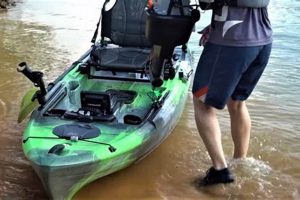
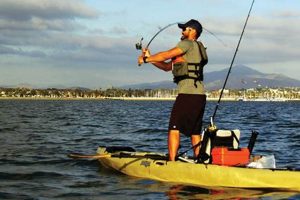
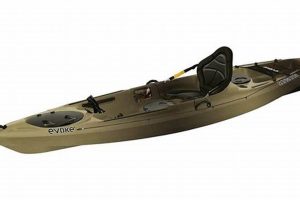
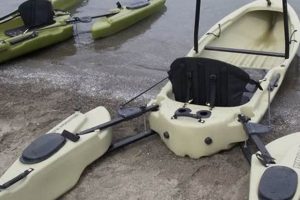
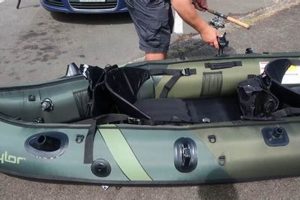
This specific type of watercraft is designed for anglers, offering a stable and efficient platform for fishing. It typically features a shallow draft for navigating shallow waters, specialized storage for fishing gear, and a design optimized for stability and maneuverability. Such vessels often incorporate features like rod holders, anchor trolleys, and livewells.
Anglers benefit from the stealth and stability these specialized kayaks offer. The low profile and often muted color schemes allow close approaches to fish without disturbance, increasing the chances of a successful catch. Their design also prioritizes stability, essential for casting lines and reeling in fish without compromising balance. Historically, fishing from small, maneuverable craft has been a common practice. This modern iteration builds upon that tradition, incorporating advanced materials and design features to enhance the fishing experience.
The subsequent sections will delve into specific aspects of these fishing platforms, including construction materials, design variations, and popular features. Furthermore, guidance on selecting the appropriate model based on individual fishing styles and target species will be provided.
Tips for Optimized Kayak Fishing
Effective angling from a kayak requires a blend of skill and preparation. These tips offer guidance for maximizing success and enjoyment on the water.
Tip 1: Prioritize Stability: Select a vessel appropriate for the intended fishing environment. Wider hulls offer greater stability, particularly beneficial in rougher waters or when standing to cast.
Tip 2: Master Paddle Strokes: Efficient paddling conserves energy and allows precise maneuvering. Practice various strokes to navigate currents and wind effectively.
Tip 3: Organize Gear Strategically: Accessibility is key. Store frequently used items within easy reach and ensure all gear is securely stowed to prevent loss or interference.
Tip 4: Choose Appropriate Attire: Dress in layers to adapt to changing weather conditions. Lightweight, quick-drying fabrics are recommended. Consider polarized sunglasses to reduce glare and improve visibility.
Tip 5: Respect Wildlife and the Environment: Practice catch-and-release whenever possible. Dispose of waste properly and avoid disturbing natural habitats.
Tip 6: Plan for Emergencies: Carry essential safety equipment, including a personal flotation device, a whistle, and a communication device. Inform someone of the fishing location and estimated return time.
Tip 7: Check Local Regulations: Familiarize oneself with fishing license requirements and any specific regulations for the chosen waterway.
By adhering to these guidelines, anglers can enhance their safety, improve their fishing performance, and contribute to the preservation of aquatic environments.
The following section offers concluding remarks and reinforces the importance of responsible kayak fishing practices.
1. Stability

Stability is a paramount consideration in fishing kayak design, directly influencing angler safety and fishing efficacy. A stable platform allows for comfortable casting, reeling, and landing fish, even in challenging conditions. For the Shadow Caster fishing kayak, stability is integral to its purpose-built design, enabling anglers to focus on the pursuit of fish rather than maintaining balance.
- Hull Design:
The hull design plays a crucial role in determining stability. Wider hulls generally provide greater initial stability, resisting tipping. Hull shapes, including pontoon, flat-bottom, and tunnel hulls, each offer distinct stability characteristics suited to different water conditions. A Shadow Caster fishing kayak might feature a specific hull design optimized for stability in its intended environment, such as calm lakes or flowing rivers. The specific hull design influences how the kayak reacts to waves, currents, and angler movement.
- Center of Gravity:
A lower center of gravity enhances stability. The distribution of weight within the kayak, including the angler, gear, and the kayak itself, affects the center of gravity. The Shadow Caster design likely considers weight distribution to optimize stability. For example, strategically placed seating and storage compartments contribute to a lower center of gravity.
- Water Conditions:
Calm water generally presents fewer stability challenges than rough water or strong currents. The Shadow Caster’s stability characteristics are relevant in the context of its intended use environment. A kayak designed for calm lakes might prioritize stability for standing casting, while a kayak intended for river fishing might emphasize secondary stability, which is the ability to recover from tipping. Understanding these factors is crucial for selecting the appropriate vessel.
- Angler Movement:
Sudden movements, such as casting, fighting fish, or shifting weight, can compromise stability. The Shadow Caster’s design aims to mitigate the impact of these movements. Features like a stable seating position and strategically placed footrests contribute to maintaining balance during dynamic angling activities. The inherent stability of the platform allows anglers to confidently execute these movements without jeopardizing their balance.
These facets of stability collectively influence the performance and suitability of a fishing kayak like the Shadow Caster. A well-designed kayak balances stability with other performance characteristics, such as maneuverability and speed, to provide an optimal fishing platform for specific conditions and angling styles. Understanding the interplay of these factors enables informed decisions regarding kayak selection and safe operation on the water.
2. Maneuverability

Maneuverability is a critical attribute for fishing kayaks, enabling efficient navigation and precise positioning in diverse aquatic environments. For a hypothetical “Shadow Caster” fishing kayak, maneuverability directly influences its effectiveness in accessing prime fishing spots and reacting to changing conditions. This characteristic is particularly important in confined areas such as shallow creeks, weed beds, and rocky shorelines. A highly maneuverable kayak allows anglers to navigate complex waterways, exploit tight pockets of water where fish may congregate, and adjust positioning quickly to changing currents or wind. For instance, a quick turn might be necessary to follow a hooked fish or avoid submerged obstacles.
Several factors contribute to kayak maneuverability, including hull design, length, and the use of a rudder or skeg. Shorter kayaks generally turn more easily than longer ones, while specific hull designs, such as those with a defined keel or tracking channels, enhance straight-line tracking. Rudders and skegs aid in directional control, especially in windy conditions or strong currents. A hypothetical “Shadow Caster” fishing kayak might prioritize maneuverability through a shorter hull design and the inclusion of a rudder system, allowing anglers to navigate intricate waterways effectively. This design choice would be particularly advantageous in environments requiring precise boat control, such as navigating through dense vegetation or around submerged structures. The ability to position the kayak accurately contributes significantly to fishing success.
Understanding the relationship between maneuverability and fishing kayak design is crucial for selecting the appropriate vessel for specific fishing environments and styles. While maneuverability is highly desirable in many situations, it’s essential to consider the trade-offs with other performance characteristics, such as stability and speed. A highly maneuverable kayak might be less stable than a wider, less agile model. Therefore, selecting a kayak requires balancing maneuverability with other essential attributes to optimize performance for the intended fishing application. The “Shadow Caster” fishing kayak, hypothetically, would represent a specific balance of these characteristics, tailored to its intended use case.
3. Stealth

Stealth, the ability to approach fish undetected, is a critical advantage in kayak fishing. A less conspicuous approach allows closer proximity to target species, increasing angling success. For a fishing kayak, minimizing visual, auditory, and pressure wave disturbances is paramount. This is where the concept of a “shadow caster” becomes relevant, suggesting a design intended to minimize its impact on the underwater environment.
- Visual Profile:
A low profile minimizes the kayak’s silhouette against the sky or shoreline, reducing its visibility to fish. Color choice also plays a crucial role. Muted earth tones, blues, and greens blend with the natural environment, further reducing visual detection. A “shadow caster” kayak might employ a dark color scheme to minimize its visual impact, allowing anglers to remain inconspicuous and approach fish more closely.
- Noise Reduction:
Minimizing noise is essential for stealth. Paddle strokes, hull slap against the water, and onboard equipment can create disturbances that alert fish. A “shadow caster” design might incorporate features to dampen these sounds. Examples include smoother hull designs to reduce water disturbance and specialized paddle shapes designed for quieter entry and exit. Minimizing gear clatter is also essential.
- Reduced Water Displacement:
The displacement of water creates pressure waves that fish can detect. A streamlined hull design and careful paddling technique minimize these disturbances. A “shadow caster” likely features a hull design that efficiently moves through the water, creating minimal disturbance and reducing the likelihood of alerting fish to the kayak’s presence.
- Approach Strategy:
Even the stealthiest kayak requires a mindful approach. Paddling smoothly and avoiding sudden movements minimizes disturbance. Utilizing natural cover, such as overhanging vegetation or shadows, further enhances concealment. Understanding wind and current direction is crucial for approaching fish undetected. These techniques complement the inherent stealth characteristics of a “shadow caster,” maximizing the chances of a successful approach.
These elements of stealth, integrated into a kayak’s design and operational practices, significantly enhance fishing success. The “shadow caster” concept, encompassing these principles, highlights the importance of minimizing disturbance to approach fish effectively. By reducing its visual, auditory, and pressure wave footprint, a stealthy kayak gives anglers a distinct advantage in their pursuit.
4. Storage Capacity
Ample and well-designed storage is crucial for a fishing kayak’s effectiveness. A “shadow caster fishing kayak,” designed for stealth and efficiency, requires specific storage solutions to maintain a low profile and facilitate access to essential gear. Storage capacity directly impacts an angler’s ability to carry tackle, safety equipment, and personal items without compromising the kayak’s stability or maneuverability. Insufficient storage can lead to a cluttered deck, hindering movement and potentially compromising safety. Conversely, well-designed storage compartments keep gear organized and secure, allowing for efficient retrieval and minimizing disruptions during critical fishing moments. For instance, dedicated rod holders prevent entanglement and damage, while readily accessible tackle storage facilitates quick lure changes without disrupting fishing flow. Dry storage compartments protect sensitive electronics and personal items from water damage, essential for longer expeditions.
Practical applications of optimized storage are readily apparent. Consider a scenario where an angler needs to quickly switch lures to match changing fish behavior. Easy access to a well-organized tackle box within a dedicated storage compartment allows for a seamless transition, maximizing fishing time and potentially increasing catch rates. Similarly, secure storage for safety equipment, such as a first aid kit or signaling device, ensures these items are readily available in emergencies without requiring extensive searching. The strategic placement and design of storage compartments also contribute to weight distribution, influencing the kayak’s stability and balance. Rear storage wells might accommodate larger items like coolers or spare paddles, while smaller compartments closer to the angler provide quick access to frequently used items.
In summary, storage capacity is an integral aspect of a “shadow caster fishing kayak’s” design. Its careful consideration directly impacts the kayak’s functionality, angler efficiency, and overall fishing experience. Adequate and strategically designed storage solutions facilitate organization, enhance accessibility, and contribute to a streamlined, efficient fishing platform. Challenges might include balancing storage capacity with maintaining a low profile and maneuverability, requiring careful design considerations. This understanding underscores the importance of prioritizing storage solutions tailored to the specific demands of kayak fishing.
5. Fishing Features
Specialized fishing features distinguish a purpose-built fishing kayak from recreational models. These features enhance angling effectiveness and efficiency, directly contributing to a more productive and enjoyable experience. In the context of a “shadow caster fishing kayak,” where stealth and functionality are paramount, these features are integral to its core design philosophy. They represent a considered approach to optimizing the kayak for its intended purpose: effective and discreet angling.
- Rod Holders:
Rod holders are fundamental, providing secure storage and quick access to fishing rods. Flush-mounted rod holders minimize interference with paddling and casting, while adjustable rod holders offer flexibility in positioning rods for different fishing techniques. Multiple rod holders allow anglers to employ various rigs simultaneously, increasing fishing versatility. In a “shadow caster” context, rod holders contribute to a streamlined profile, minimizing visual obstructions that could compromise stealth.
- Tackle Storage:
Efficient tackle storage is essential. Dedicated compartments, trays, and storage bags keep lures, hooks, and other small items organized and readily accessible. Waterproof compartments protect sensitive electronics and gear from water damage. Well-designed tackle storage minimizes time spent searching for equipment, maximizing fishing time and maintaining a clutter-free deck, crucial for maintaining a low profile in a “shadow caster” kayak.
- Anchor Systems:
Anchor systems, including anchor trolleys and stake-out poles, allow anglers to maintain position in specific locations, particularly useful in currents or windy conditions. These systems contribute to controlled drifts and precise positioning near structure or cover. For a “shadow caster,” the ability to hold position quietly enhances stealth, allowing anglers to remain undetected while targeting specific areas.
- Fish Finders and Electronics:
Integrating fish finders and other electronics enhances fishing effectiveness by providing real-time information about water depth, bottom structure, and fish location. These tools are often seamlessly integrated into the kayak’s design, minimizing interference and maximizing functionality. In a “shadow caster,” careful placement of electronics contributes to a streamlined setup, minimizing visual clutter while providing crucial data for targeted fishing.
These integrated fishing features collectively contribute to the “shadow caster fishing kayak’s” specialized purpose. They represent a design philosophy that prioritizes functionality, efficiency, and stealth. By incorporating these features, the kayak transforms from a simple watercraft into a dedicated fishing platform optimized for a more effective and immersive angling experience.
6. Shallow Water Access
Shallow water access is a defining characteristic of specialized fishing kayaks, enabling anglers to exploit environments often inaccessible to larger vessels. For a “shadow caster fishing kayak,” designed for stealth and maneuverability, shallow water access is paramount. It opens opportunities in diverse locations, from shallow flats and backwater creeks to protected marshes and mangrove forests. These environments often harbor abundant fish populations, making them prime targets for anglers seeking a challenging and rewarding experience.
- Draft and Hull Design:
A shallow draft, the vertical distance between the waterline and the bottom of the hull, is crucial for navigating shallow areas without grounding. Specific hull designs, such as flat-bottom or tunnel hulls, further enhance shallow water performance by distributing weight evenly and reducing drag. A “shadow caster” kayak likely features a carefully considered hull design optimized for minimal draft, allowing access to extremely shallow areas where fish may concentrate.
- Stability in Shallow Water:
Maintaining stability in shallow, often uneven terrain is critical. A stable platform allows anglers to stand and cast, sight fish, and maneuver effectively without risking capsize. The “shadow caster’s” design likely prioritizes stability in shallow water conditions, enabling anglers to maintain balance while navigating challenging terrain and engaging with fish.
- Propeller or Fin Considerations:
If the kayak utilizes a propeller or fins, their design and placement are crucial for shallow water operation. Minimizing the risk of entanglement with vegetation or bottom debris is paramount. A “shadow caster” might employ a protected propeller system or shallow-water-specific fin configuration to mitigate these risks, ensuring uninterrupted navigation in challenging environments.
- Stealth in Shallow Environments:
Shallow water often necessitates an even greater emphasis on stealth. Fish in these environments are often more wary due to increased visibility and proximity to predators. The “shadow caster’s” low profile and quiet operation become particularly advantageous in shallow water, allowing anglers to approach fish undetected. This advantage is amplified by the kayak’s ability to navigate silently through shallow areas, minimizing disturbance and maximizing stealth.
The ability to access shallow water significantly expands the fishing opportunities available to kayak anglers. For a “shadow caster fishing kayak,” shallow water access is not merely a feature but a core element of its design philosophy. By seamlessly integrating a shallow draft, stable platform, and quiet operation, the “shadow caster” enables anglers to explore a wider range of environments and approach fish in their preferred habitats with minimal disturbance. This capability enhances the overall fishing experience, making it more versatile, challenging, and ultimately, more rewarding.
7. Durable Construction

Durable construction is paramount for a “shadow caster fishing kayak,” ensuring longevity and resilience in demanding environments. These kayaks are often used in remote locations and challenging conditions, encountering submerged obstacles, rocky shorelines, and varying water temperatures. Durable materials and robust construction techniques safeguard against damage, ensuring the kayak remains functional and safe throughout its lifespan. This resilience translates to fewer repairs, reduced replacement costs, and a greater sense of security during extended fishing trips. For instance, a kayak constructed from high-density polyethylene (HDPE) can withstand impacts and abrasion far better than a less durable material, contributing to its long-term performance in harsh environments.
The practical implications of durable construction are significant. Consider a scenario where a “shadow caster fishing kayak” encounters a submerged log or sharp rocks. A robust hull construction, reinforced with impact-resistant materials, minimizes the risk of damage, preventing leaks and ensuring the angler’s safety. Furthermore, UV-resistant materials protect the kayak from sun damage, preventing degradation and extending its lifespan. This durability allows anglers to confidently navigate challenging environments, knowing their equipment can withstand the rigors of regular use. This reliability is essential for extended trips or expeditions where access to repair facilities might be limited. The kayak’s ability to withstand harsh conditions contributes significantly to the overall fishing experience.
In summary, durable construction is an integral aspect of a “shadow caster fishing kayak’s” design. It ensures longevity, enhances safety, and enables anglers to confidently explore diverse environments. While material selection and construction techniques influence cost, the long-term benefits of durability outweigh the initial investment. Challenges might include balancing durability with weight and cost, necessitating careful consideration of materials and construction methods. Ultimately, prioritizing durable construction ensures the kayak remains a reliable and dependable fishing platform for years to come, maximizing its value and contributing to countless successful fishing expeditions.
Frequently Asked Questions
This section addresses common inquiries regarding specialized fishing kayaks, providing concise and informative responses.
Question 1: What key features distinguish a fishing kayak from a recreational model?
Specialized fishing kayaks typically incorporate features like rod holders, tackle storage, anchor systems, and a design optimized for stability and maneuverability. These features enhance angling effectiveness and overall fishing experience.
Question 2: How does hull design influence kayak performance?
Hull design significantly impacts stability, maneuverability, and tracking. Wider hulls generally offer greater stability, while longer, narrower hulls prioritize speed and tracking. Specific hull shapes, such as pontoon or tunnel hulls, cater to different water conditions and fishing styles.
Question 3: What are the advantages of using a kayak for fishing?
Kayaks offer stealthy access to shallow waters and secluded fishing spots often inaccessible to larger boats. Their maneuverability allows precise navigation in complex environments, and their low profile minimizes disturbance to fish.
Question 4: What safety precautions should one take when kayak fishing?
Always wear a personal flotation device (PFD). Inform someone of the fishing location and estimated return time. Carry essential safety equipment, including a whistle, communication device, and first-aid kit. Check weather conditions before embarking and be aware of potential hazards such as currents and changing tides.
Question 5: How does one choose the right fishing kayak?
Consider the intended fishing environment (calm lakes, rivers, or open water), fishing style, and storage needs. Prioritize stability, maneuverability, and features relevant to the target species. Research different models and, if possible, test kayaks before purchasing.
Question 6: How does one maintain a fishing kayak?
Regular cleaning and proper storage are essential for kayak longevity. Rinse the kayak with fresh water after each use to remove salt and debris. Store the kayak in a sheltered location, protected from direct sunlight and extreme temperatures. Periodically inspect and lubricate moving parts, such as rudder and pedal systems.
Careful consideration of these frequently asked questions provides a foundation for informed decisions regarding fishing kayak selection, operation, and maintenance. Understanding these aspects contributes significantly to a safe, productive, and enjoyable fishing experience.
The following section delves further into advanced kayak fishing techniques and strategies.
Conclusion
This exploration of specialized fishing kayaks, exemplified by the hypothetical “shadow caster fishing kayak,” has highlighted the critical design elements that contribute to effective and enjoyable angling experiences. Stability, maneuverability, stealth, storage capacity, specialized fishing features, shallow water access, and durable construction collectively define a purpose-built fishing platform. Each characteristic contributes significantly to on-the-water performance, angler efficiency, and overall fishing success. The analysis of these features underscores the importance of selecting a kayak tailored to specific fishing environments, target species, and individual angling styles.
The evolution of fishing kayak design continues to refine these core principles, promising further advancements in performance, functionality, and angler experience. A deeper understanding of these elements empowers anglers to make informed decisions, maximizing their potential on the water. This pursuit of enhanced angling experiences, facilitated by continuous innovation in kayak design, underscores the enduring appeal of this specialized pursuit.