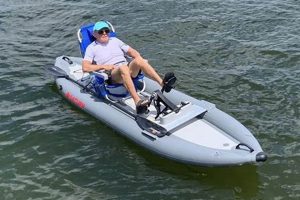
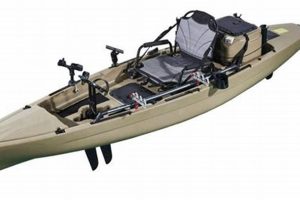
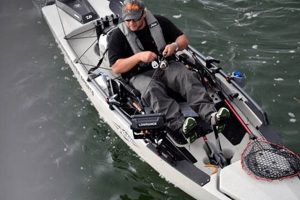
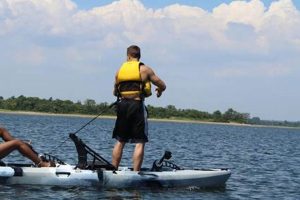
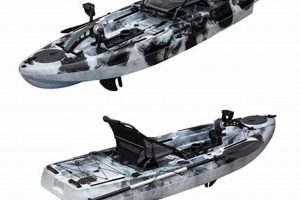
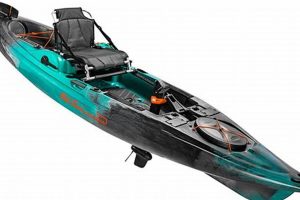
A fishing kayak of this size and type typically features a hard-shell construction, providing stability and durability. Propulsion is achieved through a pedal-driven system, allowing hands-free fishing and maneuverability. This combination of features makes it suitable for various water conditions, from calm lakes to slow-moving rivers.
Hands-free operation offers a significant advantage for anglers, enabling them to focus on casting, retrieving, and landing fish. The rigid hull design provides a stable platform, improving casting accuracy and reducing fatigue during long fishing trips. These watercraft often offer ample storage for fishing gear and accessories, further enhancing their practicality. Their increasing popularity reflects a growing demand for efficient and comfortable fishing experiences.
This discussion will further explore the advantages and disadvantages of this type of watercraft, covering topics such as materials, design variations, propulsion systems, and essential accessories. Additionally, selection criteria and maintenance best practices will be examined to provide a comprehensive understanding of these specialized fishing platforms.
Tips for Selecting and Using a Pedal-Powered Fishing Kayak
Choosing and utilizing a pedal-driven fishing kayak effectively requires careful consideration of several factors. These tips offer guidance for maximizing performance and enjoyment on the water.
Tip 1: Consider Hull Design: Different hull designs (e.g., pontoon, tunnel, displacement) offer varying degrees of stability and speed. A wider, flatter hull provides increased stability, while a narrower, more pointed hull enhances speed and tracking.
Tip 2: Evaluate Propulsion Systems: Pedal drives utilize either fins or propellers. Fin drives tend to be weedless and quieter, while propeller drives offer greater speed and efficiency in open water.
Tip 3: Assess Storage Capacity: Ample storage is crucial for carrying fishing gear, safety equipment, and personal items. Consider the size and placement of storage compartments to ensure accessibility and organization.
Tip 4: Prioritize Comfort and Adjustability: A comfortable seat and adjustable footrests are essential for long hours on the water. Ensure the kayak offers sufficient legroom and back support.
Tip 5: Practice Launching and Landing: Maneuvering a longer, heavier kayak can be challenging. Practice launching and landing in various conditions to gain proficiency and confidence.
Tip 6: Observe Proper Safety Precautions: Always wear a personal flotation device (PFD) and carry essential safety equipment, including a whistle, signaling device, and first-aid kit.
Tip 7: Maintain and Care for the Kayak: Regularly rinse the kayak with fresh water after each use, especially after exposure to saltwater. Inspect and lubricate the pedal drive system according to manufacturer recommendations.
By considering these factors and following these recommendations, anglers can select the appropriate kayak and maximize their on-the-water fishing experience. Proper preparation ensures safety, comfort, and efficient use of this specialized equipment.
This information provides a solid foundation for making informed decisions about pedal-powered fishing kayaks. The following section will conclude with a summary of key points and considerations for potential buyers.
1. Length

The length of a rigid pedal fishing kayak significantly influences its performance characteristics. Ten feet represents a common length in this category, offering a balance between maneuverability and tracking. Understanding the implications of this length is essential for selecting a kayak suited to specific fishing environments and individual preferences.
- Maneuverability
Ten feet allows for reasonable maneuverability in tighter spaces such as narrow creeks, rivers with obstacles, and vegetated shorelines. While shorter kayaks offer greater agility, the slightly longer length of a ten-foot model provides improved tracking in open water.
- Tracking and Speed
Compared to shorter kayaks, a ten-foot length tracks more efficiently, maintaining a straighter course with less effort. This length facilitates covering greater distances and reaching fishing spots more quickly. While longer kayaks offer superior tracking, they sacrifice some maneuverability.
- Stability
Length contributes to stability. A ten-foot kayak offers a stable platform suitable for standing and casting, an important consideration for anglers. While not as stable as wider, shorter kayaks, ten-foot models offer sufficient stability for most fishing situations.
- Storage and Transportation
A ten-foot kayak represents a manageable size for storage and transportation. While offering adequate storage for fishing gear and equipment, it remains compact enough for car-topping or storage in a garage or shed. Longer kayaks can present challenges for transport and storage.
These interconnected factors highlight the importance of length in kayak selection. A ten-foot rigid pedal fishing kayak provides a versatile option suitable for a variety of fishing environments, balancing maneuverability, tracking, stability, and portability. Anglers should carefully consider these characteristics to choose a kayak that aligns with their individual needs and fishing styles.
2. Hull

Hull rigidity is a defining characteristic of the 10ft pedal fishing kayak, directly influencing performance and suitability for specific fishing applications. A rigid hull, typically constructed from high-density polyethylene (HDPE) or other durable materials, offers distinct advantages over inflatable or folding kayak designs. The inherent stiffness contributes significantly to stability, speed, and tracking, crucial elements for effective fishing from a kayak.
The rigid hull provides a stable platform, essential for casting accuracy and maintaining balance, particularly in challenging conditions or when standing to sight fish. This stability translates to a more comfortable and confident fishing experience, allowing anglers to focus on the task at hand. Moreover, a rigid hull design enhances the kayak’s tracking ability, allowing it to maintain a straight course with less effort, crucial when paddling against currents or covering longer distances. The stiffness also improves the efficiency of the pedal drive system, transferring power directly to the water for increased speed and responsiveness. In contrast, a flexible hull would absorb some of the pedaling energy, reducing overall performance. This efficient power transfer is particularly beneficial in situations requiring quick maneuvering, such as navigating around obstacles or pursuing fish.
The practical significance of a rigid hull becomes evident in real-world fishing scenarios. Consider an angler fishing in moderately choppy waters. The rigid hull provides the necessary stability to maintain balance and casting accuracy, while the efficient tracking ensures the kayak stays on course. In calmer waters, the enhanced speed and maneuverability offered by the rigid hull allows the angler to cover more ground and quickly reposition to promising fishing locations. While rigid hulls can be slightly heavier and less portable than inflatable or folding options, their performance benefits are significant, making them the preferred choice for serious kayak anglers. Understanding the importance of hull rigidity in a 10ft pedal fishing kayak contributes to informed decision-making and enhances the overall fishing experience.
3. Propulsion

Pedal-driven propulsion represents a significant advantage in the context of a 10ft rigid fishing kayak. This system allows for hands-free operation, a crucial feature distinguishing these kayaks from paddle-powered counterparts. Maintaining constant contact with fishing gear, rather than paddles, significantly enhances an angler’s ability to react quickly to strikes, manage lines, and execute precise casts. This advantage becomes particularly evident in dynamic fishing situations requiring immediate adjustments, such as presenting lures in moving water or battling strong currents. Consider a scenario where an angler hooks a large fish. The hands-free nature of pedal propulsion allows immediate and controlled adjustments to rod position and drag settings, maximizing the chances of a successful landing. Furthermore, pedal power allows for more consistent speed and maneuverability compared to paddling, contributing to efficient coverage of fishing grounds and precise positioning in targeted areas. This consistent propulsion is especially beneficial when trolling or maintaining position in flowing water.
The integration of a pedal drive within the 10ft rigid hull amplifies its effectiveness. The rigid structure provides a stable platform for efficient power transfer from the pedals to the propeller or fins, maximizing propulsion efficiency and minimizing energy loss. This synergistic relationship between hull design and propulsion system translates directly into improved performance on the water. The hands-free nature of pedal propulsion also reduces fatigue over extended fishing trips, allowing anglers to maintain focus and energy throughout the day. This becomes increasingly important when fishing in challenging conditions or covering larger distances. For instance, during a full-day excursion, an angler can maintain a consistent trolling speed with minimal physical exertion, conserving energy for fighting fish and other essential activities.
In summary, pedal-driven propulsion fundamentally alters the functionality and effectiveness of the 10ft rigid fishing kayak. This system empowers anglers with enhanced control, maneuverability, and endurance, optimizing their ability to target and catch fish. The seamless integration of pedal drive and rigid hull construction results in a highly efficient and user-friendly platform, ideal for a diverse range of fishing environments and techniques. This understanding underscores the significance of pedal propulsion as a defining feature within this specialized kayak category.
4. Purpose

The explicit designation of “fishing” within the description “10ft rigid pedal fishing kayak” signifies a deliberate design optimization for angling activities. This purpose dictates specific features and functionalities directly impacting performance in fishing environments. Cause and effect relationships exist between this intended use and the kayak’s characteristics. For instance, the need for hands-free operation during fishing drives the incorporation of pedal propulsion. Similarly, the requirement for stability while casting and retrieving necessitates a rigid hull design. The inclusion of specialized features, such as rod holders, tackle storage compartments, and anchor trolleys, further underscores the kayak’s dedication to fishing applications. These elements contribute to a streamlined and efficient fishing experience, maximizing an angler’s ability to focus on the task at hand.
The importance of “fishing” as a core component of the “10ft rigid pedal fishing kayak” is evident in practical applications. Consider a scenario involving an angler targeting fish in a river system. The hands-free pedal propulsion allows for precise maneuvering and positioning within the current, while the rigid hull provides the stability needed for casting accuracy. Integrated rod holders secure rods while preparing tackle or landing fish, enhancing efficiency and safety. The specialized storage compartments keep essential gear organized and readily accessible, minimizing disruption during critical moments. These features, driven by the kayak’s designated purpose, contribute directly to the angler’s success and enjoyment on the water. Another example is an angler fishing in a lake environment. The pedal drive facilitates covering larger distances to locate fish, while the stability of the kayak allows for comfortable stand-up casting, expanding visibility and casting range.
Understanding the direct link between purpose and design in a fishing kayak facilitates informed decision-making for prospective buyers. Recognizing how specific features cater to fishing activities allows anglers to select a kayak tailored to their individual needs and fishing styles. While a recreational kayak may offer basic functionality, a dedicated fishing kayak provides optimized performance and specialized features essential for serious anglers. This targeted design approach enhances efficiency, comfort, and overall success on the water. Recognizing the “fishing” designation as a core defining characteristic, rather than a mere descriptor, emphasizes the intentional design considerations that prioritize angling performance and user experience.
5. Stability

Stability forms a cornerstone of effective performance in a 10ft rigid pedal fishing kayak. Multiple factors contribute to this stability, creating a platform conducive to various fishing activities. The rigid hull, constructed from durable materials like high-density polyethylene (HDPE), provides inherent resistance to flexing and deformation, minimizing rocking motions. This rigidity translates directly into a stable platform, particularly beneficial when standing to cast or sight fish. Furthermore, the length of the kayak, at ten feet, contributes to directional stability, reducing susceptibility to turning from wind or current. The relatively low center of gravity, influenced by hull design and the seated position of the angler, further enhances overall stability. Cause and effect relationships are evident. For example, a wider hull design increases stability at the expense of maneuverability, a trade-off considered in kayak design. The presence of a pedal drive system also influences stability. The weight of the system, typically positioned low in the hull, can contribute positively to stability by lowering the center of gravity.
The importance of stability as a core component of a 10ft rigid pedal fishing kayak becomes readily apparent in real-world scenarios. Consider an angler fishing in moderately choppy conditions. A stable platform enables maintained balance while casting and retrieving, crucial for successful hooksets and fish fighting. Stability is equally important in calmer waters, allowing anglers to confidently stand and sight fish, increasing visibility and casting range. Practical applications extend to activities like landing larger fish, where a stable platform minimizes the risk of capsizing during the critical moments of bringing a fish aboard. Conversely, a lack of stability can negatively impact fishing success. Excessive rocking or tipping can hinder accurate casting, compromise balance, and potentially lead to equipment loss or even capsizing, highlighting the critical role stability plays in overall safety and performance.
A comprehensive understanding of stability in the context of a 10ft rigid pedal fishing kayak equips anglers with the knowledge to make informed decisions. Factors influencing stability, such as hull design, length, and center of gravity, become essential considerations during kayak selection. Recognizing the cause-and-effect relationships between these factors and stability allows anglers to choose kayaks suited to their specific needs and fishing styles, enhancing both safety and fishing effectiveness on the water. This awareness translates into a more confident and enjoyable fishing experience, maximizing the advantages offered by this specialized kayak category.
6. Maneuverability

Maneuverability in a 10ft rigid pedal fishing kayak represents a critical performance attribute, directly influencing an angler’s ability to navigate diverse water environments and effectively target fish. Several factors contribute to this maneuverability, including hull design, length, and the pedal-driven propulsion system. A carefully balanced design considers the inherent trade-off between maneuverability and tracking. A shorter kayak generally offers enhanced maneuverability but sacrifices tracking performance, while a longer kayak excels in tracking but may be less agile. The 10ft length represents a compromise, aiming to provide reasonable maneuverability while maintaining acceptable tracking. The rigid hull, while contributing to stability, can influence maneuverability. A wider, flatter hull enhances stability but reduces turning efficiency, whereas a narrower hull improves turning but may compromise stability. The pedal drive system, however, offers distinct advantages for maneuverability. Hands-free operation allows for quick adjustments to direction and precise positioning, enhancing navigation through complex environments like shallows, weed beds, or tight river bends. Cause and effect relationships are evident. For example, a kayak designed with a pronounced keel improves tracking but reduces turning radius.
The practical importance of maneuverability in a 10ft rigid pedal fishing kayak becomes readily apparent in specific fishing scenarios. Consider navigating a narrow, winding creek. Efficient turning and precise control are essential for avoiding obstacles and accessing prime fishing locations. In this situation, the pedal drive system allows for quick directional changes, while the kayak’s length and hull design balance maneuverability with tracking. Similarly, when fishing in areas with dense vegetation or submerged structures, maneuverability becomes crucial for precise positioning and lure presentation. The pedal drive enables the angler to maintain position and make subtle adjustments, maximizing fishing effectiveness. Conversely, a lack of maneuverability can limit access to productive fishing areas, hinder precise lure presentation, and decrease overall fishing success. In a fast-flowing river, poor maneuverability could make holding position against the current challenging or lead to undesirable drifts, underscoring the direct impact of maneuverability on fishing outcomes.
Understanding the factors influencing maneuverability, coupled with recognition of its practical implications, allows anglers to make informed decisions during kayak selection. The interconnectedness of hull design, length, and propulsion system requires careful consideration. Balancing maneuverability with stability and tracking remains a central design challenge in fishing kayaks. Recognizing this balance enables anglers to choose a kayak tailored to their targeted fishing environments and techniques. This informed approach maximizes efficiency on the water, enhancing the overall fishing experience and increasing the likelihood of success. Prioritizing maneuverability as a key performance attribute directly contributes to effective angling and successful navigation of diverse aquatic environments.
7. Storage Capacity
Storage capacity represents a critical factor influencing the practicality and effectiveness of a 10ft rigid pedal fishing kayak. A direct correlation exists between available storage and the angler’s ability to carry essential gear, influencing both comfort and fishing success. Dedicated storage compartments, designed for specific items like rods, tackle boxes, and safety equipment, maximize organization and accessibility. Sufficient storage contributes to a more streamlined and efficient fishing experience, minimizing time spent searching for gear and maximizing time spent fishing. Cause-and-effect relationships are evident. For example, increased storage capacity allows for longer fishing trips, but may add weight and marginally affect maneuverability. The rigid hull of the kayak provides structural opportunities for integrating various storage solutions, from recessed compartments to bungee cord tie-downs. The placement and design of these storage areas significantly impact accessibility and usability on the water.
Practical examples illustrate the importance of storage capacity. Consider an angler embarking on a multi-day fishing expedition. Ample storage allows for carrying sufficient food, water, and camping gear, in addition to fishing equipment. This self-sufficiency extends the potential range and duration of fishing trips, opening up opportunities for exploring remote locations. In contrast, limited storage restricts the amount of gear carried, potentially curtailing trip duration or requiring multiple trips to transport equipment. Similarly, in day-long fishing trips, adequate storage facilitates organized access to various lures, tackle boxes, and tools, enabling efficient transitions between fishing techniques and maximizing responsiveness to changing conditions. Imagine an angler needing to quickly switch from topwater lures to bottom-fishing rigs. Well-organized storage allows for rapid retrieval of necessary equipment, minimizing disruption to the fishing flow and maximizing opportunities to capitalize on active fish.
A comprehensive understanding of storage capacity in a 10ft rigid pedal fishing kayak empowers informed decision-making. Evaluating storage solutions requires consideration of factors such as compartment size, accessibility, and water resistance. Balancing storage needs with other performance characteristics, such as maneuverability and weight capacity, remains a key consideration. This understanding enables anglers to select kayaks tailored to their specific fishing styles and trip durations, maximizing efficiency and enjoyment on the water. Recognizing storage capacity as a critical factor, rather than a mere convenience, directly contributes to a more successful and fulfilling fishing experience. Ample and well-designed storage enhances organizational efficiency, supports longer and more self-sufficient trips, and allows anglers to focus on the core objective: catching fish.
Frequently Asked Questions
This section addresses common inquiries regarding 10ft rigid pedal fishing kayaks, providing concise and informative responses to facilitate informed decision-making.
Question 1: What are the primary advantages of a pedal drive system over traditional paddling?
Pedal drives offer hands-free operation, enabling continuous engagement with fishing rods and tackle. This enhances responsiveness to strikes, improves casting accuracy, and reduces fatigue during extended fishing trips. Increased propulsion efficiency allows for covering greater distances and maintaining position in currents with less effort.
Question 2: How does hull design impact the stability and maneuverability of a 10ft rigid fishing kayak?
Wider hulls generally provide enhanced stability, particularly beneficial for stand-up fishing, but may compromise maneuverability in tight spaces. Narrower hulls offer increased maneuverability and speed but can be less stable. Hull design must balance these competing factors to optimize performance for intended fishing environments.
Question 3: What materials are typically used in the construction of rigid fishing kayaks, and how do they affect durability and weight?
High-density polyethylene (HDPE) is a common material due to its durability, UV resistance, and impact resistance. Other materials, such as fiberglass or composites, offer increased stiffness and reduced weight but often come at a higher price point. Material selection influences overall kayak weight, impacting portability and transportation.
Question 4: What are the key considerations when choosing between a propeller-based and a fin-based pedal drive system?
Propeller systems generally offer higher speeds and efficiency in open water but can be susceptible to entanglement in vegetation. Fin systems excel in shallow water and weedy environments due to their weedless design, but may provide slightly less speed compared to propellers. Drive selection depends on the prevalent fishing environment.
Question 5: How does the length of a 10ft rigid pedal fishing kayak influence its performance compared to shorter or longer kayaks?
Ten feet represents a balance between maneuverability and tracking. Shorter kayaks offer enhanced agility in tight spaces but sacrifice tracking performance in open water. Longer kayaks track exceptionally well but can be cumbersome to maneuver in confined areas. Length selection depends on the specific fishing locations and angler preferences.
Question 6: What maintenance procedures are recommended to ensure the longevity and optimal performance of a rigid pedal fishing kayak?
Regular rinsing with fresh water, especially after saltwater exposure, helps prevent corrosion and material degradation. Periodic inspection and lubrication of the pedal drive system, following manufacturer recommendations, ensures smooth operation and prolongs its lifespan. Proper storage, protected from sunlight and extreme temperatures, preserves the kayak’s structural integrity.
Careful consideration of these frequently asked questions clarifies key aspects of 10ft rigid pedal fishing kayaks. Understanding these points equips prospective buyers with the knowledge to select kayaks aligned with individual needs and fishing styles.
The subsequent section will offer concluding insights and recommendations regarding the selection and utilization of these specialized fishing platforms.
Conclusion
Exploration of the 10ft rigid pedal fishing kayak reveals a specialized watercraft designed for enhanced angling effectiveness. Key attributeslength, hull rigidity, pedal propulsion, fishing-specific design, stability, maneuverability, and storage capacityinterrelate to create a platform optimized for diverse fishing environments. Ten feet balances maneuverability within confined spaces and efficient tracking in open water. Hull rigidity ensures stability for casting and retrieving, while pedal propulsion provides hands-free operation, critical for immediate response to strikes and precise lure presentation. Dedicated storage compartments accommodate essential gear, enhancing organizational efficiency on the water.
Careful evaluation of these interconnected elements remains crucial for informed selection. Matching kayak characteristics to individual fishing styles and target environments optimizes performance and enjoyment on the water. The 10ft rigid pedal fishing kayak presents a compelling option for anglers seeking enhanced control, efficiency, and comfort, ultimately increasing the likelihood of successful fishing experiences. Consideration of these elements empowers anglers to make informed decisions, translating directly into enhanced performance on the water and a more rewarding pursuit of angling success.