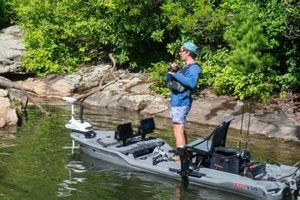
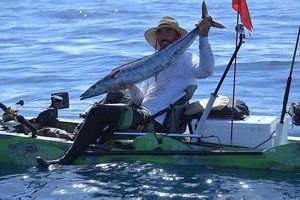
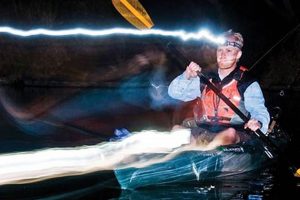
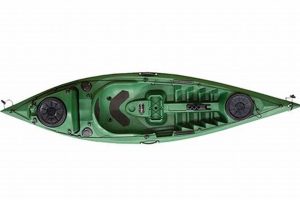
A small, maneuverable vessel designed for angling in confined waterways exemplifies this concept. Imagine a narrow, winding stream, ideally suited to a compact, lightweight watercraft built for stability and ease of paddling. Such a vessel allows anglers to access secluded fishing spots often unreachable by larger boats, enhancing their chances of a successful catch.
The ability to navigate shallow, restricted waters offers significant advantages to anglers. It opens up opportunities to explore pristine, less-pressured environments, potentially teeming with fish. This type of specialized watercraft also contributes to a more intimate connection with nature, allowing for a quiet, immersive experience in the outdoors. Historically, smaller, more portable boats have been crucial for fishing in various cultures, evolving from simple rafts and canoes to the sophisticated designs available today. This heritage underscores the enduring practicality and appeal of this approach to angling.
Further exploration of this topic will cover optimal vessel selection, essential gear, and effective techniques for navigating tight waterways and maximizing fishing success. Additionally, responsible practices for minimizing environmental impact and ensuring angler safety will be addressed.
Tips for Small Waterway Kayak Angling
Successful fishing in confined waterways requires careful planning and specialized techniques. The following tips offer guidance for a safe and productive experience.
Tip 1: Choose the Right Vessel: Opt for a shorter, lighter kayak designed for maneuverability in tight spaces. Consider features like stability, storage capacity, and comfortable seating for extended periods.
Tip 2: Pack Light and Efficiently: Minimize gear to essentials. Utilize waterproof storage bags and prioritize compact, multi-purpose tools.
Tip 3: Master Basic Paddle Strokes: Proficiency in draw strokes and other maneuvering techniques is crucial for navigating narrow channels and avoiding obstacles.
Tip 4: Understand Water Dynamics: Be aware of current flow, strainers, and other potential hazards. Research the waterway beforehand and exercise caution in unfamiliar areas.
Tip 5: Employ Stealth Tactics: Approach fishing spots quietly and avoid sudden movements that could spook fish. Utilize natural cover and camouflage whenever possible.
Tip 6: Adapt Tackle and Techniques: Favor lighter lines, smaller lures, and techniques suited to the species and conditions encountered in confined waters.
Tip 7: Practice Leave No Trace Principles: Pack out all trash, minimize disturbance to the environment, and respect wildlife.
Tip 8: Prioritize Safety: Wear a personal flotation device, inform someone of your plans, and check weather conditions before embarking on any fishing trip.
By adhering to these guidelines, anglers can significantly enhance their chances of success while enjoying a rewarding and responsible experience in small waterway environments.
These tips offer a starting point for navigating the nuances of small waterway kayak fishing. The following section will provide additional resources and further insights to enhance your angling adventures.
1. Maneuverability

Maneuverability represents a critical factor in the efficacy of a fishing kayak intended for Lost Creek. The creek’s characteristics, including narrow passages, overhanging vegetation, and potentially swift currents, necessitate a vessel capable of precise and responsive handling. A highly maneuverable kayak allows anglers to navigate complex obstacles, access secluded fishing holes, and maintain optimal positioning for casting and retrieving lines. Consider, for example, a scenario where a fallen tree obstructs the main channel. A less maneuverable kayak might require significant effort, or even prove impossible, to bypass the obstruction, effectively limiting access to upstream sections. A kayak designed for maneuverability, however, allows the angler to easily negotiate such challenges, maximizing fishing opportunities throughout the creek system.
Lost Creek’s dynamic environment further emphasizes the practical significance of maneuverability. Changes in water flow, debris accumulation, and the presence of other watercraft can create unforeseen navigational challenges. A highly maneuverable kayak provides the responsiveness needed to adapt quickly to these changing conditions, ensuring both safety and continued fishing success. For instance, a sudden shift in current direction could pose a risk to an angler in a less agile kayak. However, a kayak with superior maneuverability allows for quick adjustments in positioning and heading, minimizing the impact of such changes and maintaining control in challenging situations. This advantage translates directly to a safer and more productive fishing experience.
In summary, maneuverability is not simply a desirable feature but a fundamental requirement for a fishing kayak intended for use on Lost Creek. It directly impacts an angler’s ability to navigate the creek’s complexities, access prime fishing locations, and respond effectively to dynamic environmental conditions. Choosing a kayak optimized for maneuverability significantly contributes to both the safety and success of any Lost Creek fishing expedition.
2. Stability
Stability is a paramount consideration when selecting a fishing kayak for Lost Creek. The creek’s often shallow and dynamic waters, coupled with the need to make frequent casting motions, necessitate a vessel that provides a secure and balanced platform. Compromised stability not only hinders fishing effectiveness but also presents safety concerns, particularly in challenging conditions.
- Primary Stability
Primary stability refers to a kayak’s initial resistance to tipping. A wider, flatter hull design generally offers greater primary stability, making it ideal for calm water and stationary fishing. In Lost Creek, where conditions can change rapidly, high primary stability allows anglers to maintain balance while casting, reeling, and landing fish, even in relatively still water. For instance, the sudden weight shift when hooking a larger fish is less likely to compromise balance in a kayak with strong primary stability.
- Secondary Stability
Secondary stability describes a kayak’s ability to resist capsizing when leaned or tilted. This characteristic becomes crucial in Lost Creek’s moving water and tighter passages, where maneuvering often requires leaning into turns. A kayak with robust secondary stability provides a reassuring feeling of support, even when angled significantly, allowing anglers to confidently navigate challenging sections and maintain control in unpredictable currents. An example would be navigating a narrow bend where leaning is necessary to avoid overhanging branches; a kayak with strong secondary stability allows for this maneuver without the risk of tipping.
- Impact of Kayak Design
Hull shape, width, and length significantly influence stability. Shorter, wider kayaks generally exhibit greater initial stability, while longer, narrower designs prioritize speed and tracking. Selecting a kayak with a balanced design that prioritizes stability without sacrificing maneuverability is essential for Lost Creek. For example, a kayak with a moderate width and a shallow-V hull combines maneuverability with sufficient stability for the varying conditions encountered on the creek. Furthermore, features like outriggers or pontoons can further enhance stability, though they may compromise maneuverability in tight spaces.
- Influence of Angler Behavior and Gear
Angler behavior and gear distribution also play a role in overall stability. Distributing weight evenly, avoiding sudden movements, and maintaining a low center of gravity contribute to a more stable platform. Properly securing gear within the kayak prevents shifting weight that could compromise balance. For example, storing heavier items low and centrally within the kayak’s hull helps maintain stability. Similarly, avoiding abrupt movements, especially when standing or reaching for objects, significantly reduces the risk of tipping.
In conclusion, stability is an integral factor influencing both safety and fishing effectiveness on Lost Creek. Selecting a kayak with appropriate primary and secondary stability, coupled with mindful weight distribution and smooth movements, allows anglers to confidently navigate the creek’s challenges and focus on the task at hand. The interplay of these elements ultimately contributes to a more enjoyable and productive fishing experience.
3. Lightweight Design

Lightweight design represents a crucial attribute for fishing kayaks intended for Lost Creek. The creek’s characteristics often necessitate portaging around obstacles like fallen trees, shallow riffles, or beaver dams. A lightweight kayak significantly reduces the physical strain associated with these activities, allowing anglers to cover more ground and access otherwise unreachable sections of the creek. Consider, for example, a scenario where a significant log jam blocks the waterway. A heavier kayak would prove difficult, if not impossible, to maneuver over the obstacle, effectively ending the upstream journey. A lighter vessel, however, allows for easier portage, enabling continued exploration and access to prime fishing spots beyond the obstruction.
Beyond portaging, a lightweight design enhances overall maneuverability on the water. A lighter kayak responds more quickly to paddle strokes, facilitating navigation through tight turns and swift currents. This responsiveness proves particularly advantageous in Lost Creek’s dynamic environment, where obstacles and changing water conditions demand precise boat control. For instance, navigating a series of tight bends amidst submerged logs requires a kayak that can turn swiftly and efficiently. A lightweight hull contributes to this agility, minimizing effort and maximizing control, allowing anglers to focus on fishing rather than struggling with the vessel.
In summary, a lightweight design directly contributes to both the accessibility and maneuverability of a fishing kayak on Lost Creek. It enables anglers to overcome obstacles through portaging and enhances on-the-water responsiveness, facilitating exploration and effective navigation within the creek’s unique environment. Choosing a lightweight kayak ultimately expands fishing opportunities and enhances the overall experience on Lost Creek.
4. Storage Capacity
Adequate storage capacity is a critical factor for a successful fishing kayak excursion on Lost Creek. Given the creek’s often remote location and the need for self-sufficiency, ample storage space allows anglers to carry essential gear, safety equipment, and personal provisions comfortably. Insufficient storage can lead to difficult choices regarding what to bring, potentially compromising safety or fishing effectiveness. This section explores the multifaceted importance of storage capacity in the context of Lost Creek kayak fishing.
- Essential Gear
Fishing gear, including rods, reels, tackle boxes, and landing nets, occupies significant space. A kayak with dedicated storage compartments and sufficient overall capacity allows anglers to transport a variety of rods and tackle, optimizing preparedness for different species and fishing techniques. For instance, carrying both fly fishing and spin casting equipment expands angling options. Insufficient storage may necessitate leaving behind essential gear, limiting adaptability and potentially impacting fishing success.
- Safety Equipment
Safety equipment, such as a personal flotation device (PFD), first-aid kit, signaling devices, and extra paddle, are non-negotiable items. Dedicated storage compartments keep these items readily accessible in emergencies. For example, a quick-release hatch for the PFD ensures it can be reached instantly if needed. Compromising on safety equipment due to limited storage capacity is unacceptable and potentially dangerous, especially in Lost Creek’s often-isolated environment.
- Personal Provisions
Food, water, and extra clothing are essential for longer trips on Lost Creek. Sufficient storage space allows anglers to bring adequate provisions, ensuring comfort and preventing dehydration or hunger, particularly during extended excursions. For instance, dedicated dry storage compartments protect food and electronic devices from moisture damage. Limited storage may restrict the amount of food and water carried, potentially curtailing trip duration or compromising comfort and safety.
- Catch Storage
A designated area or cooler for storing caught fish is essential for preserving freshness and complying with regulations. Depending on the targeted species and local limits, this storage may require significant space. For example, a dedicated cooler with ice maintains the quality of caught fish for extended periods. Lack of adequate storage for the catch can lead to spoilage, necessitating early departure or the release of legally caught fish.
In conclusion, adequate storage capacity significantly impacts the safety, comfort, and effectiveness of fishing kayak trips on Lost Creek. Careful consideration of storage needs for essential gear, safety equipment, personal provisions, and catch storage ensures a well-prepared and enjoyable angling experience. Compromising on storage can lead to limitations and potentially unsafe situations, underscoring the importance of this aspect in kayak selection and trip planning.
5. Creek-specific Features

Creek-specific features in a fishing kayak significantly enhance performance and angler success on Lost Creek. These specialized adaptations address the unique challenges and opportunities presented by the creek’s environment. Lost Creek, characterized by shallow water, fallen logs, overhanging vegetation, and narrow passages, demands a kayak designed to navigate these obstacles effectively. Features such as a shallow-draft hull, retractable skeg or rudder, and a weedless propulsion system directly address these challenges.
A shallow-draft hull allows navigation in minimal water depths, expanding access to shallow riffles and backwaters often inaccessible to deeper-hulled kayaks. This expanded access exposes anglers to prime fishing locations often holding significant fish populations. For instance, a shallow draft allows access to the creek’s upper reaches where larger, deeper-draft boats cannot venture. These upstream areas often harbor less pressured fish, increasing the likelihood of a successful catch.
A retractable skeg or rudder enhances tracking and maneuverability, crucial for navigating Lost Creek’s tight bends and swift currents. The skeg improves straight-line tracking in open water sections, while the rudder provides precise control when navigating around obstacles. Consider a scenario where strong currents push the kayak off course. A rudder allows for quick corrections, maintaining the desired trajectory and preventing collisions with submerged logs or rocks. This precise control enhances both fishing effectiveness and safety.
A weedless propulsion system, such as a pedal drive or jet propulsion, minimizes entanglement in submerged vegetation and debris common in Lost Creek. This feature ensures continuous propulsion, even in heavily vegetated areas, allowing anglers to focus on fishing rather than clearing obstructions. Imagine navigating a shallow section choked with aquatic plants. A traditional propeller-driven kayak would quickly become entangled, requiring frequent stops to clear the propeller. A weedless system, however, glides through the vegetation unimpeded, maintaining fishing momentum and minimizing disruptions.
In summary, creek-specific features in a fishing kayak represent critical adaptations that significantly enhance performance and angler success on Lost Creek. These features directly address the challenges posed by the creek’s unique environment, from shallow water and tight turns to submerged vegetation and swift currents. Investing in a kayak equipped with these specialized adaptations ultimately unlocks Lost Creek’s full fishing potential while ensuring a safer and more enjoyable experience.
Frequently Asked Questions
This section addresses common inquiries regarding suitable watercraft for Lost Creek.
Question 1: What type of hull design is best suited to Lost Creek’s conditions?
A shorter kayak with a shallow-V or flat hull design offers optimal maneuverability and stability in Lost Creek’s shallow, often-winding waters. This design balances maneuverability with stability, crucial for navigating tight turns and maintaining balance in shallow areas.
Question 2: Is a sit-on-top or sit-inside kayak recommended for Lost Creek?
Sit-on-top kayaks are generally preferred for Lost Creek due to their self-bailing capabilities and ease of entry and exit. This design is advantageous in the event of a capsize and allows for wading in shallow areas.
Question 3: What propulsion system is most effective in Lost Creek?
Paddle propulsion remains the most versatile and practical choice for Lost Creek. While pedal drives offer hands-free operation, they can be susceptible to damage from submerged obstacles. Traditional paddling provides greater control and adaptability in the creek’s varied conditions.
Question 4: What safety equipment is essential for kayaking Lost Creek?
Essential safety equipment includes a personal flotation device (PFD), whistle, first-aid kit, and signaling device. A throw rope and bilge pump are also recommended. Given the creek’s often-remote location, communication devices like a waterproof cell phone or satellite messenger are strongly advised.
Question 5: What is the optimal length and weight capacity for a Lost Creek fishing kayak?
Kayaks between 10 and 14 feet in length, with a weight capacity exceeding 300 pounds, generally offer the best balance of maneuverability, stability, and storage capacity for Lost Creek. These specifications accommodate the angler, gear, and potential catch comfortably.
Question 6: Are there any specific regulations regarding kayak fishing on Lost Creek?
Anglers should consult local regulations regarding fishing licenses, catch limits, and permitted fishing methods on Lost Creek. Regulations can vary and may include restrictions on certain types of lures or fishing practices.
Careful consideration of these frequently asked questions aids in informed decision-making regarding appropriate kayak selection and preparation for a safe and successful fishing experience on Lost Creek.
The subsequent section offers additional resources and expert guidance for enhancing angling adventures on Lost Creek.
Lost Creek Fishing Kayak
Exploration of optimal kayak selection for Lost Creek emphasizes the critical interplay of maneuverability, stability, lightweight design, storage capacity, and creek-specific features. Navigating this unique environment demands a carefully considered approach, prioritizing a vessel capable of addressing the creek’s shallows, tight turns, and potential obstacles. Adequate storage ensures preparedness for varied fishing scenarios, while a lightweight design facilitates portage and enhances responsiveness on the water. Specialized features, such as a shallow draft and weedless propulsion, optimize performance in Lost Creek’s distinct conditions. Informed decision-making regarding these factors significantly impacts both safety and fishing success.
Successful navigation and angling within Lost Creek’s dynamic ecosystem necessitate informed preparation and a deep understanding of the waterway’s characteristics. Choosing appropriate equipment, coupled with responsible angling practices, ensures the preservation of this valuable natural resource for future generations. Continued exploration and mindful interaction with Lost Creek promise rewarding experiences for anglers who prioritize both personal safety and environmental stewardship.