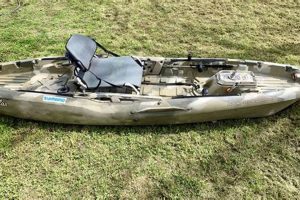
A system for vertically storing kayaks designed for angling offers a practical solution for space conservation, particularly within garages, sheds, or boathouses. These systems typically comprise brackets, straps, or slings engineered to securely cradle the hull and prevent damage. An example includes a pair of heavy-duty metal arms affixed to a wall, onto which the kayak is hoisted and strapped.
Proper storage safeguards the kayak’s integrity, extending its lifespan and maintaining its performance. Wall-mounted systems contribute to organized storage, freeing valuable floor space. This is increasingly important as outdoor recreational equipment competes for limited room in modern homes. Historically, kayaks were simply stored on the ground or leaned against structures, methods that offered little protection and consumed significant space. The evolution to specialized wall mounts reflects a growing appreciation for equipment care and efficient space utilization.
This article will delve into various aspects of these storage systems, covering topics such as selecting the right type, installation best practices, materials and construction, and maintenance considerations. It will also explore different models available, offering a comparative analysis to assist consumers in making informed decisions.
Tips for Kayak Storage Systems
Effective storage is crucial for maintaining the condition and longevity of fishing kayaks. These tips offer guidance on selecting and utilizing appropriate storage solutions.
Tip 1: Consider Kayak Weight and Dimensions: Storage systems must be rated for the specific kayak’s weight and length. Exceeding weight limits can lead to system failure and kayak damage. Measure the kayak accurately before selecting a mount.
Tip 2: Evaluate Wall Construction: Ensure the wall chosen can support the combined weight of the kayak and the fully loaded mounting system. Reinforcement may be necessary for certain wall types, such as drywall.
Tip 3: Choose Appropriate Mounting Hardware: Use suitable anchors and fasteners specifically designed for the wall material (e.g., concrete anchors for concrete walls). Incorrect hardware can compromise the system’s stability.
Tip 4: Pad Contact Points: Place padding between the kayak and the mounting system to protect the hull from scratches and pressure points. Foam padding or specialized kayak cradles are recommended.
Tip 5: Position Kayak for Balanced Storage: Distribute the kayak’s weight evenly across the mounting system to prevent strain on any single point. Adjust straps or cradles for optimal weight distribution.
Tip 6: Regularly Inspect the System: Periodically check the mounting hardware, straps, and other components for wear and tear. Replace worn parts promptly to prevent system failure.
Tip 7: Consider Environmental Factors: If storing outdoors, choose a system with weather-resistant materials. Prolonged exposure to sunlight and moisture can degrade some materials over time.
By following these guidelines, owners can ensure the safe and efficient storage of their equipment, preserving its value and readiness for future fishing excursions.
In conclusion, selecting the proper storage solution is an essential aspect of kayak ownership, contributing significantly to the vessel’s longevity and the owner’s overall experience.
1. Security

Security in the context of fishing kayak wall mounts encompasses two primary facets: safeguarding the kayak from theft and preventing accidental damage due to falls. A secure mounting system contributes significantly to the longevity and sustained value of the kayak. Inadequate security measures can result in financial loss due to theft or repair expenses from impact damage. For example, a kayak improperly secured with worn straps could detach from the wall, potentially damaging the hull or other nearby items. Similarly, a mount lacking a locking mechanism could be susceptible to theft, especially in shared storage spaces like apartment garages. Investing in robust security features mitigates these risks.
Several practical strategies enhance the security of wall-mounted kayaks. High-quality, weather-resistant locking straps or cables can deter theft. Utilizing wall anchors appropriate for the specific wall construction (e.g., concrete anchors in concrete walls) ensures the mount’s stability and prevents accidental dislodgement. Choosing a mount location away from high-traffic areas minimizes the risk of accidental impacts. In areas with higher security concerns, installing motion-sensor lighting or a security camera focused on the storage area can provide additional protection.
Prioritizing security within a kayak storage strategy protects the investment represented by the kayak itself. The cost of implementing robust security measures is often significantly less than the potential financial losses associated with theft or damage. A comprehensive security approach, incorporating appropriate hardware, strategic placement, and supplementary security systems, provides peace of mind and ensures the kayak remains ready for the next fishing trip.
2. Durability
Durability in a fishing kayak wall mount directly correlates with the system’s ability to withstand sustained stress from the kayak’s weight, environmental factors, and repeated use. This resilience is crucial for ensuring long-term functionality and preventing premature failure. A durable mount maintains its structural integrity over time, safeguarding the kayak from damage and minimizing the need for replacements. Material selection plays a pivotal role in determining durability. For instance, powder-coated steel mounts offer superior resistance to corrosion and rust compared to untreated metal, extending their lifespan in humid or coastal environments. Similarly, UV-resistant straps resist degradation from sun exposure, preserving their strength and load-bearing capacity. A mount constructed from inferior materials might buckle under the weight of a fully loaded fishing kayak, particularly in fluctuating temperature or humidity conditions. This could lead to the kayak falling and sustaining damage, potentially rendering it unusable.
The practical implications of durability extend beyond the mere longevity of the mount itself. A robust system minimizes the risk of damage to the kayak, which can be costly to repair or replace. Durable construction also contributes to user safety by preventing unexpected failures that could lead to injuries. Consider a scenario where a corroded mounting bracket fails under load, causing the kayak to fall onto a person or valuable equipment. Such incidents underscore the importance of prioritizing durability. Selecting a mount designed to withstand the specific environmental conditions and anticipated usage patterns avoids such risks and ensures the kayak remains securely stored.
Ultimately, durability represents a critical factor in evaluating the overall value and suitability of a fishing kayak wall mount. While initial costs might be higher for more durable materials and construction, the long-term benefits of reduced maintenance, minimized risk of damage, and enhanced safety outweigh the upfront investment. A durable mounting system provides a reliable and secure storage solution, preserving the kayak’s condition and enabling continued enjoyment of the sport.
3. Space Efficiency

Space efficiency is a paramount consideration when storing kayaks, particularly within limited areas like garages or sheds. Wall mounts offer a significant advantage in this regard by utilizing vertical space, which is often underutilized. This vertical orientation frees up valuable floor space for other equipment, vehicles, or activities. Consider a typical garage where floor space is often at a premium. Storing a kayak horizontally on the floor can consume considerable area, hindering movement and limiting storage capacity. A wall-mounted system allows the same kayak to be stored vertically, reclaiming that floor space for other purposes. This can be the difference between a cluttered, unusable garage and an organized, functional space.
The impact of space efficiency extends beyond mere convenience. In smaller homes or apartments, efficient storage can be essential for maintaining an organized and livable environment. Wall-mounting a kayak can free up enough floor space to create a workshop area, store bicycles, or simply allow for easier movement within the garage. Furthermore, proper storage contributes to the longevity of the kayak itself. Storing a kayak horizontally on the floor exposes it to potential damage from foot traffic, falling objects, or other equipment. Wall mounting reduces these risks, protecting the kayak’s integrity and minimizing repair costs.
In conclusion, wall-mounting a fishing kayak directly addresses the challenge of limited storage space. The vertical storage orientation maximizes space utilization, transforming potentially cluttered areas into functional and organized spaces. This approach not only enhances convenience but also contributes to the protection and longevity of the kayak, representing a practical and efficient storage solution for kayak enthusiasts. Careful consideration of available wall space, kayak dimensions, and mounting system design allows for a storage solution tailored to individual needs and spatial constraints.
4. Ease of Use

Ease of use is a critical factor influencing the practicality and overall user experience of a fishing kayak wall mount system. A system that is cumbersome or difficult to operate can deter regular use, leading to kayaks being left on the floor, negating the benefits of wall mounting. This can create a safety hazard and contribute to clutter. Furthermore, a complex mounting process can increase the risk of improper storage, potentially leading to damage to the kayak. For example, a system requiring multiple straps and buckles to secure the kayak might discourage users, particularly after a long day on the water. Conversely, a well-designed system with intuitive features, such as adjustable cradles and easy-to-operate hoists, promotes consistent and correct usage.
The practical implications of ease of use extend beyond mere convenience. A user-friendly system reduces the physical strain associated with lifting and securing a heavy kayak, minimizing the risk of injury. This is particularly relevant for individuals with limited mobility or strength. Consider a system incorporating a pulley-assisted hoist. This feature significantly reduces the effort required to lift the kayak onto the wall mount, making the process accessible to a wider range of users. Moreover, an easy-to-use system saves time, allowing users to quickly and efficiently store their kayak and move on to other tasks. This efficiency is especially valuable in busy households or shared storage spaces.
In summary, ease of use is an integral aspect of a well-designed fishing kayak wall mount. A system that prioritizes user-friendliness encourages consistent proper storage, contributing to both safety and the preservation of the kayak. Features that simplify the mounting and retrieval process enhance accessibility, reduce physical strain, and save time, ultimately improving the overall user experience and maximizing the benefits of wall-mounted kayak storage. Investing in a system designed for effortless operation ensures long-term satisfaction and encourages responsible kayak storage practices.
5. Compatibility

Compatibility between a fishing kayak wall mount and the specific kayak model is paramount for secure and damage-free storage. Several factors influence compatibility, including kayak length, width, hull design (flat bottom, pontoon, V-shaped), and weight, including any permanently affixed accessories. A mismatch can lead to instability, stress on the hull, and potential damage to both the kayak and the mount. For example, attempting to mount a wide, sit-on-top fishing kayak designed for ocean use on a mount designed for narrow, recreational kayaks could lead to excessive strain on the mounting arms and potentially warp the kayak’s hull over time. Similarly, ignoring weight limitations can cause the mount to fail, resulting in the kayak falling and incurring damage.
Manufacturers often provide compatibility guidelines specifying the dimensions and weight capacities of their mounts. Consulting these guidelines and carefully measuring the kayak are crucial steps in ensuring proper fit. Furthermore, considering the mounting location and available space ensures the mounted kayak won’t obstruct access or create a safety hazard. For instance, a longer fishing kayak might not fit comfortably in a narrow garage, even with a compatible wall mount. In such cases, alternative storage solutions or adjustments to the garage layout might be necessary. Some mounts offer adjustable cradles or straps, allowing for a degree of customization to accommodate different hull shapes and sizes. This adaptability enhances compatibility across a broader range of kayak models, providing a versatile storage solution.
Ensuring compatibility is essential for maximizing the benefits of a wall-mounted storage system. A compatible mount not only safeguards the kayak from damage but also contributes to the system’s overall stability and longevity. Neglecting compatibility can lead to costly repairs, compromised safety, and a frustrating user experience. Thorough assessment of both the kayak and the intended mounting location, coupled with careful consideration of manufacturer specifications, ensures a secure, efficient, and damage-free storage solution.
Frequently Asked Questions
This section addresses common inquiries regarding fishing kayak wall mounts, providing concise and informative responses to assist consumers in making informed decisions.
Question 1: What types of walls are suitable for mounting kayaks?
Stud-framed walls, concrete walls, and brick walls can generally support kayak mounts. However, the specific mounting hardware must be appropriate for the wall material. Drywall alone is insufficient and requires reinforcement.
Question 2: How much weight can a typical kayak wall mount support?
Weight capacity varies significantly among models. Always check the manufacturer’s specifications. Mounts designed for fishing kayaks typically support higher weights, often exceeding 200 pounds to accommodate heavier kayaks and gear.
Question 3: Are specialized mounts necessary for fishing kayaks, or can generic kayak mounts suffice?
While generic mounts might work for smaller recreational kayaks, specialized fishing kayak mounts are often recommended. These typically offer higher weight capacities, wider cradles to accommodate broader hulls, and features designed for securing fishing accessories.
Question 4: What materials offer the best durability for outdoor kayak storage?
Marine-grade stainless steel or powder-coated steel offers excellent corrosion resistance for outdoor environments. UV-resistant straps are essential to prevent degradation from sunlight exposure.
Question 5: How can one prevent damage to the kayak hull during storage?
Using padding or specialized cradles between the kayak and the mounting hardware helps distribute weight evenly and prevent pressure points that can lead to scratches or deformations.
Question 6: Are there safety precautions to consider when installing a kayak wall mount?
Using appropriate safety equipment like eye protection and gloves is recommended during installation. Ensuring proper weight distribution and secure anchoring are crucial for preventing accidents. Consulting professional installers is advisable for complex installations or if there are concerns about wall integrity.
Careful consideration of these frequently asked questions helps ensure the selection of an appropriate and effective wall mount system, contributing to safe, efficient, and long-term kayak storage.
The next section will explore specific examples of popular fishing kayak wall mounts available on the market.
Fishing Kayak Wall Mount
Proper storage is paramount for maintaining the integrity and longevity of fishing kayaks. This article has explored the multifaceted aspects of fishing kayak wall mounts, encompassing considerations of security, durability, space efficiency, ease of use, and compatibility. Selecting an appropriate mounting system requires careful evaluation of these factors in relation to the specific kayak’s dimensions, weight, and intended usage environment. Appropriate hardware, correct installation procedures, and routine system inspection contribute significantly to safe and effective long-term storage. Investing in a quality wall mount system ultimately protects the kayak investment and enhances the overall user experience.
The evolution of kayak storage solutions reflects the growing demand for efficient space utilization and equipment protection. As kayak fishing continues to gain popularity, the importance of secure and convenient storage will only become more pronounced. Careful consideration of the factors outlined in this article will empower consumers to make informed decisions, ensuring their kayaks remain protected and ready for future adventures on the water. Appropriate storage practices contribute not only to the preservation of valuable equipment but also to the continued enjoyment of the sport.