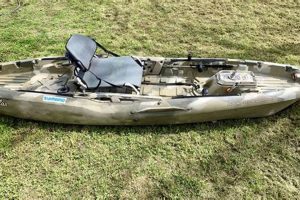
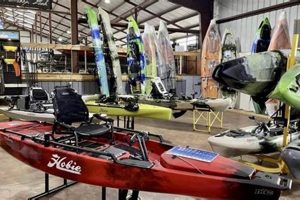
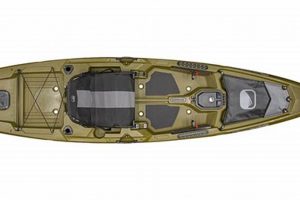
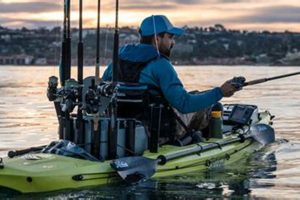
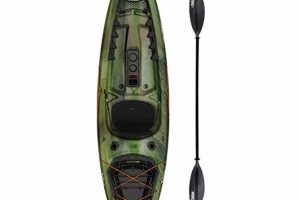
Hands-free kayaking for anglers is achieved through pedal-powered vessels designed for fishing. These watercraft utilize leg power to drive a propeller or flipper system, leaving the hands free for casting, reeling, and other fishing tasks. This design typically incorporates features like rod holders, gear tracks, and livewells specifically for angling.
This method of propulsion offers significant advantages for fishing enthusiasts. Increased maneuverability and speed compared to paddle kayaks allow anglers to cover more water efficiently. The ability to maintain position and navigate in challenging conditions like wind or current, without paddling, enhances fishing success. Furthermore, maintaining a steady position without constant paddling reduces fatigue and allows for more focused fishing. The development of these specialized kayaks reflects the growing demand for innovative fishing equipment that maximizes efficiency and improves the overall angling experience.
The following sections will explore the various propulsion systems, popular models, essential features, and techniques for effectively utilizing these specialized fishing kayaks.
Tips for Pedal Kayak Fishing
Maximizing the advantages of hands-free fishing requires careful consideration of several key factors. These tips offer guidance for selecting, using, and maintaining a pedal-driven fishing kayak.
Tip 1: Consider Water Conditions: Different propulsion systems (propeller or fin) perform differently in various environments. Propellers excel in open water but are susceptible to damage in shallow, weedy areas. Fin drives handle shallows and vegetation better but may be less efficient in deep water.
Tip 2: Prioritize Stability: Wider kayaks generally offer greater stability, crucial for standing and casting. Consider the intended fishing environment and personal balance when selecting a hull design.
Tip 3: Evaluate Seating and Adjustability: A comfortable and adjustable seat is essential for long days on the water. Ensure the seat position allows for efficient pedaling and easy access to fishing gear.
Tip 4: Research Propulsion Systems: Understand the advantages and disadvantages of propeller-driven versus fin-driven systems. Consider factors like maintenance, durability, and performance in different water conditions.
Tip 5: Practice Maneuvering: Spend time familiarizing oneself with the kayak’s turning radius and responsiveness. Practice maneuvering in open water before venturing into complex or challenging environments.
Tip 6: Maintain the Drive System: Regular maintenance, including rinsing after each use and periodic lubrication, ensures optimal performance and prolongs the life of the propulsion system.
Tip 7: Pack Strategically: Distribute weight evenly throughout the kayak for optimal balance and stability. Utilize integrated storage compartments and secure loose items to prevent shifting during movement.
By considering these factors, anglers can enhance their fishing experience and maximize the benefits of pedal-powered kayaks. The proper selection, use, and care of these specialized vessels contribute significantly to fishing success and enjoyment on the water.
This information provides a foundation for informed decision-making regarding pedal-powered fishing kayaks. Further research and hands-on experience will enhance understanding and proficiency.
1. Hands-Free Fishing

Hands-free fishing represents a significant advancement in angling, directly enabled by the development of foot-propelled kayaks. This capability fundamentally alters the fishing experience, offering substantial advantages over traditional paddling methods. The following facets explore the core components and implications of hands-free fishing within the context of pedal-driven kayaks.
- Enhanced Lure Control:
Maintaining precise lure presentation and depth becomes significantly easier without the need to manage a paddle. Subtle adjustments and consistent retrieves are achievable, optimizing lure action and attracting more fish. This is particularly beneficial in techniques like trolling or jigging where consistent lure movement is crucial. Foot propulsion allows for continuous, controlled movement, maximizing lure effectiveness.
- Improved Hookset Ratio:
With hands constantly available, anglers can react instantly to strikes, leading to more successful hooksets. The elimination of the delay associated with transitioning from paddle to rod significantly increases the likelihood of landing a fish. This responsiveness is especially advantageous in fast-action fishing scenarios.
- Multitasking Capability:
Hands-free operation allows anglers to perform multiple tasks simultaneously. Managing fishing rods, adjusting tackle, operating electronics, and even landing fish can all be accomplished without interrupting boat control. This efficiency significantly enhances the overall fishing experience, allowing for greater focus on strategy and technique. Examples include adjusting drag settings mid-fight or netting a fish without sacrificing boat position.
- Increased Situational Awareness:
By freeing the hands and upper body from paddling, anglers gain a wider field of view and improved awareness of their surroundings. This enhanced perception allows for better observation of water conditions, identification of fish-holding areas, and quicker responses to changing circumstances. This heightened awareness contributes significantly to safety and fishing success.
These combined advantages demonstrate the transformative impact of hands-free fishing facilitated by foot-propelled kayaks. This technology empowers anglers with greater control, efficiency, and responsiveness, ultimately leading to a more rewarding and successful fishing experience. The evolution of hands-free fishing continues to shape the future of angling, driving innovation and enhancing the pursuit of this time-honored sport.
2. Pedal-Powered Propulsion

Pedal-powered propulsion forms the core differentiating feature of foot-propelled fishing kayaks, distinguishing them from traditional paddle-powered vessels. This innovative propulsion method leverages biomechanics for efficient and continuous movement through water. Direct drive systems translate rotational leg motion into propeller thrust or fin movement. This hands-free propulsion offers significant advantages for anglers. For example, a propeller system, analogous to a motorized boat, generates forward momentum by displacing water. Alternatively, fin-driven systems, mimicking the motion of a fish’s tail, offer superior maneuverability in shallow or vegetated waters, a common scenario in many fishing environments.
The practical significance of pedal-powered propulsion becomes readily apparent in diverse fishing situations. Maintaining position in currents or wind, crucial for presenting lures effectively, is easily achieved without constant paddling adjustments. Similarly, covering larger distances to reach distant fishing spots becomes less physically demanding and more time-efficient. Consider trolling for pelagic fish; pedal power allows consistent lure presentation at optimal speeds without the fatigue associated with continuous paddling. In shallow-water fishing, a fin-drive system minimizes disturbance, crucial for stealthy approaches in clear water, increasing chances of a successful catch.
Understanding the nuances of pedal-powered propulsion systemspropeller versus fin driveempowers informed decision-making when selecting a fishing kayak. Factors such as fishing environment, target species, and personal preference influence the optimal choice. While propeller systems excel in open water, fin drives offer advantages in shallow, obstacle-rich environments. The efficiency and hands-free operation of pedal propulsion significantly enhance angling effectiveness and overall enjoyment, representing a substantial advancement in kayak fishing technology.
3. Enhanced Maneuverability
Enhanced maneuverability represents a defining advantage of foot-propelled fishing kayaks, significantly impacting angling effectiveness. Precise boat control is paramount for successful fishing, enabling anglers to position themselves strategically, navigate complex environments, and respond effectively to changing conditions. Foot propulsion systems directly contribute to this enhanced control, offering distinct advantages over traditional paddle kayaks.
- Precise Boat Positioning:
Maintaining precise position, crucial for presenting lures effectively or anchoring near structure, is significantly easier with foot propulsion. Subtle adjustments and corrections can be made without shifting body weight or interrupting fishing activities. This precision allows anglers to hold position in currents or wind, optimizing lure presentation and maximizing fishing success.
- Navigation in Complex Environments:
Navigating shallows, tight quarters, and obstacle-rich environments becomes more manageable with the enhanced maneuverability of pedal kayaks. Quick turns and precise movements allow anglers to access hard-to-reach fishing spots and avoid underwater hazards. Consider maneuvering through dense vegetation or around submerged logs; foot propulsion provides the control necessary to navigate these challenging scenarios effectively.
- Efficient Turning and Tracking:
Foot-propelled kayaks generally exhibit tighter turning radii and improved tracking compared to paddle kayaks. This responsiveness allows for quick changes in direction and more efficient navigation, crucial for following fish or adapting to changing water conditions. The ability to execute quick turns can be essential when targeting fast-moving species or reacting to sudden changes in fish behavior.
- Effortless Course Correction:
Maintaining a desired course, especially in wind or current, requires less effort with foot propulsion. Minor course corrections can be made smoothly and continuously without interrupting the fishing process. This effortless control allows anglers to focus on fishing rather than constantly adjusting their paddle strokes to maintain direction.
The enhanced maneuverability offered by foot-propelled fishing kayaks translates directly to increased angling effectiveness. Precise boat control, efficient navigation, and responsive handling contribute significantly to fishing success, allowing anglers to exploit diverse fishing environments and maximize their time on the water. This advantage underscores the value of foot propulsion in modern kayak fishing, solidifying its position as a key innovation in the sport.
4. Increased Fishing Efficiency
Increased fishing efficiency represents a primary benefit of foot-propelled kayaks, directly impacting an angler’s ability to maximize time and resources on the water. These kayaks offer distinct advantages over traditional paddle-powered vessels, allowing for a more streamlined and productive fishing experience. The following facets explore the key components contributing to increased efficiency.
- Reduced Physical Exertion:
Utilizing leg muscles, generally stronger than arm muscles, for propulsion reduces fatigue and allows for longer fishing sessions. This sustained energy translates to more time actively fishing, increasing the likelihood of success. Consider a full day of trolling; pedal propulsion significantly reduces fatigue compared to paddling, allowing anglers to cover more water and fish longer.
- Optimized Time Management:
Hands-free operation allows for simultaneous fishing and boat control, eliminating the need to switch between paddling and fishing activities. This continuous engagement maximizes fishing time, crucial for capitalizing on peak bite windows or changing weather conditions. For example, anglers can maintain lure presentation in a prime fishing spot while simultaneously preparing tackle or adjusting equipment.
- Improved Coverage Area:
Faster speeds and continuous propulsion enable anglers to cover more water in less time, expanding the search area and increasing the chances of encountering fish. This enhanced mobility is particularly advantageous in larger bodies of water or when searching for scattered fish populations. Consider searching for schooling fish; pedal kayaks allow for rapid exploration of different areas, increasing the likelihood of locating active feeding zones.
- Enhanced Focus on Fishing:
By eliminating the physical demands of paddling, anglers can dedicate more mental energy to fishing strategies, techniques, and observation. This enhanced focus translates to better decision-making and increased responsiveness to fish activity, ultimately improving fishing outcomes. For example, anglers can focus on reading water conditions, interpreting sonar data, or selecting the appropriate lure without the distraction of paddling.
These combined factors contribute significantly to the increased fishing efficiency offered by foot-propelled kayaks. By reducing physical exertion, optimizing time management, improving coverage area, and enhancing focus on fishing, these specialized vessels empower anglers to maximize their time on the water and improve their overall fishing success. This increased efficiency represents a key advantage, driving the popularity of foot-propelled kayaks amongst serious anglers seeking to enhance their fishing experience.
5. Specialized Design Features

Specialized design features distinguish foot-propelled fishing kayaks from recreational models, optimizing them for angling effectiveness. These features cater specifically to the demands of fishing, enhancing functionality, convenience, and overall performance on the water. The integration of these features stems directly from the unique requirements of hands-free fishing and the need to maximize efficiency in various fishing scenarios. For example, integrating rod holders and gear tracks transforms the kayak into a mobile fishing platform, while built-in livewells maintain bait viability, critical for successful angling. This specialization reflects a deliberate design philosophy prioritizing the angler’s needs and optimizing the kayak for its intended purpose.
Consider the impact of specialized seating systems. Adjustable, elevated seats offer enhanced visibility and facilitate casting, while incorporating backrests minimizes fatigue during long fishing trips. Similarly, strategically placed footrests ensure efficient power transfer to the propulsion system, maximizing speed and maneuverability. The inclusion of specialized storage compartments, designed to accommodate tackle boxes and other fishing gear, further streamlines the fishing experience. These examples illustrate the practical significance of specialized design features, directly impacting comfort, efficiency, and overall fishing performance. Understanding these features empowers anglers to select the kayak best suited to their individual fishing style and target species.
In summary, specialized design features are integral to the functionality and effectiveness of foot-propelled fishing kayaks. These features are not mere additions but carefully considered components that enhance the overall fishing experience. From rod holders and gear tracks to specialized seating and storage, these features contribute directly to angler comfort, efficiency, and success on the water. A thorough understanding of these features is essential for informed decision-making and maximizing the potential of a foot-propelled fishing kayak. The ongoing evolution of kayak design continues to refine these features, further optimizing the angling experience and pushing the boundaries of kayak fishing technology.
Frequently Asked Questions
This section addresses common inquiries regarding foot-propelled fishing kayaks, providing concise and informative responses to facilitate informed decision-making.
Question 1: What are the primary advantages of a foot-propelled fishing kayak over a traditional paddle kayak?
Key advantages include hands-free fishing, increased speed and maneuverability, reduced fatigue, and the ability to maintain position in challenging conditions like wind or current. These factors contribute to a more efficient and enjoyable fishing experience.
Question 2: How do propeller-driven and fin-driven propulsion systems differ, and which is better for specific fishing environments?
Propeller systems excel in open water and offer higher speeds, while fin systems are better suited for shallow water, vegetation, and navigating obstacles. The optimal choice depends on the intended fishing environment and personal preferences.
Question 3: What are the key features to consider when selecting a foot-propelled fishing kayak?
Essential features include stability, comfortable seating, ample storage, rod holders, gear tracks, and the type of propulsion system. Consider the target species, fishing environment, and personal preferences when selecting a model.
Question 4: How does one maintain a foot-propelled kayak’s drive system?
Regular maintenance involves rinsing the system with fresh water after each use, periodic lubrication of moving parts, and inspecting for damage or wear. Proper maintenance ensures optimal performance and prolongs the lifespan of the drive system.
Question 5: Are foot-propelled kayaks more difficult to transport and store than traditional kayaks?
While slightly heavier and potentially bulkier, many foot-propelled kayaks are designed for easy transport and storage. Consider factors like weight capacity, hull design, and available storage space when selecting a model. Specialized kayak trailers and rooftop carriers facilitate transport.
Question 6: What is the typical price range for foot-propelled fishing kayaks, and what factors influence cost?
Prices typically range from mid-range to high-end, depending on features, materials, and brand. Factors influencing cost include propulsion system complexity, hull design, materials, integrated features (e.g., fish finders, GPS), and brand reputation.
Addressing these frequently asked questions provides a foundational understanding of foot-propelled fishing kayaks. Further research and hands-on experience will contribute to informed decision-making and a more rewarding fishing experience.
The following section will provide in-depth reviews of several popular foot-propelled fishing kayak models.
Conclusion
Pedal-powered fishing kayaks represent a significant advancement in angling technology. Their capacity for hands-free operation, enhanced maneuverability, and increased efficiency presents compelling advantages for anglers. From navigating challenging waters to maximizing fishing time, these specialized vessels offer a distinct edge in diverse fishing environments. The integration of specialized design features, tailored to angling needs, further solidifies their position as a powerful tool for the serious angler. Careful consideration of propulsion systems, hull designs, and integrated features empowers informed selection and maximizes the potential of these advanced fishing platforms.
The evolution of pedal-driven fishing kayaks continues to shape the future of angling. As technology advances, further refinements in design and functionality are anticipated, promising even greater efficiency, performance, and overall fishing success. Embracing these advancements empowers anglers to explore new possibilities, refine their techniques, and deepen their connection with the sport. The future of kayak fishing undoubtedly hinges on continued innovation and the pursuit of enhanced angling experiences.