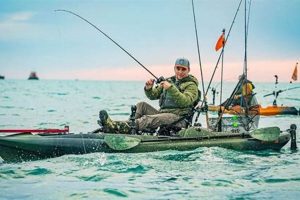
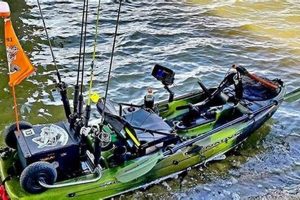
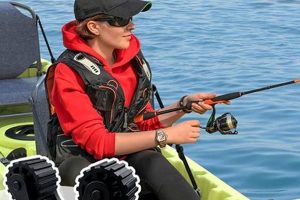
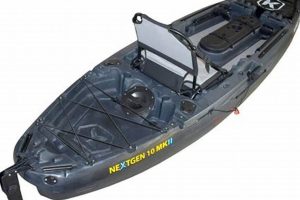
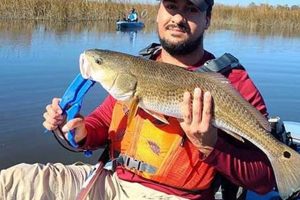
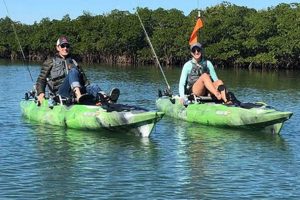
This specific watercraft is a popular choice for anglers due to its unique combination of stability, speed, and specialized features. It blends the nimble handling of a kayak with a stable platform ideal for casting and reeling, even in challenging conditions. The pedal-driven propulsion system allows hands-free fishing and maneuverability in shallow waters, while integrated features like rod holders and storage compartments cater specifically to anglers’ needs.
The vessel represents a significant advancement in fishing kayak design. Its hands-free propulsion system provides a distinct advantage, freeing anglers to focus on fishing rather than paddling. This enhances efficiency and reduces fatigue, enabling longer and more productive fishing trips. Furthermore, the platforms inherent stability allows anglers to stand and cast, offering better visibility and casting control. This design has contributed to the growing popularity of kayak fishing by making the sport more accessible and enjoyable.
Further exploration will delve into specific design elements, performance characteristics, user experiences, and potential drawbacks of this specialized watercraft, offering a comprehensive overview for both prospective buyers and those interested in the evolution of fishing kayak technology.
Tips for Utilizing the Pedal-Driven Fishing Kayak
Effective use of this specialized watercraft requires understanding its unique features and operational nuances. The following tips offer guidance for maximizing performance and ensuring a safe and productive fishing experience.
Tip 1: Master the Pedal Drive System: Practice maneuvering the vessel on calm water before venturing into more challenging conditions. Understanding the nuances of forward and reverse pedaling, along with steering techniques, is crucial for precise boat control.
Tip 2: Optimize Gear Storage: Distribute weight evenly throughout the hull for optimal stability. Secure gear within designated compartments to prevent shifting during movement and potential interference with the pedal drive system.
Tip 3: Utilize the Vantage Point: The platform’s inherent stability allows anglers to stand and cast, enhancing visibility and casting accuracy. Practice standing and casting in calm water before attempting this maneuver in rougher conditions.
Tip 4: Understand Water Conditions: Be mindful of currents, tides, and wind conditions, as these factors can significantly impact maneuverability. Plan fishing trips accordingly, taking into account prevailing conditions and potential changes.
Tip 5: Practice Proper Launching and Landing Techniques: Learn how to launch and land the vessel efficiently and safely from various shoreline types and dock configurations. This includes understanding how to handle the vessel in shallow water and navigate potential obstacles.
Tip 6: Prioritize Safety: Always wear a personal flotation device and carry essential safety equipment, including a whistle, signaling device, and first-aid kit. Inform someone of your fishing plans, including intended location and estimated return time.
Tip 7: Regular Maintenance: Rinse the hull and pedal drive system with fresh water after each use to prevent corrosion and maintain optimal performance. Periodically inspect and lubricate moving parts to ensure smooth operation.
By adhering to these guidelines, individuals can enhance their on-the-water experience, maximizing both efficiency and enjoyment while prioritizing safety.
This understanding lays the foundation for a comprehensive exploration of the broader applications and implications of this specialized watercraft within the evolving landscape of recreational fishing.
1. Pedal-driven propulsion

Pedal-driven propulsion systems represent a significant departure from traditional paddle-powered kayaks, offering distinct advantages for fishing applications. This technology is central to the Hobie Mirage Outback fishing kayak’s appeal, enabling enhanced efficiency and hands-free operation.
- Enhanced Fishing Efficiency:
Pedal drives free the angler’s hands for casting, reeling, and other fishing-related tasks. This eliminates the need to switch between paddling and fishing, streamlining the process and increasing overall fishing time. This efficiency is particularly advantageous in situations requiring quick adjustments or precise boat control, such as fighting a fish or navigating tight spaces.
- Improved Maneuverability:
The MirageDrive pedal system, specific to Hobie kayaks, utilizes a fin-based propulsion system that allows for forward and reverse movement as well as precise steering. This maneuverability is particularly beneficial in shallow water, around obstacles, and in challenging currents. Anglers can maintain position and adjust their approach without interrupting the fishing process.
- Reduced Physical Strain:
Utilizing leg muscles for propulsion reduces strain on the upper body, especially compared to traditional paddling. This translates to less fatigue over extended periods, allowing for longer fishing trips and enabling anglers to focus their energy on fishing rather than paddling. This advantage is particularly important for individuals with physical limitations or those seeking all-day fishing excursions.
- Stealth and Approach:
Pedal-driven propulsion generates less surface disturbance than paddling, resulting in a quieter and less intrusive approach. This stealth can be crucial for approaching fish in shallow waters or spooky environments. The minimal noise and vibration contribute to a more natural presentation, increasing the likelihood of attracting fish.
The integration of pedal-driven propulsion into the Hobie Mirage Outback significantly enhances its capabilities as a fishing platform. By freeing the angler’s hands, increasing maneuverability, reducing physical strain, and enabling stealthy approach, this technology contributes significantly to the kayak’s overall effectiveness and popularity within the fishing community.
2. Enhanced Stability

Stability is a critical factor in fishing kayak design, directly impacting angler safety, comfort, and fishing effectiveness. The Hobie Mirage Outback fishing kayak is recognized for its enhanced stability, a key feature that distinguishes it from traditional kayaks and contributes to its popularity. This enhanced stability derives from a combination of design elements that work together to provide a secure and balanced platform, even in challenging conditions.
- Hull Design:
The Outback features a wider, flatter hull design compared to traditional kayaks. This broader base increases the kayak’s overall stability, making it less prone to tipping or rocking. The hull’s shape displaces water more effectively, providing a stable platform even when subjected to external forces such as waves or currents. This design element is crucial for anglers who prefer to stand while fishing, enabling a more stable casting platform.
- Weight Distribution:
The Outback’s design incorporates weight distribution considerations. The placement of seating, storage compartments, and other features contributes to a lower center of gravity, further enhancing stability. Proper distribution of gear within the kayak is also essential for maintaining balance and preventing instability. Anglers are encouraged to distribute weight evenly throughout the hull to optimize stability and performance.
- Outriggers/Stabilizers (Optional):
While the Outback is inherently stable, optional outriggers or stabilizers can be added for further stability enhancement. These additions provide additional buoyancy and support, making the kayak virtually unsinkable and ideal for anglers who prioritize maximum stability or frequently fish in challenging conditions. Outriggers are particularly beneficial for individuals with balance concerns or those who require a more secure platform for standing and casting.
- Standing Platform:
The Outback is designed with a standing platform, allowing anglers to stand and fish comfortably. This elevated position provides better visibility, increased casting range, and improved leverage when fighting fish. The kayak’s inherent stability is crucial for enabling this standing position, providing a secure and balanced platform even while casting, reeling, or landing fish.
The enhanced stability of the Hobie Mirage Outback significantly contributes to its versatility and effectiveness as a fishing platform. By providing a secure and balanced platform, the Outback enables anglers to focus on fishing with confidence, enhancing both safety and enjoyment on the water. This feature, combined with the pedal-driven propulsion system, positions the Outback as a highly capable and adaptable fishing kayak suitable for a wide range of fishing environments and angler preferences.
3. Specialized fishing features
The efficacy of a fishing kayak hinges significantly on its specialized features, differentiating it from recreational kayaks. The Hobie Mirage Outback exemplifies this principle through thoughtful integrations designed to enhance angling effectiveness and overall experience. These features are not mere add-ons but integral components contributing to its recognition as a purpose-built fishing platform.
Several key features deserve highlighting. Multiple rod holders, strategically positioned for easy access and diverse fishing techniques, allow anglers to carry various rods rigged for different target species or fishing styles. Ample storage compartments, including a large rear cargo area, accommodate tackle boxes, gear, and even larger items like coolers, ensuring all essentials are readily available. Further enhancements, like the Vantage CTW seat, prioritize comfort during long fishing sessions, while the horizontal rod storage system safeguards rods during transport and navigation. These features, strategically integrated into the kayak’s design, contribute directly to improved fishing efficiency, organization, and overall comfort.
Practical examples underscore the significance of these specialized features. An angler targeting different species might carry a heavier rod for bottom fishing and a lighter one for topwater lures. Multiple rod holders eliminate the need to constantly re-rig, saving valuable fishing time. Similarly, ample storage ensures easy access to tackle and equipment, streamlining lure changes and adjustments. Consider navigating through dense vegetation; the horizontal rod storage system prevents entanglement and potential rod damage. These practical applications demonstrate how these specialized features contribute to a more productive and enjoyable fishing experience.
In conclusion, the specialized features of the Hobie Mirage Outback are integral to its function as a high-performance fishing kayak. They enhance not only practical effectiveness but also the overall fishing experience. Understanding these features’ contributions is crucial for appreciating the kayak’s value proposition within the broader context of fishing kayak design and application.
4. Durability and Construction

The Hobie Mirage Outback fishing kayak’s construction plays a crucial role in its longevity, performance, and overall value. Durability is paramount in a fishing kayak, given the demanding environments it often faces from rocky shorelines and shallow-water obstacles to extended exposure to saltwater and sunlight. A robust construction is essential not only for withstanding these challenges but also for ensuring angler safety and a long service life. Understanding the materials and construction techniques employed provides valuable insight into the kayak’s ability to perform reliably over time.
- Hull Material:
The Outback utilizes rotomolded polyethylene for its hull construction. This material is known for its impact resistance, durability, and UV resistance, crucial for withstanding impacts, abrasions, and prolonged sun exposure. Rotomolding creates a seamless, one-piece hull, eliminating potential weak points or seams that could compromise structural integrity. This robust construction ensures the kayak can endure the rigors of frequent use in diverse environments, from rocky rivers to open ocean conditions.
- UV Resistance:
Polyethylene’s inherent UV resistance is crucial for maintaining the hull’s structural integrity and preventing degradation from prolonged sun exposure. This resistance ensures the kayak’s color and material properties remain consistent over time, preventing cracking, fading, or weakening due to UV radiation. This longevity is particularly important for kayaks frequently used in sunny climates, minimizing the need for frequent replacements or repairs due to sun damage.
- Hardware and Fittings:
High-quality stainless steel and corrosion-resistant hardware are employed throughout the Outback’s construction. This includes components like rod holders, hatch latches, and rudder fittings. Corrosion-resistant materials are essential for maintaining functionality and preventing premature wear in saltwater environments. Durable hardware ensures reliable performance over time, minimizing maintenance needs and ensuring long-term usability.
- Weight Capacity and Stability:
The Outback’s construction supports a substantial weight capacity, typically exceeding 400 pounds. This capacity, combined with the hull’s inherent stability, allows anglers to carry ample gear, including tackle, coolers, and other fishing essentials. A high weight capacity is crucial for accommodating larger anglers and ensuring stability when carrying heavier loads, enhancing both safety and performance on the water.
The durability and construction of the Hobie Mirage Outback directly contribute to its long-term value and performance. By utilizing robust materials and proven construction techniques, the Outback is designed to withstand the demands of regular fishing use in diverse environments, providing anglers with a reliable and durable platform for years to come. These considerations are crucial for discerning buyers evaluating long-term investment value and performance expectations.
5. Maneuverability and Speed

Maneuverability and speed are critical performance attributes of the Hobie Mirage Outback fishing kayak, directly influencing its effectiveness in diverse fishing scenarios. The Outback’s maneuverability stems from the unique MirageDrive pedal system, which allows for precise directional control and efficient propulsion. This system, combined with the rudder steering, enables anglers to navigate tight spaces, shallow waters, and obstacle-laden environments with relative ease. The fins, rather than a propeller, minimize disturbance, allowing for stealthy approaches in shallow waters where fish may be easily spooked. Speed, while not the Outback’s primary strength compared to dedicated racing kayaks, is sufficient for covering reasonable distances and reaching fishing spots efficiently. The pedal drive provides a consistent and relatively quick mode of propulsion, particularly advantageous when compared to paddling against currents or wind.
Consider a scenario where an angler needs to navigate a narrow, winding creek choked with submerged logs and overhanging branches. The Outback’s maneuverability becomes crucial here. The pedal drive allows for hands-free operation, enabling the angler to maintain precise control while avoiding obstacles. The rudder steering allows for quick directional changes, essential for navigating tight bends and avoiding collisions. In a different scenario, an angler might need to cover a significant distance to reach an offshore fishing spot. While not a speed demon, the Outback’s pedal drive offers a more efficient and less fatiguing means of reaching the destination compared to paddling, allowing the angler to conserve energy for fishing. The relatively shallow draft further enhances maneuverability in these environments, allowing access to areas inaccessible to larger, deeper-draft vessels.
In summary, the Hobie Mirage Outback strikes a balance between maneuverability and speed, prioritizing precise control and efficient movement over outright velocity. This balance is key to its versatility as a fishing platform, enabling it to excel in a wide range of fishing environments, from shallow, confined spaces to more open waters. Understanding this balance is crucial for anglers evaluating its suitability for their specific fishing needs and preferences. The ability to navigate complex environments efficiently and quietly enhances fishing success, solidifying the importance of maneuverability and speed as key performance characteristics of this specialized fishing kayak.
6. Target Fishing Environments

The Hobie Mirage Outback fishing kayak’s versatility allows it to excel in a variety of aquatic environments. Understanding these target environments and how the kayak’s features interact with them is crucial for maximizing fishing effectiveness and overall experience. The Outback is not a one-size-fits-all solution; its design caters specifically to certain conditions, offering advantages and limitations depending on the specific fishing location. Analyzing these target environments provides a comprehensive understanding of the kayak’s strengths and optimal applications.
- Shallow Water and Flats:
The Outback excels in shallow water environments such as flats, marshes, and protected bays. Its shallow draft allows access to areas inaccessible to deeper-draft vessels. The pedal drive provides quiet propulsion, minimizing disturbance and maximizing stealth when approaching fish in shallow, clear water. The ability to stand and cast provides enhanced visibility for spotting fish and improves casting accuracy. However, the Outback’s wider hull might be slightly less maneuverable in extremely confined spaces with dense vegetation compared to narrower kayaks.
- Rivers and Streams:
The Outback’s maneuverability and stability make it suitable for navigating rivers and streams. The pedal drive allows anglers to maintain position and control in moving water, while the rudder assists in navigating currents and avoiding obstacles. The stability of the hull provides a secure platform for casting and fighting fish in flowing water. However, in fast-flowing rivers or whitewater conditions, specialized whitewater kayaks offer superior performance and safety.
- Lakes and Ponds:
The Outback performs well in lakes and ponds, offering a stable and efficient platform for covering water and reaching fishing spots. The pedal drive allows for hands-free fishing and reduces fatigue during longer excursions. The kayak’s stability enhances comfort while still fishing or trolling. While suitable for calmer lake conditions, the Outback might be less ideal in large, exposed lakes prone to strong winds and waves, where longer, more seaworthy kayaks might be preferable.
- Coastal Waters and Bays:
The Outback can handle moderate coastal conditions and protected bays. Its stability provides a reassuring platform in chop and swell, while the pedal drive maintains efficient progress in currents and tidal flows. However, venturing into open ocean or rough seas exceeds the Outback’s design parameters. Specialized sea kayaks are better suited for challenging offshore conditions due to their longer length, greater storage capacity, and enhanced tracking capabilities.
Matching the Hobie Mirage Outback to the appropriate fishing environment is essential for maximizing its effectiveness. While versatile, understanding its strengths and limitations relative to specific water conditions is critical. This awareness ensures informed decision-making and allows anglers to fully leverage the kayak’s specialized features for a successful and enjoyable fishing experience, regardless of the chosen waterway.
Frequently Asked Questions
This section addresses common inquiries regarding the Hobie Mirage Outback fishing kayak, providing concise and informative responses to facilitate informed decision-making and enhance understanding of this specialized watercraft.
Question 1: What differentiates the Hobie Mirage Outback from traditional paddle kayaks?
The primary distinction lies in the MirageDrive pedal propulsion system, enabling hands-free fishing and enhanced maneuverability. Additional features, such as enhanced stability and specialized fishing integrations, further distinguish the Outback from traditional paddle kayaks.
Question 2: How stable is the Outback, and is standing feasible while fishing?
The Outback’s wider hull and design contribute to enhanced stability, making standing and casting a practical possibility for most anglers. However, practicing in calm conditions is recommended before attempting this in rougher waters.
Question 3: What is the weight capacity of the Outback, and what factors influence it?
The Outback typically boasts a weight capacity exceeding 400 pounds. Factors influencing this capacity include the kayak’s design, materials, and the distribution of weight within the vessel.
Question 4: What maintenance is required for the MirageDrive system and the kayak overall?
Regular rinsing with fresh water after each use is crucial, especially in saltwater environments. Periodic lubrication of moving parts and inspection for wear or damage contribute to optimal performance and longevity.
Question 5: Is the Outback suitable for ocean use, or are there limitations?
While capable of handling protected bays and moderate coastal conditions, the Outback is not designed for open ocean or rough seas. Specialized sea kayaks are better suited for such environments.
Question 6: What accessories enhance the Outback’s functionality for fishing applications?
Various accessories, including rod holders, fish finders, anchor trolleys, and storage crates, can further enhance the Outback’s fishing capabilities, tailoring it to specific angler preferences and fishing styles.
Addressing these common inquiries offers a more comprehensive understanding of the Hobie Mirage Outback, highlighting its key features, capabilities, and ideal usage scenarios. This knowledge empowers prospective buyers and current owners to make informed decisions regarding its application and maintenance.
Further exploration might delve into specific user experiences, comparative analyses with other fishing kayaks, or advanced techniques for maximizing performance in diverse fishing environments.
Conclusion
Analysis of the Hobie Mirage Outback fishing kayak reveals a specialized vessel designed for diverse fishing environments. Its pedal-driven propulsion system, enhanced stability, and specialized features cater specifically to angling needs. Durability, maneuverability, and suitability across various water bodies contribute to its widespread adoption among fishing enthusiasts. Understanding these attributes clarifies its position within the broader fishing kayak market.
The Outback represents a notable evolution in fishing kayak technology, optimizing both efficiency and experience. Its hands-free propulsion and specialized design enhance angling potential across various skill levels and fishing styles. Continued exploration of kayak fishing technology promises further advancements, refining the relationship between human ingenuity and the pursuit of aquatic life.