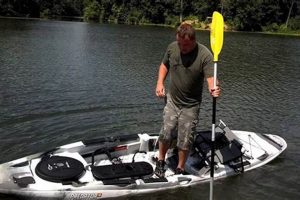
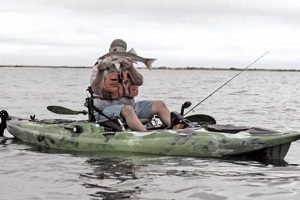
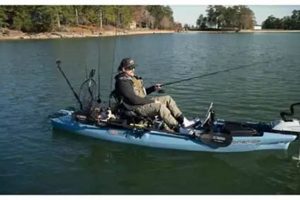
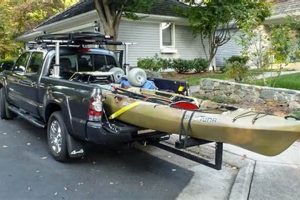
Kayaks designed for larger or taller individuals offer enhanced stability and comfort due to increased weight capacity, wider cockpits, and adjusted seat positions. These features accommodate diverse body types, ensuring a secure and enjoyable experience on the water. For example, an angler over six feet tall with a broader build would benefit from a vessel with ample legroom and a higher weight limit.
Spacious and stable platforms facilitate easier casting, reeling, and landing fish, particularly in challenging conditions. Historically, kayak designs often lacked inclusivity, limiting participation for individuals outside standard size ranges. The development of specialized kayaks expands access to this popular watersport, promoting inclusivity and allowing more individuals to experience the benefits of on-the-water recreation and angling. This focus on ergonomic design enhances not only comfort but also safety, reducing the risk of tipping or discomfort during extended periods on the water.
The subsequent sections will delve into specific design features, materials, and considerations when selecting a kayak suited for larger individuals. Topics will include weight capacity, cockpit dimensions, seat adjustability, and construction materials, providing a comprehensive guide for informed decision-making.
Tips for Selecting a Kayak for Larger Individuals
Choosing the right kayak ensures comfort, stability, and a positive on-the-water experience. Careful consideration of key features allows individuals to select a vessel appropriate for their physique and intended usage.
Tip 1: Prioritize Weight Capacity: Exceeding the manufacturer’s stated weight limit compromises stability and safety. Total weight includes body weight, gear, and any potential catches. A generous safety margin is recommended.
Tip 2: Evaluate Cockpit Dimensions: A wider cockpit offers easier entry and exit, particularly important for individuals with larger frames. Ample legroom enhances comfort during extended trips.
Tip 3: Consider Seat Adjustability: Adjustable seats accommodate varying heights and preferences. Look for features such as adjustable backrests, foot braces, and thigh supports.
Tip 4: Assess Kayak Width and Length: Wider kayaks offer increased stability, while longer kayaks generally track straighter. Balance stability and maneuverability based on intended fishing locations.
Tip 5: Examine Construction Materials: Durable materials such as high-density polyethylene (HDPE) offer resistance to impacts and wear. Consider the added weight of heavier materials and their impact on portability.
Tip 6: Test Before Purchasing: Whenever possible, try out different models before making a purchase. This allows for assessment of comfort, stability, and overall fit.
Tip 7: Research Specific Fishing Needs: Consider the type of fishing planned. Anglers targeting larger species may require a kayak with enhanced stability and features such as rod holders and storage compartments.
Selecting a well-suited kayak significantly enhances on-the-water safety and enjoyment. Focusing on these key features ensures a comfortable and productive fishing experience.
This information provides a foundation for making an informed decision. The following section will offer further guidance on specific kayak models and accessories.
1. Capacity

Capacity, often expressed as maximum weight, represents a critical factor in kayak selection, particularly for larger individuals. A kayak’s capacity determines its safe carrying limit, encompassing the combined weight of the paddler, gear, and any potential catch. Insufficient capacity compromises stability, increasing the risk of capsizing. Conversely, ample capacity ensures safe and efficient operation, contributing significantly to a positive on-the-water experience. For individuals with larger frames, higher weight capacities are essential. For example, an angler weighing 250 pounds with 50 pounds of gear requires a kayak with a minimum capacity exceeding 300 pounds. A safety margin is advisable, suggesting a capacity closer to 350 or 400 pounds.
Understanding capacity’s impact on performance is crucial. Overloading a kayak reduces freeboard, increasing the likelihood of water entering the cockpit. This can lead to instability and potentially dangerous situations, especially in challenging conditions. Adequate capacity, however, maintains optimal freeboard, promoting stability and dryness. Furthermore, proper weight distribution within the kayak enhances tracking and maneuverability. A kayak operating within its designated capacity responds more predictably to paddling inputs and external forces, like wind and waves.
Careful consideration of capacity contributes significantly to safety and enjoyment. Selecting a kayak with sufficient capacity is paramount for larger individuals. Neglecting this aspect can lead to instability and potentially hazardous outcomes. Understanding the relationship between capacity, stability, and performance allows informed decisions, promoting a secure and fulfilling kayaking experience.
2. Cockpit Size
Cockpit size represents a crucial factor influencing comfort and functionality in kayaks designed for larger individuals. Adequate cockpit dimensions accommodate varying body types and facilitate ease of entry and exit. Restricted cockpit space can create challenges for larger paddlers, hindering movement and potentially compromising safety. The following facets explore the relationship between cockpit size and the overall suitability of a kayak for larger anglers.
- Legroom and Comfort
Ample legroom within the cockpit is essential for larger individuals, allowing for comfortable seating and reducing fatigue during extended fishing trips. Restricted legroom can lead to discomfort, cramping, and difficulty maintaining balance. Kayaks with adjustable foot braces further enhance comfort by accommodating different leg lengths. A spacious cockpit allows for changes in posture and movement, crucial for maintaining circulation and comfort.
- Entry and Exit
A wider cockpit opening simplifies entry and exit, a particularly important consideration for individuals with limited mobility or larger frames. A narrow opening can present challenges, increasing the risk of falls or difficulty re-entering the kayak after a swim. Kayaks with larger cockpits allow for smoother transitions, minimizing strain and promoting safety.
- Fishing Functionality
Sufficient cockpit space facilitates casting, reeling, and landing fish, crucial aspects of the angling experience. A cramped cockpit restricts movement, hindering casting accuracy and potentially interfering with landing larger fish. Adequate space allows for comfortable and efficient fishing techniques.
- Stability and Balance
While cockpit size itself doesn’t directly determine stability, a larger cockpit can influence how paddlers interact with the kayak. A wider cockpit allows for greater freedom of movement, which can be beneficial for maintaining balance. However, it’s important to consider the overall kayak design and width for optimal stability.
Careful consideration of cockpit dimensions ensures comfort, safety, and optimal fishing functionality for larger individuals. Selecting a kayak with ample cockpit space contributes significantly to a positive and productive on-the-water experience. Balancing cockpit size with overall kayak design and stability characteristics is crucial for achieving optimal performance and angler satisfaction.
3. Seat Comfort
Seat comfort represents a pivotal factor influencing the overall experience in a big and tall fishing kayak. Extended periods on the water necessitate a supportive and adjustable seating system to mitigate fatigue and discomfort. Proper seat design contributes significantly to angler performance and enjoyment. The following facets explore the key components of seat comfort and their relevance to larger individuals.
- Adjustability
Adjustable seating systems accommodate diverse body types and preferences. Features such as adjustable backrests, lumbar support, and leg lifter straps allow anglers to customize the seat to their specific needs. Adjustable components mitigate pressure points and promote proper posture, reducing the risk of back pain and discomfort during long hours on the water. For larger individuals, adjustable features are particularly crucial, ensuring proper support and weight distribution.
- Padding and Breathability
Ample padding and breathable materials enhance comfort and prevent overheating. Closed-cell foam padding provides cushioning and resists water absorption, maintaining its supportive properties even when wet. Breathable fabrics promote air circulation, preventing discomfort from perspiration and moisture buildup. This is especially relevant for larger individuals who may generate more body heat.
- Elevated Seating Position
Elevated seating positions improve visibility and casting angles while reducing strain on the lower back. Higher seats facilitate easier entry and exit, a significant advantage for individuals with mobility limitations. The elevated position also improves paddling leverage and reduces fatigue during extended paddling sessions. For taller individuals, a higher seat position is essential for comfortable leg extension and overall posture.
- Durability and Stability
Durable seat construction and secure mounting systems ensure long-lasting performance and stability. High-quality materials and robust construction withstand the rigors of regular use and exposure to the elements. Stable mounting prevents shifting or rocking during use, enhancing comfort and safety. This is particularly important for larger individuals who exert greater forces on the seating system.
Prioritizing seat comfort enhances the overall fishing experience, particularly for larger individuals. A comfortable and supportive seat allows anglers to focus on fishing, reducing distractions caused by discomfort or fatigue. Investing in a kayak with a well-designed seating system contributes significantly to long-term enjoyment and success on the water.
4. Stability

Stability represents a critical performance characteristic in kayaks designed for larger individuals, directly impacting safety and fishing effectiveness. Increased weight capacity necessitates enhanced stability features to counteract the potential for tipping or instability. Kayak stability derives from a combination of factors, including hull design, width, and center of gravity. Wider hulls generally offer greater initial stability, resisting tipping when at rest or moving slowly. However, excessive width can compromise maneuverability and tracking in moving water. A lower center of gravity enhances secondary stability, the kayak’s ability to recover from tilting. Kayak design balances these factors to achieve optimal stability characteristics for intended usage and angler size. For example, a wider, flatter-bottomed hull provides enhanced initial stability, beneficial for larger anglers fishing in calm waters. A kayak with a more rounded hull and pronounced keel may offer less initial stability but superior tracking and maneuverability in currents or open water.
Understanding the nuances of stability is crucial for informed kayak selection. Larger individuals benefit from kayaks designed with enhanced stability features. A stable platform allows for comfortable casting, reeling, and landing fish, particularly in challenging conditions. Consider a scenario where an angler hooks a large fish. A stable kayak allows the angler to focus on fighting the fish without excessive concern for balance. Conversely, an unstable kayak might compromise safety and lead to capsizing during this critical moment. Furthermore, stable kayaks enhance confidence and reduce anxiety, allowing anglers to enjoy their time on the water. This is particularly relevant for beginners or those fishing in unfamiliar environments. Enhanced stability allows anglers to focus on the fishing experience rather than constantly managing balance.
In conclusion, stability is paramount in kayaks designed for larger individuals. Careful consideration of hull design, width, and center of gravity ensures optimal performance and safety. Understanding the interplay of these factors empowers informed decision-making, contributing to a secure and enjoyable fishing experience. Selecting a stable kayak allows larger anglers to confidently explore various fishing environments and pursue their angling passions with reduced risk.
5. Durability
Durability represents a critical factor in evaluating kayaks designed for larger individuals, directly influencing the vessel’s lifespan and overall value. Kayaks subjected to higher weight capacities and potential stresses necessitate robust construction to withstand rigorous use and diverse environmental conditions. Material selection, construction techniques, and reinforcement strategies contribute significantly to a kayak’s ability to resist impacts, abrasion, and UV degradation. High-density polyethylene (HDPE) offers a balance of durability, impact resistance, and affordability, making it a prevalent material in kayak construction. Rotational molding creates a seamless, one-piece hull with consistent wall thickness, enhancing structural integrity. Reinforced areas, such as the keel, seat mounts, and carrying handles, further enhance durability, particularly crucial for kayaks accommodating larger weights. For example, a kayak frequently used in rocky or shallow environments benefits from a reinforced hull and skid plate to protect against abrasion and impact damage. Similarly, a kayak regularly exposed to intense sunlight requires UV-resistant materials to prevent degradation and maintain structural integrity.
The practical implications of durability extend beyond lifespan considerations. A durable kayak withstands the demands of regular use, minimizing maintenance requirements and repair costs. Enhanced durability contributes to safety, reducing the risk of structural failure during use. For larger individuals, durable construction provides confidence and peace of mind, allowing for exploration of diverse environments without excessive concern for damage. Consider a scenario involving transporting a fully loaded kayak on a roof rack. A durable kayak withstands the stresses of transport, minimizing the risk of cracks or damage. Conversely, a less durable kayak might suffer structural damage during transport, compromising safety and necessitating costly repairs. Furthermore, durable kayaks retain their value over time, making them a worthwhile investment for serious anglers. The long-term cost-effectiveness of a durable kayak outweighs the potential savings from purchasing a less robust, potentially shorter-lived alternative.
In summary, durability is a paramount consideration in selecting a kayak for larger individuals. Robust construction and material selection contribute to a longer lifespan, reduced maintenance, enhanced safety, and increased resale value. Understanding the practical implications of durability empowers informed decision-making, ensuring a kayak capable of withstanding the rigors of regular use and providing years of reliable service. Investing in a durable kayak represents a commitment to long-term performance and value, essential for serious anglers seeking a dependable platform for their on-the-water pursuits.
6. Specialized Features

Specialized features in fishing kayaks designed for larger individuals enhance functionality, comfort, and overall angling effectiveness. These features cater to the specific needs and challenges associated with larger physiques and diverse fishing styles. Considerations include rod holders, gear tracks, storage compartments, and specialized seating systems. For instance, adjustable rod holders accommodate varying fishing techniques and rod lengths, crucial for larger anglers requiring specific rod placement for optimal leverage. Similarly, integrated gear tracks allow for customization and mounting of fish finders, GPS units, and other accessories essential for serious anglers.
The practical significance of these features becomes evident during extended fishing trips. Ample storage compartments accommodate larger tackle boxes, extra clothing, and safety equipment. Specialized seating systems, often incorporating adjustable backrests, lumbar support, and elevated seating positions, mitigate fatigue and enhance comfort for larger individuals during long hours on the water. Consider a scenario where an angler needs to quickly access a specific lure. Well-organized storage compartments facilitate efficient retrieval, minimizing disruption to the fishing experience. Furthermore, strategically placed rod holders allow for hands-free operation, crucial for managing lines, landing fish, or navigating challenging waters. These features contribute directly to a more productive and enjoyable angling experience.
In conclusion, specialized features distinguish fishing kayaks designed for larger individuals, enhancing their functionality and adaptability. These features address the unique needs and challenges associated with larger physiques and diverse fishing styles. The practical benefits extend to improved comfort, increased efficiency, and enhanced safety on the water. Selecting a kayak with appropriate specialized features empowers larger anglers to pursue their passion with confidence and effectiveness.
Frequently Asked Questions
This section addresses common inquiries regarding kayaks designed for larger individuals, providing concise and informative responses.
Question 1: What differentiates a “big and tall” kayak from a standard fishing kayak?
Key distinctions include increased weight capacity, wider cockpits, and often, adjustable seating systems designed to accommodate larger frames and enhance comfort.
Question 2: How crucial is weight capacity when selecting a kayak for a larger individual?
Weight capacity is paramount. Exceeding the manufacturer’s specified limit compromises stability and safety. Total weight includes body weight, gear, and potential catch.
Question 3: Are there specific cockpit dimensions recommended for enhanced comfort?
Wider cockpits facilitate easier entry and exit, particularly important for individuals with larger frames. Ample legroom is essential for comfort during extended trips.
Question 4: What seat features should larger individuals prioritize?
Adjustable backrests, lumbar support, and elevated seating positions contribute significantly to comfort and reduce fatigue during longer paddling sessions.
Question 5: How does kayak stability relate to angler size?
Kayaks designed for larger individuals often feature wider hulls and lower centers of gravity to enhance stability and counteract the increased risk of tipping.
Question 6: Beyond size, what other features should be considered in a fishing kayak?
Rod holders, gear tracks, storage compartments, and durable construction materials enhance functionality, organization, and the kayak’s lifespan.
Careful consideration of these factors ensures selection of a kayak promoting safety, comfort, and a positive fishing experience.
The following section will provide a detailed analysis of several popular kayak models suitable for larger individuals.
Big and Tall Fishing Kayak
Specialized kayaks designed for larger individuals address critical needs within the angling community. Considerations of weight capacity, cockpit dimensions, seat comfort, stability, durability, and specialized features ensure a safe, comfortable, and productive on-the-water experience. Prioritizing these factors empowers informed decision-making, leading to a kayak selection aligned with individual angler requirements and promoting long-term enjoyment of the sport.
Enhanced inclusivity within kayak fishing allows a broader range of individuals to experience the benefits of this rewarding pastime. Continued innovation in kayak design and manufacturing promises further advancements in comfort, stability, and specialized features, expanding opportunities for larger anglers to explore diverse waterways and pursue their fishing passions with confidence.