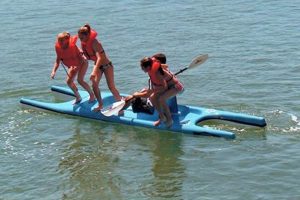
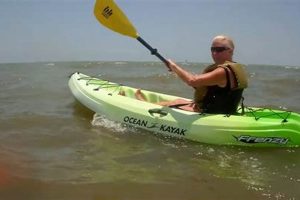
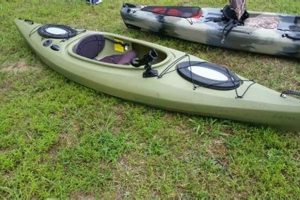
Small, human-powered watercraft offer distinct advantages for anglers seeking a close-to-nature experience. Flat-bottomed vessels, prioritizing stability and shallow-water access, contrast with nimble, enclosed designs better suited for navigating rivers and open water. Choosing the right craft depends on factors such as fishing style, target species, and the characteristics of the intended fishing location.
These small craft provide anglers with increased access to secluded fishing spots often inaccessible to larger motorized boats. Their maneuverability and quiet operation allow for a stealthier approach, minimizing disturbance to fish and enhancing the overall fishing experience. Historically, similar small watercraft have been utilized for fishing and transportation for centuries, demonstrating their enduring practicality and adaptability.
The subsequent sections will delve deeper into the specific attributes of each vessel type, comparing and contrasting their performance in various fishing scenarios and providing guidance for selecting the optimal craft based on individual needs and preferences. Topics covered will include stability, maneuverability, storage capacity, transportation considerations, and specialized features for different fishing techniques.
Tips for Choosing and Using Small Fishing Vessels
Selecting and utilizing a small watercraft for fishing requires careful consideration of various factors to ensure safety and maximize fishing success. The following tips provide valuable guidance for anglers.
Tip 1: Prioritize Stability. Vessel stability is paramount, particularly in moving water or when landing fish. Consider the hull design and its impact on balance.
Tip 2: Evaluate Maneuverability. Different hull shapes offer varying degrees of maneuverability. A vessel’s responsiveness is crucial for navigating tight spaces or changing fishing locations efficiently.
Tip 3: Assess Storage Capacity. Adequate storage is essential for carrying fishing gear, safety equipment, and personal belongings. Evaluate storage solutions carefully based on anticipated needs.
Tip 4: Consider Transportation. Factor in the ease of transporting the chosen vessel. Roof racks, trailers, or even carrying by hand may be necessary, depending on the vessel’s size and weight.
Tip 5: Factor in Fishing Style. Match the vessel type to the intended fishing style. Trolling, casting, or still-fishing each benefit from specific hull characteristics and features.
Tip 6: Understand Water Conditions. Choose a vessel suited to the typical water conditions. Rivers, lakes, and oceans present different challenges and require specific hull designs for optimal performance.
Tip 7: Prioritize Safety Equipment. Always carry essential safety gear, including a personal flotation device (PFD), a whistle, and navigation lights, particularly in low-light conditions.
Careful consideration of these factors will contribute significantly to angler safety and enhance the overall fishing experience. Choosing the right vessel and employing appropriate safety measures will lead to more productive and enjoyable fishing trips.
By understanding these core principles and applying them diligently, anglers can confidently select and utilize the appropriate small watercraft to maximize their time on the water.
1. Stability

Stability plays a critical role in the selection and effective use of small fishing vessels. A stable platform is essential for various fishing activities, including casting, reeling, and landing fish. It also contributes significantly to angler safety, especially in challenging conditions such as windy weather or moving water. The inherent stability of a vessel influences its suitability for different fishing environments and techniques. For instance, a stable jon boat allows anglers to stand and cast comfortably, while a less stable kayak might require a seated approach.
Different hull designs offer varying degrees of stability. Wider, flatter hulls generally provide greater initial stability, resisting tipping more effectively. However, they may be less maneuverable than narrower, V-shaped hulls. Kayaks, with their lower center of gravity, offer a different type of stability, often recovering more easily from initial instability. Understanding these principles allows anglers to choose a vessel appropriate for their intended fishing style and the prevailing water conditions. For example, a wider jon boat is well-suited for calm lakes or ponds, while a kayak’s stability profile might be preferable for navigating rivers or coastal areas.
Ultimately, selecting a vessel with appropriate stability characteristics is paramount for both fishing success and angler safety. Balancing stability with other factors like maneuverability and portability requires careful consideration of individual needs and preferences. Understanding the relationship between hull design, center of gravity, and stability empowers anglers to make informed decisions and enjoy a safer, more productive fishing experience.
2. Maneuverability

Maneuverability is a critical factor influencing the effectiveness and enjoyment of fishing from small watercraft. The ability to navigate efficiently through various water conditions, access tight fishing spots, and respond quickly to changing circumstances directly impacts fishing success. Different hull designs and propulsion methods offer varying degrees of maneuverability, making it essential for anglers to consider their specific needs and the characteristics of their target fishing locations.
- Navigating Tight Spaces
Maneuverability is paramount when navigating narrow creeks, shallow backwaters, or areas congested with vegetation. Kayaks, with their slim profile and paddle propulsion, often excel in these environments, allowing anglers to access secluded areas unreachable by larger, less agile vessels. Jon boats, while generally less nimble in tight quarters, can still be maneuvered effectively with appropriate paddling techniques or the use of a small trolling motor.
- Responding to Current and Wind
Water current and wind conditions significantly impact vessel control. Kayaks, though susceptible to wind drift, can be maneuvered efficiently in currents with proper paddling techniques. Jon boats, with their higher profile, are more affected by wind but offer better tracking in currents, especially when equipped with a motor. Understanding how each vessel type responds to these environmental factors is crucial for maintaining control and maximizing fishing efficiency.
- Tracking and Course Correction
Maintaining a desired course and making precise adjustments is essential for effective fishing techniques such as trolling or drifting. Jon boats, particularly those with a keel or modified V-hull, generally track straighter than kayaks. Kayaks, however, offer superior responsiveness for quick turns and course corrections using paddle strokes. The optimal choice depends on the specific fishing technique and the prevailing water conditions.
- Efficiency of Propulsion
The efficiency of the propulsion method directly influences maneuverability. Kayak paddles offer precise control and allow for quiet, stealthy movement, ideal for approaching wary fish. Jon boats, while maneuverable with paddles, often benefit from a small trolling motor for increased speed and range, particularly in larger bodies of water or against strong currents. Choosing the right propulsion method depends on factors such as fishing location, target species, and personal preference.
Ultimately, selecting a vessel with appropriate maneuverability characteristics significantly enhances the overall fishing experience. Carefully evaluating the trade-offs between stability, maneuverability, and other factors such as capacity and portability empowers anglers to choose the ideal watercraft for their specific needs and fishing style. The ability to precisely control and position the vessel contributes directly to fishing success and enjoyment on the water.
3. Capacity

Capacity, encompassing both passenger and gear volume, significantly influences the suitability of small fishing vessels for different purposes. Anglers must carefully evaluate capacity requirements based on the number of occupants, the type and quantity of fishing gear, and the anticipated duration of fishing trips. A vessel overloaded beyond its capacity compromises stability and maneuverability, increasing the risk of accidents. Conversely, excess capacity adds unnecessary weight and bulk, hindering performance and portability.
Jon boats, generally larger than kayaks, typically offer greater passenger and gear capacity. This makes them well-suited for anglers requiring ample space for multiple occupants, substantial tackle collections, or extended outings. Larger jon boats can accommodate fishing parties of two or more individuals comfortably, along with coolers, livewells, and other bulky equipment. Kayaks, while offering more limited capacity, prioritize individual maneuverability and portability. Solo anglers or those practicing minimalist fishing techniques often find a kayak’s smaller footprint advantageous, allowing access to confined waterways and requiring less storage space. Specialized fishing kayaks offer increased storage capacity for longer trips or specific gear requirements, bridging the gap between the two vessel types.
Careful consideration of capacity needs is essential for selecting the appropriate vessel. Overestimating capacity requirements leads to decreased performance and increased cost, while underestimating capacity compromises safety and limits fishing effectiveness. Evaluating the trade-offs between capacity, portability, and maneuverability allows anglers to make informed decisions based on their individual fishing styles and preferences. Understanding capacity limitations contributes significantly to both safety and enjoyment on the water.
4. Portability

Portability significantly influences the practical usability of small fishing vessels. Transporting a vessel from storage to the desired fishing location requires consideration of vehicle capacity, available launch sites, and physical handling requirements. Ease of transport directly impacts the range of accessible fishing locations and the overall convenience of the fishing experience. Kayaks, typically lighter and more compact than jon boats, often offer greater portability. Many kayaks can be easily car-topped or transported using small trailers, expanding access to remote or difficult-to-reach fishing spots. Jon boats, particularly larger models, frequently require trailers for transport, limiting accessibility based on towing capacity and launch site availability. This distinction becomes crucial when considering factors such as limited vehicle access, challenging terrain, or the desire to fish in isolated areas.
The weight and bulk of a vessel dictate the physical effort required for handling and launching. Lightweight kayaks can often be carried by a single individual, simplifying solo fishing trips and enabling access to areas where launching facilities are limited. Jon boats, especially larger models with motors and associated equipment, often require multiple individuals or specialized equipment for safe handling. This factor significantly influences the logistics of fishing trips, especially for solo anglers or those fishing in areas requiring portages or carries between water bodies. Practical considerations such as storage space also impact portability. Kayaks, due to their compact size, require less storage space than jon boats, an important factor for individuals with limited storage capacity at home or during transport.
In summary, portability plays a crucial role in determining the practicality and accessibility of small fishing vessels. Evaluating portability requirements alongside other factors such as stability, capacity, and maneuverability empowers anglers to select the most suitable vessel for their individual needs and desired fishing locations. Understanding the logistical implications of transporting and handling different vessel types contributes to a more efficient and enjoyable fishing experience, ultimately maximizing time spent on the water. The trade-offs between portability and other vessel characteristics require careful consideration to ensure the chosen craft aligns with the anglers specific circumstances and fishing goals.
5. Cost

Cost represents a significant factor influencing the accessibility and choice of small fishing vessels. Budgetary constraints often dictate the type of watercraft, associated equipment, and overall fishing experience attainable. Understanding the various cost components associated with each vessel type empowers anglers to make informed decisions aligned with their financial resources and fishing objectives. Evaluating cost alongside performance characteristics and intended usage ensures a balanced approach to vessel selection.
- Initial Purchase Price
The initial purchase price varies considerably between jon boats and kayaks. Basic kayaks typically represent a lower initial investment compared to jon boats, especially motorized models. However, higher-end fishing kayaks with specialized features can rival or exceed the cost of basic jon boats. Factors influencing purchase price include material, size, features, and brand reputation. Used vessels offer a potentially cost-effective entry point, but require careful inspection for condition and potential repairs. Financing options can mitigate the impact of initial purchase cost but introduce long-term financial obligations.
- Accessories and Equipment
Essential accessories and equipment contribute significantly to the overall cost of ownership. Kayaks necessitate paddles, personal flotation devices (PFDs), and potentially specialized seating or storage solutions. Jon boats often require trailers, motors, batteries, fuel tanks, and additional safety equipment. Fishing-specific gear such as rod holders, fish finders, and anchors further add to the cumulative expense. Choosing appropriate accessories based on intended fishing style and frequency of use helps optimize cost-effectiveness.
- Maintenance and Repairs
Ongoing maintenance and potential repairs represent a recurring cost factor. Kayaks typically require minimal maintenance, primarily cleaning and occasional inspection for damage. Jon boats, especially motorized models, necessitate more frequent maintenance, including engine servicing, trailer upkeep, and potential hull repairs. Factors influencing maintenance costs include usage frequency, storage conditions, and the complexity of the vessel’s systems. Preventive maintenance practices can mitigate long-term repair expenses and extend the lifespan of the vessel.
- Operational Costs
Operational costs vary significantly depending on the chosen vessel and its usage. Kayaks incur minimal operational costs, primarily limited to transportation expenses to and from fishing locations. Motorized jon boats introduce fuel costs, potentially impacting the affordability of frequent fishing trips, especially in areas requiring extensive travel. Factors such as fuel efficiency, travel distance, and local fuel prices influence the overall operational expense. Choosing fuel-efficient motors and optimizing travel routes can contribute to cost savings.
By carefully evaluating the various cost components associated with each vessel type, anglers can make informed decisions aligned with their budgetary constraints and fishing objectives. A comprehensive cost analysis, considering initial purchase price, accessories, maintenance, and operational expenses, facilitates a balanced approach to vessel selection. Balancing cost considerations with performance characteristics and intended usage ensures a satisfying and sustainable fishing experience without compromising safety or functionality. Ultimately, making informed decisions based on a thorough cost assessment contributes to a more enjoyable and financially responsible approach to fishing from small watercraft.
6. Fishing Style

Fishing style significantly influences the suitability of a jon boat or kayak. Specific fishing techniques often favor one vessel type over the other due to inherent design characteristics. Anglers prioritizing still-fishing or trolling, for instance, might find a jon boat’s stability and open deck layout advantageous. The stable platform allows for comfortable standing and casting, while the open deck facilitates movement and equipment management. Conversely, anglers focused on active fishing styles like casting or jigging might prefer a kayak’s maneuverability and lower profile. A kayak’s responsiveness allows for precise positioning in tight spots, while its lower profile minimizes wind resistance and enhances stealth. Understanding this interplay between fishing style and vessel choice is paramount for maximizing fishing effectiveness and enjoyment.
Consider, for example, an angler targeting bass in a shallow, weedy lake. A kayak’s maneuverability allows navigation through dense vegetation, enabling access to prime fishing locations inaccessible to larger vessels. Its lower profile also minimizes disturbance, increasing the likelihood of enticing wary fish. Conversely, an angler trolling for open-water species like salmon or trout might favor a jon boat’s stability and capacity for carrying downriggers and other specialized trolling equipment. The jon boat’s larger platform allows for comfortable movement and management of multiple fishing lines, maximizing fishing efficiency. These practical examples illustrate the importance of aligning vessel choice with intended fishing style.
In conclusion, the relationship between fishing style and vessel selection represents a crucial consideration for anglers. A mismatch between fishing technique and vessel characteristics can hinder fishing effectiveness and diminish overall enjoyment on the water. Analyzing the demands of specific fishing styles and matching them with the inherent strengths of each vessel type empowers anglers to make informed decisions, leading to a more productive and satisfying fishing experience. Optimizing vessel choice based on fishing style requires careful consideration of factors such as stability, maneuverability, capacity, and access to target fishing locations. Addressing these considerations contributes to a more strategic and fulfilling approach to angling from small watercraft.
7. Water Conditions

Water conditions significantly influence the suitability and safety of using small fishing vessels like jon boats and kayaks. Factors such as current, wind, wave height, and water temperature affect vessel performance and angler safety. Strong currents, for instance, can challenge a kayak’s maneuverability, requiring advanced paddling skills or potentially making a jon boat with a motor more suitable. High winds and waves create instability, favoring the lower profile and maneuverability of a kayak in open water while potentially making a jon boat unsafe. Conversely, calm lakes and ponds favor jon boats, providing a stable platform for fishing. Water temperature influences fishing patterns and requires appropriate vessel considerations for angler comfort and safety in extreme conditions.
Consider a scenario involving a fast-flowing river. A kayak, while potentially maneuverable, might struggle against the current, requiring significant effort and potentially posing risks in turbulent sections. A jon boat with a motor, however, offers increased control and the ability to navigate upstream effectively. Conversely, in a shallow, weedy marsh, a kayak’s shallow draft and maneuverability become advantageous, allowing access to areas a jon boat might struggle to navigate. These examples illustrate the direct impact of water conditions on vessel choice. Choosing a vessel appropriate for the anticipated water conditions is crucial for both fishing success and angler safety. Ignoring these factors can lead to challenging or even dangerous situations, highlighting the importance of careful planning and assessment.
Understanding the complex interplay between water conditions and vessel characteristics is essential for responsible and successful fishing. Matching vessel type to the prevailing and anticipated water conditions significantly influences both safety and fishing effectiveness. Failure to consider these factors can lead to compromised stability, reduced maneuverability, and potentially hazardous situations. A comprehensive understanding of water conditions empowers anglers to make informed decisions, maximizing both safety and the overall fishing experience.
Frequently Asked Questions
This section addresses common inquiries regarding the selection and use of small fishing vessels.
Question 1: Which vessel type is better suited for beginners?
The optimal vessel for beginners depends on individual circumstances and intended fishing locations. Kayaks generally require less initial investment and offer a simpler learning curve for basic paddling techniques. Jon boats, while potentially more stable, may require additional skills for maneuvering with oars or a motor.
Question 2: How does storage capacity compare between jon boats and kayaks?
Jon boats typically offer significantly more storage space than kayaks, accommodating larger quantities of gear and equipment. Kayaks prioritize a smaller, more agile profile, necessitating careful gear selection and potentially limiting the duration of fishing trips.
Question 3: Which vessel type performs better in rough water conditions?
Neither vessel type is inherently suited for rough water. Kayaks, due to their lower profile and maneuverability, may handle some rough water conditions better than jon boats, but both are susceptible to capsizing in significant waves or strong currents. Exercise caution and prioritize safety in challenging conditions.
Question 4: What are the primary cost considerations for each vessel type?
Kayaks generally represent a lower initial investment, but require additional purchases such as paddles and PFDs. Jon boats may necessitate larger initial expenditures, especially if a motor and trailer are required. Ongoing costs include maintenance, fuel (for motorized vessels), and potential repairs.
Question 5: Which vessel type is easier to transport?
Kayaks, due to their lighter weight and smaller size, are often easier to transport than jon boats. Many kayaks can be car-topped or carried on small trailers, while larger jon boats typically require larger trailers and potentially specialized towing vehicles.
Question 6: How does the choice of vessel impact fishing success?
Vessel choice indirectly impacts fishing success by influencing access to fishing locations and the efficiency of specific fishing techniques. Matching the vessel type to the target species, fishing environment, and individual angler preferences maximizes the potential for a successful fishing experience.
Careful consideration of these frequently asked questions helps prospective anglers make informed decisions regarding vessel selection. Evaluating individual needs and preferences alongside the inherent characteristics of each vessel type ensures an appropriate choice for a safe and enjoyable fishing experience.
The following section will provide detailed comparisons of specific jon boat and kayak models suitable for various fishing applications.
Jon Boat or Kayak for Fishing
Careful vessel selection significantly impacts fishing success and overall experience. Factors such as stability, maneuverability, capacity, portability, cost, fishing style, and water conditions dictate whether a jon boat or kayak proves more suitable for individual angler needs. Understanding these elements empowers informed decisions, optimizing vessel choice for specific fishing environments and techniques. Balancing performance characteristics with practical considerations like transportation and budget ensures a safe, efficient, and enjoyable fishing experience.
Ultimately, the decision between a jon boat or kayak represents a personal choice driven by individual priorities and fishing objectives. Thorough research and consideration of the factors presented herein pave the way for a rewarding and fulfilling experience on the water, regardless of the chosen vessel. Anglers equipped with this knowledge can confidently select the appropriate craft to maximize their time pursuing their passion.