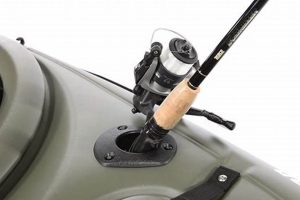
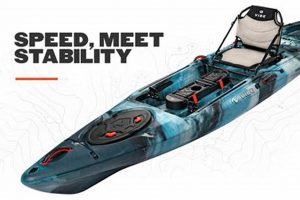
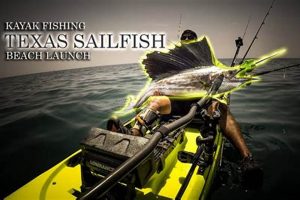
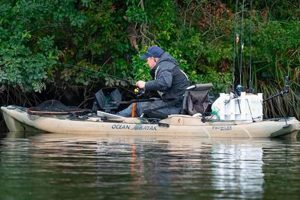
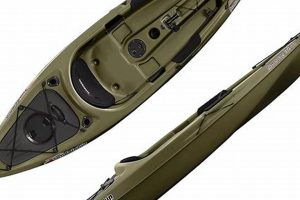
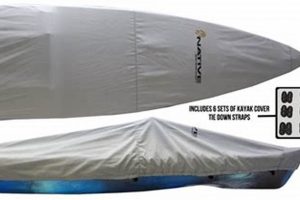
Specialty kayaks designed for angling are often available at sporting goods retailers. These watercraft typically feature specialized seating, rod holders, and storage compartments for tackle and gear. For example, a retailer might offer a sit-on-top model with adjustable footrests and a built-in cooler for keeping catches fresh.
The availability of such specialized equipment provides anglers with enhanced comfort, stability, and convenience on the water. This allows for longer, more productive fishing trips and easier access to fishing locations otherwise difficult to reach by traditional methods. The evolution of these products reflects a growing demand for specialized outdoor recreational equipment, driven by increased interest in activities like kayak fishing.
Exploring the range of available kayak features, considering factors such as hull design and propulsion systems, and understanding the nuances of choosing appropriate gear for different fishing environments are important considerations for prospective kayak anglers.
Tips for Kayak Fishing
Proper preparation contributes significantly to a successful and enjoyable kayak fishing experience. Attention to safety and equipment selection ensures anglers can focus on the sport.
Tip 1: Choose the Right Kayak: Kayak selection should consider factors such as fishing style, water conditions, and angler experience. Sit-on-top kayaks offer stability and ease of re-entry, while sit-inside kayaks provide better protection from the elements. Pedal-driven kayaks allow hands-free fishing, while paddle kayaks offer greater maneuverability in tight spaces.
Tip 2: Prioritize Safety Gear: A personal flotation device (PFD) is essential. A whistle, signaling mirror, and communication device should be included in every angler’s kit. Carrying a first-aid kit and knowing basic first aid procedures are also recommended.
Tip 3: Organize Tackle and Gear: Keeping essential gear readily accessible is crucial. Utilizing tackle boxes, rod holders, and storage compartments within the kayak maximizes efficiency and minimizes clutter. Dry bags protect sensitive items like phones and electronics.
Tip 4: Plan Your Fishing Route: Researching potential fishing spots and understanding water currents and tides helps anglers maximize their time on the water. Checking weather forecasts is essential for safety and comfort.
Tip 5: Practice Paddling and Maneuvering: Familiarization with basic paddling techniques and maneuvering the kayak before fishing allows for greater control and stability on the water, especially in challenging conditions. Practicing self-rescue techniques is highly recommended.
Tip 6: Respect the Environment: Practicing catch-and-release fishing helps preserve fish populations. Properly disposing of fishing line and other waste materials minimizes environmental impact.
Tip 7: Dress Appropriately: Wearing comfortable, weather-appropriate clothing enhances the fishing experience. Layering clothing allows for adjustment to changing conditions. Sun protection, including a hat, sunglasses, and sunscreen, is vital.
By following these guidelines, anglers can increase their chances of a successful and enjoyable kayak fishing experience, while also prioritizing safety and environmental responsibility.
Considering these preparations allows for a focused exploration of specific fishing techniques and strategies, further enhancing angling success.
1. Kayak Selection

Kayak selection represents a critical component within the broader context of acquiring fishing kayaks from a sporting goods retailer like Academy Sports. The choice of kayak directly impacts angling success and overall enjoyment on the water. Consider, for example, an angler targeting largemouth bass in a shallow, weedy lake. A shorter, wider kayak with a sit-on-top design might offer superior maneuverability and stability compared to a longer, narrower sit-inside kayak designed for open-water paddling. Alternatively, an angler pursuing offshore species might prioritize a longer, more stable kayak equipped with features like rod holders, livewells, and ample storage for tackle and gear.
Academy Sports typically offers a range of kayak models catering to diverse fishing styles and preferences. Understanding the nuances of hull design, stability, and propulsion systems empowers anglers to select a kayak optimized for their specific needs. A shorter, wider kayak with a flat bottom provides excellent stability for fishing in calm waters, while a longer, narrower kayak with a V-shaped hull tracks better in open water and handles rough conditions more effectively. The choice between a paddle kayak and a pedal-driven kayak also represents a key decision point, influenced by factors like fishing style and physical capabilities. Pedal kayaks provide hands-free fishing, increasing casting opportunities. Meanwhile, traditional paddle kayaks offer greater versatility, particularly in tight spots or rapidly changing currents.
Effective kayak selection requires careful consideration of individual fishing needs and preferences. Analyzing factors such as target species, fishing environment, and desired features allows anglers to navigate the available options at Academy Sports and select a kayak optimized for their specific requirements. This informed decision-making process contributes significantly to a successful and enjoyable fishing experience. Understanding these elements prepares anglers to delve into further crucial aspects, such as essential fishing accessories and safety equipment, which form integral components of comprehensive fishing kayak preparation.
2. Fishing Features

Specialized features distinguish fishing kayaks from recreational models, directly influencing angling effectiveness and overall experience. These features, commonly available on kayaks sold at sporting goods retailers like Academy Sports, cater specifically to the needs of anglers. Consider rod holders, for example. Flush-mounted rod holders secure rods while paddling or traversing rough water, preventing loss or damage. Adjustable rod holders offer flexibility in positioning rods for various fishing techniques. Similarly, integrated tackle storage systems keep essential gear organized and accessible, maximizing fishing efficiency. A well-designed storage system allows anglers to quickly switch lures, access tools, and manage lines without disrupting their fishing flow.
Further enhancing functionality are features like livewells. These integrated tanks maintain the health and viability of caught fish, essential for tournaments or anglers practicing catch and release. Built-in coolers offer similar benefits, preserving catches for later consumption. Foot-controlled rudder systems provide hands-free steering, allowing anglers to focus on fishing rather than kayak control. These features, often available in various configurations on fishing kayaks at Academy Sports, demonstrate the direct link between specialized design and practical angling utility. An angler targeting bottom-dwelling species in a river, for instance, would benefit significantly from a kayak equipped with a stable platform, anchor trolley system, and rod holders positioned for optimal vertical jigging.
The availability of these specialized fishing features represents a significant advancement in kayak design, directly addressing the unique requirements of anglers. Understanding the purpose and functionality of these features empowers informed purchasing decisions, optimizing kayak selection for specific fishing styles and environments. Considering the interplay between these specialized features and individual angling needs allows for a focused selection process, ultimately enhancing fishing success and overall enjoyment. This detailed understanding of fishing features provides a foundation for exploring other critical aspects of fishing kayaks, such as hull design and propulsion systems, further contributing to a comprehensive knowledge base for prospective kayak anglers.
3. Accessories Availability
Accessory availability significantly impacts the functionality and overall utility of fishing kayaks purchased from retailers like Academy Sports. Access to a comprehensive range of accessories allows anglers to customize their kayaks for specific needs and fishing styles. For example, a kayak angler targeting offshore species might require a fish finder, GPS unit, and specialized rod holders for trolling. Ready access to these accessories at the point of kayak purchase simplifies the outfitting process and ensures compatibility between the kayak and chosen accessories. Conversely, limited accessory availability can restrict customization options, potentially compromising fishing effectiveness and overall enjoyment. An angler seeking a specific type of anchor trolley system, for instance, might find their options limited if the retailer lacks a diverse inventory. This could necessitate sourcing accessories from multiple vendors, potentially leading to compatibility issues or delays in getting on the water.
The range of available accessories also influences the long-term usability and adaptability of a fishing kayak. Access to replacement parts, upgrade options, and specialized accessories allows anglers to modify their kayaks as their needs evolve. An angler transitioning from freshwater to saltwater fishing, for example, might require different accessories to address the unique challenges of the marine environment. A retailer offering a broad selection of accessories, including corrosion-resistant hardware and specialized fishing gear, facilitates this transition, maximizing the lifespan and versatility of the kayak investment. Furthermore, access to readily available accessories simplifies routine maintenance and repairs, minimizing downtime and ensuring consistent performance. A readily available replacement paddle, for example, minimizes disruption if the original paddle breaks or gets lost during a fishing trip.
Therefore, accessory availability represents a crucial consideration when evaluating fishing kayaks at retailers like Academy Sports. A comprehensive selection of accessories enhances customization options, facilitates adaptability, and simplifies maintenance, contributing significantly to the overall value and long-term utility of the kayak. This understanding empowers anglers to make informed purchasing decisions, ensuring their chosen kayak and accompanying accessories align with their specific fishing needs and long-term angling goals. This awareness allows for a smoother transition to other critical considerations such as pricing, warranty, and customer support, completing a comprehensive evaluation of the entire purchasing process.
4. Pricing and Value
Pricing and value represent intertwined concepts significantly influencing purchasing decisions related to fishing kayaks at sporting goods retailers such as Academy Sports. Price, the monetary amount exchanged for a kayak, interacts with value, the perceived benefits derived from that purchase, creating a complex equation for consumers. A lower-priced kayak, for instance, might appear attractive initially. However, if its construction quality, features, or durability prove inferior, its value proposition diminishes. Conversely, a higher-priced kayak constructed with premium materials, incorporating advanced features, and offering superior durability might represent a greater value proposition despite the higher initial investment. Consider a hypothetical scenario where two kayaks are available: a budget-friendly model priced at $300 and a premium model priced at $800. The budget model might lack essential features like rod holders, comfortable seating, or sufficient storage, ultimately diminishing its long-term value. The premium model, while more expensive, could offer enhanced stability, integrated fishing features, and superior durability, justifying the higher price through increased functionality and longevity.
Academy Sports, by offering a range of fishing kayaks at various price points, caters to diverse budgets and angling needs. Evaluating value requires careful consideration of factors beyond the sticker price. Material quality, construction techniques, features, and warranty all contribute to a kayak’s overall value proposition. A kayak constructed with rotomolded polyethylene, for example, generally offers greater durability and impact resistance compared to a kayak made from less robust materials. Similarly, a comprehensive warranty provides peace of mind and protection against potential manufacturing defects, adding to the kayak’s long-term value. Analyzing these factors within the context of price enables informed purchasing decisions, ensuring anglers acquire a kayak that aligns with both their budgetary constraints and performance expectations. For instance, an angler primarily fishing calm lakes might find sufficient value in a stable, budget-friendly kayak. An angler frequently navigating challenging ocean conditions, however, might prioritize the enhanced durability and performance of a premium kayak, justifying the higher cost.
Understanding the interplay between pricing and value empowers informed decision-making within the context of fishing kayak purchases at Academy Sports. Evaluating features, construction, and warranty alongside price allows anglers to select kayaks offering optimal value for their individual needs and budgets. This approach maximizes long-term satisfaction and ensures the chosen kayak provides lasting performance and enjoyment on the water. Failure to consider value beyond the initial price can lead to purchasing decisions that compromise long-term satisfaction and ultimately detract from the overall fishing experience.
5. Customer Support

Customer support plays a crucial role in the purchasing and ownership experience of fishing kayaks at a sporting goods retailer like Academy Sports. Effective customer support contributes significantly to customer satisfaction and long-term brand loyalty. Consider a hypothetical scenario where a customer purchases a fishing kayak and subsequently discovers a manufacturing defect. Responsive and efficient customer support, facilitating a seamless return or exchange process, mitigates frustration and reinforces the retailer’s commitment to customer satisfaction. Conversely, inadequate customer support, characterized by lengthy delays, unhelpful representatives, or complicated procedures, can erode customer trust and damage the retailer’s reputation. This negative experience could deter future purchases and generate negative word-of-mouth referrals, impacting the retailer’s overall business performance.
Furthermore, customer support extends beyond addressing product defects. Knowledgeable staff can provide valuable guidance on kayak selection, features, and accessories, empowering customers to make informed purchasing decisions. Expert advice on kayak suitability for specific fishing environments, paddling techniques, or safety procedures enhances the customer’s overall experience and fosters a sense of confidence in their purchase. Imagine a novice angler seeking advice on selecting their first fishing kayak. A knowledgeable customer service representative can guide them through the various options, explaining the advantages and disadvantages of different hull designs, propulsion systems, and fishing-specific features, enabling the customer to choose a kayak that aligns with their needs and budget. This personalized guidance fosters a positive customer experience and strengthens the retailer-customer relationship.
In conclusion, effective customer support represents a critical component of the overall value proposition when purchasing fishing kayaks at Academy Sports. Responsive issue resolution, knowledgeable staff, and proactive assistance contribute significantly to customer satisfaction, brand loyalty, and ultimately, the retailer’s long-term success. Customers seeking a positive and seamless experience, from initial purchase through ongoing product support, should prioritize retailers demonstrating a commitment to excellent customer service. Neglecting the importance of customer support can lead to negative experiences, potentially discouraging future purchases and impacting the retailer’s overall standing in the market.
Frequently Asked Questions
This section addresses common inquiries regarding the selection, purchase, and use of fishing kayaks available at sporting goods retailers.
Question 1: What are the primary differences between sit-on-top and sit-inside kayaks for fishing?
Sit-on-top kayaks offer superior stability and ease of re-entry after a water landing, making them suitable for beginners or anglers fishing in calm waters. Sit-inside kayaks provide better protection from the elements and offer a drier ride, making them suitable for colder climates or rougher water conditions.
Question 2: How important is kayak stability for fishing?
Stability is paramount for fishing kayaks. It allows anglers to cast, reel, and land fish without compromising balance or risking capsizing. Kayak stability is influenced by factors such as hull design, width, and length.
Question 3: What features should one consider when choosing a fishing kayak at a sporting goods retailer?
Essential features include rod holders, storage compartments for tackle and gear, comfortable seating, and a stable hull design. Additional features like rudder systems, anchor trolleys, and livewells enhance fishing functionality.
Question 4: What safety precautions should kayak anglers observe?
Always wear a personal flotation device (PFD). Carry essential safety equipment, including a whistle, signaling mirror, and communication device. Check weather forecasts before embarking on a fishing trip. Inform someone of your fishing plans, including location and expected return time.
Question 5: How does one transport a fishing kayak?
Fishing kayaks can be transported using roof racks, trailers, or truck beds. Ensure proper securing mechanisms are employed to prevent damage or loss during transit. Some kayaks are designed for easier transport and storage.
Question 6: What are the benefits of purchasing a fishing kayak from a specialized retailer versus a general sporting goods store?
Specialized retailers often offer a wider selection of fishing kayaks, expert advice from knowledgeable staff, and dedicated customer support tailored to the needs of kayak anglers. This expertise can prove invaluable in selecting the right kayak and accessories for specific fishing styles and environments.
Careful consideration of these frequently asked questions empowers informed purchasing decisions and enhances overall fishing kayak experiences. Understanding these aspects contributes significantly to angler safety, enjoyment, and success on the water.
Further exploration of specific kayak models, features, and accessories available at Academy Sports is encouraged for a comprehensive understanding of available options.
Conclusion
Specialized fishing kayaks sold by sporting goods retailers represent significant advancements in angling technology and accessibility. Careful consideration of factors like hull design, features, and accessories empowers anglers to select watercraft optimized for individual needs and fishing styles. Understanding the interplay between kayak selection, safety precautions, and environmental awareness contributes to responsible and productive angling experiences.
Investing in appropriate equipment and knowledge enhances enjoyment and success on the water. Continued exploration of advancements in kayak design and fishing techniques promises further refinement of the sport, fostering greater accessibility and promoting sustainable angling practices.