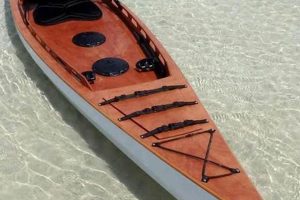
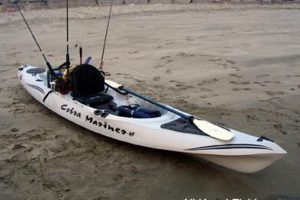
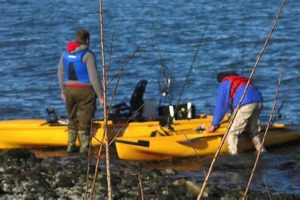
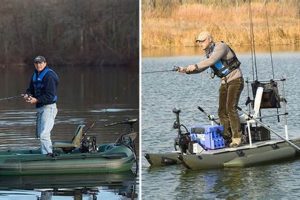
A kayak designed for fishing typically features a shorter, wider hull around 10 feet in length. This design prioritizes stability, allowing anglers to cast lines and reel in catches without compromising balance. Such kayaks often include specialized features like rod holders, gear tracks, and live wells.
Enhanced stability is crucial for anglers, providing a secure platform for fishing activities. A stable kayak allows for greater freedom of movement and reduces the risk of capsizing, particularly in challenging conditions or when handling fish. This design focus has become increasingly popular as more individuals seek recreational fishing opportunities from kayaks. This growing demand has driven innovation in kayak design and construction, resulting in a wider selection of stable fishing kayaks on the market.
This discussion will further explore specific design elements contributing to kayak stability, including hull shapes, materials, and weight capacity. Additionally, factors influencing kayak selection such as intended fishing environment and angler experience will be addressed.
Tips for Selecting a Stable Fishing Kayak
Choosing a suitable fishing kayak requires careful consideration of various factors to ensure optimal stability and performance on the water. The following tips offer guidance in this selection process.
Tip 1: Prioritize Hull Design: A wider, flatter hull generally provides greater initial stability, ideal for calm waters and stand-up fishing. A pontoon-style hull offers maximum stability. Conversely, a V-shaped hull, while less stable initially, offers better tracking and performance in rougher conditions.
Tip 2: Consider Length and Width: Shorter kayaks (under 12 feet) tend to be more maneuverable, while longer kayaks track better in a straight line. Wider kayaks (over 30 inches) provide more stability, while narrower kayaks are faster and more efficient.
Tip 3: Evaluate Weight Capacity: The kayak’s weight capacity should comfortably accommodate the angler’s weight, plus gear and any potential catch. Exceeding the weight capacity can compromise stability and performance.
Tip 4: Assess Features for Fishing: Look for features like rod holders, gear tracks, and storage compartments specifically designed for fishing. A comfortable seat with good back support is also essential for longer fishing trips.
Tip 5: Test Before Purchasing: Whenever possible, test paddle different kayak models to assess their stability and handling characteristics firsthand. This allows anglers to determine the best fit for their individual needs and preferences.
Tip 6: Factor in the Fishing Environment: Consider the typical fishing environment. Calm lakes and rivers allow for greater flexibility in kayak choice, while ocean or open-water fishing demands higher stability and seaworthiness.
Tip 7: Research Kayak Materials: Kayaks are typically constructed from polyethylene (durable and affordable) or composites (lighter and more expensive). Consider the trade-offs between durability, weight, and cost.
By carefully evaluating these factors, anglers can select a fishing kayak that provides the necessary stability, performance, and features for a safe and enjoyable fishing experience.
These considerations will help narrow down the choices to the most suitable kayak for individual fishing needs and preferences. The subsequent section will provide an overview of recommended kayak models.
1. Hull Design

Hull design significantly influences the stability of a 10-foot fishing kayak. Various hull designs exist, each offering distinct performance characteristics. Flat-bottom hulls provide excellent primary stability, ideal for calm waters and stand-up fishing. However, they can feel tippy in rougher conditions. Pontoon hulls offer maximum stability, making them suitable for anglers prioritizing a rock-solid platform. The trade-off is reduced maneuverability and tracking. A rounded or shallow-arch hull offers a compromise between stability and performance, providing reasonable stability while maintaining adequate maneuverability. Finally, a V-shaped hull, while less stable initially, offers superior tracking and performance in choppy water and wind. Choosing the appropriate hull design depends on the intended fishing environment and angler preferences.
Consider a kayak intended for calm lakes or ponds. A flat-bottom hull excels in these conditions, providing a stable platform for casting and retrieving. Conversely, a kayak designed for ocean fishing or larger bodies of water with potential chop or currents benefits from a V-shaped hull, which cuts through waves more effectively and tracks straighter. A wider, flatter hull enhances stability for stand-up fishing, while a narrower, more streamlined hull promotes speed and efficiency for covering longer distances. The interplay between hull design and intended use is crucial for optimal performance and safety.
Understanding the impact of hull design on stability is paramount when selecting a 10-foot fishing kayak. Matching the hull design to the intended fishing environment and individual needs ensures a stable and enjoyable fishing experience. Considerations such as desired stability level, maneuverability needs, and prevailing water conditions should guide the selection process. This knowledge allows anglers to choose a kayak that provides the right balance of stability and performance for their specific requirements. Neglecting hull design can lead to an unstable and potentially unsafe on-the-water experience.
2. Width

Width is a critical determinant of stability in 10-foot fishing kayaks. A wider kayak generally offers greater initial stability, resisting tipping and providing a secure platform, particularly important for activities like casting, reeling, and landing fish. Wider kayaks provide more space for gear and movement, contributing to angler comfort and reducing the feeling of confinement. However, increased width can compromise maneuverability and speed, making narrower kayaks preferable for paddling longer distances or navigating tight waterways. The ideal width depends on the balance between desired stability and intended usage.
Consider two 10-foot kayaks: one 30 inches wide and another 36 inches wide. The 36-inch kayak offers significantly greater initial stability, making it suitable for anglers prioritizing a stable platform for casting and retrieving, especially in calm waters. The 30-inch kayak, while less stable, allows for easier paddling and maneuvering, beneficial for covering greater distances or navigating confined areas. Choosing between these widths involves assessing the trade-offs between stability and maneuverability based on individual needs and fishing conditions. An angler fishing in open, choppy water might prioritize the stability of the wider kayak, while an angler fishing in narrow, winding streams might favor the maneuverability of the narrower kayak. Understanding these dynamics allows for informed decisions based on specific fishing environments and angler preferences.
Selecting the appropriate width for a 10-foot fishing kayak requires careful consideration of the trade-offs between stability, maneuverability, and intended use. Prioritizing stability often necessitates a wider hull, potentially sacrificing some maneuverability. Conversely, prioritizing maneuverability often leads to a narrower hull, potentially compromising stability. Matching the kayak’s width to the anticipated fishing environment and angler priorities is crucial for maximizing both performance and safety. This involves evaluating factors such as the typical water conditions, the type of fishing pursued, and the angler’s comfort level with different levels of stability.
3. Weight Capacity

Weight capacity is a critical factor influencing the stability of a 10-foot fishing kayak. This specification represents the maximum combined weight of the angler, gear, and any potential catch the kayak can safely support. Exceeding this limit submerges a greater portion of the hull, reducing freeboard and significantly compromising stability, increasing the risk of capsizing. A kayak operating within its weight capacity sits higher in the water, providing enhanced stability and maneuverability.
Consider a 10-foot kayak with a weight capacity of 300 pounds. An angler weighing 175 pounds, carrying 30 pounds of gear, and landing a 25-pound fish operates well within this limit, maintaining optimal stability. However, if the same angler carries significantly more gear or lands a larger fish, pushing the total weight beyond 300 pounds, the kayak sits lower in the water, reducing stability and increasing susceptibility to tipping, especially in challenging conditions such as wind or waves. Understanding the practical implications of weight capacity allows anglers to make informed choices and prioritize safety.
Selecting a 10-foot fishing kayak with appropriate weight capacity is essential for maintaining stability and ensuring a safe fishing experience. Calculating the combined weight of the angler, gear, and anticipated catch is crucial for determining the minimum required weight capacity. Choosing a kayak with a weight capacity exceeding the expected load provides a margin of safety and enhances stability. This proactive approach ensures the kayak performs optimally and minimizes the risk of instability caused by exceeding the weight limit. Neglecting weight capacity can lead to a dangerous and potentially life-threatening situation on the water.
4. Flat Bottom

Flat-bottom hull designs are frequently associated with stability in 10-foot fishing kayaks. This hull shape provides a wide, stable base, minimizing rocking and tipping, especially in calm water conditions. Understanding the benefits and limitations of flat-bottom hulls is crucial for selecting the appropriate kayak for specific fishing environments and angler preferences.
- Initial Stability
Flat bottoms excel in providing initial stability, meaning resistance to tipping from a resting position. This characteristic is highly beneficial for anglers who value a stable platform for casting, retrieving, and landing fish, especially in calm waters. A flat bottom allows anglers to shift their weight and move around the kayak with less risk of capsizing compared to kayaks with more rounded or V-shaped hulls.
- Stand-Up Fishing
The stable platform offered by a flat-bottom hull lends itself well to stand-up fishing. This technique allows for greater visibility and casting range, and a flat bottom provides the necessary stability to maintain balance while standing and casting. While some anglers can stand in kayaks with other hull designs, flat bottoms generally offer the most stable platform for this style of fishing. Consider sight fishing, where standing offers a significant advantage.
- Performance in Calm Water
Flat-bottom hulls perform optimally in calm water conditions such as lakes, ponds, and slow-moving rivers. In these environments, the stability provided by the flat bottom outweighs its limitations in tracking and maneuverability. Conversely, in rougher water or strong currents, flat bottoms can feel less stable and more susceptible to being pushed off course by wind or waves. This contrast highlights the importance of considering the intended fishing environment when selecting a hull design.
- Maneuverability and Tracking
While flat bottoms excel in initial stability, they typically exhibit reduced maneuverability and tracking compared to other hull designs. Turning a flat-bottom kayak requires more effort, and they may not track as straight in moving water. This trade-off between stability and maneuverability is a key consideration for anglers. For example, navigating tight, winding creeks or rivers necessitates greater maneuverability, potentially making a flat bottom less suitable than a kayak with a more rounded or V-shaped hull designed for enhanced tracking and turning performance.
The flat-bottom hull design offers significant advantages in stability, particularly for calm water fishing and stand-up casting. However, it’s crucial to acknowledge the trade-offs in maneuverability and performance in rougher conditions. Selecting a flat-bottom 10-foot fishing kayak requires careful consideration of the intended fishing environment and individual preferences, balancing the need for stability with other performance characteristics.
5. Construction Material
Construction material significantly influences the stability, durability, and performance of a 10-foot fishing kayak. Different materials offer varying properties affecting stiffness, weight, and impact resistance. Understanding these characteristics is essential for selecting a kayak suited to specific fishing needs and conditions.
- Polyethylene (HDPE)
High-density polyethylene (HDPE) is a common material due to its durability, affordability, and impact resistance. HDPE kayaks withstand impacts and abrasions, making them suitable for rocky shorelines or shallow waters. This robustness contributes to overall stability by maintaining hull integrity. However, HDPE is heavier than other materials, potentially affecting maneuverability.
- Thermoformed ABS
Thermoformed ABS (acrylonitrile butadiene styrene) offers a balance between durability and weight. This material allows for intricate hull designs, often resulting in enhanced performance characteristics. ABS kayaks typically exhibit greater rigidity than HDPE, contributing to stability. While generally more expensive than HDPE, ABS offers a lighter, higher-performance option.
- Composites (Fiberglass, Carbon Fiber)
Composite materials, including fiberglass and carbon fiber, offer the lightest and stiffest construction. This stiffness translates to enhanced responsiveness and efficient power transfer, benefiting stability in dynamic conditions. Composite kayaks are generally more expensive and require greater care to prevent damage. Their lighter weight enhances maneuverability and portability.
- Inflatable Kayaks with Drop-Stitch Technology
Inflatable kayaks constructed with drop-stitch technology offer portability and surprising rigidity. These kayaks feature internal threads connecting the top and bottom layers, creating a high-pressure, rigid structure when inflated. While not as rigid as solid kayaks, drop-stitch inflatables provide reasonable stability for calm water fishing. Their primary advantage lies in portability and ease of storage.
Selecting construction material requires careful consideration of priorities and intended usage. HDPE offers durability and affordability, while composites prioritize performance and light weight. ABS provides a middle ground, and inflatables emphasize portability. The chosen material directly impacts stability, durability, and the overall fishing experience. Matching material characteristics to individual needs and fishing environments ensures optimal performance and longevity.
6. Added Stability Features

Added stability features play a crucial role in enhancing the stability of 10-foot fishing kayaks, transforming them into secure platforms for angling activities. These features address inherent stability limitations, particularly in challenging conditions or when performing actions that could otherwise compromise balance. Understanding their function and benefits is essential for selecting the most suitable kayak for specific needs.
Outriggers, essentially pontoon-like extensions attached to the sides of the kayak, significantly increase lateral stability. They create a wider base, reducing the likelihood of tipping, especially during casting or reeling. This added stability is particularly advantageous in open water or when fishing standing up. Stabilizer fins, deployed beneath the hull, improve tracking and minimize side-to-side rocking, enhancing stability in windy conditions or choppy water. Anchor trolleys, while primarily used for positioning, indirectly contribute to stability by allowing anglers to maintain a fixed position in currents, reducing drift and enhancing control. These examples illustrate how added stability features directly impact the on-the-water experience, transforming potentially unstable situations into confident fishing opportunities. Imagine an angler battling a strong current without an anchor trolleymaintaining position and balance becomes significantly more challenging.
The inclusion of added stability features is a key consideration when seeking the most stable 10-foot fishing kayak. Evaluating specific needs and typical fishing environments informs the decision-making process. Anglers fishing in open, windy conditions benefit significantly from outriggers or stabilizer fins. Those prioritizing stand-up fishing find added stability crucial for maintaining balance while casting. Choosing a kayak equipped with these features empowers anglers to fish confidently in various conditions, maximizing safety and enjoyment on the water. Neglecting these considerations might limit fishing opportunities or compromise safety in challenging environments.
Frequently Asked Questions
This section addresses common inquiries regarding the stability of 10-foot fishing kayaks, providing concise and informative responses to aid informed decision-making.
Question 1: How is kayak stability measured or determined?
Kayak stability is evaluated through various factors, including hull design, width, and weight capacity. Wider, flatter hulls generally offer greater initial stability. Weight capacity indicates the maximum load a kayak can safely carry without compromising stability.
Question 2: What hull design is generally considered most stable for a 10-foot fishing kayak?
Flat-bottom and pontoon hulls are generally considered the most stable, particularly in calm water. However, these designs might compromise maneuverability in rougher conditions.
Question 3: Does kayak length affect stability?
While width is the primary determinant of stability, length also plays a role. Shorter kayaks, around 10 feet, tend to be more maneuverable but potentially less stable than longer kayaks, especially in choppy water.
Question 4: How does weight capacity relate to stability?
Exceeding a kayak’s weight capacity significantly compromises stability. Operating within the specified weight limit ensures the kayak sits higher in the water, maximizing stability and performance.
Question 5: Can added features enhance kayak stability?
Features like outriggers, stabilizers, and anchor trolleys enhance stability. Outriggers provide additional lateral stability, while stabilizers improve tracking and reduce rocking. Anchor trolleys aid in maintaining position, indirectly enhancing stability in currents.
Question 6: How does the anglers weight influence kayak stability?
Angler weight, combined with gear and potential catch, must be within the kayak’s specified weight capacity. A heavier load lowers the kayak in the water, reducing stability. Proper weight distribution within the kayak also influences balance and stability.
Understanding these factors empowers informed decisions regarding kayak selection, prioritizing stability based on individual needs and intended fishing environments. Careful consideration of these elements ensures a safe and enjoyable on-the-water experience.
The following section will explore specific kayak models renowned for their stability, further assisting the selection process.
Conclusion
Exploration of stability in 10-foot fishing kayaks reveals the critical interplay of design elements, material properties, and added features. Hull design, particularly width and bottom shape, significantly influence initial stability and performance in varying water conditions. Weight capacity dictates safe operational limits, impacting both stability and maneuverability. Material selection influences not only durability but also weight and stiffness, further impacting overall performance. Added features like outriggers and stabilizers offer enhanced stability in specific situations, allowing anglers to adapt to challenging environments.
Prioritizing stability in a 10-foot fishing kayak is paramount for a safe and enjoyable angling experience. Careful consideration of these factors empowers informed decisions, aligning kayak selection with individual needs and intended usage. Understanding the nuanced relationship between design, materials, and features unlocks the potential for enhanced stability, fostering confidence and enabling anglers to focus on the pursuit of their passion.