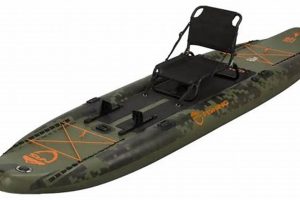
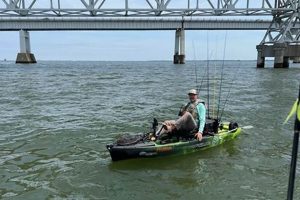
A small, maneuverable watercraft designed for angling often incorporates specialized features for deploying and retrieving fishing gear. These features might include built-in rod holders, anchor trolleys, and storage compartments suitable for nets and other equipment. Such vessels are popular among anglers seeking access to shallow waters or areas difficult to reach by larger boats, offering a hands-free method of managing catches while maintaining vessel stability.
The evolution of specialized angling watercraft reflects a growing emphasis on efficiency and ease of use in recreational fishing. These designs improve catch management, freeing anglers to focus on angling techniques. This targeted approach contributes to a more sustainable and enjoyable fishing experience, particularly in environments where careful handling of catch is paramount. The ability to swiftly and safely secure captured fish minimizes stress on the animal and maximizes the angler’s time on the water.
This discussion will further explore various aspects of kayak fishing, encompassing optimal vessel selection, effective gear utilization, and responsible fishing practices. Subsequent sections will delve into specific techniques, offering insights for both novice and experienced anglers.
Tips for Effective Kayak Fishing
Optimizing the use of specialized fishing kayaks involves thoughtful consideration of equipment and techniques. The following tips offer guidance for enhancing angling success and safety.
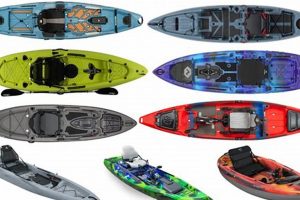
Tip 1: Choose the Right Vessel: Kayak selection should align with the intended fishing environment and target species. Consider factors such as hull stability, storage capacity, and maneuverability in various water conditions.
Tip 2: Prioritize Safety Equipment: Always wear a personal flotation device and carry essential safety gear, including a whistle, signaling device, and first-aid kit. Inform someone of the fishing location and estimated return time.
Tip 3: Organize Gear Strategically: Efficient storage and accessibility of fishing equipment are crucial in a kayak. Utilize rod holders, tackle boxes, and storage compartments to maintain a clutter-free and balanced vessel.
Tip 4: Practice Net Deployment and Retrieval: Develop proficiency in handling nets from a seated position. Smooth, controlled movements are essential for minimizing disturbance and maximizing successful capture.
Tip 5: Employ Appropriate Netting Techniques: Match net size and mesh to the target species. Lead the fish into the net headfirst to reduce the risk of escape and minimize handling stress.
Tip 6: Respect Local Regulations and Conservation Practices: Adhere to fishing regulations, including size and bag limits. Practice catch-and-release techniques whenever appropriate to promote sustainable fisheries.
Tip 7: Master Kayak Control: Develop paddling proficiency and maneuvering skills to navigate diverse water conditions and access prime fishing locations efficiently.
Tip 8: Be Mindful of Weather Conditions: Check weather forecasts before embarking on a fishing trip. Avoid venturing out in hazardous conditions such as strong winds, lightning storms, or rough waters.
By implementing these strategies, anglers can significantly enhance their kayak fishing experience, maximizing both safety and success on the water.
These preparatory steps contribute to a more rewarding and responsible approach to kayak angling. The following section will delve into specific techniques for targeting various fish species from a kayak platform.
1. Kayak Stability

Kayak stability is a critical factor for successful and safe fishing, particularly when using a net. A stable platform allows anglers to maintain balance and control during the crucial moments of landing a fish, preventing capsizing and ensuring efficient net deployment.
- Center of Gravity
A lower center of gravity contributes significantly to kayak stability. Factors influencing the center of gravity include the kayak’s design (e.g., wider hulls provide greater stability), the distribution of weight within the kayak (e.g., evenly distributed gear), and the angler’s position. Shifting weight too quickly or leaning too far can raise the center of gravity and compromise stability, especially when maneuvering a net.
- Hull Design
Different hull designs offer varying degrees of stability. Wider, flatter hulls generally provide greater primary stability (initial resistance to tipping), making them suitable for calmer waters and activities like netting fish. Longer, narrower hulls offer less primary stability but greater secondary stability (resistance to capsizing once tipped), which can be advantageous in rougher conditions but requires more experience to manage during netting. Specialized fishing kayaks often incorporate design features that enhance stability for activities like netting, such as wider beams or outriggers.
- Water Conditions
Calm, flat water presents fewer stability challenges compared to choppy or flowing water. Wind, currents, and waves can significantly impact kayak stability, making netting more difficult and increasing the risk of capsize. Anglers should carefully assess water conditions and choose locations sheltered from strong winds or currents when planning to use a net.
- Netting Technique
Smooth, controlled movements are essential for maintaining stability while netting a fish. Avoid sudden or jerky motions, and keep the net close to the kayak to minimize leverage and the risk of tipping. Practice netting techniques in calm water before attempting them in more challenging conditions. Proper technique minimizes the disruption to the kayaks center of gravity, maintaining balance throughout the process.
Understanding these interconnected factors allows anglers to select appropriate kayaks, adapt their techniques, and choose suitable fishing locations to maximize stability while netting fish, contributing to a safer and more successful fishing experience. Compromised stability during netting can lead to capsizing, loss of gear, and potentially injury, highlighting the importance of prioritizing kayak stability in fishing net applications.
2. Net Size & Type

Net size and type are critical considerations for effective kayak fishing. The chosen net must balance the needs of capturing target species while remaining manageable within the confines of a kayak. An overly large net, while potentially capable of landing larger fish, can be cumbersome to store, deploy, and maneuver from a small vessel, increasing the risk of capsizing or entanglement. Conversely, a net too small may prove inadequate for the intended catch, leading to lost fish and wasted effort. The species targeted directly influences net selection. For smaller panfish, a compact teardrop-shaped net with fine mesh is generally sufficient. Larger game fish, such as bass or pike, necessitate a larger net with a wider hoop and heavier construction. Landing nets with a rubberized or coated mesh are often preferred for catch-and-release fishing, as they minimize damage to the fish’s slime coat and reduce the risk of injury. A folding net with a telescopic handle offers a practical solution for kayak anglers, providing a balance of reach and compact storage. For example, a kayak angler targeting trout in a small stream might opt for a short-handled, fine-meshed net designed for wading, while an angler pursuing larger saltwater species from a kayak would require a larger, more robust net with a longer handle.
The net’s design also impacts its usability in a kayak. Hoop nets, while effective for scooping fish, can be challenging to manage in the limited space of a kayak cockpit. Teardrop or triangular nets offer a more streamlined profile, reducing the chance of snagging on gear or the kayak itself. Furthermore, the material of the net handle influences both its durability and weight. Aluminum or composite handles offer a lightweight yet strong option, while wooden handles provide a classic feel but require more maintenance. Consideration should be given to the net’s depth as well. A deeper net provides more security for containing active fish, but can be awkward to manage in a kayak. A shallower net may be easier to handle but requires greater precision during landing.
Selecting the appropriate net size and type for kayak fishing involves a careful evaluation of target species, kayak size and stability, and personal fishing style. Balancing these factors ensures efficient fish landing while maintaining safety and maneuverability within the limited space of a kayak. Improper net selection can hinder fishing success, compromise safety, and detract from the overall kayak fishing experience. Therefore, careful consideration of net size and type is paramount for optimizing fishing outcomes from a kayak.
3. Deployment Technique

Effective deployment of a fishing net from a kayak requires a specialized technique distinct from shore-based or larger vessel angling. The confined space and inherent instability of a kayak necessitate controlled movements and efficient net handling to minimize the risk of capsizing, tangling, or losing the catch. Understanding and practicing proper deployment technique is essential for maximizing success and ensuring angler safety.
- Maintaining Kayak Balance
Maintaining balance is paramount throughout the deployment process. Before attempting to net a fish, the kayak should be positioned securely, preferably perpendicular to the current or wind. Weight distribution within the kayak must be carefully managed to prevent tipping. Smooth, deliberate movements are crucial when reaching for and deploying the net, avoiding sudden shifts in weight that could compromise stability. Keeping the net close to the kayak during deployment minimizes leverage and the risk of overbalancing. Practicing deploying and retrieving the net in calm water helps develop the necessary muscle memory and coordination for successful use in more challenging conditions.
- Net Orientation and Approach
The net should be oriented and approached strategically to maximize the chances of a successful capture. Ideally, the fish should be led headfirst into the net, minimizing the chance of escape and reducing stress on the fish. Leading the fish slightly ahead of its position allows the net to intercept its path effectively. Avoid chasing the fish with the net, as this can increase the likelihood of tangling or startling the fish. Patience and observation are key to anticipating the fish’s movements and positioning the net for optimal capture.
- Securing the Catch
Once the fish is within the net, securing the catch requires careful handling. Lifting the net quickly and smoothly out of the water minimizes the chance of the fish escaping or the net tearing. Keeping the net submerged while maneuvering it towards the kayak allows for greater control and reduces stress on the fish. Once aboard, the fish should be handled swiftly and humanely, minimizing handling time and ensuring proper release or storage procedures are followed. A secure and readily accessible holding device or cooler is essential for containing the catch while maintaining a stable kayak platform.
- Storage and Readiness
Proper storage and readiness of the fishing net are critical for efficient deployment. The net should be readily accessible within the kayak, but stored securely to prevent entanglement or interference with paddling. A net with a telescopic handle or a folding mechanism can be beneficial for compact storage within the limited space of a kayak. Before embarking on a fishing trip, ensuring the net is free of tangles and in good working order streamlines the deployment process and increases the chances of a successful catch.
Mastering these deployment techniques significantly improves the efficiency and safety of using a fishing net from a kayak. The combination of balance, strategic approach, secure capture, and efficient storage contributes to a more seamless and successful kayak fishing experience. Failure to implement these techniques can result in lost catches, compromised stability, and potentially dangerous situations. Therefore, developing proficiency in net deployment is essential for any angler seeking to effectively utilize a fishing net from a kayak.
4. Secure Storage

Secure storage of a fishing net is paramount for safe and efficient kayak angling. An unsecured net presents several hazards in the confined environment of a kayak. Entanglement with paddling gear, fishing rods, or other equipment can impede maneuverability, creating a potentially dangerous situation, particularly in challenging water conditions. A loose net can also snag on underwater obstacles, increasing the risk of capsizing. Furthermore, an unsecured net occupies valuable space within the kayak, hindering access to other essential gear. Secure storage solutions, such as specialized net holders, clips, or integrated storage compartments within the kayak, mitigate these risks. These solutions ensure the net remains readily accessible while minimizing the potential for entanglement or interference. For instance, a retractable leash attached to the net handle and a secure point on the kayak allows quick deployment and retrieval while preventing the net from drifting overboard or becoming entangled. Similarly, a dedicated net holster mounted within easy reach keeps the net organized and prevents it from obstructing paddling strokes or casting.
The practical implications of secure net storage extend beyond immediate safety concerns. A well-stored net contributes to a more organized and efficient fishing experience. Reduced clutter within the kayak allows for smoother transitions between paddling, casting, and landing fish, maximizing angling time and minimizing frustration. Moreover, proper storage protects the net from damage, extending its lifespan and ensuring its readiness for use. For example, storing a net in a protective sleeve prevents snags and tears, preserving its structural integrity and functionality. Integrating secure net storage into kayak fishing practices underscores a commitment to both safety and efficiency, essential components of a successful and enjoyable angling experience.
In summary, secure net storage in a kayak fishing context is not merely a matter of convenience but a critical safety and efficiency consideration. Proper storage solutions mitigate entanglement risks, optimize space utilization, and protect valuable equipment. Implementing these practices enhances angler safety, streamlines fishing operations, and ultimately contributes to a more rewarding experience on the water. The relationship between secure storage and successful kayak angling underscores the importance of thoughtful planning and preparation in maximizing both safety and efficiency in this specialized angling discipline.
5. Efficient Retrieval

Efficient retrieval of a fishing net is crucial for successful kayak angling. Rapid net retrieval minimizes stress on the captured fish, promoting humane catch-and-release practices. Swift retrieval also reduces the likelihood of the fish escaping, maximizing angling success. Furthermore, efficient retrieval minimizes disruption to the kayak’s stability, a critical factor in the confined environment of a small watercraft. A tangled or slow-to-retrieve net can compromise balance, increasing the risk of capsizing, particularly in challenging conditions. Consider a scenario where an angler hooks a sizable fish from a kayak. A swift, controlled retrieval of the net ensures the fish is landed quickly and efficiently, minimizing its struggle and reducing the chance of escape or injury. Conversely, a fumbled or delayed retrieval can lead to a lost fish, a disrupted kayak, and a potentially frustrating experience.
Several factors contribute to efficient net retrieval. Net design plays a significant role; a net with a smooth, snag-free mesh and a streamlined frame reduces resistance during retrieval. The length and material of the handle also influence retrieval speed and ease. A telescopic handle allows for compact storage while providing adequate reach, facilitating efficient retrieval in the limited space of a kayak. Regular maintenance, including cleaning and inspection of the net for damage, ensures smooth operation and prevents unexpected delays during retrieval. Practice is also key; anglers should rehearse net retrieval techniques in calm water to develop muscle memory and efficient movements, preparing for real-world scenarios. Furthermore, the placement and accessibility of the net within the kayak influence retrieval speed. A dedicated net holder or clip within easy reach allows for swift deployment and retrieval, optimizing efficiency and minimizing disruption to the angling process. For instance, a kayak angler targeting fast-moving species like bass benefits from a readily accessible net with a robust handle and snag-resistant mesh, enabling swift retrieval and minimizing the chance of escape.
Efficient retrieval is a fundamental component of successful and responsible kayak fishing. It represents the culmination of appropriate net selection, diligent maintenance, and practiced technique. The ability to swiftly and smoothly retrieve a net directly influences catch retention, angler safety, and overall fishing efficiency. Neglecting this aspect can lead to lost opportunities, compromised stability, and potentially stressful situations for both the angler and the fish. Therefore, prioritizing efficient retrieval techniques, combined with appropriate gear selection and maintenance, is essential for maximizing success and promoting ethical practices in kayak angling.
6. Legal Compliance

Legal compliance is an integral aspect of kayak fishing, particularly concerning net use. Regulations regarding fishing nets vary significantly by jurisdiction and often target specific species or conservation concerns. These regulations may dictate permissible net types, mesh sizes, and overall dimensions. Consequences of non-compliance can include fines, confiscation of equipment, and suspension of fishing privileges. For example, some areas prohibit the use of gill nets or other entangling nets to protect non-target species, while others regulate mesh size to allow smaller fish to escape. Understanding and adhering to local regulations regarding net use is essential for responsible kayak angling. Prior to fishing in any location, anglers using kayaks should consult local fish and wildlife authorities or relevant regulatory bodies to ensure compliance with all applicable net regulations. This proactive approach ensures a legal and ethical fishing experience, contributing to the sustainability of local fisheries. Failure to comply with regulations not only jeopardizes individual fishing privileges but also undermines conservation efforts and the overall health of aquatic ecosystems.
The practical implications of legal compliance extend beyond avoiding penalties. Adhering to net regulations demonstrates a commitment to responsible angling practices, fostering respect for the environment and shared resources. Furthermore, legal compliance often aligns with ethical considerations. Regulations regarding mesh size, for example, contribute to the selective harvest of target species, minimizing bycatch and promoting sustainable populations. By understanding and adhering to these regulations, kayak anglers contribute to the long-term health and viability of fisheries. Moreover, compliance with net regulations can enhance the overall fishing experience. Using legal and appropriate gear often leads to greater efficiency and success on the water. For instance, using a net with a legal mesh size tailored to the target species can reduce the time spent handling undersized fish, maximizing angling time and minimizing stress on non-target species.
In conclusion, legal compliance in the context of fishing net use from a kayak is not merely a matter of avoiding legal repercussions but a fundamental component of responsible and sustainable angling. Understanding and adhering to local regulations demonstrates respect for the environment, supports conservation efforts, and enhances the overall fishing experience. Kayak anglers have a responsibility to inform themselves about applicable regulations and ensure their fishing practices align with legal and ethical standards. This proactive approach contributes to the long-term health and sustainability of aquatic ecosystems, preserving these valuable resources for future generations. Ultimately, the intersection of legal compliance and kayak fishing underscores the interconnectedness of angler responsibility and environmental stewardship.
Frequently Asked Questions
This section addresses common inquiries regarding the use of fishing nets in the context of kayak angling.
Question 1: What type of fishing net is most suitable for kayak use?
Folding nets with telescopic handles are generally preferred due to their compact storage profile and adjustable reach. Rubberized or coated mesh nets minimize harm to fish, particularly important for catch-and-release practices. Net size should correspond to the target species.
Question 2: How does one maintain kayak stability while deploying and retrieving a net?
Maintaining a low center of gravity is crucial. Distribute weight evenly within the kayak and avoid sudden movements. Practice deploying and retrieving the net in calm conditions to develop smooth, controlled techniques. Keeping the net close to the kayak during operation minimizes leverage and reduces the risk of tipping.
Question 3: Where should a fishing net be stored on a kayak for easy access and safety?
Dedicated net holders, clips, or integrated storage compartments within the kayak are recommended. The net should be readily accessible yet securely stored to prevent entanglement or interference with paddling or other equipment. A retractable leash can provide additional security while maintaining accessibility.
Question 4: Are there specific regulations regarding fishing net use from a kayak?
Regulations vary by jurisdiction and may include restrictions on net types, mesh sizes, and overall dimensions. Consulting local fish and wildlife authorities or relevant regulatory bodies is essential to ensure compliance and avoid penalties.
Question 5: How can one prevent a fishing net from tangling while kayak fishing?
Choosing a net with a snag-resistant mesh and a streamlined frame minimizes tangling potential. Regularly inspecting and cleaning the net helps prevent debris buildup that can contribute to tangles. Secure storage practices also play a crucial role in preventing entanglement with other equipment.
Question 6: What are the benefits of using a rubberized or coated mesh net for kayak fishing?
Rubberized or coated mesh minimizes damage to a fish’s slime coat, reducing the risk of infection and promoting healthy recovery after release. This type of net is particularly beneficial for catch-and-release fishing, contributing to the sustainability of fish populations.
Careful consideration of these frequently asked questions contributes to safer, more efficient, and legally compliant kayak fishing practices. Understanding these aspects enhances the overall angling experience while promoting responsible use of resources.
The next section will provide further details on specific techniques and strategies for various kayak fishing scenarios.
Conclusion
Effective utilization of a fishing net from a kayak necessitates careful consideration of several interconnected factors. Selection of appropriate net size and type, coupled with practiced deployment and retrieval techniques, directly impacts angling success and fish welfare. Secure net storage and adherence to relevant regulations ensure both safety and responsible resource management. Prioritizing these elements contributes to an efficient and ethical kayak fishing experience.
Thoughtful integration of these principles promotes sustainable angling practices within the unique constraints of kayak fishing. Continued exploration of specialized techniques and equipment advancements promises further enhancement of both efficiency and conservation within this evolving angling discipline.