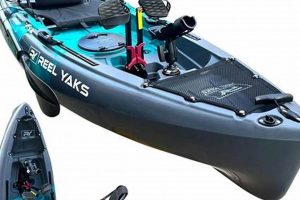
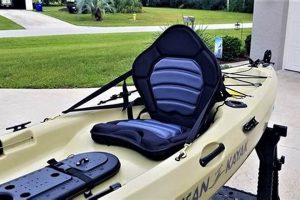
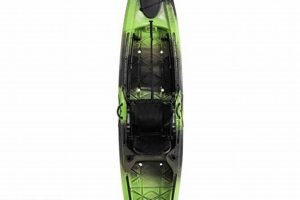
A system designed to secure kayaks, specifically those used for fishing, to the roof of a vehicle facilitates transportation to and from waterways. These systems typically comprise two crossbars attached to the vehicle’s roof, cradles or saddles designed to support the hull, and straps to secure the kayak in place. Specialized cradles designed to accommodate fishing kayaks with features like rod holders and outriggers are also available.
Transporting watercraft safely and efficiently is essential for anglers. Dedicated roof-mounted systems offer a significant advantage over other methods like trailers or inside vehicle transport, especially for longer distances. These systems free up valuable vehicle space and offer improved fuel economy compared to towing. The evolution of these systems has mirrored the growth in popularity of kayak fishing, with designs becoming increasingly specialized to accommodate the unique features and heavier weight of fishing kayaks. This specialization enables anglers to transport their fully rigged kayaks, minimizing preparation time at the launch site.
This article will delve into various aspects of choosing and using these transport systems, including different types of roof racks, kayak carriers, loading and unloading techniques, safety precautions, and relevant legal regulations. It will also explore factors such as vehicle compatibility, kayak size and weight, and individual needs to help readers make informed decisions.
Tips for Transporting Fishing Kayaks
Proper transport of fishing kayaks ensures both the safety of other road users and the longevity of the equipment. The following tips offer guidance for safe and efficient transport.
Tip 1: Choose Appropriate Equipment: Select a roof rack system with a weight capacity exceeding the combined weight of the kayak and any installed accessories. Consider specialized cradles designed for fishing kayaks to accommodate features like rod holders and outriggers.
Tip 2: Secure the Kayak Properly: Use high-quality straps rated for the kayak’s weight. Secure the kayak to the crossbars at both the bow and stern, ensuring straps are snug but not over-tightened. Use cam straps for quick and easy tightening.
Tip 3: Distribute Weight Evenly: Center the kayak on the vehicle’s roof to distribute weight evenly. If transporting multiple kayaks, ensure balanced placement.
Tip 4: Check Straps Regularly: Before each trip, inspect straps for wear and tear. Replace worn straps immediately. Periodically check strap tension during longer journeys, particularly after encountering rough roads.
Tip 5: Consider Wind Resistance: Reduce wind resistance by positioning the kayak bow-first. This minimizes drag and improves fuel efficiency. For longer kayaks, consider using a bow and stern line tied down to the vehicle’s front and rear.
Tip 6: Observe Height Restrictions: Be mindful of height restrictions when entering parking garages or passing under low-hanging structures. Know the combined height of the vehicle and loaded kayak.
Tip 7: Practice Loading and Unloading: Develop a safe and efficient loading and unloading routine, preferably with assistance. Use a step stool or ladder for easier access.
Adhering to these guidelines enhances safety, protects equipment, and contributes to a positive experience on the water. Proper preparation and execution are crucial elements of successful kayak fishing excursions.
By understanding these key aspects of kayak transportation, anglers can focus on what matters most: enjoying their time on the water. The following section offers concluding remarks and further resources.
1. Rack Type

The foundation of any fishing kayak car rack system lies in the rack type itself. Selecting the appropriate rack is crucial for safe and efficient kayak transportation. The rack type must be compatible with the vehicle and capable of supporting the combined weight of the kayak and any gear. This section explores various rack types commonly used for transporting fishing kayaks.
- Roof Racks
Roof racks are the most common type of rack system for transporting kayaks. They attach to the roof of a vehicle using existing mounting points or rain gutters. Roof racks provide a versatile platform for carrying various types of kayaks and offer good ground clearance. Examples include factory-installed roof rails, aftermarket crossbar systems, and specialized kayak racks. The primary advantage of roof racks is their versatility, accommodating different kayak sizes and hull shapes. However, they increase overall vehicle height, requiring attention to overhead clearances.
- Hitch Racks
Hitch racks mount to a vehicle’s trailer hitch receiver. These racks offer easier loading and unloading compared to roof racks, particularly for heavier kayaks. They also maintain a lower center of gravity, enhancing stability during transport. Examples include extendable hitch platforms and specialized kayak cradles designed for hitch mounting. While hitch racks offer convenient access, they can obscure rear visibility and limit access to the vehicle’s rear cargo area. They also extend the overall vehicle length.
- Truck Bed Racks
Truck bed racks are designed specifically for pickup trucks. These racks utilize the truck bed as a platform for carrying kayaks, often employing cradles or saddles for support. Truck bed racks eliminate the need for lifting kayaks onto a roof and offer secure transport within the truck bed itself. Examples include adjustable bar systems, over-the-rail racks, and custom-built solutions tailored to specific truck bed dimensions. While convenient for truck owners, these systems limit the available cargo space within the truck bed and may require lifting the kayak onto the rack.
- Inflatable Roof Racks
Inflatable roof racks offer a temporary, portable solution for transporting kayaks on vehicles not equipped with permanent rack systems. These racks consist of inflatable pads that cushion the kayak’s hull and are secured with straps that run through the vehicle’s interior. They offer a budget-friendly alternative, particularly for occasional use. However, inflatable roof racks are generally less secure than fixed rack systems and have lower weight capacities. Their suitability depends on the kayak’s weight and dimensions, as well as the vehicle’s roof structure.
The choice of rack type significantly influences the overall safety, convenience, and practicality of transporting a fishing kayak. Each type offers distinct advantages and disadvantages, requiring careful consideration of individual needs, vehicle type, and kayak characteristics. Selecting the correct rack is essential for a secure and efficient transport experience, ensuring both the protection of the kayak and the safety of other road users.
2. Kayak Carrier

Kayak carriers are integral components of fishing kayak car rack systems, serving as the crucial interface between the kayak and the rack itself. These specialized supports cradle and secure the kayak during transport, preventing damage and ensuring safe road travel. The carrier type significantly influences the stability, security, and ease of loading and unloading. Understanding the relationship between the carrier and the overall rack system is fundamental for efficient and safe kayak transportation. For instance, J-cradles, with their vertical orientation, are well-suited for shorter kayaks and offer excellent hull support, while stackers allow multiple kayaks to be transported vertically, maximizing carrying capacity but requiring more careful balancing. Saddle-style carriers, which cradle the kayak horizontally, distribute weight evenly and are suitable for longer kayaks, especially fishing kayaks with added features.
Choosing the appropriate carrier depends on factors such as kayak size and hull shape, the type of fishing kayak car rack system being used, and the number of kayaks being transported. A longer, heavier fishing kayak with a pronounced keel might benefit from a saddle-style carrier on a roof rack system, ensuring even weight distribution and minimizing stress on the hull. Conversely, a shorter, lighter kayak might be adequately supported by J-cradles on a hitch-mounted rack. Selecting a carrier incompatible with the kayak or the rack system can lead to instability, damage during transit, and potentially dangerous driving conditions. Improper carrier selection can also complicate loading and unloading, increasing the risk of injury or damage to the kayak.
Appropriate carrier selection optimizes the fishing kayak car rack system’s functionality, contributing significantly to safe and efficient kayak transportation. Understanding the interplay between the carrier, the kayak, and the rack system ensures a secure, stable load, minimizes the risk of damage, and simplifies the loading and unloading process. This knowledge translates directly into a more positive and productive kayaking experience, allowing anglers to focus on their time on the water rather than the logistics of transportation. Consideration should also be given to carrier material, weight capacity, and ease of use when selecting the optimal carrier for a specific fishing kayak and rack system.
3. Securement Method

Securement methods are fundamental to the safe and effective transportation of fishing kayaks. A properly secured kayak minimizes the risk of damage during transit and ensures the safety of other road users. The securement method chosen directly impacts the stability of the kayak on the fishing kayak car rack, influencing its resistance to wind, road vibrations, and sudden maneuvers. Understanding the principles of securement and selecting appropriate methods are critical for responsible kayak transportation.
- Straps and Tie-Downs
Straps and tie-downs are the most common securement tools. High-quality, UV-resistant straps with appropriate weight ratings are essential. Cam buckle straps offer convenient tightening and quick release, while ratchet straps provide higher tensioning capabilities for heavier kayaks. Proper placement of straps is crucial, typically securing the kayak at both the bow and stern to the crossbars of the rack system. Additional straps may be used to secure the hull to the cradles or saddles, further enhancing stability. Examples include using two cam straps over the hull, connected to the front and rear crossbars, supplemented by bow and stern lines to the vehicle’s frame for added security during highway travel. Incorrect strap placement or insufficient tension can result in shifting or detachment during transit, posing a significant safety hazard.
- Rope Tie-Offs
Rope tie-offs offer an alternative securement method, often used in conjunction with straps or as a primary method for specific rack types. Knots such as the trucker’s hitch and bowline provide secure attachment points. Rope can be particularly useful for securing oddly shaped kayaks or for adding additional stability to existing strap systems. For instance, rope can be used to secure outriggers or other accessories that might not be easily accommodated by straps alone. However, rope requires more skill and time to tie and secure properly, and knot security must be verified regularly during transport. Improperly tied knots can loosen, compromising the kayak’s stability.
- Specialized Kayak Locks
Specialized kayak locks offer enhanced security against theft. These locks typically consist of a cable or chain that passes through the kayak and is locked to the rack system. They provide a deterrent against opportunistic theft, particularly during transport stops or when the kayak is left unattended on the vehicle. While locks provide added security, they do not replace the need for proper strapping and tie-downs. Relying solely on locks without adequate strapping can still result in kayak movement or detachment during transit. Locks are a supplementary security measure, not a primary method of securement.
- Bow and Stern Lines
Bow and stern lines provide additional stability, particularly for longer kayaks or during highway travel. These lines connect the bow and stern of the kayak to secure points on the vehicle, such as the front and rear bumpers or tow hooks. Bow and stern lines minimize kayak sway and reduce the impact of wind gusts, enhancing overall stability and reducing stress on the rack system. They are particularly beneficial for longer fishing kayaks, which are more susceptible to wind resistance. Using bow and stern lines in conjunction with proper strapping creates a comprehensive and highly secure transport system.
Effective securement is paramount for the safe and efficient transport of fishing kayaks. Choosing the appropriate method and applying it correctly ensures the kayak remains stable on the fishing kayak car rack, minimizing the risk of damage or detachment during transit. Proper securement also safeguards other road users by preventing accidents caused by shifting or falling kayaks. Understanding the principles of each securement method and selecting the appropriate combination of techniques contributes significantly to responsible kayak transportation. Neglecting proper securement procedures can have significant consequences, ranging from minor damage to major accidents, emphasizing the importance of meticulous attention to detail in this critical aspect of kayak transport.
4. Weight Capacity

Weight capacity is a critical factor in selecting and using a fishing kayak car rack system. Ignoring weight limitations can lead to equipment failure, kayak damage, and potentially dangerous driving conditions. Understanding weight capacity and its implications ensures safe and reliable kayak transport. This involves considering the combined weight of the kayak, fishing gear, and the rack system itself. Exceeding the specified weight capacity of any component, whether it’s the roof rack, the kayak carriers, or the vehicle’s roof itself, compromises safety and increases the risk of accidents. Careful consideration of weight capacity is paramount for responsible kayak transportation.
- Kayak Weight
Fishing kayaks vary considerably in weight, influenced by factors such as length, width, and construction material. Heavier kayaks require rack systems and carriers with higher weight capacities. For example, a longer, heavier fishing kayak made from rotomolded polyethylene will exert more force on the rack system than a shorter, lighter kayak made from composite materials. Accurately determining the kayak’s weight, including any installed accessories like fish finders or rod holders, is essential for selecting appropriate equipment. Underestimating kayak weight can overload the rack system, leading to potential failure during transit.
- Gear Weight
Fishing gear adds significant weight to the overall load. Tackle boxes, rods, reels, and other equipment contribute to the total weight that the rack system must support. For example, a fully loaded tackle box and multiple fishing rods can add a substantial amount of weight, especially for longer fishing trips. This additional weight must be factored into the overall weight capacity calculation when selecting a rack system. Failure to account for gear weight can overload the system and compromise its stability.
- Rack System Capacity
Rack systems have specified weight limits, determined by their design and construction. Exceeding these limits compromises the system’s structural integrity, increasing the risk of failure. For example, a roof rack system designed for lighter loads may not be suitable for heavier fishing kayaks and associated gear. Consulting the manufacturer’s specifications for both the roof rack and the kayak carriers is crucial for determining the overall weight capacity of the system. Choosing a rack system with ample weight capacity ensures safe and reliable kayak transport.
- Vehicle Roof Capacity
The vehicle’s roof itself has a weight limit, which must be considered in conjunction with the rack system’s capacity. Exceeding the vehicle’s roof capacity can damage the roof structure and compromise vehicle handling. For example, overloading the roof of a smaller car with a heavy fishing kayak and gear can negatively impact its stability and handling characteristics. Consulting the vehicle’s owner’s manual provides information on the maximum roof load. Respecting the vehicle’s roof capacity is essential for safe and responsible kayak transportation.
Careful consideration of all weight factors, including kayak weight, gear weight, rack system capacity, and vehicle roof capacity, is paramount for safe and successful kayak transportation. Accurately assessing and distributing weight ensures the chosen fishing kayak car rack system operates within its designed limits, minimizing the risk of damage, equipment failure, and potential accidents. Neglecting weight considerations can compromise safety and negatively impact the overall kayaking experience. Responsible kayak transport relies on a thorough understanding and application of weight capacity principles.
5. Vehicle Compatibility

Vehicle compatibility is paramount when selecting a fishing kayak car rack system. The vehicle’s roof structure, dimensions, and existing attachments dictate which rack systems are suitable. Ignoring compatibility can lead to improper installation, reduced safety, and potential damage to both the vehicle and the kayak. For example, a rack system designed for a vehicle with factory-installed roof rails will not be compatible with a vehicle that lacks these rails. Attempting to install an incompatible system can damage the vehicle’s roof or result in an unstable and unsafe kayak transport configuration. Furthermore, the vehicle’s size and weight-bearing capacity also influence compatibility. A smaller car with a lower roof weight capacity may not be suitable for carrying larger, heavier fishing kayaks, even with a compatible rack system. Overloading a vehicle’s roof can compromise its handling and stability, creating a safety hazard. Assessing vehicle compatibility requires careful consideration of the vehicle’s specific features and limitations.
Practical considerations related to vehicle compatibility extend beyond mere fit. Access to the kayak, loading and unloading procedures, and overall vehicle handling are also influenced by the chosen rack system. For instance, a roof rack system on a tall SUV might require a step stool or ladder for loading and unloading, while a hitch-mounted rack on a lower car might offer easier access. The vehicle’s height, combined with the height of the kayak and rack system, can also affect access to low-clearance areas such as parking garages. Furthermore, the added wind resistance of a kayak on a vehicle’s roof impacts fuel efficiency, a factor to consider for longer journeys. Understanding these practical implications of vehicle compatibility allows for informed decision-making, leading to a safer and more efficient transport experience.
In conclusion, vehicle compatibility is a crucial element in selecting and using a fishing kayak car rack system. Proper assessment of the vehicle’s roof structure, dimensions, and weight capacity ensures safe and reliable kayak transport. Ignoring compatibility can lead to installation difficulties, compromised safety, and potential damage. Furthermore, practical considerations such as loading access, vehicle handling, and fuel efficiency are also influenced by vehicle compatibility. A comprehensive understanding of these factors allows for informed decisions, optimizing the kayak transport experience and ensuring safe and efficient travel to and from the water. Thorough research and careful selection based on vehicle compatibility contribute significantly to a positive and productive kayaking experience.
Frequently Asked Questions
This section addresses common inquiries regarding the selection, installation, and usage of fishing kayak car rack systems. Understanding these key aspects ensures safe and efficient kayak transportation.
Question 1: How is the appropriate roof rack system determined for a specific vehicle and kayak?
Determining the appropriate roof rack system requires considering both vehicle specifications and kayak dimensions. Consult the vehicle owner’s manual for approved roof rack attachments and weight limitations. The kayak’s length, width, and weight influence the necessary carrier type and overall rack capacity. Compatibility between the roof rack, carriers, and the vehicle’s roof structure is essential.
Question 2: What are the advantages and disadvantages of different kayak carrier types?
J-cradles offer excellent hull support for shorter kayaks but can be less stable for longer models. Stackers maximize carrying capacity for multiple kayaks but require careful balancing. Saddles distribute weight evenly and accommodate longer kayaks, including those with specialized features, but may require more roof clearance. Carrier selection depends on kayak dimensions and hull shape.
Question 3: What safety precautions should be observed when loading and unloading a kayak?
Loading and unloading should always be performed with assistance when possible. Use a step stool or ladder for safer access to the vehicle’s roof. Ensure the kayak is securely held before releasing any straps or tie-downs. Clear the surrounding area of obstacles and be mindful of overhead obstructions.
Question 4: How can wind noise and resistance be minimized during transport?
Positioning the kayak bow-first reduces wind resistance. Using bow and stern lines tied down to the vehicle’s front and rear further minimizes sway and wind noise, especially for longer kayaks. Specialized aerodynamic accessories, such as fairings, can also deflect airflow and reduce noise.
Question 5: What legal regulations pertain to transporting kayaks on a vehicle?
Regulations vary by jurisdiction but commonly address maximum allowable load dimensions, including height and width. Proper lighting and marking may be required for overhanging loads. Securement methods must comply with safety standards. Researching local regulations ensures compliance and avoids potential fines or safety hazards.
Question 6: How should a fishing kayak car rack system be maintained to ensure longevity and safety?
Regular inspection and maintenance are crucial. Check straps and tie-downs for wear and tear, replacing them as needed. Clean the rack system and carriers to remove dirt and debris that can accelerate corrosion. Lubricate moving parts, such as cam buckles and ratchets, to ensure smooth operation. Periodically inspect the vehicle’s roof for any signs of damage or stress caused by the rack system.
Careful consideration of these frequently asked questions contributes to safe, efficient, and legally compliant kayak transportation. Prioritizing safety and adhering to best practices ensures a positive experience on the water.
This concludes the frequently asked questions section. The following section provides additional resources for further exploration of kayak transportation.
Fishing Kayak Car Rack Systems
Effective and safe transport of fishing kayaks relies heavily on properly chosen and utilized specialized rack systems. This article has explored essential components, including rack types, kayak carriers, securement methods, weight capacities, and vehicle compatibility. Each element plays a crucial role in ensuring secure transport, minimizing the risk of damage, and promoting responsible road usage. Understanding the interplay between these components enables informed decisions, leading to a more efficient and enjoyable kayaking experience.
Transporting fishing kayaks requires a comprehensive approach, encompassing careful planning and meticulous execution. Choosing the appropriate fishing kayak car rack system, based on individual needs and specific circumstances, is an investment in both safety and convenience. Adherence to best practices regarding securement, weight distribution, and legal regulations ensures responsible transport, protecting both the kayak and fellow road users. Ultimately, a well-chosen and properly utilized system contributes to a seamless transition from road to water, enabling anglers to focus on the pursuit of their passion.