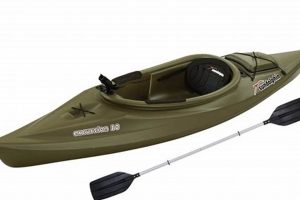
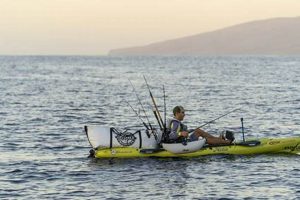
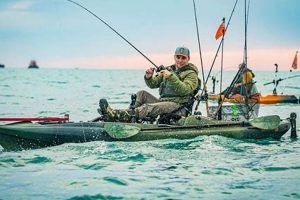
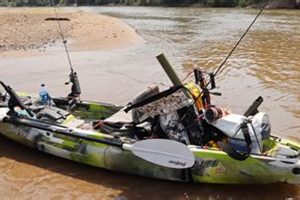
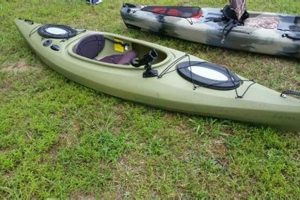
Kayaks outfitted specifically for angling represent a specialized category within recreational watercraft. These vessels come equipped with features like rod holders, fish finders, storage compartments for tackle, and often, specialized seating designed for comfort during long hours on the water. A typical example might include a sit-on-top kayak with adjustable footrests, a built-in rudder system, and pre-installed mounting points for accessories.
The popularity of these customized watercraft stems from their ability to access shallow waters and hard-to-reach fishing spots often inaccessible to larger boats. This enhanced accessibility, combined with increased stability offered by wider hulls in some models, presents distinct advantages for anglers. Historically, fishing from small, maneuverable craft has been a common practice, but modern advancements in kayak design and materials have elevated the experience, providing greater comfort, efficiency, and safety.
This exploration will delve further into key considerations for selecting an appropriate fishing kayak, encompassing hull design, propulsion methods, and essential accessories. Subsequent sections will also address best practices for safe and responsible kayak fishing.
Tips for Effective Kayak Fishing
Careful planning and preparation contribute significantly to successful fishing excursions. Consider the following recommendations to optimize on-the-water experiences.
Tip 1: Stability is Paramount: Prioritize kayaks designed for stability, especially when fishing in moving water or open areas. Wider hulls generally offer greater stability.
Tip 2: Choose Appropriate Propulsion: Paddle propulsion suits calm waters and short distances. Pedal-driven systems or electric motors offer advantages for covering longer distances or navigating currents.
Tip 3: Essential Gear Selection: Rod holders, a fish finder, and ample storage for tackle represent critical components of a well-equipped fishing kayak.
Tip 4: Safety First: Always wear a personal flotation device (PFD) and carry essential safety equipment, including a whistle, signaling device, and first-aid kit. Inform someone of planned fishing locations and estimated return times.
Tip 5: Weather Awareness: Check weather forecasts before embarking on any fishing trip. Avoid venturing out in adverse conditions, such as high winds or thunderstorms.
Tip 6: Respectful Angling Practices: Adhere to local fishing regulations, practice catch-and-release principles where appropriate, and minimize environmental impact by properly disposing of waste.
Tip 7: Plan Your Fishing Strategy: Research target species and preferred fishing locations. Prepare appropriate tackle and bait beforehand. Consider using a fish finder to identify productive areas.
By integrating these recommendations, anglers can enhance safety, efficiency, and overall enjoyment on the water. Preparation fosters successful and rewarding fishing experiences.
These tips provide a foundation for informed decisions regarding equipment and practices. The following section offers concluding thoughts and encourages responsible enjoyment of the sport.
1. Stability

Stability forms a cornerstone of effective kayak fishing. A stable platform allows anglers to cast, retrieve, and fight fish without compromising balance or safety. This characteristic becomes particularly crucial when standing to cast, landing larger fish, or navigating challenging water conditions. Kayak stability directly influences angling success and overall safety on the water. A stable hull minimizes the risk of capsizing, especially during unexpected movements or when encountering waves or wakes. Consider, for example, an angler battling a strong fish in choppy conditions. A stable kayak provides the necessary platform to maintain control and successfully land the catch, while an unstable craft could easily lead to capsizing.
Several factors contribute to kayak stability, including hull design, width, and length. Wider kayaks generally provide greater initial stability, making them suitable for calmer waters. Longer, narrower kayaks tend to track better in moving water but may sacrifice some initial stability. Specialized hull designs, such as pontoon-style or multi-hull configurations, offer enhanced stability but may compromise maneuverability. The distribution of weight within the kayak also plays a significant role. Proper loading and weight balancing contribute substantially to maintaining stability, preventing tipping, and ensuring a comfortable fishing experience. For instance, placing heavier items lower in the kayak and distributing weight evenly enhances overall stability.
Understanding the factors influencing kayak stability empowers anglers to select appropriate craft for specific fishing environments and target species. Choosing a kayak with adequate stability for the intended use enhances safety, improves fishing effectiveness, and ultimately contributes to a more enjoyable and productive angling experience. A well-balanced and stable kayak provides a secure platform for anglers to focus on their technique and the pursuit of their catch, minimizing distractions caused by instability and maximizing opportunities for success.
2. Propulsion Systems
Propulsion systems represent a crucial aspect of rigged fishing kayaks, directly influencing maneuverability, range, and overall fishing effectiveness. Selection depends on factors such as fishing environment, target species, and individual angler preferences. Common propulsion methods include traditional paddles, pedal drives, and electric motors. Each system presents distinct advantages and disadvantages.
Paddle propulsion, the most fundamental method, offers simplicity, affordability, and quiet operation, beneficial for stealthy approaches in shallow waters. However, paddling requires physical exertion, potentially limiting range and tiring anglers during long fishing trips. Pedal drives provide hands-free operation, allowing anglers to focus on fishing while maintaining speed and maneuverability. This system excels in moderate currents or open water scenarios, enabling efficient coverage of larger areas. For instance, anglers targeting pelagic species in open bays benefit from the continuous propulsion offered by pedal drives. Electric motors offer the greatest power and range, particularly valuable in strong currents, large bodies of water, or when navigating against wind. This system minimizes angler fatigue and maximizes time spent fishing, crucial for extended trips or challenging conditions. Consider anglers fishing vast reservoirs or navigating tidal rivers; electric motors provide the necessary power and range to effectively cover these areas. However, electric motors introduce added weight and complexity, requiring battery management and potentially increasing noise levels.
Effective propulsion system selection necessitates careful consideration of individual fishing styles and target environments. Paddles offer simplicity and affordability, ideal for calm waters and short distances. Pedal drives provide hands-free operation and moderate range, advantageous for navigating moderate currents and open areas. Electric motors maximize power and range, essential for challenging conditions and larger bodies of water, but introduce added weight and complexity. Understanding the capabilities and limitations of each system empowers anglers to optimize their fishing kayaks for specific needs and enhance overall on-the-water effectiveness. Choosing the appropriate propulsion system directly contributes to a more productive and enjoyable fishing experience.
3. Rod Holders

Rod holders constitute an integral component of rigged fishing kayaks, significantly impacting angling efficiency and safety. They provide secure storage for rods when not in use, preventing loss or damage during navigation or while handling fish. Furthermore, rod holders facilitate hands-free operation, enabling anglers to manage lines, change lures, or handle other tasks without compromising rod security. This capability proves particularly valuable when fishing in challenging conditions, such as strong currents or windy environments. For example, an angler battling a strong fish can securely place other rods in holders, minimizing entanglement and focusing on landing the catch. Dedicated trolling rod holders, often angled specifically for this technique, allow anglers to present multiple lines simultaneously, increasing the likelihood of attracting fish.
The type and placement of rod holders influence functionality and angler convenience. Flush-mounted rod holders offer a streamlined profile, minimizing interference with paddling or casting. Adjustable rod holders allow anglers to customize rod angles for specific techniques, such as trolling or vertical jigging. Rotating rod holders provide further versatility, enabling quick adjustments to changing fishing conditions or target species. Strategic placement of rod holders within easy reach of the angler maximizes efficiency and minimizes disruption during critical moments. Consider a scenario where an angler spots a school of feeding fish; readily accessible rods allow for swift deployment of lines, maximizing opportunities for success. Integrating multiple rod holders caters to diverse fishing styles, accommodating spinning, baitcasting, and fly fishing rods within a single kayak setup.
Effective rod holder selection and placement contribute significantly to organized and productive kayak fishing experiences. Secure rod storage minimizes the risk of equipment loss or damage, while convenient access enhances angling efficiency. Specialized rod holders cater to specific fishing techniques, maximizing versatility and success on the water. Understanding the functional role of rod holders within a rigged fishing kayak empowers anglers to optimize their setups for specific needs and target species. Thoughtful consideration of rod holder type, placement, and quantity ultimately translates to a more efficient, enjoyable, and successful fishing experience.
4. Fish Finders

Fish finders represent a pivotal technological advancement in angling, significantly enhancing the effectiveness of rigged fishing kayaks. These electronic devices utilize sonar technology to locate fish, map underwater structures, and determine water depth and temperature. Integration of fish finders onto kayaks provides anglers with real-time underwater intelligence, directly impacting fishing success. Consider, for example, an angler seeking specific bottom structures attractive to certain species; fish finders reveal these details, enabling targeted fishing efforts. Conversely, without this technology, locating such features relies on guesswork or prior knowledge, potentially reducing fishing efficiency. This knowledge translates into increased catch rates, particularly valuable for anglers targeting specific species or navigating unfamiliar waters.
The practical significance of fish finders extends beyond simply locating fish. Understanding bottom contours, vegetation density, and water temperature gradients allows anglers to identify optimal fishing locations and tailor techniques accordingly. For instance, locating thermoclineslayers of water with rapid temperature changesoften reveals concentrations of baitfish and predator species. This knowledge allows anglers to strategically position their kayaks and select lures that mimic the prevalent forage, optimizing fishing strategies and maximizing catch potential. Furthermore, GPS integration in many modern fish finders enhances navigation and allows anglers to mark productive fishing spots, facilitating return trips to successful locations. This capability proves invaluable in vast bodies of water or when navigating complex shorelines. The cumulative effect of these features transforms rigged fishing kayaks into highly effective and information-rich fishing platforms.
Fish finders fundamentally alter the dynamics of kayak fishing, providing a significant advantage in locating fish and understanding underwater environments. This technology empowers anglers with detailed underwater insights, enabling strategic decision-making, optimizing fishing techniques, and ultimately maximizing catch rates. While traditional methods rely heavily on experience and intuition, fish finders provide real-time data, enhancing precision and effectiveness. Integrating fish finders into rigged fishing kayaks represents a significant step toward data-driven angling, optimizing success in diverse aquatic environments. However, effective utilization requires understanding fish finder operation and interpretation of displayed data. Continual learning and adaptation to evolving fish finder technology remain essential for maximizing the benefits offered by this powerful tool.
5. Storage Capacity

Storage capacity represents a critical factor influencing the effectiveness and enjoyment of rigged fishing kayaks. Adequate storage facilitates organized transport of essential gear, including tackle boxes, safety equipment, and personal items. Insufficient storage can lead to cluttered decks, hindering movement and potentially compromising safety. Consider an angler navigating through dense vegetation or attempting to land a fish in limited space; excess gear impedes maneuverability and increases the risk of entanglement or equipment loss. Conversely, well-organized storage promotes efficient access to necessary items, maximizing fishing time and minimizing distractions. For instance, readily accessible tackle boxes allow for quick lure changes, adapting to changing fish behavior or water conditions without disrupting the fishing flow.
Kayak anglers frequently carry a variety of items, ranging from extra rods and reels to rain gear, food, and water. Dedicated storage compartments within the kayak hull or strategically placed dry bags protect these items from water damage and maintain organization. Consider a scenario where an angler encounters unexpected rain; readily accessible dry bags containing spare clothing and electronic devices prevent damage and maintain comfort. Furthermore, specialized storage solutions, such as tackle organizers and integrated storage compartments, enhance efficiency and minimize clutter. For instance, a dedicated compartment for fishing tools or a designated area for storing a first-aid kit ensures rapid access during critical moments.
Optimizing storage capacity within a rigged fishing kayak directly contributes to a more organized, efficient, and ultimately, more enjoyable fishing experience. Adequate and strategically designed storage solutions facilitate access to essential gear, minimize clutter, and enhance safety. Understanding the importance of storage capacity empowers anglers to select kayaks and storage accessories tailored to their individual needs and fishing styles. This foresight allows anglers to focus on the core pursuit fishing rather than managing a disorganized and potentially hazardous accumulation of gear. Effective storage solutions enhance the overall kayak fishing experience, promoting safety, efficiency, and enjoyment on the water.
6. Safety Equipment

Safety equipment represents a non-negotiable aspect of responsible kayak fishing. Operating in aquatic environments presents inherent risks, and preparedness proves crucial for mitigating potential hazards. Integrating appropriate safety equipment into a rigged fishing kayak contributes significantly to angler well-being and facilitates a safe and enjoyable experience. Neglecting safety precautions can lead to dire consequences, even in seemingly calm conditions. Preparedness distinguishes responsible anglers and fosters a culture of safety on the water.
- Personal Flotation Devices (PFDs)
PFDs constitute the most fundamental piece of safety equipment. Wearing a properly fitted PFD provides essential buoyancy in the event of capsizing or accidental immersion. Various PFD types exist, ranging from basic foam vests to inflatable models. Selecting a comfortable and appropriately rated PFD for kayaking ensures adequate flotation and freedom of movement during fishing activities. Consider a scenario where an angler unexpectedly encounters strong currents or rough water; a PFD becomes a life-saving device, preventing drowning and increasing the chances of rescue. PFDs should not be viewed as optional accessories but as mandatory safety essentials for every kayak fishing trip.
- Signaling Devices
Signaling devices play a crucial role in attracting attention and facilitating rescue in emergency situations. Whistles, air horns, flares, and signal mirrors represent effective means of communication when beyond shouting distance or in conditions with limited visibility. Consider an angler experiencing equipment failure or requiring assistance far from shore; signaling devices become critical tools for alerting other boaters or rescue personnel. Carrying multiple signaling devices and ensuring familiarity with their operation enhances preparedness for unforeseen circumstances. Regularly inspecting and replacing expired flares or batteries ensures reliable functionality when needed most.
- First-Aid Kit and Emergency Supplies
A comprehensive first-aid kit addresses minor injuries and provides essential supplies in the event of more serious incidents. Bandages, antiseptic wipes, pain relievers, and sunscreen address common ailments encountered during fishing trips. Including additional items such as a waterproof fire starter, a multi-tool, and a space blanket enhances preparedness for unexpected situations, especially during extended trips or in remote locations. Consider an angler sustaining a hook injury or experiencing a minor medical emergency far from immediate assistance; a well-equipped first-aid kit provides essential care until professional help arrives.
- Communication Devices
Maintaining communication capability proves essential for summoning assistance in emergencies or informing others of unexpected delays. Waterproof cell phones or VHF radios provide reliable communication links, particularly in areas with limited cellular coverage. Consider an angler encountering rapidly changing weather conditions or experiencing a mechanical issue; a communication device allows for contacting emergency services or informing family or friends of the situation. Sharing float plans with trusted contacts before embarking on a fishing trip provides an additional layer of safety, ensuring awareness of intended fishing locations and expected return times. Regularly checking weather forecasts and adjusting plans accordingly minimizes exposure to hazardous conditions.
Integrating these safety measures into rigged fishing kayaks transforms them from recreational vessels into responsible and well-prepared fishing platforms. Prioritizing safety enhances angler confidence, promotes responsible angling practices, and minimizes potential risks associated with on-the-water activities. These precautions contribute to a positive and safe fishing experience, allowing anglers to focus on their passion while mitigating potential hazards. Safety should never be an afterthought but rather an integral aspect of every kayak fishing adventure.
7. Customization Options
Customization options represent a defining characteristic of rigged fishing kayaks, differentiating them from standard recreational models. The ability to tailor a kayak to individual angling styles and target species significantly enhances fishing effectiveness and overall experience. Customization transforms a generic platform into a personalized and highly functional fishing machine. Consider an angler targeting bass in heavily vegetated areas; customizing a kayak with weedless propellers, specialized rod holders for flipping techniques, and a camouflage color scheme optimizes the vessel for this specific fishing style. Conversely, an angler pursuing offshore pelagic species might prioritize customizations such as rod holders for trolling, outriggers for stability, and a high-capacity battery system for powering electric motors. The inherent adaptability of rigged fishing kayaks through customization distinguishes them as specialized angling platforms.
Customization extends beyond simply adding accessories. Modifying seating positions, installing anchor trolleys for controlled drift fishing, and integrating specialized lighting systems for night fishing exemplify the diverse range of customization possibilities. These modifications directly impact angling success by optimizing ergonomics, enhancing boat control, and extending fishing opportunities into different times of day or environmental conditions. For instance, an angler with physical limitations might customize seating arrangements for enhanced comfort and support, maximizing fishing endurance. Similarly, incorporating a livewell system allows for keeping baitfish or caught fish alive and fresh, essential for tournament fishing or when preserving catch for later consumption. The practical applications of customization options cater to diverse fishing styles, target species, and individual angler preferences, transforming rigged fishing kayaks into versatile and highly effective fishing platforms.
Understanding the potential for customization empowers anglers to optimize their kayaks for specific needs and fishing environments. The ability to tailor a kayak to individual preferences and target species significantly enhances fishing effectiveness, comfort, and overall enjoyment. While pre-rigged kayaks offer a convenient starting point, embracing the potential for customization unlocks the full potential of these specialized vessels. The resulting synergy between angler, kayak, and environment maximizes fishing success and fosters a deeper connection with the sport. However, customization requires careful planning and consideration of compatibility between various accessories and the kayak’s design. Balancing customization with practicality and safety considerations ensures a functional and enjoyable fishing experience. Investing time and effort in thoughtful customization transforms a rigged fishing kayak from a generic platform into a personalized and highly effective tool for pursuing aquatic quarry.
Frequently Asked Questions
This section addresses common inquiries regarding fishing kayaks equipped for angling.
Question 1: What differentiates a fishing kayak from a recreational kayak?
Fishing kayaks feature specialized design elements catering specifically to anglers. These include rod holders, storage compartments for tackle and gear, often a wider and more stable hull design, and potential integration of features like fish finders, anchor trolleys, and pedal-drive or motor systems.
Question 2: How does one choose the right size fishing kayak?
Kayak size selection depends on angler weight, intended use, and storage/transport considerations. Larger kayaks offer greater stability and storage capacity but sacrifice maneuverability. Smaller kayaks enhance agility in tight spaces but may limit storage and stability.
Question 3: What are the primary propulsion options for fishing kayaks?
Propulsion options include traditional paddles, pedal drives, and electric motors. Paddles offer simplicity and affordability, pedal drives provide hands-free operation, and electric motors offer power and range for larger bodies of water or challenging conditions.
Question 4: What essential safety equipment should accompany every fishing kayak outing?
Essential safety gear includes a properly fitted personal flotation device (PFD), signaling devices (whistle, air horn, flares), a first-aid kit, communication device (waterproof cell phone or VHF radio), and navigation tools (map, compass, GPS).
Question 5: What factors influence kayak stability, and why is it important for fishing?
Stability depends on hull design, width, length, and weight distribution. Enhanced stability allows anglers to cast, fight fish, and navigate various water conditions safely, minimizing the risk of capsizing. Wider hulls generally offer greater initial stability.
Question 6: How does one maintain and care for a fishing kayak?
Regular cleaning, proper storage, and timely maintenance of moving parts ensure kayak longevity and optimal performance. Rinsing with freshwater after each use prevents saltwater corrosion. Storing kayaks away from direct sunlight and extreme temperatures protects hull integrity. Regular inspection and lubrication of pedal drives or other mechanical components ensure smooth operation.
Understanding these fundamental aspects contributes to informed decision-making regarding equipment selection and safe fishing practices. Prioritizing safety and responsible angling practices ensures rewarding and enjoyable experiences on the water.
For further exploration of specific topics related to rigged fishing kayaks, consult the detailed sections within this resource.
Rigged Fishing Kayaks
Rigged fishing kayaks represent a specialized segment within the broader kayaking landscape, offering anglers unique opportunities to access diverse fishing environments. This exploration has highlighted key aspects of these specialized vessels, emphasizing the importance of stability, propulsion systems, rod holders, fish finders, storage capacity, safety equipment, and customization options. Understanding the interplay of these components empowers anglers to make informed decisions, optimizing their kayaks for specific fishing styles and target species.
The evolution of kayak fishing continues, driven by advancements in design, materials, and technology. As anglers seek greater efficiency, comfort, and access to previously unreachable waters, rigged fishing kayaks will undoubtedly remain at the forefront of this evolution. Careful consideration of the elements presented herein ensures not only successful fishing experiences but also fosters responsible stewardship of aquatic environments. The future of kayak fishing hinges on embracing innovation while prioritizing safety and environmental consciousness.